Call + 91 98853 07909

+91 98853 07909
ISO 14001:2026 Published April 2026 | Key Changes, Benefits & Transition Guide | CK Associates.
Introduction
In April 2026, the global benchmark for environmental management evolved once again. ISO 14001:2026, the fourth edition of the world’s most recognized Environmental Management System (EMS) standard, was officially published on April 15, 2026. This update replaces ISO 14001:2015 and introduces refined requirements that deliver greater clarity, stronger accountability, and measurable environmental performance.
For organizations across India and the United States, this is more than a compliance update — it is a strategic opportunity to transform operations, reduce risks, cut costs, enhance reputation, and demonstrate genuine leadership in sustainability.
The new standard builds on nearly 30 years of proven success. With over 670,000 certified organizations worldwide, ISO 14001 has helped businesses improve resource efficiency, achieve regulatory compliance, and build stakeholder trust. The 2026 edition makes these outcomes easier to achieve through clearer guidance, better integration with other ISO standards, and a sharper focus on today’s critical issues: climate change, biodiversity, lifecycle thinking, and supply chain responsibility.
When organizations adopt the latest environmental management frameworks, they achieve superior results when implementation is guided by experienced professionals. At CK Associates, we have supported 390+ clients in India and the USA through every major ISO transition, turning potential challenges into competitive advantages.
In this in-depth guide, you will discover:
Whether you operate a manufacturing facility in Hyderabad, a tech company in Bangalore, or a supply chain business serving the US market, this guide will equip you with actionable insights. Read on to understand how ISO 14001:2026 can future-proof your organization — and how CK Associates can make the journey seamless.
Section 1: What is ISO 14001:2026 and Why Does It Matter?
ISO 14001 provides a structured framework for organizations to identify, manage, monitor, and control their environmental impacts. The 2026 edition maintains the high-level Annex SL structure for easy integration with ISO 9001, ISO 45001, and others, while introducing refinements that reflect evolving global priorities.
Key drivers for the revision include:
The result? A standard that is smoother to implement, more results-oriented, and better aligned with business strategy. Organizations that embrace ISO 14001:2026 gain not only compliance but also enhanced resilience, cost efficiencies, and market differentiation — especially vital in competitive Indian and American markets.
Section 2: Detailed Key Changes in ISO 14001:2026 vs. 2015
The 2026 revision is described as an evolution, not a revolution. Most changes focus on clarity, expanded guidance (especially in Annex A), and stronger emphasis on specific environmental conditions. Here is a clause-by-clause breakdown:
Clause 4 – Context of the Organization The new edition requires explicit consideration of a broader range of environmental conditions, including climate change, pollution levels, biodiversity, ecosystem health, and availability of natural resources. The scope of the EMS must now incorporate a lifecycle perspective from the outset. Documented information requirements are clarified for better traceability.
Clause 5 – Leadership and Commitment Top management must demonstrate greater accountability and actively support leadership at all levels — not just management roles. This strengthens integration of environmental management into core business culture and decision-making.
Clause 6 – Planning Risks and opportunities processes are restructured for improved clarity. A new subclause (around 6.3) introduces structured planning and managing of changes that could affect the EMS. Emergency situations with environmental impacts receive explicit attention. Lifecycle thinking is strengthened when identifying environmental aspects and impacts.
Clause 7 – Support Documentation requirements are refined throughout. The standard clarifies what must be “documented information” versus evidence of implementation.
Clause 8 – Operation Focus expands from “outsourced processes” to externally provided processes, products, and services — strengthening supply chain due diligence and control.
Other Improvements
These changes make the standard more intuitive while raising expectations for proactive, lifecycle-based environmental management. Organizations with mature systems will find the transition manageable, especially with professional support.
Section 3: Powerful Advantages of ISO 14001:2026 for Your Company.
Implementing ISO 14001:2026 delivers concrete business value:
Forward-thinking organizations that act early turn the transition into a strategic advantage rather than a compliance burden.
Section 4: Benefits for Society and the Planet.
Beyond business, ISO 14001:2026 drives wider positive impact:
When organizations lead with robust environmental management, society and the planet reap lasting benefits.
Section 5: The Transition Timeline and How to Prepare.
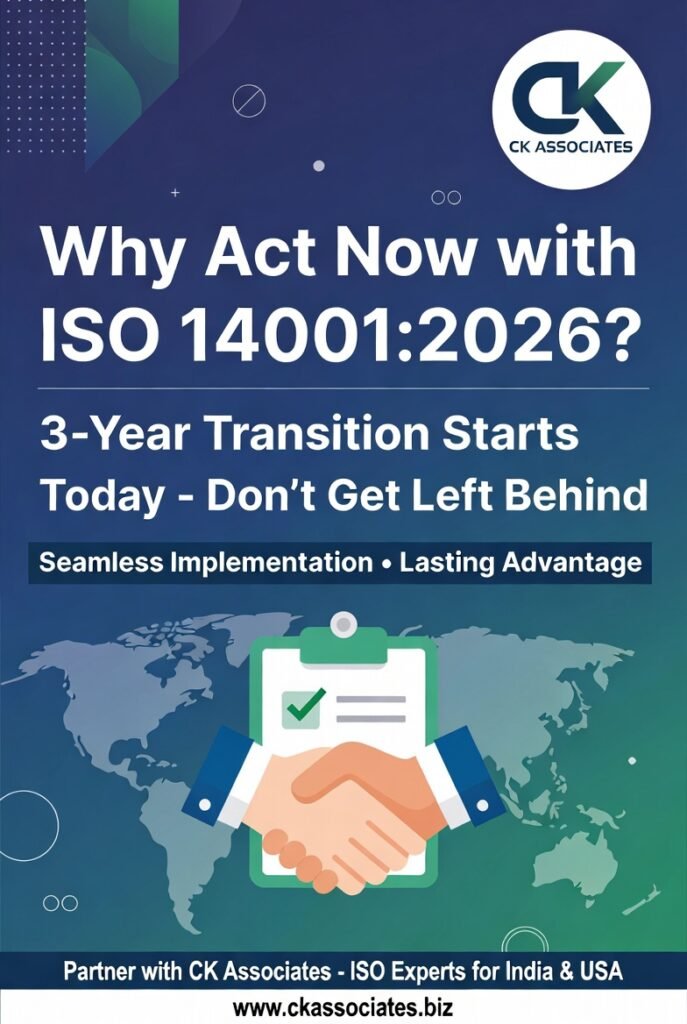
Organizations certified to ISO 14001:2015 have a three-year transition period, expected to end around April/May 2029. Certificates to the 2015 version will cease to be valid after this date.
Recommended steps:
Starting now gives ample time for a smooth, low-disruption transition.
When navigating complex standard updates, organizations achieve faster, more effective implementation when supported by seasoned ISO professionals. CK Associates brings 17+ years of experience, proven methodologies, and deep knowledge of Indian and US regulatory landscapes to every project.
Our services include gap analysis, customized implementation support, training, internal audits, and full transition management — all designed to minimize disruption while maximizing ROI.
Conclusion
ISO 14001:2026 represents a golden opportunity to elevate your environmental performance and secure long-term competitive advantage. Don’t leave your transition to chance.
Take action today: Book your free gap analysis with CK Associates and discover exactly how the new standard can benefit your organization.
Contact us at www.ckassociates.biz or DM us for a no-obligation consultation. Let our expert team guide your successful journey to ISO 14001:2026 certification.
