
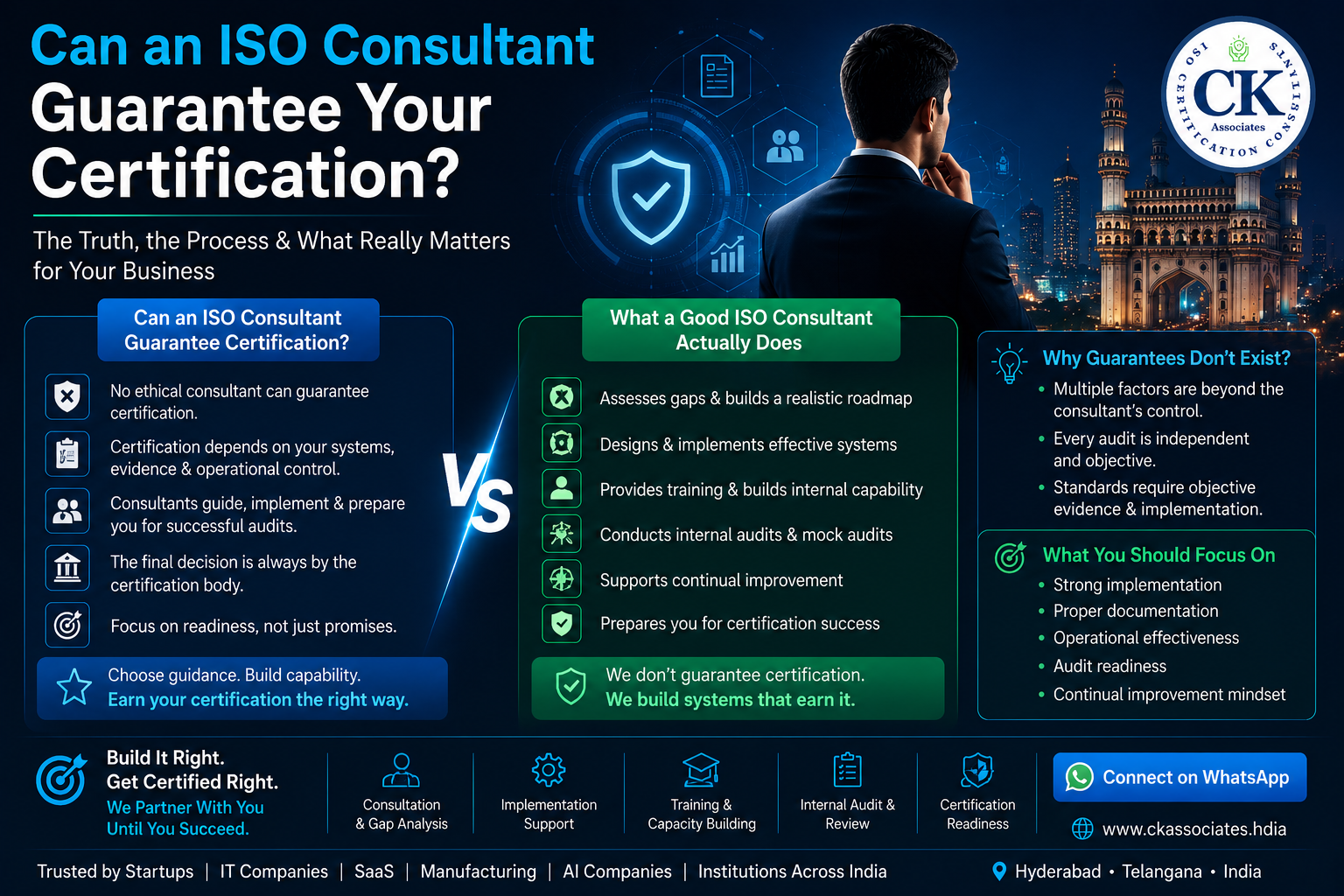
No legitimate ISO consultant can ethically or legally guarantee ISO certification. Certification decisions are made independently by accredited certification bodies after evaluating whether your organization meets the requirements of the applicable ISO standard.
A professional ISO consultant can significantly improve your organization’s readiness by helping with:
- Gap analysis
- Documentation development
- Operational implementation
- Employee awareness
- Internal audits
- Corrective actions
- Management review preparation
- Audit readiness
However, the final certification outcome depends on:
- Actual implementation effectiveness
- Leadership involvement
- Operational maturity
- Employee adoption
- Risk management
- Evidence availability
- Certification body audit findings
Businesses should avoid consultants making “100% guaranteed certification” claims because these promises often indicate weak implementation practices, shortcut documentation models, or non-compliant consulting approaches.
Understanding the Reality Behind ISO Certification Guarantees
Many businesses beginning their ISO journey ask an important question:
“Can an ISO consultant guarantee that we will get certified?”
This question is especially common among:
- Startups seeking enterprise clients
- Manufacturing companies entering export markets
- SaaS companies targeting international customers
- IT organizations pursuing compliance maturity
- Educational institutions improving governance systems
- AI companies building trust frameworks
The short answer is simple:
No ethical ISO consultant can guarantee certification.
But understanding why this matters is critical.
The reality is that ISO certification is not a product that can be purchased. It is an independent validation process conducted by accredited certification bodies.
A consultant supports implementation readiness.
The certification body evaluates compliance.
Those roles must remain separate.
Businesses that understand this distinction typically build stronger governance systems, achieve better operational maturity, and maintain certification successfully over the long term.
Why ISO Certification Cannot Be Guaranteed
Certification Bodies Make the Final Decision
ISO consultants are not the organizations issuing certificates.
Certification is awarded only after independent auditors assess whether your management system complies with the applicable ISO standard.
Examples include:
- ISO 9001 for Quality Management
- ISO 27001 for Information Security
- ISO 14001 for Environmental Management
- ISO 45001 for Occupational Health & Safety
- ISO 42001 for AI Management Systems
The certification body performs:
- Stage 1 audits
- Stage 2 audits
- Evidence reviews
- Process evaluations
- Employee interviews
- Risk assessments
- Nonconformity verification
Even the best consultant cannot control the auditor’s independent findings.
The Ethical Problem with “Guaranteed Certification” Claims
Warning Sign #1: Shortcut Documentation
Some consultants create template-heavy systems that are not aligned with actual operations.
This creates several long-term problems:
- Employees do not understand procedures
- Processes become difficult to maintain
- Internal audits become ineffective
- Management reviews lose value
- Nonconformities increase
- Surveillance audits become stressful
A mature ISO implementation should strengthen operational governance — not merely generate documents.
Warning Sign #2: Audit Manipulation Practices
Businesses should be cautious if a consultant:
- Claims “special relationships” with auditors
- Promises guaranteed approvals
- Avoids operational implementation
- Focuses only on documentation
- Discourages employee participation
- Minimizes internal audits
- Ignores risk management
These approaches can damage long-term compliance maturity.
In many cases, organizations later struggle during:
- Surveillance audits
- Recertification audits
- Customer audits
- Supplier assessments
- Cybersecurity reviews
- Regulatory inspections
Warning Sign #3: Lack of Operational Integration
Strong ISO systems are operational systems.
Weak ISO systems are isolated documentation systems.
The difference becomes obvious after certification.
Organizations with weak implementations often experience:
- Low employee adoption
- Poor process consistency
- Repeated corrective actions
- Audit fatigue
- Compliance confusion
- Governance gaps
This is why experienced ISO consultants focus on sustainable implementation rather than unrealistic guarantees.
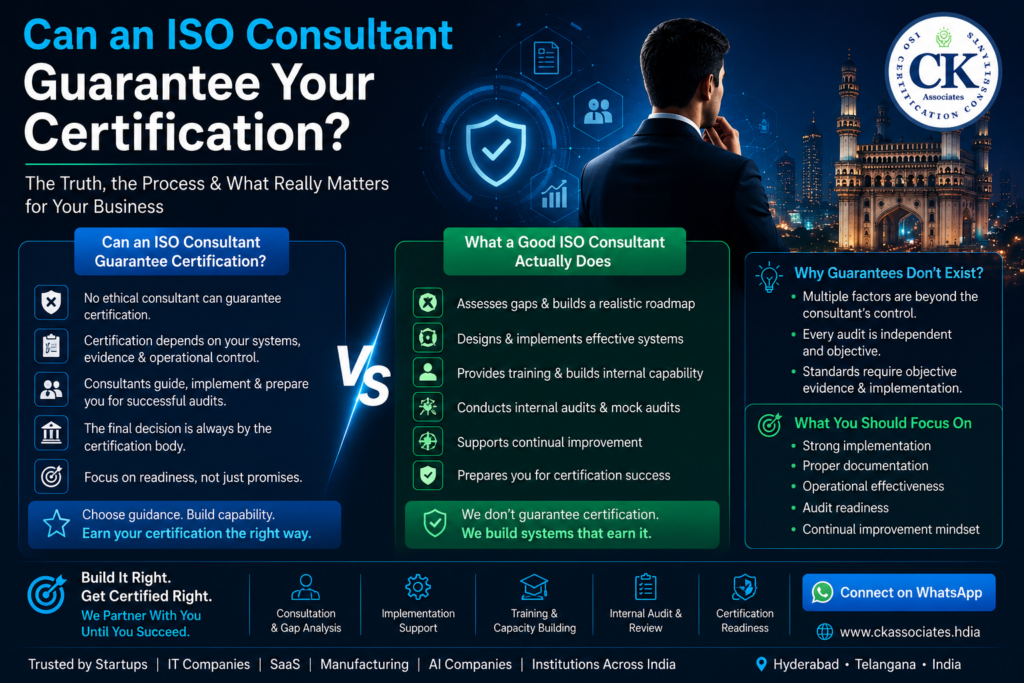
What a Professional ISO Consultant Actually Does
A high-quality ISO consultant improves the probability of certification success through structured implementation support.
Typical ISO Consulting Activities
1. Gap Analysis
The consultant evaluates your current operational maturity against ISO requirements.
This identifies:
- Missing controls
- Process gaps
- Documentation weaknesses
- Governance risks
- Operational inefficiencies
- Compliance exposure areas
2. System Design and Documentation
Professional consultants help create:
- Policies
- Procedures
- Process maps
- Risk registers
- Objectives
- SOPs
- Governance workflows
- Internal audit mechanisms
The goal should always be operational usability.
3. Implementation Support
This stage is often ignored by low-quality providers.
Real implementation involves:
- Leadership alignment
- Employee awareness
- Operational adoption
- Risk management integration
- Monitoring mechanisms
- KPI development
- Evidence generation
This is where actual organizational maturity develops.
4. Internal Audits
Internal audits help organizations identify issues before the certification audit.
A mature internal audit process improves:
- Process visibility
- Corrective action effectiveness
- Compliance readiness
- Governance maturity
- Operational discipline
5. Audit Readiness Preparation
Consultants often help businesses prepare for:
- Stage 1 audits
- Stage 2 audits
- Employee interview readiness
- Evidence presentation
- Corrective action responses
However, preparation is not the same as guaranteed certification.
What Actually Determines Certification Success?
Leadership Commitment
Management involvement is one of the biggest certification success factors.
Organizations where leadership actively supports implementation usually perform better during audits.
Auditors often evaluate:
- Strategic direction
- Quality objectives
- Governance involvement
- Resource allocation
- Continual improvement culture
Employee Awareness
Employees should understand:
- Their responsibilities
- Applicable procedures
- Risk controls
- Operational workflows
- Escalation processes
When employees cannot explain processes during audits, it raises concerns about implementation effectiveness.
Process Consistency
ISO certification is heavily evidence-based.
Auditors verify whether documented processes are consistently followed.
Strong evidence includes:
- Monitoring records
- Training records
- Audit reports
- KPI tracking
- Corrective actions
- Risk assessments
- Management review records
Operational Maturity
Organizations with stronger operational maturity generally achieve smoother certification outcomes.
Operational maturity includes:
- Defined responsibilities
- Process ownership
- Governance structures
- Measurable objectives
- Risk-based thinking
- Continual improvement culture
Industry-Specific Examples
SaaS Companies Pursuing ISO 27001
A SaaS company may believe documentation alone is enough for ISO 27001 certification.
However, auditors typically examine:
- Access control implementation
- Incident management
- Backup controls
- Supplier management
- Risk treatment plans
- Employee security awareness
- Asset inventories
Without actual operational controls, certification becomes difficult.
Manufacturing Companies Seeking ISO 9001
Manufacturing organizations are often evaluated on:
- Process consistency
- Traceability
- Calibration systems
- Supplier controls
- Production monitoring
- Corrective action effectiveness
- Quality objectives
A consultant cannot “guarantee” these operational realities.
AI Companies Exploring ISO 42001
AI governance standards increasingly focus on:
- Risk management
- Ethical AI controls
- Governance accountability
- Data management
- Bias mitigation
- Transparency mechanisms
These systems require actual governance maturity — not superficial compliance.
How Businesses Should Evaluate ISO Consultants
Look for Governance-Focused Consultants
The best consultants position ISO as:
- Operational maturity framework
- Governance system
- Risk management structure
- Continuous improvement model
- Strategic business enablement system
Avoid consultants focused only on certificates.
Ask About Sustainability
Important questions include:
- Will employees understand the system?
- Is implementation customized?
- How are risks managed?
- What happens after certification?
- How are internal audits handled?
- How is continual improvement maintained?
Evaluate Industry Experience
Industry context matters.
For example:
- IT companies face cybersecurity governance challenges
- Manufacturing companies require process control depth
- Educational institutions need operational standardization
- Startups require scalable governance systems
An experienced consultant understands industry-specific operational realities.
ISO Certification Is About More Than Passing an Audit
Many businesses initially pursue ISO certification because:
- Customers require it
- Tenders demand it
- Export markets expect it