
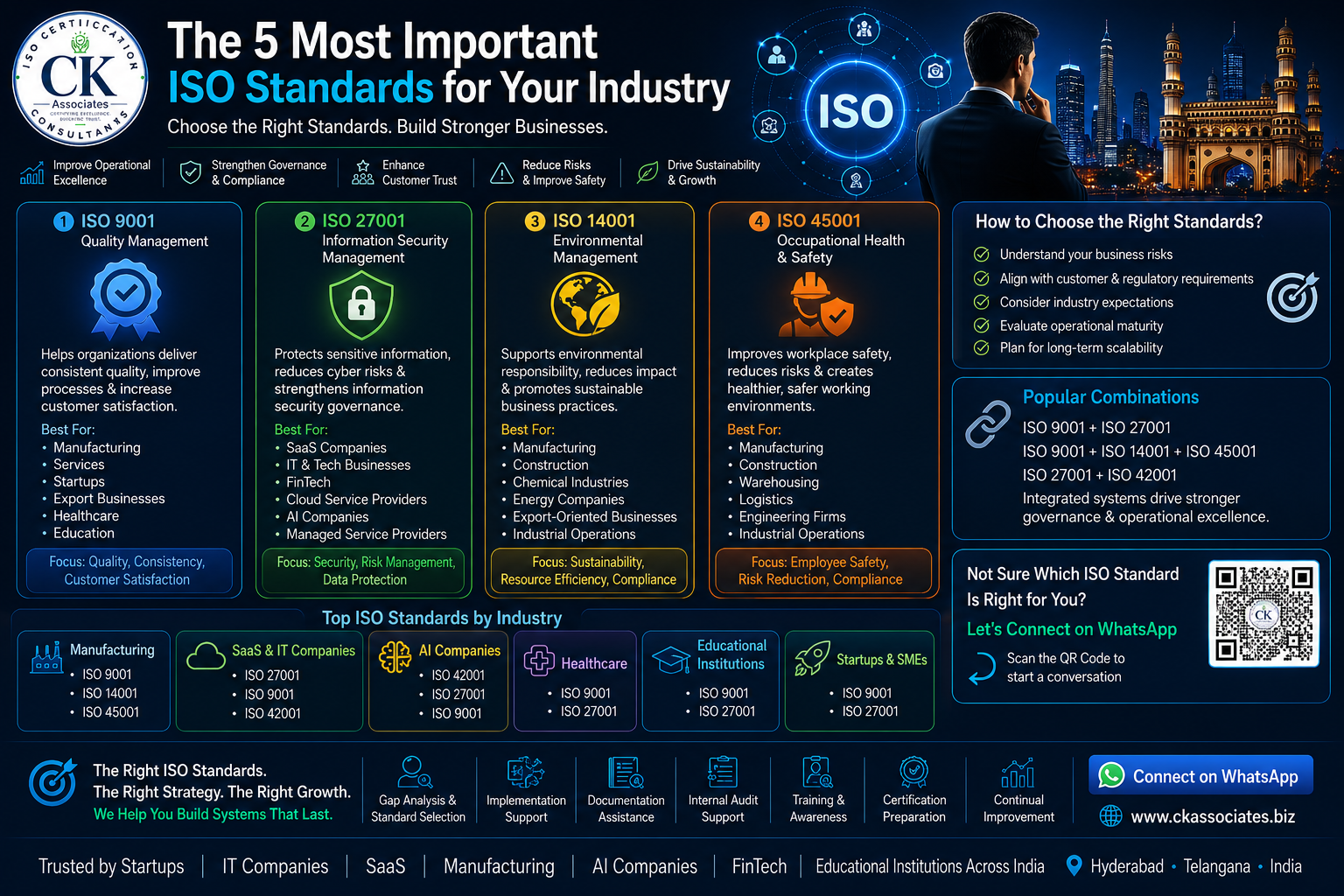
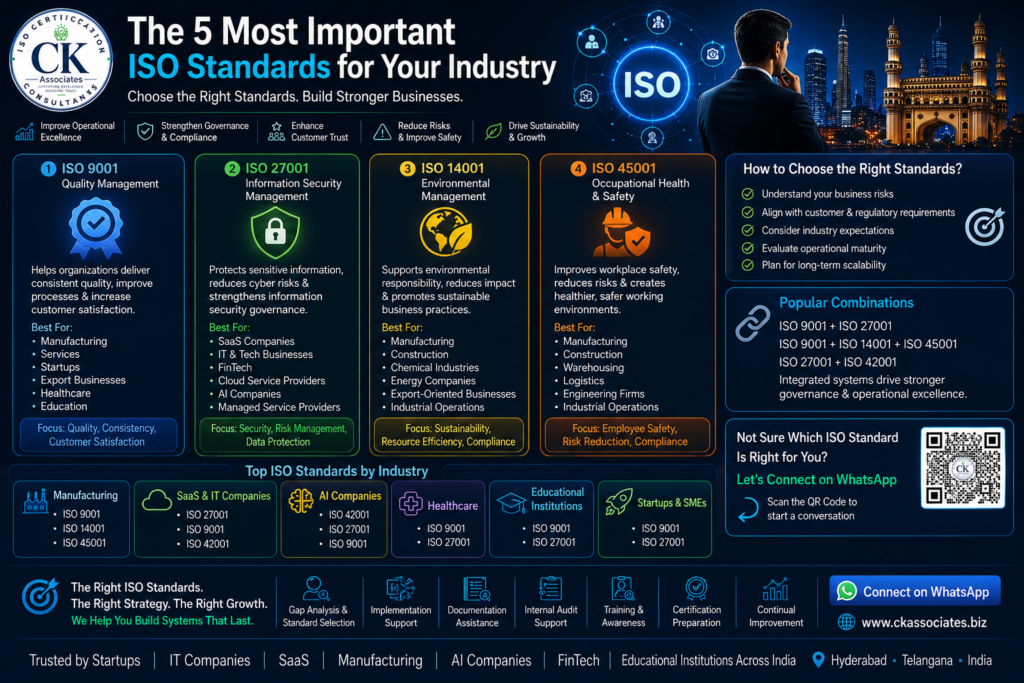
The most important ISO standards depend on your industry, operational risks, customer expectations, governance maturity goals, and compliance requirements.
The five most widely adopted and strategically important ISO standards across industries are:
- ISO 9001 – Quality Management
- ISO 27001 – Information Security Management
- ISO 14001 – Environmental Management
- ISO 45001 – Occupational Health & Safety
- ISO 42001 – AI Management Systems
Different industries prioritize different standards based on operational complexity and governance needs.
For example:
- Manufacturing businesses often prioritize ISO 9001, ISO 14001, and ISO 45001
- SaaS and IT companies increasingly prioritize ISO 27001 and ISO 42001
- Export businesses commonly require ISO 9001
- AI companies increasingly evaluate ISO 42001 governance readiness
The best ISO strategy aligns certification with long-term operational maturity and business growth goals.
What are the most important ISO standards for businesses?
The most important ISO standards for businesses include ISO 9001 for quality management, ISO 27001 for information security, ISO 14001 for environmental management, ISO 45001 for occupational health and safety, and ISO 42001 for AI governance. The right standard depends on industry risks, customer requirements, and operational goals.
Why Choosing the Right ISO Standard Matters
Many businesses initially pursue ISO certification because:
- Customers request it
- Tenders require it
- Export markets expect it
- Enterprise clients demand governance maturity
However, selecting the wrong standard can create:
- Unnecessary implementation costs
- Governance misalignment
- Operational inefficiencies
- Weak adoption
- Poor long-term value
Across Hyderabad, Telangana, Andhra Pradesh, and India, organizations increasingly approach ISO certification as a strategic governance decision rather than simply a compliance activity.
Understanding Industry-Specific ISO Needs
Every industry faces different operational risks.
For example:
- Manufacturing businesses focus heavily on quality consistency and safety
- SaaS companies prioritize cybersecurity governance
- AI companies require accountability frameworks
- Healthcare organizations focus on operational reliability and data protection
This is why ISO standard selection should align with operational maturity goals.
ISO Standard #1: ISO 9001 – Quality Management System
What Is ISO 9001?
ISO 9001 is the world’s most widely adopted Quality Management System (QMS) standard.
It helps organizations improve:
- Process consistency
- Customer satisfaction
- Operational efficiency
- Accountability
- Continual improvement
Best Industries for ISO 9001
ISO 9001 is valuable for almost every industry, including:
- Manufacturing
- IT services
- Startups
- Healthcare
- Education
- Logistics
- Export businesses
- Retail organizations
Why Businesses Choose ISO 9001
ISO 9001 improves:
✔ Customer trust
✔ Operational consistency
✔ Vendor credibility
✔ Process accountability
✔ Scalability
For many businesses, ISO 9001 becomes the operational foundation for future governance systems.
ISO Standard #2: ISO 27001 – Information Security Management
What Is ISO 27001?
ISO 27001 is an Information Security Management System (ISMS) standard.
It helps organizations manage:
- Cybersecurity risks
- Data protection
- Access control
- Incident response
- Vendor security
- Governance accountability
Best Industries for ISO 27001
ISO 27001 is especially important for:
- SaaS companies
- IT businesses
- AI companies
- FinTech organizations
- Cloud service providers
- Managed service providers
Why Businesses Choose ISO 27001
Organizations increasingly adopt ISO 27001 because enterprise customers demand stronger cybersecurity governance.
ISO 27001 improves:
✔ Customer trust
✔ Vendor eligibility
✔ Risk management
✔ Cybersecurity maturity
✔ Operational resilience
ISO Standard #3: ISO 14001 – Environmental Management System
What Is ISO 14001?
ISO 14001 helps organizations manage environmental impact and sustainability responsibilities.
It improves:
- Environmental governance
- Waste management
- Resource efficiency
- Regulatory readiness
- Sustainability accountability
Best Industries for ISO 14001
Most relevant for:
- Manufacturing
- Construction
- Industrial operations
- Chemical industries
- Energy businesses
- Export-oriented companies
Why Businesses Choose ISO 14001
Organizations increasingly adopt ISO 14001 because sustainability expectations are growing globally.
Benefits include:
✔ Better environmental governance
✔ Improved regulatory readiness
✔ Sustainability credibility
✔ Operational efficiency
ISO Standard #4: ISO 45001 – Occupational Health & Safety
What Is ISO 45001?
ISO 45001 helps organizations establish Occupational Health & Safety Management Systems.
It improves:
- Workplace safety
- Risk management
- Incident prevention
- Employee protection
- Operational discipline
Best Industries for ISO 45001
Most relevant for:
- Manufacturing
- Construction
- Warehousing
- Logistics
- Engineering companies
- Industrial operations
Why Businesses Choose ISO 45001
Organizations adopt ISO 45001 to improve:
✔ Workplace safety
✔ Risk reduction
✔ Employee confidence
✔ Operational resilience
✔ Compliance readiness
ISO Standard #5: ISO 42001 – AI Management Systems
What Is ISO 42001?
ISO 42001 is an emerging AI Management System standard focused on AI governance and accountability.
It supports:
- AI governance
- Risk visibility
- Ethical AI practices
- Accountability frameworks
- Operational oversight
Best Industries for ISO 42001
Most relevant for:
- AI startups
- SaaS companies
- Data-driven businesses
- Enterprise AI teams
- Technology platforms
Why Businesses Choose ISO 42001
AI governance expectations are increasing rapidly worldwide.
ISO 42001 helps organizations demonstrate:
✔ Responsible AI governance
✔ Operational accountability
✔ Risk management maturity
✔ Ethical AI practices
Which ISO Standard Is Right for Your Industry?
Manufacturing Businesses
Most Important Standards:
- ISO 9001
- ISO 14001
- ISO 45001
Manufacturing organizations require:
- Process consistency
- Safety governance
- Environmental accountability
SaaS & IT Companies
Most Important Standards:
- ISO 27001
- ISO 9001
- ISO 42001
Technology businesses increasingly prioritize:
- Cybersecurity maturity
- Governance accountability
- Operational scalability
AI Companies
Most Important Standards:
- ISO 42001
- ISO 27001
- ISO 9001
AI governance maturity is becoming strategically important.
Healthcare Organizations
Most Important Standards:
- ISO 9001
- ISO 27001
Healthcare businesses require:
- Operational reliability
- Information security governance
- Patient trust
Educational Institutions
Most Important Standards:
- ISO 9001
- ISO 27001
Educational organizations increasingly focus on:
- Operational standardization
- Student data protection
- Governance maturity
Startups and SMEs
Most Important Standards:
- ISO 9001
- ISO 27001
Growing businesses benefit from early operational maturity and governance discipline.
Should Businesses Implement Multiple ISO Standards?
Increasingly, yes.
Many organizations now integrate multiple standards to create broader governance systems.
Examples:
- ISO 9001 + ISO 27001
- ISO 9001 + ISO 14001 + ISO 45001
- ISO 27001 + ISO 42001
Integrated governance systems improve:
- Operational visibility
- Process alignment
- Risk management
- Audit efficiency
Hyderabad and India ISO Trends
Across Hyderabad and India, demand is increasing for:
- Cybersecurity governance
- AI governance maturity
- Sustainability governance
- Operational resilience
- Enterprise readiness
Businesses increasingly evaluate ISO implementation based on long-term governance strategy rather than audit completion alone.
ISO Standards Are Becoming Strategic Governance Systems
The role of ISO standards is evolving.
Modern businesses increasingly use ISO frameworks to strengthen:
- Operational maturity
- Risk management
- Governance accountability
- Customer confidence
- Enterprise scalability
This shift is especially visible among:
- SaaS companies
- AI startups
- Export businesses
- Manufacturing organizations
- Enterprise suppliers
ISO Consulting Cost Considerations
Implementation consulting is commonly structured around approximately ₹9,000 per manday depending on:
- Organization size
- Industry complexity
- Governance maturity
- Scope of implementation
- Number of departments
What Is a Manday?
A manday refers to one consultant working day dedicated to activities such as:
- Gap analysis
- Documentation support
- Internal audits
- Employee training
- Governance workshops
- Audit preparation
Certification body fees are generally separate from consulting fees.
Which ISO certification is best for businesses?
The best ISO certification depends on industry risks, operational maturity goals, customer expectations, and governance requirements.
What is the most important ISO standard?
ISO 9001 is the most widely adopted ISO standard because it improves quality management and operational consistency.
Do SaaS companies need ISO 27001?
Many SaaS companies pursue ISO 27001 because enterprise customers increasingly require cybersecurity governance maturity.
Why is ISO 42001 important?
ISO 42001 helps organizations establish AI governance, accountability, and risk management frameworks.
FAQ Section
Which ISO standard is best for startups?
Many startups begin with ISO 9001 or ISO 27001 depending on operational focus and customer requirements.
What is the most important ISO standard for manufacturing?
Manufacturing businesses commonly prioritize ISO 9001, ISO 14001, and ISO 45001.
Why do SaaS companies pursue ISO 27001?
SaaS organizations increasingly require cybersecurity governance maturity to satisfy enterprise customer expectations.
Should businesses implement multiple ISO standards?
Yes. Many organizations integrate multiple standards to strengthen governance maturity and operational resilience.
Is ISO 42001 important for AI businesses?
Yes. ISO 42001 supports AI governance accountability, ethical oversight, and operational risk management.