
What Is HACCP Certification?
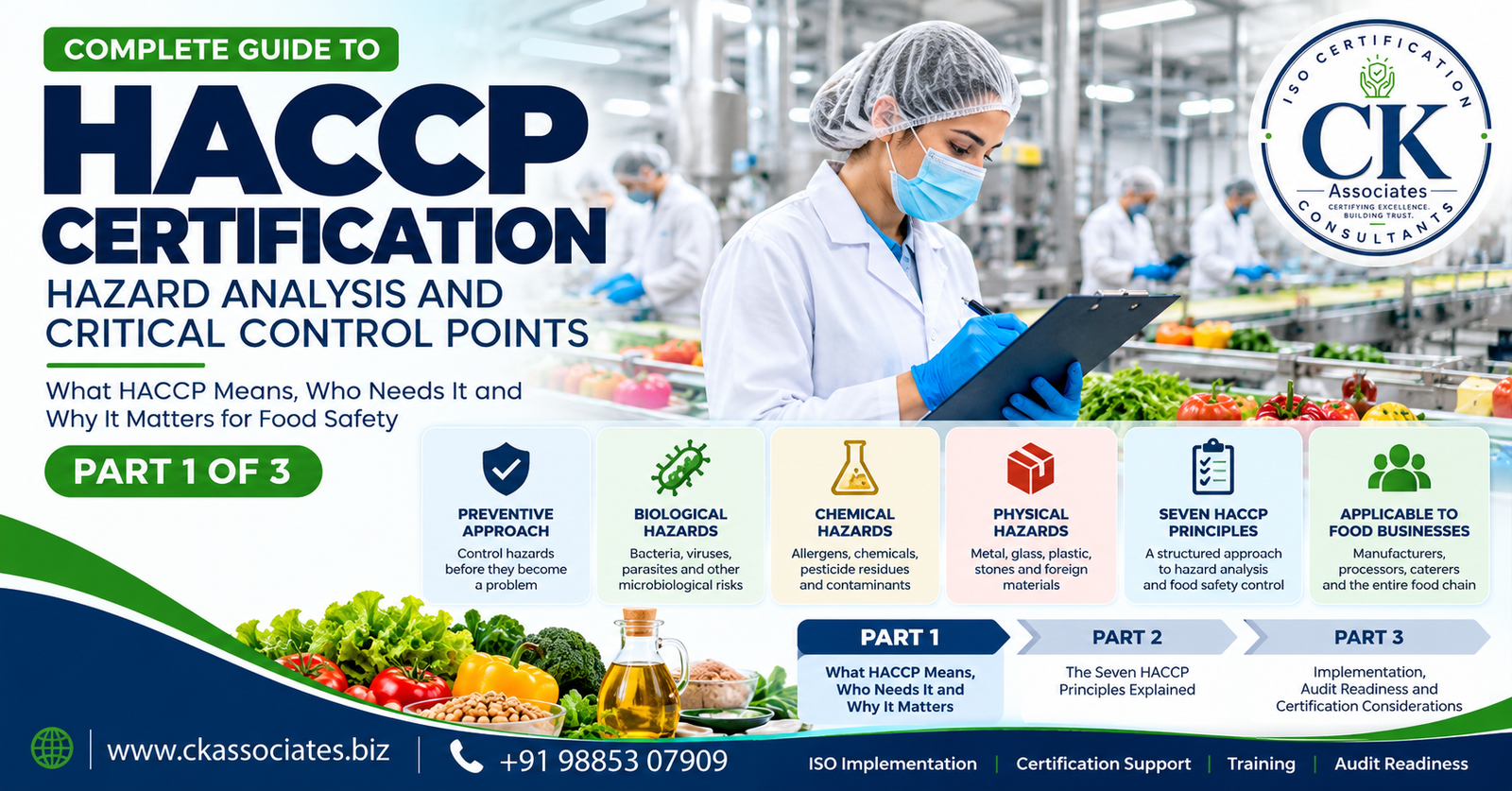
HACCP stands for Hazard Analysis and Critical Control Point. It is a systematic, science-based approach to identifying, evaluating and controlling significant food safety hazards throughout food production and handling. Instead of relying only on final-product inspection, HACCP focuses on preventing hazards or bringing them under control at appropriate stages of the process.
A HACCP-based system examines potential biological, chemical and physical hazards, identifies critical control points where necessary, establishes validated critical limits, and defines monitoring, corrective action, verification and recordkeeping arrangements. Before HACCP is applied, appropriate prerequisite programmes and good hygiene practices must be in place.
Food manufacturers, processors, caterers and other organizations handling food may need to implement HACCP because of applicable regulatory requirements, customer specifications, export-market expectations or their own food safety objectives. The precise legal and certification requirements depend on the country, sector and customer. HACCP is a food safety methodology; it should not automatically be treated as equivalent to certification against ISO 22000 or a private certification scheme.
What Are the Seven HACCP Principles?
The seven HACCP principles are:
- Conduct a hazard analysis.
- Determine the critical control points (CCPs).
- Establish validated critical limits for each CCP.
- Establish monitoring procedures.
- Establish corrective actions.
- Validate the HACCP plan and establish verification procedures.
- Establish documentation and records.
These principles are described in the Codex Alimentarius framework for food hygiene and HACCP. Their application must reflect the organization’s actual products, processes, hazards and operating conditions.
HACCP in Brief
- HACCP is designed to prevent and control significant food safety hazards.
- It addresses biological, chemical and physical hazards.
- It requires a systematic understanding of products, processes and potential hazards.
- Prerequisite programmes and good hygiene practices provide the foundation.
- A HACCP plan must be implemented, monitored, verified and maintained—not merely documented.
- HACCP and ISO 22000 are related but not identical.
- HACCP implementation and any required certification must reflect applicable regulations, customer requirements and the organization’s circumstances.
1. Introduction: Why Food Safety Requires a Preventive Approach
Food safety is a business responsibility that extends well beyond the final inspection of a product.
A food product may pass through several stages before reaching the consumer: raw-material procurement, receiving, storage, preparation, processing, cooling, packaging, transportation and distribution. At each stage, conditions may arise that affect the safety of the product.
For example, a manufacturer may receive contaminated raw materials. A food processor may experience an uncontrolled heating process. A cold-storage facility may fail to maintain required conditions. A packaging operation may introduce foreign material, or an employee may unintentionally transfer contamination between work areas.
These examples illustrate an important principle: food safety needs to be managed throughout the process, not assessed only after the process has finished.
Traditional inspection and product testing remain useful, but they cannot, by themselves, guarantee that every unit of food is safe. A preventive system helps organizations identify where hazards may arise, determine which controls are necessary, and establish evidence that those controls are working as intended.
This is where HACCP becomes important.
HACCP provides a structured method for examining food production and handling processes, identifying significant hazards and establishing controls at the stages where those controls are needed. The approach is recognized internationally through the Codex Alimentarius food hygiene framework developed by the FAO/WHO Codex Alimentarius Commission.
For a food business, HACCP is not simply a document prepared for an inspection. It is a way to organize food safety decisions around the actual risks associated with its operations.
2. What Does HACCP Stand For?
HACCP stands for Hazard Analysis and Critical Control Point.
The name describes the two central ideas behind the method.
Hazard Analysis
Hazard analysis involves identifying potential food safety hazards associated with ingredients, products, equipment, processes, storage, handling and distribution. The organization evaluates those hazards and determines which require control.
Not every possible hazard automatically becomes a critical control point. The assessment must be systematic and appropriate to the product and process.
Critical Control Point
A Critical Control Point, commonly called a CCP, is a step at which control is essential to prevent or eliminate a significant food safety hazard or reduce it to an acceptable level.
For example, a validated heat-treatment step may be a CCP when it is essential to control a significant microbiological hazard. The actual designation depends on the hazard analysis, the process and the evidence supporting the control decision.
A CCP requires defined critical limits, monitoring, corrective action, verification and appropriate records.
What HACCP Is Designed to Achieve
HACCP helps an organization move from general statements such as “we maintain hygiene” to a more systematic approach:
- What could make this product unsafe?
- Where could the hazard occur?
- How significant is the hazard?
- Which control measure is appropriate?
- How will the organization know the control is working?
- What happens when the control fails?
- What evidence demonstrates that the system is functioning?
These questions connect food safety objectives with everyday operational decisions.
3. Understanding the Three Main Categories of Food Safety Hazards
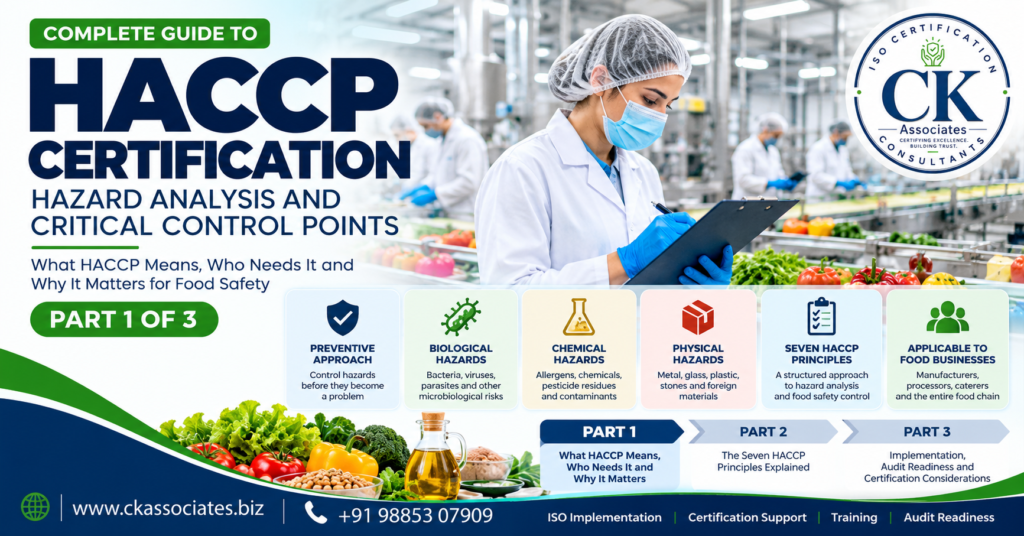
A HACCP study considers hazards relevant to the product and process. Three broad categories are commonly examined: biological, chemical and physical hazards.
3.1 Biological Hazards
Biological hazards may include pathogenic bacteria, viruses, parasites and other harmful biological agents.
Potential sources include contaminated raw materials, unsafe water, inadequate temperature control, poor personal hygiene, contaminated equipment and cross-contamination between raw and ready-to-eat products.
Examples may include:
- Microbiological contamination of raw ingredients.
- Growth of harmful microorganisms during inappropriate storage.
- Inadequate heat treatment where a validated treatment is required.
- Cross-contamination during handling or preparation.
The relevant hazards depend on the type of food, intended use, processing method and consumers who may be exposed.
A control measure appropriate for a cooked product may be insufficient for a ready-to-eat product that receives no further treatment before consumption. HACCP therefore requires product-specific assessment rather than the use of one generic hazard list for every business.
3.2 Chemical Hazards
Chemical hazards may arise from substances that are harmful when present at inappropriate levels or through unintended contamination.
Examples include:
- Cleaning and sanitizing chemical residues.
- Certain pesticide or veterinary-drug residues.
- Allergens that are not appropriately managed or declared.
- Lubricants or other chemicals contaminating food.
- Chemical contaminants introduced through raw materials or processing.
The appropriate controls may involve supplier approval, ingredient specifications, chemical storage, allergen management, cleaning procedures, cross-contact prevention, testing where justified and applicable labelling controls.
An organization should not assume that chemical hazards are controlled merely because it has a cleaning procedure. It needs to assess whether the procedure is suitable, implemented and effective for the hazards identified.
3.3 Physical Hazards
Physical hazards involve foreign materials that may injure consumers or otherwise make food unsafe.
Examples include:
- Metal fragments.
- Glass pieces.
- Hard plastic.
- Stones or other foreign matter in raw materials.
- Fragments from damaged equipment or packaging.
Possible controls include raw-material inspection, equipment maintenance, protective covers, sieving, filtration, magnets, metal detection or X-ray inspection where appropriate.
The correct measure depends on the product, the likelihood and significance of the hazard, and the process. Installing a metal detector, for example, does not control every physical hazard and does not replace the broader hazard analysis.
Why Hazard Classification Matters
Hazard classification is the starting point, not the conclusion.
A strong HACCP study connects each relevant hazard to:
- The stage where it could occur or be introduced.
- The conditions that make it significant.
- The control measures available.
- The basis for deciding whether the control is necessary.
- The monitoring, verification or other evidence needed to demonstrate control.
This is what makes hazard analysis useful in practice. It turns a list of potential problems into a structured control strategy.
4. Who Needs HACCP?
HACCP is relevant to many organizations that manufacture, process, prepare, store, transport or serve food. The need for implementation, formal certification or a particular scheme depends on the applicable regulatory framework, customer requirements, sector and market.
Food Manufacturers
Food manufacturers may need to evaluate hazards associated with raw materials, formulation, processing, packaging, storage and dispatch.
Their HACCP arrangements should reflect the products manufactured and the hazards associated with each production process.
Food Processing Companies
Processors may handle products through washing, cutting, mixing, cooking, cooling, drying, freezing or other operations.
Each process may introduce different hazards or require different control measures. Process flow diagrams and hazard analysis help establish where controls are necessary.
Dairy, Meat, Poultry and Seafood Businesses
These sectors may face significant biological hazards and specific temperature, handling, processing or contamination-control requirements.
Their HACCP systems need to reflect the relevant products, processes, regulations and validated controls.
Catering Companies, Restaurants and Commercial Kitchens
Food-service operations must consider receiving, storage, preparation, cooking, cooling, reheating where applicable, service and prevention of cross-contamination.
The complexity of a HACCP-based system should be appropriate to the operation, but the controls must still be effective and implemented consistently.
Food Packaging and Food-Contact Material Suppliers
Organizations supplying food packaging or food-contact materials may need to manage hazards associated with materials, manufacturing processes, contamination and suitability for intended use.
Their precise food safety controls depend on their role in the supply chain and the applicable customer and regulatory requirements.
Warehousing, Cold Storage and Distribution
Storage and distribution businesses may need to control temperature, segregation, stock handling, traceability, contamination risks and the conditions under which products are received and dispatched.
A warehouse does not necessarily manufacture food, but its activities can affect product safety.
Ingredient and Raw-Material Suppliers
Suppliers may need to establish controls that address hazards in agricultural commodities, ingredients, additives or other materials used in food production.
Their responsibilities also involve communication with customers about relevant hazards and control expectations.
Is HACCP Required for Every Food Business?
Not every business has the same legal obligations or certification needs.
Before starting an implementation project, an organization should establish:
- Which food safety laws and regulatory requirements apply.
- Whether customers or buyers require HACCP-based controls or independent certification.
- Whether an export market or contractual arrangement imposes additional requirements.
- Which products and processes fall within the proposed scope.
- Whether a recognized food safety management system or certification scheme is required.
The correct approach is to identify the applicable requirements before selecting a certification route. HACCP implementation, regulatory compliance and third-party certification are related but distinct matters.
5. What Is the Difference Between HACCP and Routine Food Inspection?
Routine inspection and HACCP support food safety in different ways.
| Area | Routine inspection or testing | HACCP-based approach |
|---|---|---|
| Primary purpose | Identify specified problems or verify selected conditions | Identify and control significant hazards systematically |
| Timing | May occur at defined inspection or sampling points | Controls are applied throughout relevant operations |
| Process focus | Depends on the inspection or test | Uses a structured analysis of products and processes |
| Response to failure | Follow-up depends on the finding and applicable procedure | Defined corrective actions address loss of control |
| Records | Inspection and test results | Hazard analysis, control monitoring, corrective actions, verification and supporting records |
These approaches are complementary, not interchangeable. Product testing and inspection can provide important evidence, while HACCP establishes a preventive framework for managing identified hazards.
For example, a satisfactory laboratory result from a sampled batch does not automatically demonstrate that every batch was produced under effective control. A well-designed HACCP system examines the process and the evidence needed to demonstrate that relevant controls were consistently applied.
6. HACCP Is More Than a Documentation Exercise
One of the most common misunderstandings about HACCP is that it can be implemented by preparing a hazard analysis table and a collection of monitoring forms.
Documents are necessary where they support the system, but they do not prove that the system is working.
Consider a food manufacturer that has a written temperature-monitoring procedure. If the relevant employee does not understand the monitoring method, the measuring equipment is unsuitable, records are completed retrospectively, or deviations are ignored, the procedure is not providing reliable control.
An effective HACCP-based system connects the documented arrangements with actual operations.
That means:
- Employees understand their food safety responsibilities.
- Equipment and measuring methods are suitable for their intended purpose.
- Monitoring occurs at the required frequency.
- Results are recorded accurately.
- Deviations trigger appropriate action.
- Potentially affected products are evaluated and controlled.
- Verification activities assess whether the system is functioning as intended.
- The organization reviews the system when relevant changes occur.
The objective is not to create the largest possible set of documents. It is to establish the right controls, implement them reliably and retain sufficient evidence to demonstrate their effectiveness.
7. What Are Prerequisite Programmes, and Why Do They Matter?
HACCP does not operate in isolation.
Before applying HACCP, a food business should have appropriate prerequisite programmes and good hygiene practices in place. These establish the basic conditions needed to produce and handle food safely.
Depending on the operation, prerequisite programmes may address:
- Cleaning and sanitation.
- Personal hygiene and employee practices.
- Pest control.
- Water and utility suitability.
- Equipment maintenance.
- Waste management.
- Supplier and incoming-material controls.
- Prevention of cross-contamination.
- Storage and handling conditions.
- Facility design and hygienic zoning.
The appropriate programmes depend on the business and its operations.
For example, a cleaning programme may manage routine contamination risks across a production area. HACCP hazard analysis then evaluates whether additional controls are necessary for a specific significant hazard at a particular processing stage.
This distinction matters because a business should not designate every hygiene activity as a CCP. Critical control points must be identified through a reasoned hazard analysis, not by treating every procedure as equally critical.
Prerequisite programmes and HACCP controls work together: the former establish the hygienic foundation, while the latter addresses significant hazards requiring specific control through the HACCP system.
8. HACCP and ISO 22000: What Is the Relationship?
HACCP and ISO 22000 are closely related, but they are not the same.
HACCP is a methodology for analysing food safety hazards and controlling them at appropriate stages of a food operation. Its seven principles provide a structured approach to hazard analysis and critical control.
ISO 22000 is an international standard that specifies requirements for a food safety management system. It incorporates HACCP principles and adds broader management-system requirements, including leadership, planning, communication, competence, operational control, performance evaluation and continual improvement.
ISO describes ISO 22000 as applicable to organizations across the food chain, regardless of their size or position. https://www.iso.org/iso-22000-food-safety-management.html
| Comparison | HACCP | ISO 22000 |
|---|---|---|
| What it is | A food safety hazard-control methodology | A food safety management system standard |
| Main focus | Identifying and controlling significant food safety hazards | Managing food safety through an integrated management system |
| Core elements | Hazard analysis, CCPs, critical limits, monitoring and related principles | Management-system requirements, prerequisite programmes and HACCP-based operational controls |
| Management-system scope | Depends on the HACCP-based system established | Includes leadership, planning, support, operation, evaluation and improvement |
| Certification | Requirements depend on the relevant programme or scheme | Third-party certification may be obtained against ISO 22000 through an appropriate certification body |
Which should a business choose?
That decision should begin with the organization’s regulatory obligations, customer requirements, supply-chain expectations, existing food safety controls and business objectives.
A company may need an effective HACCP-based system without necessarily needing ISO 22000 certification. Another organization may require ISO 22000 because it needs a broader management system or independent assurance for customers.
The important point is to select an approach that meets the actual requirements rather than assuming one certificate automatically satisfies every obligation.
9. What Does HACCP Certification Mean?
The expression “HACCP certification” is used in the marketplace, but it does not always refer to one identical certification arrangement.
An organization may implement HACCP principles as part of its food safety controls. It may also seek an independent assessment against a specific HACCP certification programme or a wider food safety certification scheme.
Before engaging a certification provider, the organization should establish:
- The exact standard or certification scheme being assessed.
- The scope of products, sites and activities covered.
- The applicable audit and certification requirements.
- Whether the certification is recognized by the intended customer or market.
- The certification body’s competence, accreditation status where relevant, and scope of recognition.
- The surveillance, renewal and maintenance obligations.
A certificate should not be represented as proof that every product is free of every possible hazard. It provides evidence of conformity within the defined scope and assessment criteria. Food safety still depends on effective day-to-day controls and continued compliance.
10. Why HACCP Matters for Food Businesses in Hyderabad and Across India
Food manufacturers, processors, ingredient suppliers, caterers, cold-storage providers and other food-chain businesses in Hyderabad and across India may face a combination of regulatory requirements, customer expectations and supply-chain demands.
A business supplying a large retailer may have different requirements from a business serving a local market. An exporter may need to satisfy additional destination-market or buyer requirements. A contract manufacturer may need to demonstrate that its food safety controls align with a customer’s specifications.
For this reason, the first step should be a review of the business’s products, processes, legal obligations and customer requirements—not the assumption that every organization needs the same certificate.
For businesses evaluating HACCP implementation, a structured gap analysis can help establish:
- The existing food safety controls.
- The applicable requirements.
- The significant hazards relevant to the operation.
- The prerequisite programmes that need to be established or strengthened.
- The additional HACCP controls and records required.
- The training, verification and audit activities needed to maintain the system.
The resulting implementation plan should be practical, proportionate to the operation and based on evidence.
11. What Should a Business Understand Before Starting HACCP?
Before beginning implementation, management should be able to answer several foundational questions:
- Which products and processes are included in the scope?
- What are the intended uses of the products?
- Which food safety hazards could arise at each process stage?
- Which prerequisite programmes are necessary?
- Who will conduct the hazard analysis and maintain the system?
- What technical expertise is required?
- How will control measures be validated where necessary?
- How will monitoring, corrective actions and verification be recorded?
- Which legal, customer or certification requirements apply?
These questions help determine the scale of work required and prevent the organization from purchasing a generic HACCP plan that does not reflect its actual operations.
What Are the Seven Principles of HACCP?
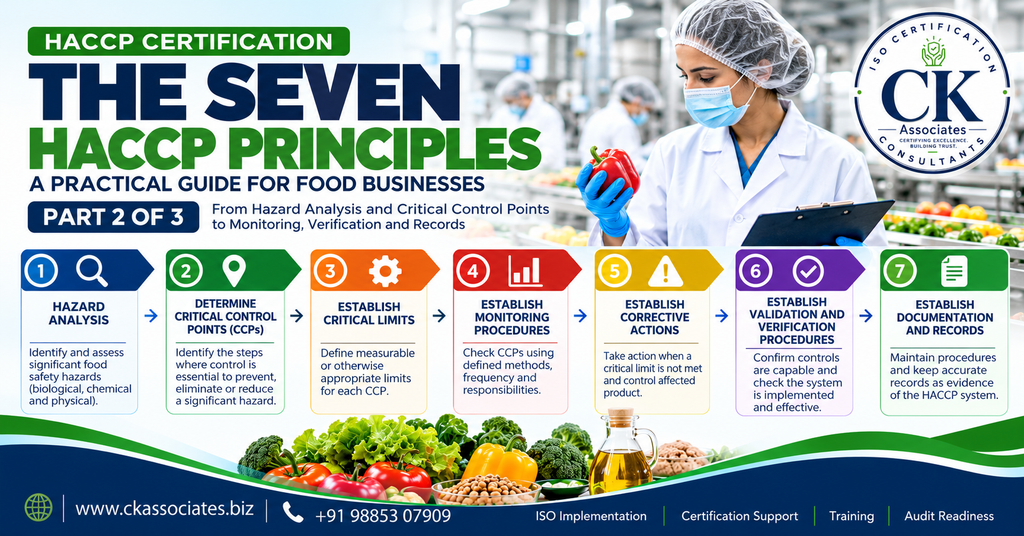
The seven principles of HACCP provide a systematic framework for identifying and controlling significant food safety hazards. They are: conduct a hazard analysis; determine Critical Control Points (CCPs); establish critical limits; establish monitoring procedures; establish corrective actions; establish validation and verification procedures; and establish documentation and recordkeeping.
Each principle serves a specific purpose. Hazard analysis determines which hazards require control. CCP determination identifies the process steps where control is essential. Critical limits define the boundaries that must be met at a CCP. Monitoring detects loss of control, while corrective actions address deviations and affected products. Validation establishes whether the planned controls are capable of controlling the hazards, and verification checks whether the system is implemented and effective. Documentation and records provide evidence of these activities.
The principles must be applied to the organization’s actual products and processes, supported by appropriate prerequisite programmes and good hygiene practices. A generic HACCP plan cannot automatically be applied to every food business.
List the Seven HACCP Principles
- Conduct a hazard analysis.
- Determine Critical Control Points.
- Establish critical limits.
- Establish monitoring procedures for CCPs.
- Establish corrective actions.
- Establish validation and verification procedures.
- Establish documentation and recordkeeping.
These principles are described in the Codex Alimentarius Commission’s General Principles of Food Hygiene, CXC 1-1969. The practical application must be adapted to the relevant food operation and hazards.
How the HACCP Principles Work
- Principle 1: Identify and assess significant food safety hazards.
- Principle 2: Determine the steps where control is essential.
- Principle 3: Define the measurable or otherwise appropriate critical limits that separate acceptable control from loss of control at a CCP.
- Principle 4: Monitor CCPs using defined methods, frequencies and responsibilities.
- Principle 5: Take corrective action when a critical limit is not met.
- Principle 6: Validate the plan and verify its implementation and effectiveness.
- Principle 7: Maintain appropriate documented procedures and records.
The seven principles are connected. If the hazard analysis is inaccurate, the CCPs may be incorrectly selected. If monitoring is inadequate, a deviation may go undetected. If records are unreliable, the organization may be unable to demonstrate that controls were applied consistently.
1. Understanding the HACCP System Before Applying the Seven Principles
HACCP is a systematic, science-based method for controlling significant food safety hazards. It is not simply a collection of forms or a checklist completed before an audit.
Before applying the principles, an organization needs appropriate prerequisite programmes, including relevant good hygiene practices. Depending on the operation, these may cover sanitation, personal hygiene, pest control, equipment maintenance, water quality, supplier controls, waste management and prevention of cross-contamination.
The organization also needs a clear understanding of:
- The products it manufactures, processes, stores or handles.
- The ingredients and raw materials involved.
- The intended use of the product.
- The people who may consume it, including relevant vulnerable groups.
- The processing methods and operating conditions.
- The applicable legal, regulatory and customer requirements.
- The hazards that may arise at different stages of the operation.
The HACCP study uses this information to identify significant hazards and establish suitable controls.
The relationship between the preliminary steps and the seven principles
In practical implementation, the seven principles are preceded by preparatory activities. These commonly include assembling the HACCP team, describing the product, identifying its intended use, constructing a process flow diagram and confirming the diagram against actual operations.
These preliminary activities are essential because hazard analysis must reflect the real process, not an assumed or outdated description.
The Food and Agriculture Organization’s HACCP Toolbox explains the application of the principles through a structured sequence of practical steps. See the FAO/WHO Good Hygiene Practices and HACCP Toolbox.
2. Principle 1: Conduct a Hazard Analysis
Hazard analysis is the foundation of the HACCP system. It involves identifying potential hazards associated with ingredients, products, equipment, processing, storage, handling and distribution, then evaluating which hazards are significant and require control.
The analysis should consider hazards that may be introduced, increased or insufficiently reduced at each relevant stage.
Step 1: Map the process
A food manufacturer may use a process flow such as:
Raw-material receiving → Storage → Preparation → Processing → Cooling → Packaging → Finished-product storage → Dispatch.
The actual sequence will depend on the product and process. Some operations may include cooking, fermentation, freezing, drying, filtration, metal detection or other controls.
The HACCP team should confirm the flow diagram on site so that it reflects actual operating conditions, including relevant rework routes, delays, transfers and handling activities.
Step 2: Identify potential hazards
At each process step, the team should consider relevant biological, chemical and physical hazards.
For example, during raw-material receiving, possible concerns may include microbiological contamination, chemical residues or foreign materials. During storage, temperature abuse or cross-contamination may be relevant. During processing, the team may need to evaluate whether a treatment adequately controls a significant hazard.
The examples are illustrative. The actual hazards depend on the food, ingredients, process and intended use.
Step 3: Evaluate significance
Not every theoretical hazard requires a CCP. The team must assess the likelihood of occurrence and the severity of the consequences, taking into account the existing controls and relevant scientific, technical and regulatory information.
A documented risk assessment may use a defined likelihood-and-severity method, but the scoring method must not replace sound technical judgement. A low numerical score does not automatically make a serious hazard insignificant.
The assessment should explain why a hazard is or is not considered significant and how it will be controlled.
Step 4: Identify appropriate control measures
Control measures may include supplier controls, cleaning, separation of raw and ready-to-eat materials, validated processing, temperature control, allergen management or other suitable measures.
The team must determine whether a hazard is adequately managed through prerequisite programmes or requires additional control through the HACCP plan.
Example: Hazard analysis for a cooked food product
Consider a hypothetical manufacturer producing a cooked, ready-to-eat food.
| Process stage | Illustrative hazard | Potential control consideration |
|---|---|---|
| Raw-material receiving | Microbiological contamination | Supplier approval, specifications and appropriate receiving checks |
| Chilled storage | Growth of harmful microorganisms | Defined storage conditions and monitoring |
| Cooking | Survival of relevant pathogens | Validated heat treatment where applicable |
| Post-cook handling | Recontamination | Hygienic handling, separation and sanitation |
| Packaging | Contamination or packaging failure | Suitable packaging controls and inspection |
This table is not a complete HACCP plan. The team must assess the specific product, relevant hazards, existing controls and scientific basis before determining the appropriate control classification.
Evidence an auditor may review
- Product descriptions and intended-use information.
- Confirmed process flow diagrams.
- Hazard analysis worksheets.
- The basis for hazard significance decisions.
- Relevant scientific, regulatory or technical references.
- Defined control measures.
- Evidence that the analysis reflects actual site conditions.
A strong hazard analysis explains the reasoning behind the decisions. A table containing hazard names without a clear evaluation or control rationale is unlikely to provide the same level of assurance.
3. Principle 2: Determine the Critical Control Points
A Critical Control Point, or CCP, is a step at which control is essential to prevent or eliminate a significant food safety hazard or reduce it to an acceptable level.
CCPs are identified through the hazard analysis. They should not be selected merely because a process step looks important, requires a record or is routinely checked by an employee.
How to determine a CCP
The HACCP team should examine each significant hazard and determine where an essential control can be applied. A Codex-based decision tree may help structure the assessment, although the selected method must be suitable for the operation and applied with technical judgement.
The assessment should consider:
- Whether the hazard is significant.
- Whether existing prerequisite programmes adequately control it.
- Whether a specific process step is essential for control.
- Whether a later step will prevent, eliminate or reduce the hazard to an acceptable level.
- Whether the proposed control is supported by appropriate evidence.
The reasoning should be documented so that the CCP determination can be understood and reviewed.
Example: Cooking as a CCP
Suppose a heat-treatment step is essential for controlling a significant microbiological hazard in a particular product. If the process is validated for that product and the relevant conditions, the heat-treatment step may be designated a CCP.
However, cooking is not automatically a CCP for every food product. The designation depends on the hazard analysis, the process and the role of that step in controlling the hazard.
Similarly, a cleaning activity may be essential to food safety without being classified as a CCP. It may be managed through a prerequisite programme.
CCP versus other operational controls
| Question | Critical Control Point | Prerequisite programme or other control |
|---|---|---|
| Purpose | Controls a significant hazard at a step where control is essential | Establishes hygienic conditions or manages hazards through an appropriate control arrangement |
| Determination | Based on hazard analysis and CCP assessment | Based on the relevant operational, hygiene and hazard-control requirements |
| Critical limits | Established for each CCP | Requirements may use other defined criteria, procedures or limits as appropriate |
| Monitoring | Defined monitoring is required to assess whether the CCP remains within its critical limits | Monitoring or checks are defined according to the programme and risks |
| Response to failure | Corrective action and control of affected product are required | Appropriate correction, corrective action and product control depend on the nature of the failure |
The distinction is important. Treating every hygiene procedure as a CCP creates unnecessary complexity, while failing to identify a genuine CCP can leave a significant hazard inadequately controlled.
What auditors look for
An auditor may examine whether the CCP determination follows logically from the hazard analysis, whether the selected control is appropriate, and whether the monitoring and corrective-action arrangements are sufficient.
The FAO guidance on determining CCPs provides additional detail.
4. Principle 3: Establish Critical Limits
A critical limit is a criterion that separates acceptable from unacceptable control at a CCP. The limit must be appropriate to the hazard and supported by a valid technical or scientific basis.
Critical limits should be defined clearly enough for personnel to determine whether the CCP is under control.
Examples of critical-limit parameters
Depending on the product and process, relevant parameters may include:
- Time and temperature.
- pH.
- Water activity.
- Moisture level.
- Available chlorine or another relevant chemical parameter.
- Other measurable or assessable characteristics justified by the control measure.
These are examples, not universal limits. The appropriate parameter and value depend on the hazard, product, process, equipment and applicable requirements.
How to establish a suitable critical limit
The organization should:
- Identify the significant hazard that the CCP is intended to control.
- Determine the control measure and the conditions needed for effective control.
- Obtain appropriate scientific, technical or regulatory evidence.
- Establish a limit applicable to the actual product and operating conditions.
- Validate the suitability of the limit where required.
- Define the measurement method, equipment, responsibility and monitoring frequency.
Where external guidance is used, the organization must establish that it applies to its product, process and equipment. A limit copied from another company’s plan may be unsuitable.
Critical limits and operating targets
A critical limit should not be confused with an operating target.
An operating target may be set inside the acceptable boundary to provide a margin for process adjustment. The critical limit defines the boundary at which the CCP is considered out of control.
For example, a facility may use an internal operating target that prompts an operator to adjust a process before the critical limit is reached. The exact target and critical limit must be based on the validated process and applicable requirements.
Evidence and documentation
The HACCP plan should identify the critical limit for each CCP, the supporting basis and the method used to assess compliance. Supporting records may include validation studies, authoritative technical guidance, applicable regulations, process studies or other relevant evidence.
An auditor may ask not only what the limit is, but also why it is appropriate and how the organization knows it is capable of controlling the identified hazard.
5. Principle 4: Establish Monitoring Procedures
Monitoring is the planned sequence of observations or measurements used to determine whether a CCP is under control.
A monitoring procedure must be practical, sufficiently frequent and capable of detecting a loss of control in time for the organization to respond appropriately.
What should a monitoring procedure specify?
For each CCP, the HACCP plan should define:
- What is monitored.
- How it is monitored.
- When or how frequently monitoring occurs.
- Who is responsible.
- Which equipment or instruments are required.
- Where the result is recorded.
- What happens when a deviation is detected.
The method and frequency should be based on the hazard, process variability, critical limits and ability to detect loss of control.
Example: Monitoring a temperature-controlled process
Suppose a validated process requires a defined temperature-time combination at a CCP. The monitoring procedure must specify the relevant measurements and how compliance is determined.
The responsible employee must understand the method, use suitable equipment and record the actual result. The procedure should also identify how deviations are reported and acted upon.
A form with a blank temperature field does not establish effective monitoring. The result must reflect an actual measurement taken in accordance with the procedure.
Continuous and periodic monitoring
Continuous monitoring may be appropriate when equipment can reliably measure and record a relevant parameter continuously.
Where continuous monitoring is not practical, periodic monitoring may be used if its frequency provides sufficient assurance that the CCP remains under control. The decision must consider the process and the possibility of losing control between measurements.
A monitoring frequency should not be selected solely for convenience.
Common monitoring failures
- Recording results after the event rather than at the time of monitoring.
- Using an unsuitable or inaccurate instrument.
- Failing to define monitoring frequency.
- Allowing untrained personnel to make critical measurements.
- Recording only “OK” without the information needed to demonstrate compliance.
- Failing to report deviations.
- Reviewing records without investigating inconsistent results.
Evidence an auditor may examine
- Completed CCP monitoring records.
- Instrument identification and calibration or accuracy checks, as appropriate.
- Employee training and competence evidence.
- Defined monitoring responsibilities.
- Evidence that deviations were reported and addressed.
- Records demonstrating that the monitoring method follows the HACCP plan.
Monitoring provides the immediate evidence of control at a CCP. It is not a substitute for verification, which evaluates whether the system is being followed and remains effective.
6. Principle 5: Establish Corrective Actions
Corrective actions must be established for situations in which monitoring indicates that a CCP is not under control.
A deviation may involve a critical limit being exceeded, a measurement showing non-compliance, a monitoring failure that leaves the status uncertain, or another condition identified by the HACCP plan as requiring action.
The response must address both the process and any potentially affected product.
The essential elements of corrective action
A suitable procedure should establish how the organization will:
- Identify and report the deviation.
- Restore control of the process.
- Identify the product potentially affected since the last acceptable control result, as appropriate.
- Place affected product under control while its disposition is evaluated.
- Determine whether the product can be safely released, requires reprocessing where permitted, must be diverted to an appropriate alternative use, or must be rejected or destroyed.
- Investigate the cause of the deviation.
- Implement measures to prevent recurrence where needed.
- Record the actions and verify their effectiveness.
The exact response depends on the hazard, product, process, legal requirements and applicable procedures.
Example: A deviation during heat treatment
Consider a hypothetical operation in which a CCP monitoring result indicates that the validated critical limit has not been met.
The organization should not simply adjust the equipment and continue as if nothing happened. It must establish control, identify the affected product, assess the food safety implications and determine an appropriate disposition.
The cause should also be investigated. Possible contributing factors might include equipment malfunction, incorrect settings, an unsuitable loading pattern, an instrument problem or an error in the monitoring procedure.
Any corrective measure must be supported by evidence that it is suitable for the identified cause.
Correction versus corrective action
These terms are related but not identical.
- Correction addresses a detected problem or nonconformity.
- Corrective action addresses the cause of a problem to prevent recurrence.
For example, isolating affected product and restoring the process may be immediate corrections. Investigating why the process repeatedly falls outside its limits and preventing the recurrence may require corrective action.
What an auditor may expect
Records should demonstrate the deviation, the relevant monitoring result, the affected product assessment, the action taken, the responsible personnel and the outcome. Where cause analysis and preventive measures are necessary, those should also be recorded.
A procedure that says only “inform the supervisor” is unlikely to be sufficient if it does not explain how control is restored and affected product is managed.
7. Principle 6: Establish Validation and Verification Procedures
Validation and verification are both essential, but they answer different questions.
Validation asks whether the control measures and HACCP plan are capable of controlling the significant hazards.
Verification asks whether the HACCP plan is being implemented as intended and remains effective.
Confusing these activities can create gaps in a food safety system.
7.1 Validation: Is the planned control capable of working?
Validation should establish, before implementation of the HACCP plan and when relevant changes require it, that the selected control measures can control the identified hazards under the conditions for which they are intended.
Depending on the control measure, evidence may include:
- Scientific literature or authoritative technical guidance.
- Relevant regulatory requirements.
- Process validation studies.
- Equipment or process performance data.
- Appropriate technical studies or models.
- Evidence demonstrating that the control applies to the actual product and process.
For example, a heat-treatment limit should be supported by appropriate evidence showing that the relevant time-temperature conditions are suitable for controlling the target hazard in the product and process concerned.
Validation cannot be replaced by a statement that the process has worked in the past.
7.2 Verification: Is the system working in practice?
Verification involves methods, procedures, tests and other evaluations, in addition to routine monitoring, to determine whether the HACCP plan is being followed and remains effective.
Verification activities may include:
- Reviewing CCP monitoring records.
- Examining corrective-action records and product dispositions.
- Observing operations.
- Checking relevant equipment and measurement arrangements.
- Reviewing the HACCP plan when changes occur.
- Conducting appropriate internal audits.
- Using sampling or testing where justified.
- Confirming that identified hazards and control measures remain appropriate.
Verification should be conducted at a defined frequency and whenever relevant events indicate that the system may need reassessment.
7.3 Calibration and equipment accuracy
Where instruments are used to monitor critical parameters, the organization should establish suitable arrangements for calibration, verification of accuracy or other equipment checks, as applicable.
For example, an instrument used for a critical temperature measurement must be suitable for the intended measurement and maintained in an appropriate condition. If the instrument is found to be inaccurate, the organization may need to assess whether earlier monitoring results and affected product decisions remain reliable.
7.4 What triggers a review?
The HACCP system should be reviewed when relevant changes occur. Triggers may include:
- New products or ingredients.
- Changes to process steps or equipment.
- New packaging or intended uses.
- Changes to storage or distribution arrangements.
- Repeated deviations.
- New scientific or regulatory information.
- Relevant customer complaints or product incidents.
- Findings that question the adequacy of existing controls.
Where a change affects the validity of the hazard analysis or control measures, the organization should revise the HACCP plan and revalidate affected elements as necessary.
Validation versus verification: comparison
| Question | Validation | Verification |
|---|---|---|
| Main purpose | Establish that the planned controls can control the hazards | Confirm that the plan is implemented and effective |
| Typical timing | Before implementation and when relevant changes require reassessment | During implementation at defined intervals and when triggered by relevant events |
| Typical evidence | Scientific or technical basis, studies and supporting data | Record reviews, observations, audits, equipment checks and appropriate testing |
| Example | Evidence that a defined heat treatment controls the relevant hazard | Review of monitoring records and observation that the validated process is being followed |
The FAO guidance on HACCP validation and verification provides additional practical guidance.
8. Principle 7: Establish Documentation and Recordkeeping
Documentation and records demonstrate how the HACCP system has been designed, implemented, monitored and reviewed.
Documentation describes the system and the procedures to be followed. Records provide evidence of what actually happened.
Both are necessary, but they serve different purposes.
8.1 Typical HACCP documentation
Depending on the nature and complexity of the operation, the documented information may include:
- HACCP scope and product descriptions.
- Intended use and relevant consumer considerations.
- Confirmed process flow diagrams.
- Hazard analysis and hazard significance assessment.
- CCP determination and supporting rationale.
- Critical limits and their technical basis.
- Monitoring procedures.
- Corrective-action procedures.
- Validation and verification arrangements.
- Procedures for handling affected product.
- Relevant prerequisite programmes and work instructions.
The exact documentation set should be appropriate to the operation and applicable requirements.
8.2 Typical HACCP records
Records may include:
- CCP monitoring results.
- Storage and processing measurements.
- Deviations and corrective actions.
- Affected-product assessment and disposition.
- Relevant equipment checks or calibration records.
- Verification and validation evidence.
- Internal audit findings, where applicable.
- Training and competence evidence.
- Relevant supplier or incoming-material checks.
- HACCP review and revision records.
Not every item is necessarily a CCP record. The organization should maintain records appropriate to its hazard controls, prerequisite programmes and applicable requirements.
8.3 What makes a record reliable?
A useful record should be attributable, legible, accurate and sufficiently detailed to demonstrate the activity performed.
Depending on the record, this may include:
- Date and time.
- Product, batch or process identification.
- Actual measurement or observation.
- The person who performed the activity.
- The relevant equipment or measurement reference, where needed.
- The outcome and any action taken.
- Review or authorization, where required by the procedure.
Records must reflect actual activities. Retrospective completion, unexplained alterations and repeated identical readings without evidence of measurement can undermine confidence in the system.
8.4 Paper-based and digital records
A HACCP system may use paper records, digital forms, monitoring software or a combination of these approaches.
The format alone does not determine whether the records are effective. The organization should ensure that records are accessible, protected from inappropriate alteration or loss, retained for the required period and retrievable when needed.
Digital monitoring may improve visibility and response times, but it does not remove the need for suitable sensors, defined responsibilities, accurate data and effective action when deviations occur.
9. How the Seven Principles Work Together: A Practical Example
Consider a hypothetical manufacturer producing a ready-to-eat product that requires a validated heat-treatment step.
The HACCP team identifies a relevant microbiological hazard during hazard analysis. The team evaluates the process and determines that the heat-treatment step is essential to control that hazard. It establishes a CCP and defines a scientifically supported critical limit.
A monitoring procedure specifies what is measured, how the measurement is taken, how often it occurs and who is responsible. If a result falls outside the critical limit, the corrective-action procedure requires the organization to restore control and assess affected product.
Validation provides evidence that the heat-treatment control is suitable for the identified hazard. Verification examines whether the process is being followed and the control remains effective. Records capture the monitoring results, deviations, product decisions and relevant review activities.
This example illustrates the connection between the principles:
Hazard identification → CCP determination → Critical limit → Monitoring → Corrective action → Validation and verification → Documentation and records.
The sequence is not merely administrative. Each element supports the next, and the overall system depends on their consistent application.
10. Common HACCP Implementation Mistakes
Even when a business has prepared a HACCP plan, several weaknesses can prevent the system from controlling hazards effectively.
Mistake 1: Using a generic hazard analysis
A generic template may omit hazards specific to the product, ingredients, process or intended use.
Better approach: Develop the analysis around the actual products and operations, and verify the process flow on site.
Mistake 2: Designating too many CCPs
Treating every inspection, cleaning activity or operational check as a CCP can make monitoring unnecessarily complicated.
Better approach: Apply a systematic CCP determination method and distinguish prerequisite programmes from controls that genuinely require CCP management.
Mistake 3: Using unsupported critical limits
A limit copied from another facility may not apply to the organization’s process.
Better approach: Establish a technical basis and verify that the evidence applies to the product, process and equipment concerned.
Mistake 4: Monitoring without a defined method
A procedure may state that temperature is checked without specifying the location, frequency, equipment or responsible person.
Better approach: Define the monitoring method and responsibilities clearly enough for consistent implementation.
Mistake 5: Recording results without responding to deviations
A monitoring record is not sufficient if out-of-limit results are ignored or affected product is not evaluated.
Better approach: Establish clear procedures for restoring control, assessing affected product and documenting the response.
Mistake 6: Confusing validation with verification
A successful trial does not demonstrate that staff follow the process every day. Conversely, reviewing completed records does not by itself prove that a control measure is scientifically adequate.
Better approach: Maintain separate, clearly defined validation and verification activities.
Mistake 7: Treating documentation as the objective
A complete file does not guarantee that operational controls are effective.
Better approach: Compare the documented procedures with actual practice, observe operations, review records and investigate deviations.
Mistake 8: Failing to review the system after changes
A change in ingredients, equipment, packaging or processing conditions may affect the original hazard analysis.
Better approach: Establish a change-review process that determines whether the HACCP plan needs updating or revalidation.
11. HACCP Evidence: What an Auditor May Examine
An auditor’s assessment depends on the applicable audit criteria, certification programme, regulatory context and scope. However, an effective HACCP system should be able to demonstrate a clear relationship between hazards, controls, implementation and evidence.
| Area | Evidence that may be reviewed |
|---|---|
| Hazard analysis | Product and process information, significant hazards, assessment rationale and control measures |
| CCP determination | Documented reasoning for identifying CCPs |
| Critical limits | Defined limits and supporting technical evidence |
| Monitoring | Completed records, responsibilities, equipment suitability and monitoring frequency |
| Corrective action | Deviations, affected-product assessment, disposition and actions taken |
| Validation | Evidence that the planned controls are suitable for the hazards and process |
| Verification | Record reviews, observations, audits and other appropriate verification activities |
| Documentation | Current procedures, traceable records, revision control and retrieval arrangements |
| Competence | Relevant training, responsibilities and evidence that personnel can perform assigned activities |
The evidence should be consistent with actual operations. A monitoring record, for example, should match the product, process, equipment and time of the activity.
The strongest approach is to maintain the system as part of everyday operations rather than attempting to reconstruct records shortly before an audit.
12. HACCP Readiness Checklist
Use this checklist as a preliminary internal review. It is not a formal certification score or a substitute for a product-specific hazard analysis.
Process and hazard analysis
- The HACCP scope and products are clearly identified.
- Product descriptions and intended uses are documented.
- Process flow diagrams reflect actual operations.
- Relevant biological, chemical and physical hazards have been assessed.
- Hazard significance decisions have a documented rationale.
- Appropriate prerequisite programmes are established.
Control measures and CCPs
- CCPs are determined using a suitable, documented method.
- The reason for each CCP designation is understood.
- Critical limits have an appropriate technical basis.
- Monitoring methods, frequencies and responsibilities are defined.
- Corrective actions address loss of control and potentially affected product.
Validation, verification and records
- Relevant control measures have been validated as necessary.
- Verification activities and frequencies are defined.
- Measurement equipment is suitable and appropriately checked.
- Monitoring and corrective-action records are accurate and retrievable.
- Relevant changes trigger review of the HACCP system.
- Personnel understand their responsibilities and know how to report deviations.
A gap in any area should be assessed according to its significance and potential effect on food safety. Issues affecting a critical control or the safety of potentially affected product require appropriate and timely attention.
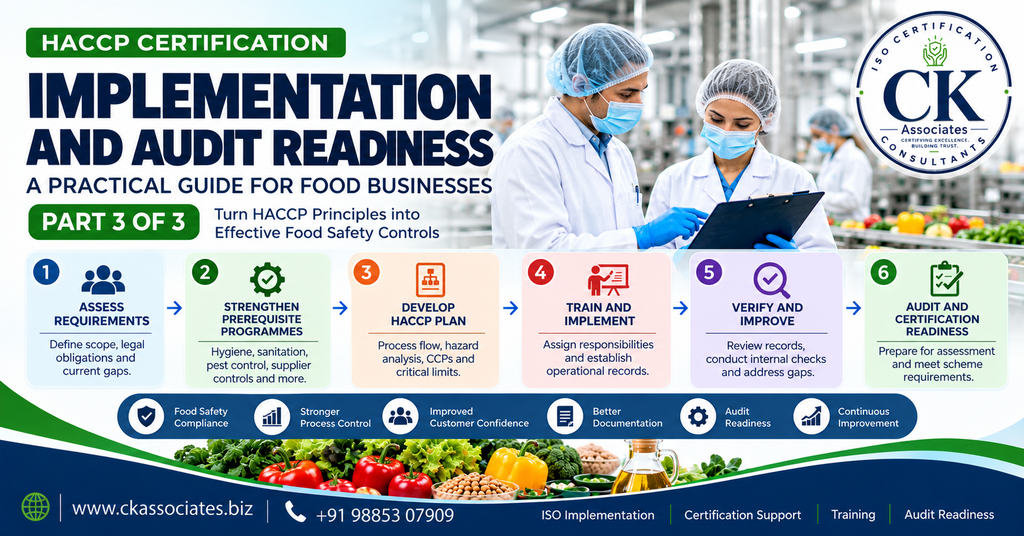
How Do You Implement HACCP?
HACCP implementation begins with understanding the products, processes, intended use and applicable food safety requirements. The organization establishes appropriate prerequisite programmes and good hygiene practices, forms a competent HACCP team, describes the product and process flow, identifies and evaluates relevant hazards, and determines where control measures are required. Where critical control points are identified, the system establishes scientifically justified critical limits, monitoring procedures, corrective actions, validation and verification activities, and appropriate records. The system must then be implemented in daily operations, reviewed when relevant changes occur and supported by competent personnel. If independent certification is required, the organization must identify the exact certification scheme, scope and assessment criteria accepted by its customer or target market. HACCP implementation does not automatically mean that a business holds a third-party certificate.
What are the main steps in HACCP implementation?
- Define the scope and assemble a competent HACCP team.
- Describe the products, intended use and process flow.
- Establish prerequisite programmes and good hygiene practices.
- Conduct a hazard analysis and determine necessary controls.
- Identify CCPs and establish justified critical limits where applicable.
- Define monitoring, corrective action, verification and recordkeeping.
- Train employees, implement the system and retain reliable evidence.
- Review effectiveness, correct weaknesses and prepare for any required independent assessment.
The exact activities and their sequence should be aligned with the applicable Codex guidance, legislation and certification scheme.
What a food business should do
- Build HACCP around the actual products and processes—not a generic template.
- Establish effective hygiene and prerequisite programmes first.
- Make sure employees understand the controls relevant to their jobs.
- Keep monitoring records accurate, timely and traceable.
- Investigate deviations and control potentially affected product.
- Verify that the system is implemented and working effectively.
- Confirm the exact certification or customer requirement before selecting a provider.
- Continue maintaining the system after an audit or certificate is issued.
1. From HACCP principles to an implemented food safety system
A HACCP plan becomes useful when its controls are incorporated into the way the business actually operates.
A document may describe a control correctly, but implementation requires the right people, equipment, instructions, monitoring methods and response arrangements. The organization must also be able to demonstrate that the system is followed consistently.
For example, a food manufacturer may identify a heat-treatment stage as a critical control point. The practical system must define the relevant product and process conditions, establish a scientifically supported critical limit, identify how monitoring will take place, specify what happens if the limit is not met and retain the evidence needed to verify control.
The specific limits and methods must be established for the actual product and process. A generic time or temperature value should never be copied into a HACCP plan without appropriate technical justification.
1.1 Establish the foundation
Before developing or revising the HACCP plan, review the operational conditions that support food safety:
- Cleaning and sanitation arrangements.
- Personal hygiene and training.
- Pest management.
- Equipment maintenance.
- Water and utility suitability.
- Supplier approval and incoming-material controls.
- Storage conditions and temperature control where applicable.
- Prevention of cross-contamination.
- Allergen management where relevant.
- Traceability and product identification.
- Waste handling and facility hygiene.
The necessary programmes depend on the nature and complexity of the operation. Codex guidance treats good hygiene practices as the foundation for applying HACCP effectively.
FAO
+1
1.2 Make the HACCP plan specific to the business
A useful plan should reflect the actual product categories, ingredients, equipment, process stages, packaging, storage conditions and intended use.
The team should confirm that the process flow diagram reflects what happens on the production floor. Where necessary, the flow should be checked on site and corrected to reflect real operating conditions.
A plan that describes an ideal process rather than the process actually followed is unlikely to provide reliable control.
1.3 Assign clear responsibilities
Employees need to know who is responsible for monitoring, reviewing records, reporting deviations, assessing affected product, authorizing release where appropriate and verifying the system.
Responsibilities should be practical and clear enough that a shift change, absence or production pressure does not leave a critical control unattended.
2. HACCP documentation: what records may be needed?
HACCP documentation should support hazard control, operational consistency and evidence of implementation. There is no single universal set of forms that fits every food business.
Depending on the operation, the documentation may include the following:
| Document or record | Purpose |
|---|---|
| Product description and intended use | Establishes the product characteristics relevant to food safety |
| Process flow diagram | Shows the steps in the actual process |
| Hazard analysis | Records relevant hazards, their evaluation and the rationale for controls |
| CCP determination | Documents why a step is or is not a CCP |
| HACCP plan | Defines the controls, critical limits where applicable, monitoring, corrective action and verification |
| Monitoring records | Provides evidence that required checks were carried out |
| Deviation and corrective-action records | Shows what happened when a control was lost and how the issue was handled |
| Validation and verification evidence | Supports the adequacy of controls and checks ongoing implementation |
| Training records | Demonstrates relevant employee instruction and competence |
| Calibration or equipment-check records | Supports confidence in measurements where applicable |
| Cleaning and sanitation records | Provides evidence of relevant hygiene activities |
| Supplier and receiving records | Supports control of incoming materials and relevant supplier risks |
| Traceability and withdrawal/recall records | Helps identify affected materials or products and support appropriate action |
| Review and change records | Shows that the system is reviewed when relevant circumstances change |
Not every record in this table is necessarily a CCP record, and not every item is mandatory for every organization under every scheme. The documentation set should be determined from the hazards, controls, applicable legal obligations and chosen certification criteria.
Practical rule: a record should provide useful evidence of a defined activity or decision. Completing forms simply to increase the document count does not make the food safety system more effective.
3. What happens when a HACCP control fails?
A food business needs a planned response to loss of control. It should not wait until an auditor discovers that monitoring results are outside the established limits.
A suitable response depends on the hazard, product, process and applicable requirements, but the organization should be prepared to:
- Identify and record the deviation.
- Restore control of the affected process.
- Identify and place potentially affected product under appropriate control.
- Evaluate the product’s safety using competent, documented decision-making.
- Determine the appropriate disposition of affected product.
- Investigate the cause of the deviation.
- Implement corrective action to prevent recurrence where needed.
- Verify that the corrective action and relevant controls are effective.
- Retain records of the event, decision and follow-up.
Illustrative example: an out-of-limit process
Suppose a food processor has established a validated heat-treatment control for a particular product. During production, monitoring indicates that the defined critical limit was not achieved.
The operator should not simply repeat the reading until an acceptable result appears or change the record to match the target. The deviation must be recorded, and the process and potentially affected product must be managed according to the documented procedure.
A competent person must determine the appropriate action using the validated process, the nature of the deviation and relevant food safety requirements. Product should not be released merely because production needs to continue.
This is an illustrative scenario, not a universal instruction for every food product. The appropriate technical response depends on the specific hazard and validated control.
4. Validation and verification: why both matter
Validation and verification are related but serve different purposes.
Validation establishes whether a control measure, or combination of control measures, is capable of controlling the relevant hazard when properly implemented. It should be supported by appropriate scientific, technical or other suitable evidence.
Verification determines whether the HACCP system is being implemented as intended and continues to operate effectively. Activities may include review of monitoring records, observation of practices, internal audits, review of deviations and other checks appropriate to the system.
For example, validation may establish that a particular processing treatment is capable of controlling a specified hazard under defined conditions. Verification may then examine whether the treatment is consistently applied, the required records are complete and deviations are managed correctly.
A monitoring record showing that a measurement was taken is not, by itself, proof that the selected control is scientifically adequate. Similarly, a scientifically adequate control can fail in practice if staff do not follow the procedure.
The organization needs both a sound basis for its controls and evidence that the controls work in operation.
FAO
+1
5. How to prepare for a HACCP audit
Audit readiness should be the result of routine implementation, not a last-minute exercise in completing missing records.
The organization should review whether its system is documented appropriately, implemented in practice and supported by reliable evidence.
Before the audit
- Confirm the proposed audit scope, sites, products and activities.
- Identify the applicable certification scheme or assessment criteria.
- Review the hazard analysis and HACCP plan for current relevance.
- Check that process-flow diagrams reflect actual operations.
- Review prerequisite programmes and relevant hygiene practices.
- Examine monitoring records for completeness and consistency.
- Review deviations, corrective actions and product-disposition decisions.
- Check validation and verification evidence.
- Confirm relevant employee training and assigned responsibilities.
- Check traceability arrangements and applicable withdrawal or recall procedures.
- Review internal audit findings and management follow-up where applicable.
- Resolve known gaps honestly and retain evidence of the actions taken.
During the audit
Employees should be able to explain the controls relevant to their work and show how they follow them. The organization should provide accurate records, demonstrate actual practices and answer questions honestly.
If a gap is identified, the organization should understand the finding, establish the required corrective action and follow the applicable assessment process. Audit readiness should never depend on concealing deviations or retrospectively fabricating records.
After the audit
Review all findings and agreed actions, assign responsibility, establish realistic deadlines and retain evidence of completion. If the assessment is part of a formal certification scheme, follow the certification body’s applicable requirements for reviewing and closing findings.
The exact process, including whether additional evidence or another assessment is required, depends on the scheme and certification body’s rules.
6. HACCP audit checklist: questions to ask before the assessment
Use this checklist for an internal readiness review. A “yes” should be supported by evidence, not just verbal confirmation.
HACCP readiness self-check
0 of 18Is the HACCP scope clearly defined and appropriate to the products and processes?Are product descriptions and intended uses documented where needed?Does the process flow diagram match actual operations?Are prerequisite programmes established and implemented?Have relevant biological, chemical and physical hazards been evaluated?Are the identified control measures technically justified?Have CCPs been determined using a documented, reasoned approach?Are applicable critical limits supported by suitable evidence?Do monitoring procedures specify who, what, how and when?Are deviations recorded and affected product appropriately controlled?Are corrective actions investigated and followed up?Is validation evidence available for the relevant control measures?Are verification activities completed and recorded?Can employees explain the procedures relevant to their responsibilities?Are records legible, traceable, accurate and retained appropriately?Are traceability and applicable withdrawal or recall arrangements tested or reviewed?Are changes to products, equipment, ingredients and processes evaluated?Have internal findings and previous audit actions been addressed?
Reset checklistCopy checklist
This is a practical self-assessment aid, not a substitute for the applicable legal requirements or certification-scheme audit criteria.
7. How long does HACCP implementation take?
There is no single implementation timeline that applies to every food business. The time required depends on the number of products and process lines, the complexity of the hazards, the maturity of existing hygiene programmes, the availability of technical expertise, the quality of existing records and the certification route, if any.
A business with well-established controls may need less preparation than a multi-site operation with several product categories and significant gaps in its current practices.
A practical project plan may include these phases:
| Phase | Main activities |
|---|---|
| Initial assessment | Review scope, processes, applicable requirements and existing controls |
| Gap closure | Strengthen prerequisite programmes, facilities, procedures and training where needed |
| HACCP study | Map processes, evaluate hazards, determine controls and develop the HACCP plan |
| Implementation | Train employees, introduce monitoring and corrective-action arrangements, and generate operational records |
| Verification and review | Check implementation, evaluate records, investigate gaps and confirm the system’s effectiveness |
| External assessment, if required | Arrange the appropriate audit or certification assessment and address findings under the scheme rules |
These are project phases, not promised durations. The business should establish a realistic schedule after its initial gap assessment. A consultant or certification provider should not guarantee a certificate by a fixed date without understanding the operation and the applicable assessment requirements.
8. What affects HACCP implementation and certification cost?
The cost depends on the work required and on whether the business is implementing HACCP internally, engaging a consultant or seeking third-party certification.
Key factors include:
- Number of sites and production locations.
- Number and complexity of products and process lines.
- Existing hygiene programmes and food safety documentation.
- The need for technical studies or validation evidence.
- Staff training and competence requirements.
- Equipment, facility or process improvements.
- Testing, calibration or other specialist services where applicable.
- Consultant scope and the level of onsite support required.
- Audit days, travel and other charges under the chosen scheme.
- Surveillance, renewal or ongoing assessment costs where applicable.
A quotation should distinguish consultancy and implementation support from laboratory testing, equipment investment, certification-body fees and any other external expenses.
Before comparing quotations, confirm that each provider is quoting for a comparable scope. A low-cost package that supplies generic documents may not cover the operational work needed to implement an effective HACCP system.
For businesses in Hyderabad and across India: establish the applicable legal and customer requirements first, then request a scope-based proposal that identifies deliverables, responsibilities, exclusions and expected milestones.
9. HACCP implementation versus third-party certification
This distinction is important when evaluating providers.
HACCP implementation means establishing and operating a food safety hazard-control system appropriate to the business.
Third-party certification or assessment involves an external organization evaluating conformity against the specific criteria of its scheme. The scheme determines its scope, audit process, certification decisions and maintenance requirements.
Before paying for a certification service, ask:
- What exact standard or scheme will be assessed?
- Does the customer, regulator or target market accept that scheme?
- Which products, sites and activities will the certificate cover?
- What are the auditor’s competence requirements and the certification provider’s relevant accreditation or recognition status, where applicable?
- What are the audit stages, fees and rules for closing findings?
- What ongoing surveillance, renewal or maintenance obligations apply?
- What claims may the organization make about the resulting certificate?
Do not assume that every certificate marketed as “HACCP certified” has identical recognition or acceptance. Verify the scheme and provider against the requirement that matters to your business.
Should you choose HACCP or ISO 22000?
The answer depends on your business objective.
HACCP provides a structured methodology for controlling significant food safety hazards. ISO 22000 specifies requirements for a broader food safety management system and can be used as the basis for third-party certification.
ISO 22000 — Food safety management
+1
A food business may need HACCP-based controls to support its operations or meet applicable requirements without needing ISO 22000 certification. Another business may need ISO 22000 because of buyer expectations, supply-chain requirements or its own management-system objectives.
Before choosing, map the requirement to the appropriate system and confirm acceptance with the relevant customer, regulator or market. Neither route should be assumed to satisfy every legal or contractual obligation automatically.
10. Common HACCP implementation mistakes to avoid
Some recurring weaknesses can undermine a HACCP system even when the documentation looks complete.
- Using a generic plan: hazards and controls may not reflect the actual products or processes.
- Treating every control as a CCP: CCPs should be determined through a reasoned hazard analysis, not by labelling every hygiene activity as critical.
- Choosing unsupported limits: critical limits must have an appropriate technical basis.
- Ignoring prerequisite programmes: a HACCP plan cannot compensate for inadequate foundational hygiene controls.
- Recording checks without responding to failures: monitoring is useful only when deviations are recognized and managed.
- Confusing validation with verification: evidence that a control is capable of working is different from checking that the system works in practice.
- Training only before an audit: employees need the competence to perform their actual duties consistently.
- Completing records retrospectively: records must reflect what actually occurred.
- Ignoring process changes: changes to ingredients, equipment, packaging, suppliers or operating conditions may require review of hazards and controls.
- Assuming a certificate replaces management responsibility: day-to-day implementation remains essential after external assessment.
The corrective approach is to connect every significant hazard to a suitable control, assign responsibility, establish reliable evidence and review the system when conditions change.
11. Maintaining HACCP after implementation
HACCP is not a one-time project. The organization should keep the system current and verify that its controls remain suitable and effective.
Review the HACCP plan when relevant changes occur, such as:
- A new product, ingredient or supplier.
- Changes to formulation, packaging or intended use.
- New equipment or modified process conditions.
- A change to the production layout or flow.
- A monitoring failure, food safety incident or recurring deviation.
- New scientific or technical information relevant to a hazard or control.
- Changes in applicable legal, customer or certification requirements.
- Findings from verification, internal audits or external assessments.
Management should also ensure that corrective actions are completed, responsibilities remain clear and resources are available for the system to operate.
Continual review helps prevent the HACCP plan from becoming an outdated document that no longer represents the business.
12. HACCP implementation: a practical roadmap for food businesses
For organizations starting from the beginning, a structured approach can make implementation more manageable.
Step 1 — Assess the requirements
Define the scope, applicable food safety obligations, customer expectations and current gaps.
Step 2 — Strengthen prerequisite programmes
Review hygiene, sanitation, pest control, supplier controls, maintenance and other relevant foundational programmes.
Step 3 — Develop the HACCP plan
Map the process, conduct hazard analysis and determine appropriate controls, including CCPs where necessary.
Step 4 — Train and implement
Assign responsibilities, train relevant employees and establish operational monitoring and corrective-action records.
Step 5 — Verify and improve
Review evidence, investigate gaps, confirm control effectiveness and update the plan when necessary.
Step 6 — Complete the required external assessment
Where certification is required, follow the selected scheme’s assessment process and address findings appropriately.
The roadmap should be adapted to the organization’s actual operations. Some activities may run in parallel, while others depend on earlier work being completed.
13. Frequently asked questions about HACCP
1. Is HACCP certification mandatory in India?
The answer depends on the applicable food safety legislation, the type of food operation and the specific regulatory or contractual requirement. A business should distinguish statutory food business obligations from a customer’s requirement for HACCP-based controls or third-party certification. Check the current requirements applicable to your activity rather than assuming every food business needs the same certificate.
2. Is HACCP the same as ISO 22000?
No. HACCP is a systematic methodology for analysing and controlling significant food safety hazards. ISO 22000 is a food safety management system standard that incorporates HACCP principles alongside broader management-system requirements.
ISO 22000 — Food safety management
+1
3. Can a small food business implement HACCP?
Yes. HACCP-based controls can be adapted to the size and complexity of a food operation. The system must still address relevant hazards effectively. Small businesses should avoid copying complex documentation designed for a different operation and instead establish controls and records appropriate to their own processes and applicable requirements.
4. How long does HACCP certification take?
There is no universal timeline. It depends on the current state of the food safety system, the products and processes covered, the gaps requiring correction, staff availability and the selected certification scheme. An initial gap assessment provides a better basis for estimating the work and schedule.
5. What documents are required for HACCP?
Depending on the operation, documents and records may include product descriptions, process flow diagrams, hazard analysis, the HACCP plan, monitoring records, corrective-action records, verification evidence, training records and relevant prerequisite programme records. The final set should reflect the hazards, controls and applicable requirements.
6. What is a Critical Control Point (CCP)?
A CCP is a step where control is essential to prevent or eliminate a significant food safety hazard or reduce it to an acceptable level. A step should not be designated as a CCP simply because it is important; the decision must be supported by the hazard analysis and applicable HACCP methodology.
7. What is the difference between validation and verification?
Validation establishes whether a control measure is capable of controlling the relevant hazard when properly implemented. Verification checks whether the system is being implemented as intended and remains effective. Both are important, but they serve different purposes.
FAO
+1
8. Does HACCP guarantee that food is completely safe?
No food safety system can reasonably guarantee the absence of every possible hazard under all circumstances. HACCP is intended to identify and control significant hazards through a systematic, evidence-based approach. Its effectiveness depends on suitable controls, implementation, competent people, accurate records and ongoing review.
9. Can an organization use an external consultant for HACCP implementation?
A business can use competent external expertise to help assess gaps, develop its HACCP plan, provide training and support implementation. However, management and employees still need to operate and maintain the system. The organization should also verify the consultant’s competence and ensure that the proposed plan reflects its actual operations.
10. Should a food business choose HACCP or ISO 22000?
Start with the actual requirement. If the priority is to establish hazard-based food safety controls, a HACCP-based system may be the appropriate starting point. If the business needs a broader food safety management system and independent certification, ISO 22000 may be worth evaluating. Confirm customer, regulatory and market expectations before deciding.
11. What should a business check before purchasing a HACCP certificate?
Confirm the exact scheme, scope, recognition or accreditation arrangements where applicable, audit process, fees, corrective-action requirements and ongoing maintenance obligations. Verify that the certificate will be accepted by the customer or market for which it is intended.
12. Can HACCP be integrated with other management systems?
Yes, organizations may align relevant procedures, responsibilities, document controls, internal audits and corrective-action processes with existing management systems where appropriate. Integration should reduce unnecessary duplication without weakening the specific food safety controls required by HACCP or the applicable standards.
14. Final conclusion: HACCP must work on the production floor
HACCP is most effective when it is treated as an operational food safety system rather than a documentation or certificate-acquisition exercise.
The seven principles provide a structured method for identifying significant hazards, determining where control is essential and establishing monitoring, corrective action, verification and records. But the principles deliver value only when they are applied to the actual products and processes, supported by appropriate hygiene programmes and followed consistently by trained employees.
For a food business, the practical priorities are clear:
- Understand the hazards associated with the products and processes.
- Establish effective prerequisite programmes and appropriate control measures.
- Develop a HACCP plan supported by suitable technical evidence.
- Make monitoring, corrective action and verification part of routine operations.
- Maintain accurate records and investigate deviations.
- Review the system when relevant changes occur.
- Confirm the applicable regulatory, customer and certification requirements before selecting an external assessment route.
The real measure of HACCP readiness is not how many documents a business has prepared. It is whether the organization can demonstrate that its significant food safety hazards are understood, its controls are suitable, and its system is implemented and maintained effectively.
For food manufacturers, processors, caterers, ingredient suppliers and other food-chain organizations in Hyderabad and across India, a structured gap assessment is a practical starting point for identifying what is already in place, what needs improvement and which implementation or certification route fits the business.
About the Author
Sirish K — Founder & Lead ISO Consultant, CK Associates
Sirish K leads ISO management-system consulting and implementation support at CK Associates. His work includes helping organizations understand applicable requirements, establish practical management systems, prepare for audits and identify implementation gaps. This article is intended as general educational guidance; each food business should evaluate its own products, processes, legal obligations and certification-scheme requirements.
Search Summary
HACCP (Hazard Analysis and Critical Control Point) is a preventive food safety methodology used to identify, evaluate and control significant hazards associated with food production and handling. Its seven principles cover hazard analysis, CCP determination, critical limits, monitoring, corrective actions, validation and verification, and documentation. Effective HACCP implementation also relies on suitable prerequisite programmes, competent personnel, operational records and periodic review. HACCP implementation is distinct from third-party certification, and certification schemes may differ in their requirements and recognition. ISO 22000 is a broader food safety management system standard that incorporates HACCP principles. Food businesses should assess their processes, applicable legal requirements, customer expectations and target-market needs before choosing an implementation or certification route.
Need help assessing your food safety management requirements? CK Associates can help you review your current controls, identify implementation gaps and determine an appropriate path for HACCP-based implementation or ISO 22000 readiness.