
What is BRCGS Food Safety certification?
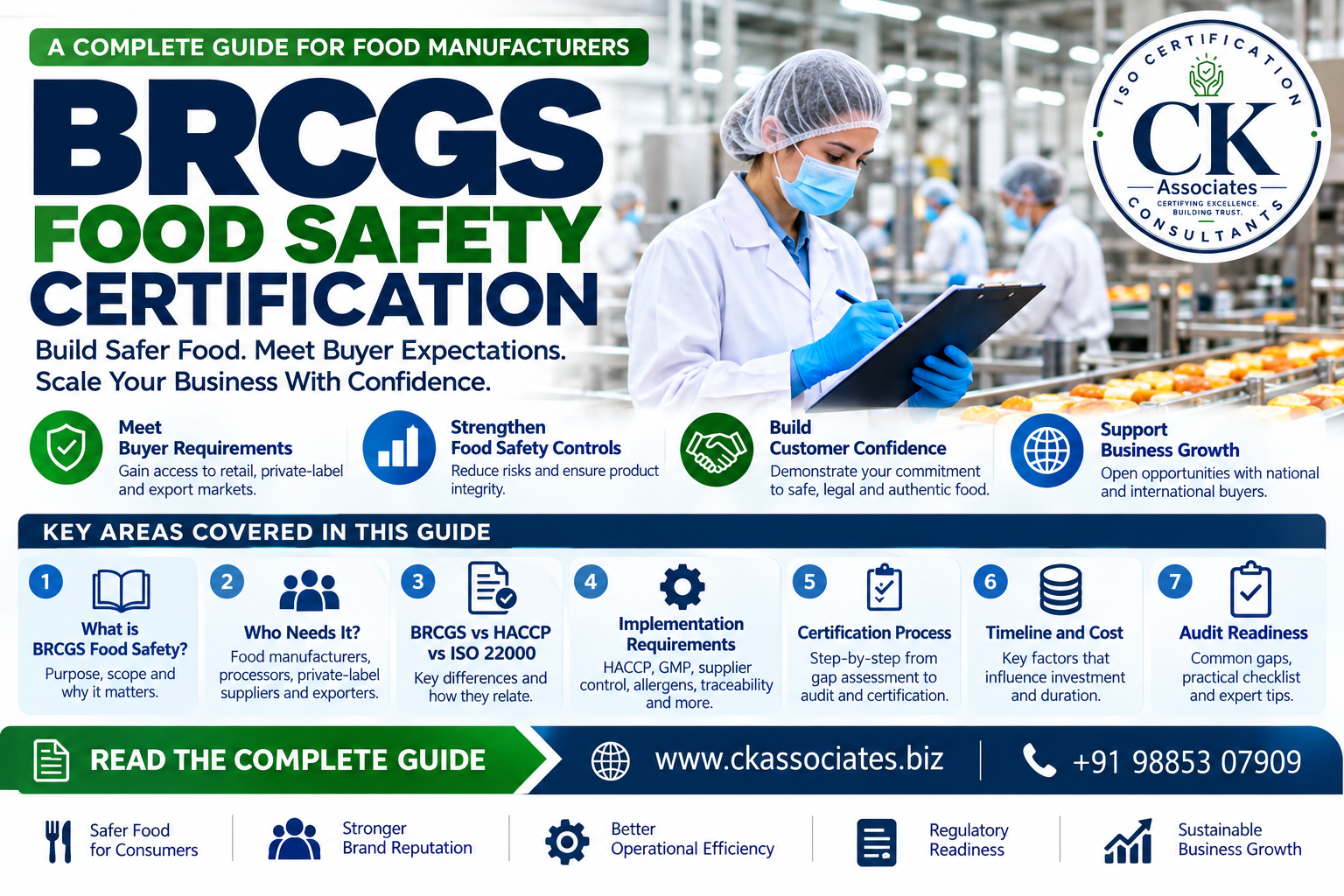
BRCGS Food Safety certification is an independent certification programme for food manufacturing, processing and packing sites that need to demonstrate effective controls over food safety, product legality, authenticity and quality. It is widely used by retailers, brand owners and food buyers when assessing suppliers. The certification process involves defining the site’s scope, assessing gaps against the applicable BRCGS standard, implementing the required controls, training employees, conducting internal audits and completing an audit through an appropriately approved certification body. For Indian food businesses, BRCGS can be important when supplying international customers, private-label brands or buyers who specify this certification. As of October 2026, Food Safety Issue 9 remains the published standard, and the applicable Issue 9 position statements must also be considered. BRCGS certification is not achieved simply by preparing documents: the food safety system must operate effectively and be supported by reliable evidence.
What are the main steps to achieve BRCGS certification?
- Confirm the customer requirement, product category and certification scope.
- Obtain and review the applicable BRCGS Food Safety Standard and current position statements.
- Conduct a gap assessment against the requirements.
- Establish an effective HACCP-based food safety plan and prerequisite programmes.
- Implement site hygiene, traceability, supplier controls, allergen management and other applicable requirements.
- Train employees and maintain operational records.
- Complete internal audits, management review and corrective actions.
- Arrange the certification audit through an appropriate BRCGS-approved certification body.
- Address audit findings within the applicable protocol and achieve certification.
Key Takeaways
- BRCGS certification can be a commercial requirement for food suppliers serving retailers, brand owners and export markets.
- BRCGS Food Safety is broader than a HACCP study or a collection of food safety procedures.
- Existing ISO 22000 certification can provide a useful foundation, but it does not automatically establish BRCGS compliance.
- Effective implementation, employee competence and operational evidence matter as much as documentation.
- Food Safety Issue 9 and its applicable position statements must be checked before implementation and audit planning.
- Timelines and costs depend on site readiness, product risk, facility complexity, audit arrangements and the extent of corrective work required.
1. Introduction: Why food businesses consider BRCGS certification
Food manufacturers are increasingly expected to demonstrate that their products are safe, legal, authentic and manufactured under controlled conditions. Buyers want more than an assurance that a supplier follows good practices. They may require independent evidence that the supplier operates a structured food safety management system and can demonstrate its effectiveness.
This is where BRCGS Food Safety certification becomes relevant.
For an Indian food manufacturer, certification may be requested when entering a new export market, supplying a retail chain, manufacturing products for another brand or responding to a customer’s supplier approval requirements.
However, a business should not begin by asking only, “How quickly can we obtain the certificate?”
A more useful starting question is:
“What does our customer expect, and can our facility consistently demonstrate that our food safety controls work?”
The answer determines the implementation scope, resources, timeline and audit preparation strategy.
This guide explains the BRCGS certification process, its relationship with HACCP and ISO 22000, the major implementation areas, typical cost factors and the evidence a food business should prepare before its audit.
2. What is BRCGS Food Safety?
BRCGS is a global standards organisation whose certification programmes support product safety, legality, authenticity, quality and confidence in supply chains.
The BRCGS Global Standard Food Safety is intended for applicable food manufacturing, processing and packing sites. It provides a framework of requirements that a site must meet and demonstrate during an independent certification audit.
The standard addresses both management-system controls and practical conditions at the facility. This means a site must demonstrate that its documented procedures match its actual operations.
For example, a food manufacturer may have a written cleaning procedure. During an audit, however, the auditor may also examine cleaning records, chemical controls, employee practices, the condition of equipment and the effectiveness of the cleaning process.
A procedure alone does not prove that the process is effective.
What does BRCGS certification demonstrate?
Depending on the scope and applicable requirements, certification provides evidence that a site has been independently assessed against the BRCGS Food Safety Standard.
It supports confidence in the site’s controls for areas such as:
- Food safety and hazard management.
- Product legality and authenticity.
- Site standards, hygiene and contamination prevention.
- Supplier approval and raw-material control.
- Product specifications and process controls.
- Traceability, incident management and recall arrangements.
- Employee competence and food safety culture.
- Monitoring, verification and continual improvement.
Certification does not eliminate every food safety risk or replace applicable legal obligations. It demonstrates conformity with the applicable certification requirements within the defined scope.
3. Which version of BRCGS Food Safety applies in 2026?
As of October 2026, BRCGS Global Standard Food Safety Issue 9 remains the current published edition. Issue 10 is under development, and businesses should not assume that unpublished requirements are already mandatory.
There is an important additional consideration: BRCGS published updated Issue 9 position statements, document F926, effective from 10 August 2026.
These position statements provide binding clarifications and interpretations for applicable requirements. Sites preparing for certification or surveillance should obtain the current official standard and the latest applicable position statements.
Official resources:
- BRCGS Food Safety Help and Guidance: https://www.brcgs.com/our-standards/food-safety/help-and-guidance
- BRCGS Position Statements: https://www.brcgs.com/document-resources-position-statements/
- BRCGS update on the position statements effective 10 August 2026: https://www.brcgs.com/about-brcgs/news/2026/important-update-position-statements-effective-from-10-august-2026
Before planning an audit, confirm the applicable edition, position statements, certification protocol and any customer-specific requirements with the appropriate certification body.
4. Who needs BRCGS Food Safety certification?
BRCGS Food Safety may be relevant to food businesses whose customers require this specific certification or whose commercial strategy depends on demonstrating independently assessed food safety controls.
Potentially relevant businesses include:
Food manufacturers and processors
Businesses producing packaged foods, processed ingredients, ready-to-eat products, snacks, sauces, bakery products, confectionery, frozen foods or other products within the standard’s scope may need to evaluate BRCGS requirements.
Private-label manufacturers
Manufacturers producing food for a retailer or another company’s brand may be asked to obtain certification as part of supplier approval.
Export-oriented food businesses
An overseas buyer may specify BRCGS certification when qualifying suppliers. Requirements vary by buyer, product category, market and contractual arrangement, so the exact requirement should be confirmed before implementation begins.
Food ingredient suppliers
Businesses supplying ingredients to other manufacturers may need to demonstrate robust controls over raw materials, contamination risks, specifications and traceability.
Growing food businesses
A company expanding from local or regional distribution into larger retail or export supply chains may need to strengthen its food safety system to meet new customer expectations.
Important: BRCGS Food Safety is not automatically required for every food business. The decision should be based on customer requirements, the applicable scope, commercial objectives and the suitability of the certification programme.
5. BRCGS vs HACCP vs ISO 22000: What is the difference?
These three are related, but they are not interchangeable.
| Area | HACCP | ISO 22000 | BRCGS Food Safety |
|---|---|---|---|
| Primary purpose | Identify and control significant food safety hazards | Establish a food safety management system | Assess a food site against a detailed food safety certification standard |
| Main emphasis | Hazard analysis and control measures | Management system, communication, hazard control and continual improvement | Food safety controls, site practices, product integrity and defined audit requirements |
| Prerequisite programmes | Essential foundation | Integral to the food safety management system | Essential to effective site implementation |
| Certification | Depends on the certification scheme being used | Certification is available through applicable certification arrangements | Certification is available through the BRCGS programme and appropriate certification bodies |
| Customer acceptance | Depends on the buyer and scheme | Depends on customer and market requirements | Often specifically requested by certain retailers, brands or buyers |
Is HACCP certification mandatory for BRCGS?
An effective HACCP-based food safety plan is a fundamental part of BRCGS Food Safety implementation.
However, this does not mean that every site must hold a separate standalone HACCP certificate before it can pursue BRCGS certification. A separate certificate may be required by a particular buyer, contract or other scheme, but it should not be presented as a universal BRCGS prerequisite.
The site must demonstrate that its hazard analysis, control measures and food safety plan meet the applicable requirements.
Is ISO 22000 enough for BRCGS certification?
Not necessarily.
An organisation certified to ISO 22000 may already have useful foundations, including hazard analysis, prerequisite programmes, monitoring, verification, internal audits and management review.
But BRCGS includes its own detailed requirements and audit protocol. The organisation must assess those requirements individually and close any gaps.
For example, the business may need to strengthen its approach to site standards, product authenticity, food fraud, food defence, supplier approval, environmental monitoring, label control or other applicable requirements.
Existing certification should be treated as a foundation—not as proof that BRCGS requirements have already been met.
6. What are the main BRCGS implementation requirements?
A successful implementation project should address the applicable requirements of the standard in a coordinated way. The following areas are central to most food manufacturing readiness assessments, although the exact requirements depend on the site’s scope and product category.
6.1 Senior management commitment
Food safety cannot operate as the responsibility of the quality department alone.
Senior management needs to provide appropriate resources, define responsibilities, support training and review system performance. The business should be able to demonstrate that food safety issues receive attention and that necessary corrective actions are implemented.
Useful evidence may include assigned responsibilities, objectives, meeting records, resource decisions and management review outputs.
6.2 HACCP-based food safety plan
The site must understand its products, intended use, process flow, hazards and control measures.
A practical hazard analysis should reflect actual operations rather than copied descriptions. It should consider relevant biological, chemical, physical and allergen hazards, as well as the risks associated with ingredients, processing, packaging, storage and distribution.
The food safety team should establish appropriate control measures and determine critical control points where required by the hazard analysis and applicable methodology.
Monitoring and corrective-action arrangements must be clear enough for employees to follow during normal production and when a deviation occurs.
6.3 Prerequisite programmes and good manufacturing practices
Prerequisite programmes provide the hygienic and operational foundation for hazard control.
Relevant areas can include:
- Cleaning and disinfection.
- Personal hygiene and protective clothing.
- Pest management.
- Water and utility controls.
- Waste management.
- Equipment maintenance.
- Prevention of cross-contamination.
- Foreign-body control.
- Storage and handling practices.
- Management of chemicals and cleaning materials.
These programmes must be implemented effectively and supported by suitable monitoring and records.
6.4 Supplier approval and raw-material control
A food safety system is only as reliable as its controls over incoming materials and external suppliers.
The site should establish appropriate supplier approval, risk assessment, specifications, verification and monitoring arrangements. The level of control should reflect the material, its hazards, the supplier’s performance and the site’s own risk assessment.
For example, a business handling allergen-containing ingredients needs appropriate controls to prevent unintended cross-contact and to ensure that ingredient information is reliable.
6.5 Allergen management
Allergen management must be based on the products, ingredients, processes and applicable legal requirements.
The site should assess allergen risks, establish appropriate segregation and handling controls, verify cleaning where required, manage rework and prevent incorrect product or packaging use.
Labelling controls are particularly important because an incorrect label can create a serious consumer safety risk even if the product has been manufactured under otherwise controlled conditions.
6.6 Traceability, incident management and product recall
The site should be able to trace relevant materials and products through its supply chain in accordance with applicable requirements.
Traceability should be supported by accurate records, clear batch identification and defined responsibilities. The business should also have documented arrangements for managing incidents, product withdrawal and recall where required.
A traceability exercise or mock recall can help the site evaluate whether it can retrieve the necessary information promptly and identify affected products and materials.
The exercise should test the actual system, not merely demonstrate that a procedure exists.
6.7 Food fraud and food defence
Food fraud concerns intentional deception for economic gain, such as substitution, dilution or misrepresentation of ingredients.
Food defence addresses protection against intentional malicious contamination or interference.
These are different risks and should not be treated as identical. The business should assess relevant vulnerabilities, establish appropriate controls and maintain evidence that the assessments are reviewed when necessary.
6.8 Environmental monitoring and contamination controls
Where relevant to the product, process and risk assessment, environmental monitoring helps assess whether the facility’s hygiene controls are effective.
The programme should have a clear rationale for sampling locations, frequency, organisms or indicators, response to results and follow-up actions. A positive or adverse result should trigger an appropriate investigation and response rather than simply being filed away.
Environmental monitoring requirements and expectations depend on the site’s activities and the applicable clauses of the standard.
6.9 Product specifications, labels and process control
The business should maintain suitable product specifications and control the processes that affect safety, legality, authenticity and quality.
Relevant controls may include formulation, processing parameters, packaging, label approval, weight or quantity checks, product release and management of non-conforming products.
Where a process parameter is important to product safety, the organisation should define how it is monitored, what constitutes an unacceptable deviation and what happens when a limit is not met.
6.10 Training and food safety culture
Employees need to understand the food safety responsibilities relevant to their work.
Training should be suitable for the role, supported by appropriate records and reinforced through supervision and daily practice. The organisation should evaluate whether people actually follow the procedures, not just whether they have attended a training session.
Food safety culture is reflected in everyday decisions: reporting problems, following hygiene requirements, preventing shortcuts and escalating issues before they affect product safety.
7. Step-by-step BRCGS implementation process
A structured implementation project helps the organisation identify gaps, prioritise work and prepare evidence before the certification audit.
Step 1: Confirm scope and customer expectations
Identify the site, products, processes, activities and applicable product category. Confirm the specific customer requirement and whether additional customer or legal obligations apply.
Scope decisions should be discussed with an appropriate certification body where necessary.
Step 2: Obtain the current standard and applicable guidance
Use the official BRCGS documentation, current position statements and relevant guidance. Avoid building an implementation programme solely around outdated checklists or generic templates.
Step 3: Conduct a gap assessment
Compare the existing food safety system and actual site practices against the applicable requirements.
Record each gap, its risk or significance, the required action, the responsible person and the target completion date.
Step 4: Prepare an implementation plan
Prioritise issues that could affect food safety, product legality, facility hygiene or the site’s ability to demonstrate conformity.
Assign resources and deadlines. A realistic plan should include time for operational changes, employee training, monitoring, verification and corrective action.
Step 5: Strengthen the food safety system
Update the HACCP-based plan, prerequisite programmes, procedures, specifications and records as required. Implement site-level controls and ensure employees understand their responsibilities.
Documentation should accurately describe the way the facility operates.
Step 6: Implement and collect evidence
Allow sufficient time for processes to operate and generate meaningful records.
Evidence may include monitoring logs, cleaning verification, supplier approval records, training records, traceability exercises, maintenance records, calibration evidence, internal audit results and corrective-action records, as applicable.
Step 7: Conduct internal audits and management review
Internal audits should assess both documented arrangements and actual implementation. Findings should be investigated, corrected and followed through.
Management review should evaluate system performance, significant issues, resources, objectives and improvement actions.
Step 8: Conduct a readiness assessment
Review outstanding gaps, verify key controls and determine whether the facility is prepared for an external audit.
A mock audit can be useful when performed by a competent person who understands the applicable standard and audit protocol.
Step 9: Arrange the certification audit
Select an appropriate BRCGS-approved certification body and agree the scope, audit arrangements and relevant dates.
The site should understand the audit process, required information, access arrangements and any applicable protocol requirements.
Step 10: Respond to audit findings
If the audit identifies non-conformities, the site must address them according to the applicable certification protocol. Responses may require correction, root-cause analysis, corrective action and objective evidence.
Certification is dependent on the applicable audit outcome and protocol—not simply on submitting documents.
8. What documents and records should a food manufacturer prepare?
There is no single document pack that suits every food manufacturing site. The required documentation depends on the standard, product category, process, risks and scope.
A readiness review may examine the following areas:
- HACCP-based food safety plan and hazard analysis.
- Product descriptions, intended use and process flow diagrams.
- Prerequisite programmes and hygiene procedures.
- Supplier approval records and raw-material specifications.
- Allergen risk assessments and relevant controls.
- Cleaning, sanitation and pest-management records.
- Maintenance, calibration and equipment checks.
- Process monitoring and product release records.
- Traceability, incident and recall arrangements.
- Training and competence records.
- Internal audit programme and findings.
- Corrective-action and root-cause records.
- Management review records.
- Food fraud and food defence assessments, where applicable.
- Relevant environmental monitoring results.
- Product specifications, label approval and change-control records.
This is an indicative list, not a substitute for reviewing the full applicable BRCGS requirements.
The objective is not to create the maximum number of documents. It is to establish a system that is complete, controlled, usable and supported by evidence.
9. How long does BRCGS certification take?
There is no universal implementation timeline.
The time required depends on the current maturity of the food safety system, the condition and complexity of the facility, the product category, available personnel, unresolved gaps and the availability of audit arrangements.
A site with a functioning ISO 22000 system and effective prerequisite programmes may have a stronger starting point than a facility that needs substantial operational changes.
However, an existing certificate does not automatically make the site ready for BRCGS.
Indicative planning ranges
The following are planning estimates for implementation—not official BRCGS deadlines or guarantees.
| Site starting point | Illustrative planning range |
|---|---|
| Mature food safety system with limited gaps | Approximately 2–3 months may be feasible |
| Existing system requiring significant upgrades | Approximately 3–6 months may be more realistic |
| Major facility, process or system deficiencies | Longer; determine after a detailed gap assessment |
The schedule should include time for implementing controls, training employees, collecting evidence, completing internal audits and addressing gaps.
The certification audit date must be planned separately with the selected certification body. Do not promise a certificate by a particular date before the site readiness and audit arrangements are understood.
10. What is the cost of BRCGS certification in India?
BRCGS certification cost varies by site and project. It is important to distinguish between implementation consultancy fees and the charges associated with the certification audit.
Factors that affect cost
1. Site size and complexity: The number of processes, production lines, shifts and areas covered can influence the amount of work required.
2. Product category and risk: Different products and operations require different controls and audit considerations.
3. Existing system maturity: A well-implemented ISO 22000 system may reduce some implementation work, while major gaps can increase the required effort.
4. Facility improvements: Repairs, equipment, zoning, hygiene facilities, monitoring systems or other operational changes may add cost.
5. Training and internal audits: Staff training, specialist support and readiness assessments may need separate budgeting.
6. Certification audit fees: These depend on the certification body’s arrangements, audit duration, travel and other applicable charges.
7. Corrective actions: Closing gaps identified during implementation or audit may require additional time and resources.
How should a business budget?
Request a scoped proposal that separates:
- Gap assessment and implementation consultancy.
- Documentation and system development.
- Training and internal audit support.
- Facility or equipment improvements, if required.
- Certification-body audit and related charges.
- Follow-up activities and corrective-action support.
This gives management a more realistic view of the total project investment.
Be cautious about offers that promise a guaranteed certificate at a fixed low price without understanding the site, products and current controls.
11. Can a company implement BRCGS if it already has ISO 9001, ISO 14001, ISO 45001, ISO 22000 and HACCP?
Yes, a company with existing management-system certifications can pursue BRCGS Food Safety if the site’s scope and other applicable conditions are suitable.
Those existing systems may provide useful foundations for documentation, management review, internal auditing, corrective action, training and food safety management.
However, BRCGS should be treated as a separate set of applicable requirements with its own certification protocol.
A gap assessment should specifically examine the BRCGS requirements that may not be fully covered by the existing systems, such as relevant site standards, product integrity controls, food fraud and food defence, traceability, environmental monitoring, label control and other applicable provisions.
The right question is not, “How many certificates does the company already hold?”
It is, “What additional requirements must this site implement and demonstrate to meet BRCGS?”
12. Common BRCGS implementation mistakes
Mistake 1: Treating BRCGS as a documentation project
A comprehensive manual cannot compensate for ineffective controls on the production floor.
Better approach: Verify that documented procedures reflect actual practices and that the site can produce evidence of implementation.
Mistake 2: Copying a generic HACCP plan
A generic hazard analysis may not reflect the site’s actual ingredients, processes, hazards and control measures.
Better approach: Develop and maintain a hazard analysis based on the real process and relevant technical knowledge.
Mistake 3: Assuming ISO 22000 automatically covers every BRCGS requirement
There is overlap, but the standards are not identical.
Better approach: Perform a clause-by-clause gap assessment against the applicable BRCGS requirements.
Mistake 4: Ignoring employee understanding
Employees may be unable to explain a procedure that exists in the documentation.
Better approach: Train people for their roles and verify competence through observation and appropriate evaluation.
Mistake 5: Failing to investigate recurring problems
Repeated cleaning failures, monitoring deviations or incomplete records may indicate that root causes have not been addressed.
Better approach: Investigate causes, implement appropriate corrective action and check whether the action was effective.
Mistake 6: Preparing for the audit only at the last minute
A system needs time to operate and generate meaningful evidence.
Better approach: Plan implementation and internal verification early enough to identify and close gaps before the external audit.
Mistake 7: Using outdated requirements
Older checklists may not reflect current interpretations or position statements.
Better approach: Use the current official standard, relevant guidance and applicable position statements.
13. BRCGS certification in Hyderabad, Telangana and India
Food manufacturers in Hyderabad and across Telangana and Andhra Pradesh may consider BRCGS when expanding into organised retail, supplying private-label brands or responding to domestic and international buyer requirements.
The commercial case depends on the target market and customer. A company should confirm whether its buyer requires BRCGS specifically, accepts another certification scheme or expects additional product- or market-specific controls.
For a Hyderabad-based manufacturer, implementation planning should consider the actual facility, raw-material suppliers, process risks, storage conditions, transport arrangements and workforce training needs.
The same principle applies to manufacturers elsewhere in India: certification readiness must be based on the site’s operations and the buyer’s requirements, not on the location alone.
CK Associates can support businesses in assessing gaps, strengthening food safety management arrangements, coordinating implementation activities and preparing for certification audits. The certification decision remains with the appropriate certification body under the applicable scheme.
14. BRCGS audit readiness checklist
Use the following questions as an initial management review. They are not an official BRCGS scoring tool and do not replace the standard’s full requirements.
Management and planning
- Have we confirmed the correct certification scope and applicable requirements?
- Has management assigned responsibilities and resources?
- Is our HACCP-based food safety plan appropriate for the actual process?
- Have we reviewed the current standard and applicable position statements?
Operational controls
- Are cleaning, hygiene and prerequisite programmes implemented effectively?
- Are suppliers and incoming materials controlled appropriately?
- Are allergen and contamination risks assessed and managed?
- Are product specifications, labels and process controls maintained?
- Are traceability and recall arrangements tested where required?
- Have we addressed relevant food fraud and food defence risks?
Evidence and improvement
- Are monitoring records accurate and complete?
- Do employees understand the procedures relevant to their roles?
- Are internal audits completed and findings followed through?
- Are root causes investigated and corrective actions verified?
- Has management reviewed performance and outstanding issues?
- Can we demonstrate that the system operates in practice?
If the business cannot answer these questions confidently, it should identify the gaps and agree on corrective actions before committing to an audit date.
15. Frequently asked questions about BRCGS Food Safety certification
What is BRCGS Food Safety certification?
It is an independent certification programme that assesses an applicable food manufacturing, processing or packing site against the BRCGS Global Standard Food Safety and its audit protocol.
Is BRCGS certification mandatory in India?
It is not a universal legal requirement for every food business in India. It may be commercially required by particular retailers, brand owners, importers or other customers. Applicable food laws and customer contracts must be considered separately.
Is HACCP required for BRCGS certification?
A suitable HACCP-based food safety plan is a fundamental requirement. A separate standalone HACCP certificate is not universally required unless an additional customer, contractual or scheme-specific requirement applies.
Can we obtain BRCGS certification without ISO 22000?
A company does not have to assume that ISO 22000 certification is a universal prerequisite for pursuing BRCGS Food Safety. It must, however, meet all applicable BRCGS requirements and demonstrate an effective food safety system.
Is ISO 22000 equivalent to BRCGS?
No. ISO 22000 and BRCGS Food Safety have different structures and requirements. Existing ISO 22000 implementation can help, but a BRCGS gap assessment remains necessary.
How long does BRCGS implementation take?
The duration depends on site readiness, operational complexity, outstanding gaps, staff availability and audit scheduling. A realistic estimate should follow a site-specific assessment.
How much does BRCGS certification cost in India?
There is no single fee for every site. The total budget depends on consultancy, training, facility improvements, implementation gaps and certification-body charges.
Which BRCGS Food Safety edition applies in October 2026?
Issue 9 remains the current published edition based on the official information reviewed for this article. Applicable Issue 9 position statements effective from 10 August 2026 should also be considered. Issue 10 is under development; confirm the latest status with BRCGS before planning an audit.
Can a small or medium-sized food manufacturer obtain BRCGS certification?
Potentially, yes, if the site and its operations fall within the programme’s scope and the business meets the applicable requirements. Readiness depends on the actual operation, not merely on company size.
Does BRCGS certification guarantee that no food safety incident will occur?
No. Certification demonstrates conformity with applicable requirements within the defined scope. Organisations must continue monitoring risks, maintaining controls and improving their food safety system.
Who conducts the BRCGS certification audit?
The audit is conducted through an appropriately BRCGS-approved certification body in accordance with the applicable scheme requirements and protocol.
Can CK Associates help with BRCGS implementation?
CK Associates can assist with gap assessment, food safety system development, implementation planning, training, internal audit support and audit readiness. The certification audit and certification decision must be handled by the appropriate certification body.
16. Conclusion: Build a food safety system that works beyond the audit
BRCGS Food Safety certification should be approached as an operational improvement and assurance project, not simply as a document-preparation exercise.
For food manufacturers, the strongest preparation begins with understanding customer expectations, reviewing the current requirements, assessing the actual facility and implementing controls that employees can consistently follow.
Existing ISO 22000 or HACCP arrangements can provide a valuable foundation, but the organisation must address the specific BRCGS requirements applicable to its products and processes.
A structured gap assessment, realistic implementation plan, effective training, reliable records and competent internal verification can help the business prepare for the certification audit.
For manufacturers in Hyderabad, Telangana, Andhra Pradesh and elsewhere in India, the first step is to establish the scope, the buyer’s expectations and the site’s current level of readiness. From there, management can make informed decisions about resources, timing and certification arrangements.
About the Author
Sirish K is the Founder & Lead ISO Consultant at CK Associates, an ISO and management-system consultancy based in Hyderabad, Telangana, India.
CK Associates supports organisations with management-system gap assessments, documentation, implementation, employee training, internal audits, audit preparation and certification coordination across applicable standards.
The firm brings over 20 years of experience and has supported more than 450 certification projects, according to its company profile.
Summary
BRCGS Food Safety certification helps applicable food manufacturing, processing and packing sites demonstrate conformity with a recognised food safety standard. In India, businesses may pursue it when required by retailers, private-label customers, importers or other buyers. Implementation involves scope confirmation, a gap assessment, a HACCP-based food safety plan, prerequisite programmes, supplier and allergen controls, traceability, training, internal audits and preparation for an independent certification audit. Existing ISO 22000 and HACCP systems can provide a foundation but do not automatically establish BRCGS conformity. As of October 2026, Food Safety Issue 9 remains the published edition, and the applicable position statements effective from 10 August 2026 must also be considered. Timelines and costs depend on the facility, scope, gaps and audit arrangements.