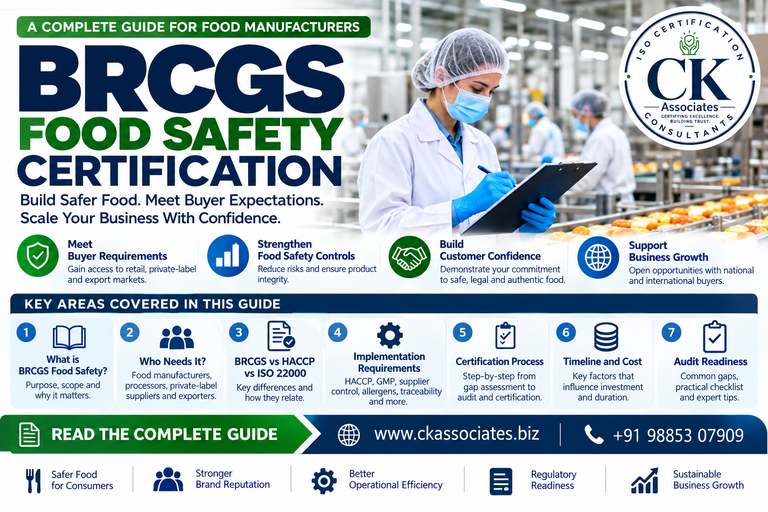

Food manufacturers often struggle to decide between BRCGS, ISO 22000, and HACCP certification. While all three improve food safety, they serve different business objectives. HACCP is a preventive methodology for identifying and controlling food safety hazards. ISO 22000 builds on HACCP by establishing a complete Food Safety Management System (FSMS) with leadership, risk management, internal audits, and continual improvement. BRCGS Global Standard Food Safety is a retailer-focused certification recognized by the Global Food Safety Initiative (GFSI), emphasizing product safety, quality, operational controls, traceability, food fraud prevention, and supplier management. The best certification depends on whether your organization serves domestic markets, exports products, supplies retailers, or manufactures private-label foods.
Should Food Businesses Choose BRCGS, ISO 22000 or HACCP?
There is no single certification that suits every food business. HACCP provides the foundation for hazard control, ISO 22000 establishes a comprehensive Food Safety Management System, and BRCGS delivers retailer-focused food safety and quality requirements recognized by major international buyers. Businesses should select the certification based on customer expectations, export goals, regulatory requirements, and market strategy.
If you operate a food business:
✅ HACCP controls food safety hazards.
✅ ISO 22000 creates a complete Food Safety Management System.
✅ BRCGS is widely accepted by retailers and export markets.
✅ FSSAI provides the legal framework for eligible food businesses in India.
✅ Growing food businesses often implement multiple certifications based on customer requirements.
Key Takeaways
- HACCP is the foundation of preventive food safety.
- ISO 22000 incorporates HACCP into a management system.
- BRCGS is one of the world’s leading retailer-recognized food safety certification schemes.
- Export-oriented manufacturers often require GFSI-recognized certification.
- Hyderabad’s growing food industry benefits from internationally recognized certifications.
- Food safety certifications improve customer confidence and market competitiveness.
- Choosing the right certification depends on your business model and target market.
- Integrated food safety systems reduce operational risks and support continual improvement.
Introduction
Food safety has become one of the most critical success factors for modern food businesses.
Consumers no longer evaluate food products solely on taste or price. They expect safe manufacturing practices, consistent product quality, transparent supply chains, and internationally recognized food safety standards.
At the same time, retailers, exporters, e-commerce platforms, institutional buyers, and multinational companies increasingly require suppliers to demonstrate robust food safety systems before awarding contracts.
This has created a common question among food business owners:
Should we implement HACCP, ISO 22000, or BRCGS?
The answer depends on your business objectives, customer requirements, export plans, and market strategy.
Each certification serves a different purpose while sharing the common goal of producing safe food.
This comprehensive guide explains:
- What BRCGS is
- What ISO 22000 is
- What HACCP is
- Key differences between them
- Which certification suits different businesses
- How Hyderabad food companies can gain a competitive advantage through internationally recognized food safety certifications
Why Food Safety Certifications Matter More Than Ever
Today’s food industry operates in an environment of increasing expectations.
Customers expect:
- Safe food
- Consistent quality
- Product traceability
- Transparent supply chains
- Responsible sourcing
- Regulatory compliance
- Reliable manufacturers
Retailers expect suppliers to demonstrate structured food safety controls.
Export markets increasingly require internationally recognized food safety certifications.
Investors and business partners also evaluate operational maturity before entering commercial relationships.
Food safety certifications provide independent assurance that organizations have implemented systematic controls to protect consumers and maintain product quality.
What is BRCGS?
BRCGS (Brand Reputation through Compliance Global Standards) is one of the world’s leading food safety certification schemes.
Originally developed by the British Retail Consortium (BRC), the standard has evolved into a globally recognized certification program used by manufacturers supplying supermarkets, retailers, wholesalers, importers, and export markets.
Unlike basic compliance programs, BRCGS establishes detailed requirements covering:
- Food Safety
- Product Quality
- Operational Controls
- Facility Standards
- Hygiene
- Traceability
- Supplier Approval
- Food Fraud Prevention
- Food Defense
- Product Authenticity
- Risk Management
BRCGS certification demonstrates that an organization has implemented internationally recognized controls that meet the expectations of major retail customers.
Evolution of BRCGS
The BRC Global Standard for Food Safety was originally created to help retailers ensure consistent food safety throughout their supply chains.
Over time, the standard evolved into BRCGS Global Standard Food Safety, expanding beyond the United Kingdom to become one of the most widely accepted certification schemes globally.
Today, BRCGS certification is recognized across:
- Europe
- North America
- Asia
- Australia
- Middle East
- Africa
Many global retailers and private-label brands require suppliers to hold BRCGS certification or another GFSI-recognized certification.
What is HACCP?
HACCP stands for Hazard Analysis and Critical Control Points.
It is a preventive food safety methodology designed to identify, evaluate, and control biological, chemical, and physical hazards during food production.
Instead of relying on final product inspection, HACCP focuses on preventing hazards before they occur.
The seven HACCP principles include:
- Conduct Hazard Analysis
- Identify Critical Control Points (CCPs)
- Establish Critical Limits
- Monitor CCPs
- Define Corrective Actions
- Verify the HACCP System
- Maintain Documentation
HACCP forms the scientific foundation for many modern food safety standards, including ISO 22000.
What is ISO 22000?
ISO 22000 is an internationally recognized Food Safety Management System (FSMS) standard published by the International Organization for Standardization (ISO).
It combines:
- HACCP Principles
- Risk-Based Thinking
- Leadership
- Communication
- Prerequisite Programs (PRPs)
- Operational PRPs (OPRPs)
- Internal Audits
- Management Reviews
- Continual Improvement
Unlike HACCP alone, ISO 22000 integrates food safety into the organization’s overall management system.
This enables businesses to systematically manage food safety risks while continually improving organizational performance.
Who Should Implement BRCGS?
BRCGS is particularly valuable for:
- Food Manufacturers
- Private Label Manufacturers
- Exporters
- Supermarket Suppliers
- Beverage Manufacturers
- Dairy Companies
- Bakery & Confectionery Businesses
- Meat & Poultry Processors
- Frozen Food Manufacturers
- Ready-to-Eat Food Producers
- Ready-to-Cook Manufacturers
- Food Packaging Companies
Organizations supplying major retailers often choose BRCGS because it aligns with retailer expectations and global supply chain requirements.
Why Hyderabad Food Businesses Should Consider BRCGS
Hyderabad has emerged as one of India’s fastest-growing food manufacturing and food innovation hubs.
The region continues to see rapid expansion in:
- Food Processing Industries
- Cloud Kitchens
- Packaged Food Manufacturers
- Millet-Based Food Startups
- Organic Food Brands
- Ready-to-Eat Manufacturers
- Ready-to-Cook Companies
- Central Kitchens
- Bakery & Confectionery Businesses
- Food Exporters
- D2C Food Brands
As competition increases, food businesses need more than regulatory compliance—they need internationally recognized certifications that build trust with customers, retailers, and export markets.
BRCGS certification can help organizations demonstrate a commitment to food safety, quality, and operational excellence while opening doors to larger domestic and international opportunities.
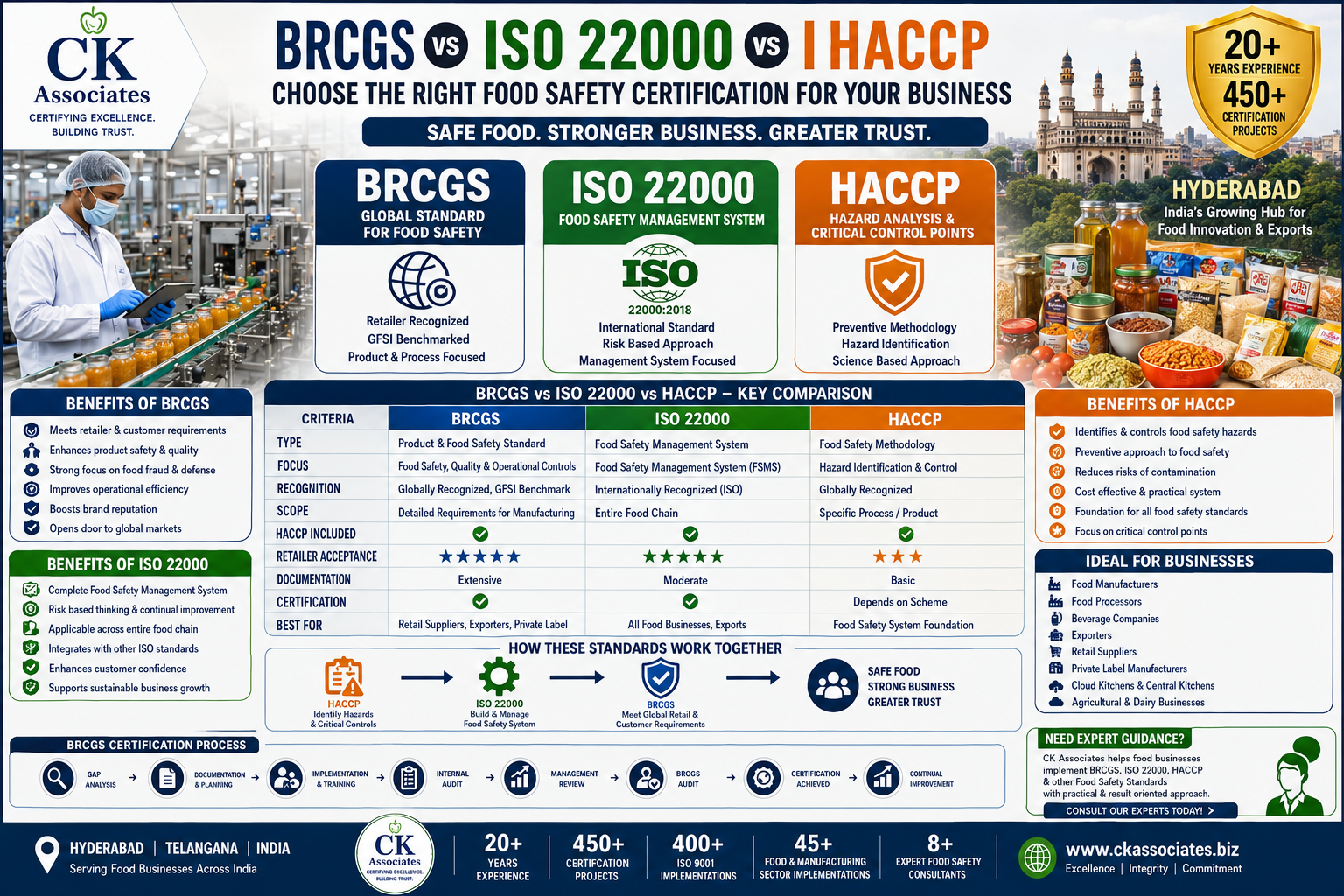
BRCGS vs ISO 22000 vs HACCP – Detailed Comparison
Choosing the right food safety certification is one of the most important strategic decisions for any food business. While HACCP, ISO 22000, and BRCGS all focus on food safety, they differ significantly in scope, structure, customer acceptance, and market expectations.
Understanding these differences helps organizations invest in the certification that best aligns with their business goals.
Understanding the Food Safety Certification Hierarchy
The relationship between these three standards can be visualized as a progression.
HACCP → ISO 22000 → BRCGS
- HACCP establishes scientific hazard control.
- ISO 22000 builds a complete Food Safety Management System around HACCP.
- BRCGS adds retailer-specific operational controls, product quality requirements, food fraud prevention, food defense, and supplier management.
Rather than competing standards, they represent increasing levels of food safety maturity.
What Makes BRCGS Different?
Many organizations assume BRCGS is simply another ISO standard.
It is not.
BRCGS was developed specifically to satisfy retailer requirements.
The standard places strong emphasis on:
- Product Safety
- Product Quality
- Operational Excellence
- Factory Standards
- GMP Compliance
- Hygiene Practices
- Food Fraud Prevention
- Food Defense
- Supplier Management
- Traceability
- Product Authenticity
This makes BRCGS particularly attractive for manufacturers supplying supermarkets and global retailers.
What Makes ISO 22000 Different?
ISO 22000 follows the ISO Harmonized Structure used by:
- ISO 9001
- ISO 14001
- ISO 45001
- ISO 27001
- ISO 42001
This allows organizations to build a single Integrated Management System.
ISO 22000 emphasizes:
- Leadership
- Risk-Based Thinking
- Organizational Context
- Communication
- Food Safety Objectives
- Internal Audits
- Management Review
- Continual Improvement
Unlike BRCGS, ISO 22000 focuses more on management systems than retailer-specific operational requirements.
What Makes HACCP Different?
HACCP is not a complete management system.
Instead, it is a preventive methodology designed to identify and control food safety hazards before they affect consumers.
It concentrates on:
- Hazard Identification
- Critical Control Points
- Monitoring
- Corrective Actions
- Verification
- Documentation
Most international food safety standards incorporate HACCP because it provides the scientific foundation for preventive food safety management.
GFSI Recognition Explained
One of the most common questions asked by exporters is:
“What is GFSI?”
The Global Food Safety Initiative (GFSI) is an international benchmarking organization that recognizes food safety certification schemes meeting globally accepted requirements.
Many multinational retailers and international buyers require suppliers to hold a GFSI-recognized certification.
Examples include:
- BRCGS
- FSSC 22000
- SQF
- IFS
- GlobalG.A.P. (for relevant sectors)
This recognition reduces duplicate supplier audits and increases confidence across global supply chains.
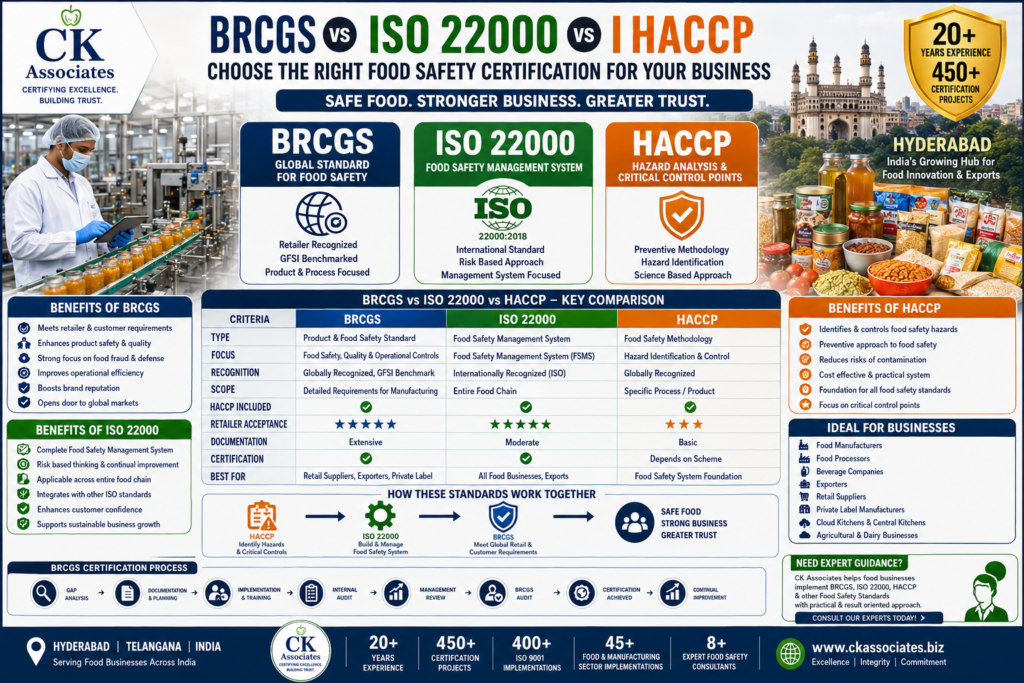
Comparison Table – BRCGS vs ISO 22000 vs HACCP
| Feature | BRCGS | ISO 22000 | HACCP |
|---|---|---|---|
| Standard Type | Retail Food Safety Standard | Food Safety Management System | Food Safety Methodology |
| Global Recognition | Excellent | Excellent | Excellent |
| GFSI Recognition | Yes | Through FSSC 22000 certification | Depends on certification scheme |
| Retail Acceptance | Excellent | High | Moderate |
| Export Acceptance | Excellent | High | Moderate |
| Product Quality Focus | Strong | Moderate | Limited |
| Food Fraud Controls | Comprehensive | Basic | Not Covered |
| Food Defense | Comprehensive | Basic | Not Covered |
| Supplier Management | Extensive | Moderate | Limited |
| Leadership Requirements | Yes | Yes | No |
| Internal Audits | Mandatory | Mandatory | Recommended |
| Management Review | Mandatory | Mandatory | Limited |
| Continual Improvement | Yes | Yes | Limited |
Comparison Table – Which Certification Fits Your Business?
| Business Type | HACCP | ISO 22000 | BRCGS |
| Home Food Business | ✔ | Optional | No |
| Bakery | ✔ | ✔ | Optional |
| Restaurant | ✔ | ✔ | No |
| Cloud Kitchen | ✔ | ✔ | Optional |
| Food Startup | ✔ | ✔ | As Business Grows |
| Packaged Food Manufacturer | ✔ | ✔ | Recommended |
| Food Exporter | ✔ | ✔ | Highly Recommended |
| Retail Supplier | ✔ | ✔ | Preferred |
| Private Label Manufacturer | ✔ | ✔ | Essential in Many Cases |
| Large Food Manufacturer | ✔ | ✔ | Strongly Recommended |
Comparison Table – Business Benefits
| Business Objective | HACCP | ISO 22000 | BRCGS |
| Improve Food Safety | ★★★★★ | ★★★★★ | ★★★★★ |
| Improve Quality | ★★★ | ★★★★ | ★★★★★ |
| Retail Acceptance | ★★ | ★★★★ | ★★★★★ |
| Export Readiness | ★★★ | ★★★★ | ★★★★★ |
| Customer Confidence | ★★★ | ★★★★ | ★★★★★ |
| Operational Standardization | ★★★ | ★★★★★ | ★★★★★ |
| Brand Reputation | ★★★ | ★★★★ | ★★★★★ |
Core Requirements of BRCGS
The latest BRCGS Food Safety Standard includes comprehensive requirements covering:
Senior Management Commitment
Leadership must actively support food safety culture.
HACCP Plan
A validated HACCP system must be implemented.
Food Safety & Quality Management System
Organizations should maintain documented procedures, policies, records, and verification activities.
Site Standards
Requirements include:
- Facility design
- Cleaning
- Pest control
- Waste management
- Maintenance
- Environmental controls
Product Control
Includes:
- Allergen management
- Product testing
- Label verification
- Packaging controls
Process Control
Organizations must monitor manufacturing processes to ensure product safety and consistency.
Personnel
Employee hygiene, competence, training, and protective clothing requirements are clearly defined.
ISO 22000 Framework Explained
ISO 22000 combines management system principles with food safety controls.
Major elements include:
- Organizational Context
- Leadership
- Planning
- Support
- Operation
- Performance Evaluation
- Improvement
Operational controls include:
- PRPs
- OPRPs
- HACCP
- Emergency Preparedness
- Traceability
- Withdrawal & Recall
- Communication
HACCP Principles Explained
The seven internationally recognized HACCP principles remain the backbone of preventive food safety.
Principle 1
Conduct Hazard Analysis
Principle 2
Determine Critical Control Points (CCPs)
Principle 3
Establish Critical Limits
Principle 4
Monitor Critical Control Points
Principle 5
Define Corrective Actions
Principle 6
Verify the HACCP System
Principle 7
Maintain Documentation
Why Food Exporters Prefer BRCGS
Many global retailers prefer BRCGS because it provides:
- Consistent audit methodology
- Detailed operational requirements
- Strong supplier management
- Product authenticity controls
- Food fraud prevention
- Food defense requirements
- Comprehensive traceability
These features increase confidence throughout international supply chains.
Hyderabad – A Growing Hub for Food Manufacturing
Hyderabad has become one of India’s fastest-growing food manufacturing ecosystems.
Major sectors include:
- Food Processing
- Beverage Manufacturing
- Dairy
- Bakery
- Ready-to-Eat Foods
- Millet Products
- Frozen Foods
- Organic Foods
- Nutraceuticals
- Export-Oriented Manufacturing
As competition increases, certifications such as ISO 22000 and BRCGS help businesses differentiate themselves through internationally recognized food safety practices.
Key Industry Statistics
Food Processing Growth
India’s food processing sector continues to grow due to increasing domestic consumption, organized retail expansion, and export demand.
Why it matters: Businesses with robust food safety systems are better positioned to participate in this growth.
Retail Expectations
Major retail chains increasingly expect suppliers to demonstrate structured food safety management and traceability.
Why it matters: Certifications strengthen supplier credibility.
Export Opportunities
Global food trade continues to expand, with many buyers expecting internationally recognized food safety certifications.
Why it matters: Export readiness depends not only on product quality but also on documented food safety management.
Real-World Implementation Example
Organization
A Hyderabad-based ready-to-eat food manufacturer supplying supermarkets and export markets.
Challenge
The company already maintained HACCP-based controls but received requests from international buyers for a more comprehensive certification accepted by global retailers.
CK Associates Solution
- Gap Analysis
- Documentation Development
- HACCP Validation
- GMP Improvements
- Employee Training
- Internal Audits
- Management Review
- Certification Readiness Support
Outcome
The organization strengthened its food safety management system, improved customer confidence, enhanced audit preparedness, and expanded opportunities with organized retail and export customers.
Lessons Learned
Food safety certification should be viewed as a strategic investment rather than a compliance exercise. Organizations that adopt internationally recognized standards improve operational discipline, customer trust, and long-term competitiveness.
Why Trust This Guidance?
Food safety certifications require practical implementation experience, regulatory understanding, and industry knowledge.
CK Associates has supported organizations across food manufacturing, processing, restaurants, cloud kitchens, bakeries, dairy, beverage production, packaged foods, and export-oriented industries with internationally recognized food safety management systems.
CK Associates Authority
✅ 20+ Years Experience
✅ 450+ Certification Projects
✅ 400+ ISO 9001 Implementations
✅ HACCP & Food Safety Specialists
✅ Integrated Management System Experts
✅ Practical Implementation Approach
Our focus is not just certification—we help organizations build sustainable food safety systems that improve operational performance and strengthen customer confidence.
About the Author
Sirish K
Founder & Lead ISO Consultant – CK Associates
With over 20 years of experience and 450+ certification projects, Sirish K specializes in Food Safety Management Systems, HACCP, ISO 22000, Integrated Management Systems, and business process improvement.
He has worked with food manufacturers, exporters, restaurants, cloud kitchens, packaged food companies, and processing industries to implement practical food safety solutions that support compliance, operational excellence, and sustainable growth.
<h2>About the Author</h2>

<p><strong>Sirish K</strong> is the Founder & Lead ISO Consultant at CK Associates. With over 20 years of experience and 450+ certification projects completed, he specializes in ISO 9001, ISO 22000, HACCP, ISO 27001, ISO 27701, ISO 42001, ISO 14001, ISO 45001, ISO 22301 and Integrated Management Systems.</p>

<p><a href="https://ckassociates.biz/sirish-k/">View Full Author Profile</a></p>
Frequently Asked Questions (FAQ)
1. What is BRCGS Certification?
BRCGS (Brand Reputation through Compliance Global Standards) is an internationally recognized food safety and quality certification scheme designed primarily for food manufacturers supplying retailers, supermarkets, private-label brands, and export markets. It is benchmarked by the Global Food Safety Initiative (GFSI).
2. Is BRCGS better than ISO 22000?
Neither certification is universally “better.” The right choice depends on your business objectives.
- BRCGS is ideal for organizations supplying retailers, supermarkets, and export markets.
- ISO 22000 is suitable for organizations seeking an internationally recognized Food Safety Management System that integrates with other ISO standards.
Many export-oriented manufacturers implement both ISO 22000 (or FSSC 22000, depending on customer requirements) and BRCGS to satisfy different market expectations.
3. Is HACCP enough for food manufacturing?
HACCP provides the scientific foundation for food safety by identifying and controlling hazards. However, many retailers and international buyers expect a broader Food Safety Management System or a GFSI-recognized certification scheme.
4. Who should implement BRCGS?
BRCGS is recommended for:
- Food Manufacturers
- Beverage Manufacturers
- Dairy Companies
- Bakery & Confectionery Businesses
- Ready-to-Eat Food Manufacturers
- Ready-to-Cook Manufacturers
- Food Exporters
- Private Label Manufacturers
- Supermarket Suppliers
5. Is BRCGS recognized globally?
Yes.
BRCGS is one of the world’s most widely accepted GFSI-benchmarked certification schemes and is recognized by retailers, importers, distributors, and multinational food companies across numerous countries.
6. Can ISO 22000 and BRCGS be implemented together?
Yes.
Many organizations implement ISO 22000 to establish a comprehensive Food Safety Management System and pursue BRCGS certification to satisfy retailer and export market requirements.
7. What is GFSI?
The Global Food Safety Initiative (GFSI) benchmarks food safety certification schemes against internationally recognized criteria, helping retailers and buyers accept trusted certification programs across global supply chains.
8. Does BRCGS include HACCP?
Yes.
A validated HACCP plan is a core requirement within the BRCGS Food Safety Standard. Organizations must demonstrate effective hazard analysis and control as part of certification.
9. How long does BRCGS implementation take?
Implementation depends on the organization’s size and existing systems.
Typical timelines:
- Small Food Manufacturer: 3–4 months
- Medium Organization: 4–6 months
- Large Manufacturing Facility: 6–9 months
10. Can restaurants obtain BRCGS Certification?
BRCGS Food Safety is primarily intended for food manufacturing and processing organizations. Restaurants and cloud kitchens typically benefit more from HACCP or ISO 22000, depending on customer and business requirements.
11. Which certification is best for exporters?
Export requirements vary by customer and destination market.
Many international buyers prefer suppliers to hold GFSI-recognized certification such as BRCGS, while others may accept different food safety certification schemes depending on contractual requirements.
12. Why are Hyderabad food manufacturers adopting international certifications?
Hyderabad has become one of India’s leading food manufacturing and food processing hubs.
International certifications help businesses:
- Improve customer confidence
- Expand exports
- Meet retailer expectations
- Enhance operational consistency
- Strengthen brand reputation
13. Can BRCGS improve retailer acceptance?
Yes.
Many supermarket chains and private-label buyers recognize BRCGS because it provides comprehensive controls for food safety, product quality, traceability, food fraud prevention, and operational excellence.
14. How can CK Associates help?
CK Associates provides:
- Food Safety Gap Analysis
- HACCP Implementation
- ISO 22000 Consulting
- BRCGS Readiness Support
- Documentation Development
- Employee Training
- Internal Audits
- Certification Preparation
- Integrated Management System Consulting
15. Which certification should a growing food startup choose?
The appropriate certification depends on the business model, target customers, and growth plans.
A typical progression may involve:
- FSSAI compliance (where applicable)
- HACCP implementation
- ISO 22000 certification
- BRCGS readiness for businesses supplying retailers or export markets
Summary
BRCGS, ISO 22000, and HACCP are complementary food safety frameworks that address different business needs. HACCP is a preventive methodology for controlling food safety hazards. ISO 22000 builds a comprehensive Food Safety Management System using HACCP, leadership, risk management, and continual improvement. BRCGS is a GFSI-benchmarked certification widely accepted by retailers and export markets, with detailed requirements for food safety, quality, traceability, supplier management, food fraud prevention, and operational controls. Organizations should select the most appropriate certification based on customer requirements, export goals, and long-term business strategy.