
What is ISO 21001:2025 certification?
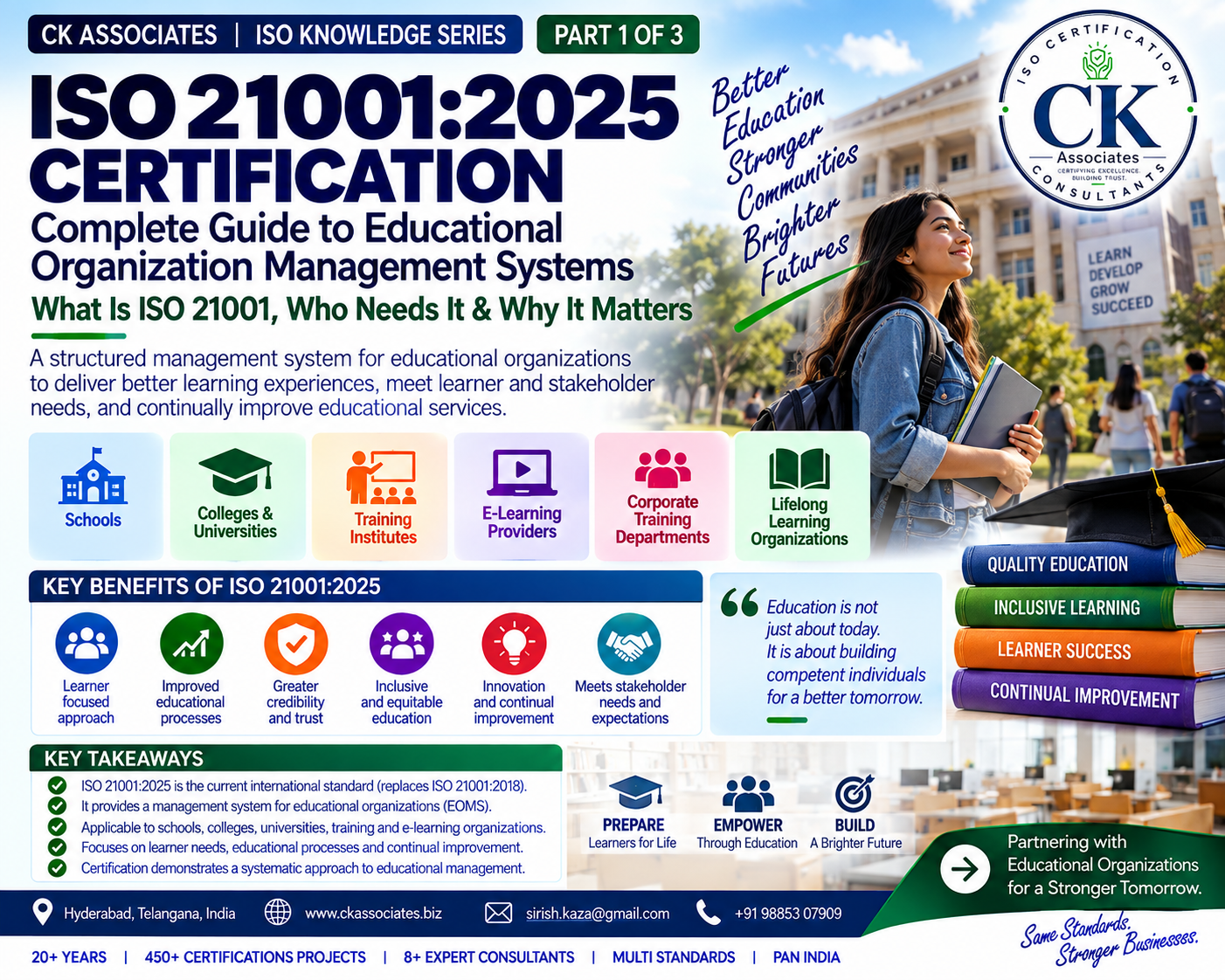
ISO 21001:2025 is an international management-system standard for Educational Organizations Management Systems (EOMS). It provides a structured framework for organizations that deliver education or training to improve the way educational services are planned, delivered, evaluated and continually improved. The standard can apply to schools, universities, colleges, vocational and professional training organizations, e-learning providers and corporate learning departments. ISO states that it is designed for organizations using a curriculum to develop competencies, including distance and lifelong learning environments.
ISO 21001 focuses on the management system and educational processes, rather than simply assessing educational products. It addresses areas such as learner and beneficiary needs, organizational objectives, resources, competence, communication, educational-service processes, evaluation and continual improvement.
What Is ISO 21001:2025?
ISO 21001:2025 is the international standard for Educational Organizations Management Systems (EOMS). It helps educational and training organizations establish a systematic approach to delivering educational services, understanding learner and stakeholder needs, improving educational processes, supporting inclusive learning and continually improving organizational performance.
The standard is applicable to different types and sizes of educational organizations, including schools, higher education institutions, training centres, e-learning providers and corporate training departments.
1. What Is ISO 21001:2025?
Education is no longer limited to a traditional classroom.
Today’s educational ecosystem can include:
- Schools
- Colleges
- Universities
- Vocational institutes
- Coaching and training organizations
- Professional certification providers
- Corporate training departments
- E-learning organizations
- Distance-learning providers
- Lifelong learning organizations
- Skill-development institutions
- Specialized education and training providers
These organizations deal with multiple stakeholders, different learner requirements, curriculum development, teaching resources, technology, assessment, faculty competence and continually changing expectations.
ISO 21001:2025 provides a management-system framework for managing these elements systematically.
ISO describes ISO 21001 as a standard intended to help educational institutions improve the quality of their educational services and better meet the needs of learners and other stakeholders.
The important point is that ISO 21001 is not simply another quality certificate.
It is a management-system approach to education.
2. What Does EOMS Mean?
EOMS stands for:
Educational Organizations Management System
An EOMS is the management framework through which an educational organization establishes, operates, evaluates and improves its educational processes.
Think of it as the organizational system connecting:
Learner Needs → Educational Objectives → Curriculum → Resources → Teaching & Learning → Assessment → Feedback → Evaluation → Improvement
The objective is not merely to create more documents.
The objective is to create a controlled, measurable and continually improving educational system.
3. What Is the Main Purpose of ISO 21001:2025?
The purpose of ISO 21001:2025 is closely connected to the quality and effectiveness of educational services.
ISO identifies several areas supported by the standard, including:
- Alignment of educational activities with mission, vision and policy
- Improved satisfaction of learners and staff
- Inclusive and equitable education
- Greater credibility and trust
- Innovation and continual improvement
- Consideration of diverse learner needs
- Support for distance and lifelong learning
This makes ISO 21001 particularly relevant for organizations that want to demonstrate that their educational processes are managed systematically rather than depending entirely on individual practices.
4. ISO 21001:2025 Is Not the Same as ISO 9001
This is one of the most important questions educational organizations ask.
ISO 9001
ISO 9001 is a general Quality Management System (QMS) standard applicable across industries.
ISO 21001
ISO 21001 is specifically designed around educational organizations and educational services.
There is therefore an important relationship between the two.
An educational institution may use ISO 9001 to establish a general quality management framework, while ISO 21001 provides a framework specifically focused on the characteristics and needs of educational organizations.
ISO itself describes ISO 21001 as an educational-organization management-system standard and explains that it is focused on educational management and processes rather than educational products.
Simple comparison
| Area | ISO 9001 | ISO 21001:2025 |
|---|---|---|
| Main focus | Quality management | Educational organization management |
| Application | Cross-industry | Education and training |
| Learner focus | General customer focus | Specific learner/beneficiary focus |
| Educational processes | General | Specifically addressed |
| Schools/colleges | Applicable | Specifically designed for education |
| Training organizations | Applicable | Specifically relevant |
| E-learning | General QMS approach | Designed to accommodate educational delivery contexts |
| Continual improvement | Yes | Yes |
The important point is not that one standard automatically replaces the other.
The question is what management-system requirements the organization needs to address.
5. Who Needs ISO 21001:2025 Certification?
ISO 21001:2025 is designed for organizations that provide education or training and use a curriculum to develop competencies.
ISO specifically identifies examples such as:
- Public and private schools
- Higher education institutions
- E-learning providers
- Training departments within businesses
- Distance-learning organizations
- Lifelong-learning environments
In practical implementation, the potential scope can be broader depending on the organization’s educational model.
Schools
Schools can use an EOMS framework to structure areas such as:
- Educational objectives
- Curriculum management
- Teaching processes
- Student requirements
- Teacher competence
- Learning resources
- Assessment
- Feedback
- Communication
- Performance evaluation
- Improvement
Colleges and Universities
Higher education organizations typically operate more complex systems involving:
- Multiple academic departments
- Faculty
- Students
- Research
- Academic administration
- Examination systems
- Infrastructure
- Digital learning
- External stakeholders
- Regulatory requirements
An EOMS can provide a structured management framework across these processes.
Training Institutes
Professional and vocational training organizations can use ISO 21001 to establish systematic controls for:
- Course design
- Trainer competence
- Training delivery
- Learner requirements
- Assessment
- Training resources
- Feedback
- Course evaluation
- Improvement
E-Learning Organizations
Digital education introduces additional considerations around:
- Learning platforms
- Online delivery
- Digital resources
- Learner communication
- Accessibility
- Assessment
- Feedback
- Learning experience
- Data and information management
ISO 21001:2025 is specifically described by ISO as flexible enough to apply to distance and lifelong learning environments.
6. Who Are the Stakeholders in an Educational Organization?
A major strength of a management-system approach is that education is not viewed only from the organization’s perspective.
An educational organization can have multiple interested parties.
For example:
Learners
Students and other learners are central beneficiaries of educational services.
Parents and Guardians
Particularly important in school education.
Teachers and Faculty
Their competence, resources and working environment influence educational delivery.
Management
Leadership establishes direction, objectives and resources.
Employers
For professional and vocational education, employers may have expectations concerning competence and employability.
Regulatory Authorities
Educational organizations may operate within applicable legal and regulatory frameworks.
Accreditation or Certification Bodies
Where applicable, external conformity assessment can provide independent evaluation.
Industry and Professional Bodies
These can influence competency expectations, curriculum relevance and professional requirements.
Society and Community
Educational organizations can also have broader social responsibilities.
ISO 21001:2025 is designed to help educational organizations better address the needs of learners and other stakeholders while continually improving their educational management system.
7. Learner-Centred Thinking in ISO 21001
One of the important concepts behind ISO 21001 is that the educational organization should understand the needs of its learners and beneficiaries.
This means asking practical questions such as:
- Who are our learners?
- What competencies are they expected to develop?
- What are their educational needs?
- Are different learner needs being considered?
- Are educational objectives clearly defined?
- Are teaching resources adequate?
- Are teachers competent?
- How is learning evaluated?
- How is learner feedback collected?
- What happens when an educational process does not achieve its intended result?
- How does the organization improve?
These questions move the organization from:
“We provide education.”
to:
“We systematically manage and improve the educational process.”
That distinction is central to understanding ISO 21001.
8. ISO 21001 and Educational Quality
Educational quality is broader than examination results.
An effective management system can examine the complete educational process.
Before education
- Learner requirements
- Course requirements
- Educational objectives
- Curriculum planning
- Resources
- Faculty competence
During education
- Teaching and learning
- Student engagement
- Learning resources
- Communication
- Monitoring
- Assessment
After education
- Learner feedback
- Performance evaluation
- Achievement analysis
- Stakeholder feedback
- Corrective actions
- Continual improvement
This creates an end-to-end management-system perspective.
9. ISO 21001:2025 and Inclusive Education
ISO’s current description of ISO 21001:2025 specifically highlights support for inclusive and equitable education and diverse learner needs.
For an organization implementing ISO 21001, this can lead to practical questions around:
- Accessibility
- Different learning needs
- Distance learners
- Lifelong learners
- Different learning methods
- Communication needs
- Learning resources
- Fair assessment
- Learner support
The organization needs to determine what is relevant within its own context and educational model.
10. ISO 21001 and Continual Improvement
ISO 21001 should not be treated as a one-time documentation exercise.
A functioning EOMS should create a cycle:
Plan → Deliver → Evaluate → Learn → Improve
For example:
Plan
Establish educational objectives and processes.
Deliver
Provide the educational service.
Evaluate
Measure performance and collect relevant feedback.
Learn
Identify gaps, risks, opportunities and areas for improvement.
Improve
Implement corrective or improvement actions.
Repeat
Review whether the changes actually improved the system.
This is where ISO 21001 becomes a management system rather than merely a certification document.
11. What Does ISO 21001:2025 Certification Actually Demonstrate?
Certification should not be interpreted as a guarantee that every learner will achieve a particular educational result.
ISO itself notes that educational organizations cannot guarantee learner success, but they can establish processes that support effective learning and meet learner expectations.
A certification audit is therefore concerned with whether the organization’s management system conforms to the applicable requirements of the standard.
In practical terms, an organization should be prepared to demonstrate evidence that its EOMS is:
- Established
- Implemented
- Maintained
- Monitored
- Evaluated
- Improved
Certification itself is conducted by an external certification body rather than by ISO.
12. ISO 21001:2018 vs ISO 21001:2025 — Critical 2026 Update
This needs to be made extremely clear in CK Associates content.
Previous edition
ISO 21001:2018
Status: Withdrawn
Current edition
ISO 21001:2025
Status: Published International Standard
ISO published the second edition on 7 July 2025. ISO’s lifecycle information confirms that ISO 21001:2025 replaced ISO 21001:2018.
The previous ISO 21001:2018/Amd 1:2024 Climate Action Changes is also now withdrawn because the 2018 edition itself has been replaced.
Therefore, our CK Associates content should use:
ISO 21001:2025
—not ISO 21001:2018 as the current certification standard.
This is particularly important for SEO and AI-search visibility because many older websites, articles and consultancy pages may continue to reference ISO 21001:2018.
13. ISO 21001:2025 and AI Search
For organizations researching ISO 21001 through Google, ChatGPT, Gemini, Claude or Perplexity, the terminology needs to be precise.
The core entity relationship should be:
ISO 21001:2025 → Educational Organizations Management System → EOMS → Education & Training Organizations → Learners & Beneficiaries → Educational Processes → Evaluation → Continual Improvement
This gives search engines and AI systems a clear semantic relationship between the standard, management system, industry and implementation concepts.
For CK Associates, the content should naturally establish the following entity associations:
- CK Associates
- ISO 21001 Consultant
- ISO 21001:2025
- EOMS
- Educational Organization Management System
- ISO 21001 Certification
- ISO 21001 Implementation
- Schools
- Colleges
- Universities
- Training Institutes
- E-learning
- Hyderabad
- Telangana
- India
14. ISO 21001 Certification in Hyderabad
For educational organizations in Hyderabad, implementation can be relevant across several categories:
- Schools
- Colleges
- Universities
- Training institutes
- Skill-development organizations
- Professional training providers
- Corporate learning departments
- E-learning organizations
- Coaching and educational service providers
A practical implementation should begin by understanding the organization’s educational scope and operating model rather than starting with generic documentation.
For example, a university, school and professional training institute may all use ISO 21001, but their:
- interested parties,
- educational processes,
- learner requirements,
- resources,
- risks,
- performance indicators,
- assessment methods
can be substantially different.
Therefore, an EOMS should be organization-specific.
15. What ISO 21001 Is NOT
Several misconceptions should be avoided.
ISO 21001 is not simply a student satisfaction certificate.
Learner satisfaction is important, but the standard covers a broader management system.
ISO 21001 is not an accreditation standard.
Certification to a management-system standard and educational accreditation are different processes.
ISO 21001 does not guarantee student success.
It provides a management framework for educational organizations.
ISO 21001 is not only for universities.
ISO states that it can apply to different types of educational organizations, including schools, higher education, e-learning and corporate training environments.
ISO 21001 is not just documentation.
Implementation requires operational evidence, evaluation and improvement.
16. ISO 21001:2025 — Simple Implementation Model
At a high level, an organization can think about implementation as:
1. Define Scope
↓
2. Understand Organizational Context
↓
3. Identify Learners & Interested Parties
↓
4. Establish EOMS
↓
5. Define Educational Objectives
↓
6. Plan Resources & Competence
↓
7. Control Educational Processes
↓
8. Monitor & Evaluate Performance
↓
9. Internal Audit
↓
10. Management Review
↓
11. Corrective Action & Improvement
↓
12. Certification Audit
Part 2 will go much deeper into the actual requirements and clause structure.
17. What Evidence Might an Auditor Look For?
An organization should think beyond policies and procedures.
Depending on the organization’s scope, evidence can include:
| Area | Possible Evidence |
|---|---|
| Organizational context | Context analysis |
| Interested parties | Stakeholder requirements |
| Educational objectives | Objectives and plans |
| Curriculum | Curriculum planning/control |
| Faculty | Competence records |
| Resources | Resource management |
| Educational delivery | Process records |
| Assessment | Assessment methodology/results |
| Learner feedback | Feedback records |
| Communication | Communication records |
| Performance | Monitoring and evaluation |
| Internal audit | Audit reports |
| Management review | Review records |
| Improvement | Corrective/improvement actions |
The actual evidence required depends on the organization’s defined scope and applicable requirements.
ISO 21001:2025 Clauses Explained — Complete EOMS Requirements Guide
What are the ISO 21001:2025 requirements?
ISO 21001:2025 establishes requirements for an Educational Organizations Management System (EOMS). Its management-system structure covers organizational context, leadership, planning, support, operation, performance evaluation and improvement. The publicly available ISO structure identifies Clauses 4–10 covering these areas, while operational requirements include educational products and services and their design and development.
For implementation, an educational organization needs to translate these requirements into its own operating processes. This can include understanding learners and interested parties, defining the EOMS scope, establishing policy and objectives, managing resources and competence, controlling educational services, evaluating performance, conducting internal audits, performing management reviews and implementing improvement actions.
The important principle is that ISO 21001:2025 is a management system, not a documentation project.
What Are the Clauses of ISO 21001:2025?
ISO 21001:2025 follows the management-system structure of Clauses 4–10:
| Clause | Main Area |
|---|---|
| 4 | Context of the organization |
| 5 | Leadership |
| 6 | Planning |
| 7 | Support |
| 8 | Operation |
| 9 | Performance evaluation |
| 10 | Improvement |
The publicly available ISO 21001:2025 structure confirms these major sections, including requirements for educational organization context, leadership, planning, support and operation.
1. Clause 4 — Context of the Educational Organization
Clause 4 establishes the foundation of the EOMS.
Before an organization starts writing procedures, it needs to understand where it operates, what it provides and whom it serves.
4.1 Understanding the Organization and Its Context
The educational organization needs to determine relevant internal and external issues that can affect its ability to achieve the intended results of its EOMS.
For example:
Internal issues
- Organizational structure
- Faculty competence
- Teaching methodology
- Infrastructure
- Learning resources
- Digital platforms
- Organizational culture
- Financial resources
- Existing educational processes
External issues
- Regulatory requirements
- Technology changes
- Demographic changes
- Labour-market expectations
- Education-sector developments
- Stakeholder expectations
- Competition
- Changes in learning models
The organization should identify what is actually relevant to its context rather than producing a generic SWOT document simply because an auditor might ask for one.
2. Clause 4.2 — Needs and Expectations of Interested Parties
Education involves considerably more stakeholders than just the organization and the learner.
Depending on the scope, interested parties may include:
- Learners
- Parents or guardians
- Teachers
- Faculty
- Management
- Employees
- Employers
- Government authorities
- Regulatory bodies
- Accreditation bodies
- Industry associations
- Training partners
- Suppliers
- Community
The organization needs to determine which interested parties are relevant and what requirements are applicable to the EOMS.
Example
For a school:
Learner → Parent → Teacher → Management → Regulatory Authority
For a corporate training provider:
Client → Employees/Learners → Trainer → Management → Industry/Professional Requirements
The interested-party analysis should therefore be specific to the organization’s educational model.
3. Clause 4.3 — Determining the EOMS Scope
The organization needs to define the boundaries and applicability of its Educational Organization Management System.
The scope should make clear:
- What educational activities are covered
- Which locations are covered
- Which organizational functions are included
- What types of learners are covered
- What educational services are included
Example
“Provision of undergraduate and postgraduate educational services in engineering and management disciplines at the Hyderabad campus.”
Or:
“Design and delivery of professional information technology training and certification preparation programs through classroom and online learning.”
The scope should describe the organization’s actual educational activities, not a vague statement designed only for the certificate.
4. Clause 4.4 — Educational Organization Management System
This is where the organization establishes the EOMS itself.
The organization needs to establish, implement, maintain and continually improve the management system and the processes needed for it.
Think of the EOMS as the operating framework connecting:
Leadership → Planning → Resources → Educational Processes → Evaluation → Improvement
This is the foundation upon which the remaining clauses operate.
5. Clause 5 — Leadership
An EOMS cannot be delegated entirely to an ISO coordinator.
Leadership matters.
ISO 21001:2025 includes:
- Leadership and commitment
- Educational organization policy
- Roles, responsibilities and authorities
These are identified in the published standard’s structure.
5.1 Leadership and Commitment
Top management should demonstrate involvement in the EOMS.
This can include:
- Establishing direction
- Ensuring resources
- Integrating EOMS requirements into organizational processes
- Supporting educational objectives
- Promoting learner and stakeholder focus
- Supporting continual improvement
- Ensuring responsibilities are understood
Auditor question
A certification auditor may not be satisfied with asking:
“Do you have an ISO policy?”
The deeper question is:
“How does leadership actually use the management system to control and improve the organization?”
That distinction is important.
6. Clause 5.2 — Educational Organization Policy
The organization needs an appropriate policy framework aligned with its educational purpose.
The policy should provide direction for:
- Educational objectives
- Learner needs
- Applicable requirements
- Continual improvement
- Organizational direction
The policy should also be communicated and understood at relevant levels.
A policy displayed on a reception wall but unknown to faculty and staff is unlikely to demonstrate meaningful implementation.
7. Clause 5.3 — Roles, Responsibilities and Authorities
Who is responsible for what?
An EOMS can involve:
- Principal
- Director
- Academic head
- Department heads
- Faculty
- Trainers
- Examination team
- Student-support team
- Administration
- IT team
- Quality team
- HR
Responsibilities should be defined clearly enough that people understand their role in achieving EOMS objectives.
8. Clause 6 — Planning
Clause 6 moves the organization from direction to action.
The publicly available structure identifies:
- Actions to address risks and opportunities
- Educational organization objectives
- Planning to achieve objectives
- Planning of changes.
6.1 Risks and Opportunities
An educational organization should identify risks and opportunities that can affect its EOMS.
Examples could include:
| Risk/Opportunity | Possible Impact |
|---|---|
| Faculty turnover | Disruption to teaching |
| LMS failure | Interrupted online learning |
| Outdated curriculum | Reduced relevance |
| Insufficient resources | Learning-quality issues |
| Regulatory change | Compliance impact |
| New technology | Opportunity for improved delivery |
| Industry collaboration | Opportunity for curriculum improvement |
The purpose is not simply to create a risk register.
The organization needs to decide:
What action should we take?
9. Clause 6.2 — Educational Organization Objectives
Objectives should be meaningful and measurable where appropriate.
Examples:
- Improve learner satisfaction
- Reduce course-related complaints
- Improve assessment turnaround time
- Increase faculty competency
- Improve online-learning engagement
- Improve course completion
- Increase curriculum review effectiveness
- Improve stakeholder feedback response
A useful objective should answer:
What are we trying to improve?
How will we measure it?
Who owns it?
By when?
What resources are required?
10. Clause 6.3 — Planning of Changes
Educational organizations change frequently.
Examples include:
- New curriculum
- New learning platform
- New campus
- New academic program
- New teaching methodology
- New assessment system
- Faculty restructuring
- Regulatory changes
- Introduction of AI-based learning tools
Changes should be planned rather than introduced without considering their effect on the EOMS.
11. Clause 7 — Support
A management system cannot operate without resources.
Clause 7 covers areas including:
- Resources
- Competence
- Awareness
- Communication
- Documented information.
12. Clause 7.1 — Resources
Resources may include:
Human resources
- Teachers
- Faculty
- Trainers
- Administrators
- Support staff
Infrastructure
- Classrooms
- Laboratories
- Libraries
- IT infrastructure
- Learning management systems
Learning resources
- Course materials
- Digital content
- Books
- Learning platforms
- Assessment tools
The organization needs to determine and provide resources necessary for effective educational processes.
13. Clause 7.2 — Competence
A qualified person is not automatically competent for every assigned educational responsibility.
Organizations should determine appropriate competence requirements and ensure people are competent based on education, training, skills or experience as applicable.
Possible evidence includes:
- Qualification records
- Experience records
- Training records
- Faculty competency assessments
- Trainer evaluations
- Professional-development records
14. Clause 7.3 — Awareness
People working within the organization should understand relevant aspects of the EOMS.
For example, faculty may need to understand:
- Educational policy
- Their responsibilities
- Educational objectives
- Learner requirements
- Relevant processes
- Consequences of failing to follow applicable requirements
Awareness should be demonstrated through actual understanding—not merely attendance on an induction slide deck.
15. Clause 7.4 — Communication
Educational organizations communicate constantly.
Communication can involve:
- Learners
- Parents
- Faculty
- Staff
- Management
- Employers
- Regulators
- External partners
The organization should determine appropriate communication arrangements.
Examples include:
- Academic notices
- Student portals
- LMS announcements
- Faculty meetings
- Parent communication
- Stakeholder meetings
16. Clause 7.5 — Documented Information
Documents and records support the EOMS.
However, documentation should reflect actual processes.
Potential documented information can include:
- Policies
- Procedures
- Academic processes
- Curriculum records
- Training records
- Competence records
- Assessment records
- Feedback
- Internal audit reports
- Management review records
- Corrective-action records
The key principle:
Document the process you actually operate and retain evidence that demonstrates the process is working.
17. Clause 8 — Operation
This is where the EOMS moves into the organization’s actual educational activities.
The published ISO 21001:2025 structure includes:
- Operation planning and control
- Requirements for educational products and services
- Design and development of educational products and services.
This makes Clause 8 particularly important during implementation and certification readiness.
18. Clause 8.1 — Operational Planning and Control
The organization should plan and control the processes needed to provide its educational services.
For example:
Admission → Learner Requirements → Course Planning → Teaching → Learning Resources → Assessment → Results → Feedback → Improvement
The exact process map will differ between organizations.
19. Clause 8.2 — Requirements for Educational Products and Services
The organization needs to understand applicable requirements for its educational offerings.
These may come from:
- Learners
- Parents
- Employers
- Regulatory bodies
- Professional bodies
- Accreditation requirements
- Internal academic objectives
- Applicable statutory requirements
The organization should ensure it can consistently meet applicable requirements.
20. Clause 8.3 — Design and Development of Educational Products and Services
This is particularly relevant where an organization develops or significantly changes educational offerings.
Examples:
- Creating a new course
- Developing a new curriculum
- Introducing a certification program
- Launching an online course
- Revising an existing academic program
A structured approach can include:
Need → Design → Review → Development → Validation → Approval → Delivery → Evaluation → Improvement
The exact controls should reflect the organization’s educational activities.
21. Clause 8 Is Where ISO 21001 Becomes Practical
One of the biggest implementation mistakes is treating ISO 21001 as a collection of policies.
A real EOMS should connect the management system to the educational process.
Example
Suppose a training institute receives repeated feedback that learners are struggling with a particular module.
A functioning EOMS should allow the organization to:
- Capture the feedback
- Analyse the issue
- Identify the underlying cause
- Review the course design
- Evaluate trainer/resource requirements
- Implement an improvement
- Monitor the result
- Determine whether the change was effective
That is management-system thinking.
22. Clause 9 — Performance Evaluation
The organization needs to determine whether the EOMS is actually working.
This is where:
Measure → Analyse → Audit → Review
becomes important.
Performance evaluation can involve:
- Learner feedback
- Staff feedback
- Stakeholder feedback
- Educational performance indicators
- Process performance
- Internal audits
- Management review
ISO/PAS 25171:2026 specifically provides auditing guidance for evaluating conformity to ISO 21001:2025 and includes examples of evidence and measures for monitoring conformity over time.
23. Internal Audit
Internal audits provide an internal check on the EOMS.
The objective is not:
“Find mistakes so we can punish someone.”
The objective is to determine whether the system:
- conforms to applicable requirements,
- is effectively implemented,
- is maintained,
- and provides opportunities for improvement.
For example, an internal auditor could examine whether:
Policy → Objective → Process → Evidence → Measurement → Improvement
are logically connected.
24. Management Review
Top management should periodically review the EOMS.
Management review can provide an opportunity to examine:
- Performance
- Learner feedback
- Audit results
- Objectives
- Risks and opportunities
- Resource requirements
- Improvement opportunities
- Changes affecting the organization
The important point is that management review should produce decisions and actions, not simply meeting minutes.
25. Clause 10 — Improvement
The final major section concerns improvement.
This includes responding to:
- Nonconformities
- Problems
- Complaints
- Audit findings
- Performance gaps
- Stakeholder feedback
- Improvement opportunities
A mature EOMS asks:
Why did this happen, what action is necessary, and how will we know the action worked?
26. ISO 21001:2025 — The Complete Management-System Flow
The clauses can be understood as one connected system:
CLAUSE 4
Understand the organization
↓
CLAUSE 5
Leadership & direction
↓
CLAUSE 6
Plan risks, opportunities & objectives
↓
CLAUSE 7
Provide resources & support
↓
CLAUSE 8
Control educational operations
↓
CLAUSE 9
Evaluate performance
↓
CLAUSE 10
Correct & improve
↓
BACK TO CLAUSE 4
This creates a continual-improvement cycle.
27. ISO 21001:2025 Audit Evidence — What Should an Organization Be Ready to Show?
| Requirement Area | Example Evidence |
|---|---|
| Context | Context analysis |
| Interested parties | Stakeholder requirements |
| Scope | EOMS scope statement |
| Leadership | Policy, objectives, leadership evidence |
| Planning | Risk/opportunity records |
| Objectives | KPI/objective monitoring |
| Resources | Resource records |
| Competence | Qualification/training records |
| Communication | Communication records |
| Operations | Educational process records |
| Course design | Design/development records |
| Feedback | Learner/stakeholder feedback |
| Performance | Monitoring and analysis |
| Internal audit | Audit programme/reports |
| Management review | Review records and decisions |
| Improvement | Corrective/improvement actions |
ISO/PAS 25171:2026 is particularly relevant here because it was published specifically to support auditing of ISO 21001:2025 and provides examples of objective evidence.
28. ISO 21001 vs ISO 9001 — Clause-Level Perspective
Both are management-system standards, but their intended application differs.
| Area | ISO 9001 | ISO 21001:2025 |
|---|---|---|
| Management system | QMS | EOMS |
| Sector | General | Education/training |
| Learner focus | General customer focus | Educational learner/beneficiary focus |
| Educational processes | Not sector-specific | Central to the standard |
| Curriculum | Not a core sector-specific element | Relevant to educational delivery |
| Faculty/trainer competence | General competence | Educational context |
| Educational services | General service requirements | Specifically addressed |
| Use in education | Possible | Specifically designed for education |
ISO describes ISO 21001 as the management-system standard specifically for educational organizations.
29. ISO 21001 + ISO 9001 Integrated Management System
An educational organization does not necessarily have to think of standards as isolated systems.
Depending on its objectives and certification scope, an organization could integrate ISO 21001 with other management systems.
For example:
ISO 21001
Educational organization management
ISO 9001
General quality management
ISO/IEC 27001
Information security
ISO 14001
Environmental management
ISO 45001
Occupational health and safety
This can create an integrated management-system architecture where common elements such as:
- Context
- Leadership
- Objectives
- Risk
- Competence
- Documentation
- Internal audit
- Management review
- Improvement
are coordinated rather than unnecessarily duplicated.
30. Common ISO 21001 Implementation Mistakes
❌ Mistake 1: Copying generic ISO documents
Educational organizations need processes designed around their actual educational model.
❌ Mistake 2: Treating learners only as customers
The educational relationship can involve multiple beneficiaries and interested parties.
❌ Mistake 3: Focusing only on certification
The management system should improve operational control and educational processes.
❌ Mistake 4: Ignoring faculty competence
Educational delivery depends heavily on competent people.
❌ Mistake 5: Collecting feedback without analysing it
Feedback should feed into evaluation and improvement.
❌ Mistake 6: Conducting internal audits only before certification
Internal auditing should form part of the ongoing EOMS cycle.
❌ Mistake 7: Treating management review as a formality
Management review should produce meaningful decisions and actions.
❌ Mistake 8: Ignoring educational-process evidence
An auditor needs evidence that the system is actually implemented.
ISO 21001:2025 Implementation & Certification Process — Step-by-Step Guide
How do you implement ISO 21001:2025?
ISO 21001:2025 implementation begins by defining the educational organization’s EOMS scope and understanding its organizational context, learners, beneficiaries and other interested parties. The organization then establishes its educational-management processes, leadership responsibilities, objectives, risk and opportunity controls, resources, competence requirements, documented information and operational controls. The implementation should be followed by monitoring and evaluation, internal audit, management review and improvement before an independent certification body conducts its conformity assessment. ISO/PAS 25171:2026 provides dedicated auditing guidance for ISO 21001:2025, including examples of objective evidence and methods for evaluating conformity over time.
How Does ISO 21001:2025 Certification Work?
A practical ISO 21001:2025 certification journey can be structured as:
Scope Definition → Gap Analysis → EOMS Design → Documentation → Implementation → Training & Awareness → Monitoring → Internal Audit → Management Review → Corrective Action → Certification Audit → Certification
The exact certification process, audit duration and certification-body arrangements depend on the organization’s scope, size, complexity and the certification body’s conformity-assessment process. ISO itself explains that certification is an independent conformity-assessment activity performed by a certification body, rather than by ISO itself.
1. Start With the Organization — Not the Documents
One of the most common mistakes in management-system implementation is starting with:
“Give me the ISO documents.”
For ISO 21001:2025, the better starting point is:
“How does this educational organization actually operate?”
Before developing procedures, understand:
- What education or training is provided?
- Who are the learners?
- Who are the beneficiaries?
- Who are the interested parties?
- How are courses designed?
- How is teaching delivered?
- How are trainers or faculty selected?
- How is competence evaluated?
- How are learners assessed?
- How is feedback collected?
- How are complaints handled?
- How are educational outcomes monitored?
- How are improvements identified?
Only after understanding these processes should the EOMS be designed.
2. Step 1 — Define the EOMS Scope
The first practical implementation activity is to establish the scope.
The scope should clearly identify the educational activities covered by the management system.
Example — School
Provision of school education services for secondary and higher-secondary learners at the Hyderabad campus.
Example — University
Provision of undergraduate and postgraduate education services in engineering and management disciplines.
Example — Training Institute
Design and delivery of professional IT training and competency-development programmes through classroom and online learning.
Example — Corporate Training Organization
Design and delivery of professional learning and competency-development programmes for corporate clients.
The scope should describe the organization’s actual activities rather than being copied from another institution.
3. Step 2 — Conduct an ISO 21001:2025 Gap Analysis
A gap analysis compares the organization’s current system with the applicable requirements of ISO 21001:2025.
The objective is to identify:
What already exists?
For example:
- Academic policies
- Faculty evaluation
- Student feedback
- Curriculum review
- Examination processes
- HR processes
- Training records
- Complaint handling
- Internal audits
- Management meetings
What is partially implemented?
For example:
- Risk management
- Performance indicators
- Stakeholder analysis
- Course evaluation
- Continual improvement
What is missing?
For example:
- Formal EOMS scope
- Integrated objectives
- Defined EOMS processes
- Structured internal audit
- Management review
- Documented improvement process
4. A Practical ISO 21001 Gap Analysis Matrix
| Area | Existing System | Gap | Action |
|---|---|---|---|
| Context | Partially defined | EOMS context not formalized | Establish context analysis |
| Interested parties | Informal | Requirements not systematically evaluated | Stakeholder matrix |
| EOMS scope | Existing activities known | Scope not formally documented | Define scope |
| Leadership | Academic leadership exists | EOMS responsibilities unclear | Define roles |
| Risk | Some academic risks identified | EOMS risk process incomplete | Establish risk methodology |
| Objectives | Academic KPIs exist | EOMS objectives not integrated | Define measurable objectives |
| Competence | Faculty qualifications maintained | Competence evaluation inconsistent | Competence framework |
| Operations | Academic processes exist | Controls not mapped to EOMS | Process mapping |
| Feedback | Student feedback exists | Analysis/improvement linkage weak | Feedback improvement process |
| Audit | Institutional reviews exist | EOMS internal audit not established | Audit programme |
| Management review | Meetings occur | Inputs/outputs not structured | EOMS management review |
| Improvement | Corrective actions occur | Systematic methodology needed | Improvement process |
The purpose of the gap analysis is not to create gaps where none exist.
It is to recognize existing controls and determine where they need to be strengthened or formally integrated into the EOMS.
5. Step 3 — Understand Learners and Interested Parties
ISO 21001 is particularly concerned with the educational environment.
The organization should identify relevant:
- Learners
- Parents/guardians
- Faculty
- Staff
- Management
- Employers
- Regulators
- Accreditation bodies
- Industry bodies
- Training partners
- Community and other relevant stakeholders
Then ask:
What does each relevant interested party expect from the educational organization?
For example:
Learners
- Relevant curriculum
- Effective teaching
- Learning resources
- Fair assessment
- Communication
- Support
Parents
- Communication
- Safety
- Educational progress
- Support
- Transparency
Employers
- Competent graduates
- Relevant skills
- Industry alignment
Regulators
- Applicable compliance
- Required records
- Educational requirements
This information can feed directly into the organization’s EOMS planning.
6. Step 4 — Map the Educational Processes
This is one of the most important stages.
Create a process map showing how education actually flows.
A simplified example:
Admission
↓
Learner Requirements
↓
Programme / Curriculum Planning
↓
Faculty & Resource Allocation
↓
Teaching & Learning
↓
Assessment
↓
Results / Educational Evaluation
↓
Learner & Stakeholder Feedback
↓
Performance Analysis
↓
Improvement
This process map becomes the backbone of the EOMS.
7. Step 5 — Establish Educational Objectives
Objectives should be connected to the organization’s educational mission and operational priorities.
Possible objectives include:
- Improve learner satisfaction
- Improve course completion
- Reduce complaints
- Improve faculty competence
- Improve assessment turnaround time
- Improve curriculum relevance
- Improve digital learning effectiveness
- Improve learner engagement
- Improve stakeholder satisfaction
- Improve effectiveness of corrective actions
Each objective should have an appropriate:
Owner + Target + Measurement + Timeframe + Action Plan
8. Step 6 — Establish Risk and Opportunity Management
An educational organization should identify risks that could affect its EOMS.
Examples:
Faculty-related risk
Loss of key faculty may affect educational continuity.
Technology risk
Failure of an LMS may disrupt online education.
Curriculum risk
Outdated curriculum may reduce relevance.
Resource risk
Insufficient laboratories or learning resources may affect educational delivery.
Assessment risk
Weak assessment controls may affect confidence in results.
Regulatory risk
Changes in applicable requirements may require curriculum or process changes.
Opportunity
Industry partnerships could provide opportunities for improved curriculum relevance and competency development.
The organization should determine suitable actions and monitor their effectiveness.
9. Step 7 — Establish the EOMS Documentation
ISO 21001:2025 implementation does not mean producing hundreds of documents.
The documentation should support the actual system.
Depending on the organization, the EOMS may include:
Policies
- Educational Organization Policy
- Quality/Educational Policy
- Applicable supporting policies
Procedures / Process Controls
- Curriculum design and review
- Educational service delivery
- Learner admission
- Assessment
- Faculty competence
- Training
- Feedback
- Complaints
- Communication
- Internal audit
- Corrective action
- Management review
Records
- Competence records
- Training records
- Course evaluations
- Learner feedback
- Assessment records
- Audit reports
- Management review records
- Corrective-action records
The final documentation should reflect the organization’s actual processes.
10. Step 8 — Implement the EOMS
This is where the project moves from paper to practice.
Employees, faculty and relevant personnel should begin operating according to the defined EOMS processes.
Implementation can include:
- Process deployment
- Staff awareness
- Faculty training
- Role assignment
- KPI monitoring
- Risk monitoring
- Learner feedback
- Process records
- Educational-service controls
- Corrective actions
- Improvement activities
A document that exists but is never used is not evidence of an effectively implemented management system.
11. Step 9 — Train Faculty and Staff
Training should be appropriate to people’s responsibilities.
Top Management
Focus on:
- EOMS purpose
- Leadership responsibilities
- Objectives
- Performance
- Risk
- Resources
- Improvement
Faculty / Trainers
Focus on:
- Educational processes
- Learner requirements
- Competence
- Course delivery
- Assessment
- Feedback
- EOMS responsibilities
Administration
Focus on:
- Documented information
- Communication
- Records
- Learner support
- Operational controls
Internal Auditors
Focus on:
- ISO 21001:2025 requirements
- Audit methodology
- Evidence
- Interview techniques
- Audit findings
- Corrective action
12. Step 10 — Monitor the EOMS
Once the system is operating, the organization needs to evaluate its performance.
Possible indicators include:
| Indicator | What It Can Show |
|---|---|
| Learner satisfaction | Learner perception |
| Course completion | Delivery effectiveness |
| Complaint trends | Problem areas |
| Faculty competence | Capability |
| Assessment performance | Educational process effectiveness |
| Course review results | Curriculum relevance |
| Stakeholder feedback | External expectations |
| Corrective actions | Improvement effectiveness |
The organization should select indicators appropriate to its own educational context.
13. Step 11 — Conduct the Internal Audit
Before inviting an external certification body, the organization should conduct an internal audit of its EOMS.
The audit should examine whether the system:
- Meets applicable ISO 21001:2025 requirements
- Is implemented
- Is maintained
- Produces appropriate evidence
- Is achieving intended results where applicable
A useful audit approach is to follow the process rather than simply checking documents.
Example
Instead of asking only:
“Do you have a learner-feedback procedure?”
an auditor could follow:
Feedback Requirement → Feedback Collection → Analysis → Action → Follow-up → Evidence of Improvement
That provides a much better view of how the system actually works.
ISO/PAS 25171:2026 was specifically developed to support auditing ISO 21001:2025 and provides examples of questions, evidence and measures for evaluating conformity over time.
14. Step 12 — Corrective Action
Internal audits may identify nonconformities or improvement opportunities.
A corrective-action process should generally address:
- What happened?
- What requirement was not met?
- What is the immediate correction?
- Why did it happen?
- What is the root cause?
- What corrective action is required?
- Who is responsible?
- When will it be completed?
- Was the action effective?
Example
Finding: Faculty competence records were incomplete.
Correction: Complete missing records.
Root cause: No defined process for periodic competence-record verification.
Corrective action: Establish periodic competence-record review.
Effectiveness: Verify during the next internal audit.
This demonstrates the difference between correction and corrective action.
15. Step 13 — Conduct Management Review
Management review should evaluate the performance and suitability of the EOMS.
Possible inputs include:
- Internal audit results
- Learner feedback
- Stakeholder feedback
- Educational performance
- Objectives
- Risks and opportunities
- Nonconformities
- Corrective actions
- Resource requirements
- Changes affecting the EOMS
- Improvement opportunities
Management review should result in meaningful decisions and actions.
For example:
“Learner feedback indicates insufficient digital learning resources in two programmes. Management approves additional resources and assigns the academic technology team to implement the improvement.”
That is more meaningful than simply recording:
“Management reviewed learner feedback.”
16. Step 14 — Certification Readiness Review
Before the external audit, conduct a final readiness assessment.
Scope
☐ EOMS scope defined
☐ Scope reflects actual educational activities
Context
☐ Internal/external issues identified
☐ Interested parties identified
☐ Applicable requirements identified
Leadership
☐ Policy established
☐ Roles defined
☐ Leadership involvement demonstrated
Planning
☐ Risks/opportunities addressed
☐ Objectives established
☐ Objectives monitored
☐ Changes planned
Support
☐ Resources available
☐ Competence established
☐ Awareness completed
☐ Communication arrangements defined
☐ Documented information controlled
Operation
☐ Educational processes implemented
☐ Educational requirements controlled
☐ Curriculum/design processes controlled where applicable
☐ Educational-service evidence available
Evaluation
☐ Monitoring performed
☐ Internal audit completed
☐ Management review completed
Improvement
☐ Nonconformities addressed
☐ Corrective actions completed
☐ Improvement activities monitored
17. What Happens During Certification?
ISO explains certification as an independent body’s written assurance that a product, service or system meets specified requirements. ISO itself does not issue management-system certificates. Certification is performed by independent certification bodies.
For an ISO 21001 certification project, organizations commonly encounter a staged certification assessment.
Stage 1 — Readiness / Documentation Review
The certification body assesses aspects such as:
- Management-system documentation
- Scope
- Organizational context
- Readiness
- Understanding of applicable requirements
- Preparedness for the next audit stage
The exact activities are determined by the certification body.
Stage 2 — Certification Audit
The certification body evaluates implementation and conformity of the EOMS through evidence, interviews, records, processes and other appropriate audit methods.
The organization may need to demonstrate that its EOMS is not merely documented but actually implemented.
Important: Stage 1 and Stage 2 terminology describes common certification practice; the exact certification programme and audit arrangements depend on the certification body and applicable conformity-assessment requirements.
18. What Does an ISO 21001 Auditor Actually Look For?
The strongest evidence chain is:
Requirement → Process → Responsible Person → Implementation → Record/Evidence → Measurement → Improvement
For example:
Requirement
Learner feedback needs to be addressed.
Process
Feedback is collected through a defined method.
Responsible Person
Academic department owns analysis.
Implementation
Feedback is reviewed periodically.
Evidence
Analysis records and action records exist.
Measurement
Trends are monitored.
Improvement
Actions are implemented and effectiveness is reviewed.
That is much stronger than simply showing the auditor a feedback procedure.
19. How Long Does ISO 21001:2025 Implementation Take?
There is no universal ISO-mandated implementation timeline.
The duration depends on factors such as:
- Organization size
- Number of campuses
- Number of programmes
- Number of employees/faculty
- Educational delivery methods
- Existing management systems
- Documentation maturity
- Process maturity
- Scope complexity
- Availability of personnel
- Speed of implementation
For a relatively focused organization with an existing management structure, implementation can be planned in phases.
Example practical project sequence
Month 1
Scope + Gap Analysis + Context + Interested Parties
↓
Month 2
EOMS Design + Documentation + Objectives + Risk
↓
Month 3
Implementation + Training + Records + Monitoring
↓
Month 4
Internal Audit + Corrective Actions + Management Review
↓
Certification Readiness
This is an illustrative consulting roadmap, not an ISO requirement or guaranteed certification timeline.
Larger universities, multi-campus institutions or organizations with complex educational portfolios may require substantially more time.
20. What Determines ISO 21001 Certification Cost?
There is no single universal ISO 21001 certification price.
Total project cost can involve two different categories:
A. Consulting / Implementation Cost
This may depend on:
- Organization size
- Scope
- Number of locations
- Existing system maturity
- Number of educational programmes
- Documentation requirements
- Training requirements
- Internal audit support
- Implementation duration
B. Certification Body Fees
These are determined by the certification body based on factors such as:
- Scope
- Organization size
- Audit duration
- Locations
- Complexity
- Applicable accreditation/conformity-assessment requirements
Therefore, a reliable quotation should be based on the organization’s actual scope and complexity rather than a generic “ISO 21001 certificate price.”
21. How to Select an ISO 21001 Certification Body
The consultant and certification body have different roles.
Consultant
Typically helps with:
- Gap analysis
- EOMS design
- Documentation
- Implementation
- Training
- Internal audit
- Management review preparation
- Certification readiness
Certification Body
Provides the independent conformity assessment.
ISO advises organizations to consider certification-body competence and relevant accreditation when choosing a certification body.
The organization should therefore verify:
- Relevant certification scope
- Competence in ISO 21001
- Applicable accreditation
- Audit capability
- Geographic coverage
- Certification process
- Audit duration
- Certification costs
- Surveillance arrangements
22. ISO 21001 + ISO 9001 Integrated Implementation
An educational organization may already have ISO 9001.
In that situation, the organization does not necessarily need to create completely independent systems for every common management-system element.
Common elements can potentially be integrated, such as:
- Context
- Leadership
- Risk and opportunities
- Objectives
- Competence
- Document control
- Internal audit
- Management review
- Corrective action
- Continual improvement
The organization should then identify the education-specific requirements that need to be addressed under ISO 21001.
This can create a more coherent management-system architecture.
23. ISO 21001 + ISO/IEC 27001 for Digital Education
For e-learning organizations, educational management and information security can be closely connected.
An organization may have:
ISO 21001
Focused on:
- Educational processes
- Learner needs
- Educational service
- Curriculum
- Learning experience
- Evaluation
- Improvement
ISO/IEC 27001
Focused on:
- Information security
- Confidentiality
- Integrity
- Availability
- Information-security risk
- Security controls
For an e-learning provider, these systems can potentially be integrated where appropriate.
For example:
Learner Data → Information Security → Educational Service → Learner Experience
The exact integration should reflect the organization’s scope and risk profile.
24. Practical Example — ISO 21001 Implementation in a Training Institute
Consider a Hyderabad-based professional training institute offering:
- Classroom training
- Online training
- Certification preparation
- Corporate training
Current problem
Learner feedback is collected, but there is no systematic process for:
- analysing trends,
- identifying root causes,
- assigning improvement actions,
- measuring effectiveness.
EOMS approach
Step 1: Define learner and stakeholder requirements.
Step 2: Establish learner-feedback criteria.
Step 3: Collect feedback.
Step 4: Analyse feedback by programme, trainer and delivery method.
Step 5: Identify recurring issues.
Step 6: Establish corrective/improvement actions.
Step 7: Implement actions.
Step 8: Monitor subsequent learner feedback.
Step 9: Review results through management review.
Now the organization has created a closed-loop process:
Feedback → Analysis → Action → Measurement → Improvement
That is the kind of system-level thinking ISO 21001 is intended to support.
25. ISO 21001 Certification Readiness Checklist
Before approaching certification, ask these questions:
Organizational Context
- Do we know our EOMS scope?
- Have we identified relevant internal and external issues?
- Have we identified interested parties?
Learners
- Do we understand learner requirements?
- Do we have appropriate learner-feedback mechanisms?
- Are diverse learner needs considered where relevant?
Leadership
- Is management actively involved?
- Is the educational organization policy established?
- Are responsibilities defined?
Planning
- Have risks and opportunities been addressed?
- Are objectives measurable where appropriate?
- Are changes planned?
Resources
- Are faculty and staff competent?
- Are learning resources adequate?
- Is infrastructure suitable?
Educational Operations
- Are educational processes controlled?
- Are educational requirements defined?
- Are curriculum/design processes controlled where applicable?
Evaluation
- Are KPIs monitored?
- Is learner/stakeholder feedback analysed?
- Has the internal audit been completed?
- Has management review been completed?
Improvement
- Are nonconformities addressed?
- Are corrective actions effective?
- Is continual improvement demonstrated?
If several answers are “not yet,” the organization should address them before certification.
26. Common Certification-Readiness Problems
1. The system exists only on paper
Policies and procedures exist, but staff do not actually use them.
2. Learner feedback is collected but not analysed
Collecting feedback alone does not demonstrate an improvement cycle.
3. Objectives have no measurement
“Improve educational quality” is difficult to evaluate without defined measures.
4. Faculty competence records are incomplete
Qualifications may exist, but competence requirements and evaluations may not be systematically controlled.
5. Internal audits are superficial
Checking documents without examining actual processes can miss important gaps.
6. Management review is treated as a meeting
The purpose is evaluation and decision-making, not simply producing minutes.
7. Corrective action stops at correction
Fixing the immediate problem without addressing the underlying cause may not prevent recurrence.
8. Scope does not match actual operations
The EOMS scope needs to accurately represent what the organization is actually doing.
27. ISO 21001:2025 — Implementation Roadmap
Here is the complete CK Associates implementation model:
PHASE 1 — DISCOVER
Scope → Context → Interested Parties → Existing Processes
↓
PHASE 2 — ASSESS
Gap Analysis → Risks → Opportunities → Compliance Requirements
↓
PHASE 3 — DESIGN
EOMS Architecture → Policy → Objectives → Process Controls → Documentation
↓
PHASE 4 — IMPLEMENT
Training → Awareness → Process Deployment → Records → Monitoring
↓
PHASE 5 — VERIFY
Performance Evaluation → Internal Audit → Corrective Action
↓
PHASE 6 — REVIEW
Management Review → Decisions → Resources → Improvement
↓
PHASE 7 — CERTIFY
Certification Body Assessment → Audit Findings → Closure → Certification Decision
↓
PHASE 8 — IMPROVE
Surveillance → Monitoring → Continual Improvement
28. The 2026 Audit Perspective: ISO/PAS 25171:2026
There is an important reason to include this in a current ISO 21001 article.
ISO/PAS 25171:2026 was published on 30 June 2026 and is specifically titled:
Educational organizations — Management systems — Guidance for auditing ISO 21001
It provides examples of:
- Open-ended audit questions
- Objective evidence
- Measures for demonstrating conformity over time
The document follows the structure of ISO 21001:2025 and is intended to support both educational organizations and auditors.
This means an organization preparing for ISO 21001:2025 certification in 2026 has a dedicated current auditing-guidance document available to help think about what evidence demonstrates effective conformity.
29. Consultant’s Insight — CK Associates
Don’t build ISO 21001 around a certificate. Build it around the educational organization.
A school, university, college, vocational institute and e-learning provider may all pursue ISO 21001:2025, but their management systems should not look identical.
The implementation should begin with:
What educational service do we provide?
Then:
Who are our learners and interested parties?
Then:
What processes deliver that service?
Then:
How do we measure whether those processes are working?
And finally:
How do we improve them?
That creates the logic:
Educational Need → Process → Evidence → Evaluation → Improvement
For CK Associates, this is the difference between ISO documentation and ISO implementation.
30. Why Trust This Guidance?
CK Associates brings a practical management-system implementation approach developed across multiple ISO standards and industry sectors.
CK Associates
20+ Years Experience
450+ Certification Projects
400+ ISO 9001 Projects
25+ ISO 27001 Projects
4+ ISO 42001 Projects
45+ ISO 14001 Projects
45+ ISO 45001 Projects
Sirish K
Founder & Lead ISO Consultant
CK Associates
Implementation support includes:
- Gap Analysis
- EOMS Design
- Documentation
- Process Mapping
- Training & Awareness
- Risk & Opportunity Management
- Internal Audit
- Management Review Support
- Corrective Action
- Certification Readiness
- Certification Audit Coordination
- Surveillance Audit Support
31. FAQ — ISO 21001:2025 Certification
What is ISO 21001:2025?
ISO 21001:2025 is the international standard for Educational Organizations Management Systems (EOMS). It provides a management-system framework for organizations that deliver education or training.
Is ISO 21001:2018 still the current standard?
No. ISO 21001:2018 is withdrawn. ISO 21001:2025 is the current published edition.
Who can implement ISO 21001:2025?
It can apply to schools, universities, higher-education institutions, training centres, e-learning providers and corporate learning departments, among other educational organizations.
Is ISO 21001 mandatory?
ISO 21001 is a voluntary international management-system standard unless a particular contractual, regulatory or organizational requirement makes certification applicable.
How long does ISO 21001 implementation take?
There is no universal ISO-prescribed implementation duration. The project timeline depends on scope, organization size, existing systems, number of locations, educational processes and implementation maturity.
How much does ISO 21001 certification cost?
There is no single universal price. Consulting and certification-body costs depend on scope, size, complexity, locations and other audit-related factors.
Does ISO issue the ISO 21001 certificate?
No. ISO develops the standard. Certification is performed by independent certification bodies.
What is ISO/PAS 25171:2026?
It is a 2026 ISO document providing guidance for auditing ISO 21001:2025, including examples of audit questions, objective evidence and measures for demonstrating conformity over time.
Can ISO 21001 and ISO 9001 be integrated?
Yes, an organization can design an integrated management system where common management-system processes are coordinated, while ISO 21001-specific educational requirements are addressed within the EOMS.
Can an e-learning organization implement ISO 21001?
Yes. ISO states that ISO 21001 is designed to be flexible and can apply to distance and lifelong-learning environments.
Summary
ISO 21001:2025 implementation is the process of establishing, operating, evaluating and improving an Educational Organizations Management System (EOMS) against the requirements of ISO 21001:2025.
The typical implementation sequence is:
Scope → Context → Interested Parties → Gap Analysis → Risk & Opportunities → Objectives → EOMS Design → Documentation → Implementation → Training → Monitoring → Internal Audit → Management Review → Corrective Action → Certification Audit → Continual Improvement.
ISO 21001:2025 applies to educational organizations including schools, universities, training centres, e-learning providers and corporate learning departments.
In 2026, ISO/PAS 25171:2026 provides dedicated auditing guidance for ISO 21001:2025, including examples of objective evidence and conformity-monitoring measures.
For an organization in Hyderabad or elsewhere in India, implementation should be customized to its educational scope, learner population, interested parties, curriculum, delivery methods, resources and existing management processes.
Key Takeaways
- ISO 21001:2025 is the current edition.
- ISO 21001:2018 has been withdrawn.
- Implementation should begin with scope and organizational context, not document creation.
- A gap analysis identifies what the organization already has and what needs to be strengthened.
- Learners and relevant interested parties should be incorporated into EOMS planning.
- Educational processes should be mapped and controlled.
- Faculty and staff competence is an important implementation element.
- Objectives should be measurable where appropriate.
- Internal audit and management review should occur before certification readiness is declared.
- Corrective actions should address causes, not only immediate problems.
- Certification is performed by an independent certification body, not ISO itself.
- ISO/PAS 25171:2026 provides current auditing guidance specifically for ISO 21001:2025.
- An effective EOMS connects learner needs → educational processes → evidence → evaluation → improvement.
32. Consultant’s Insight — CK Associates
The biggest difference between an ISO 21001 document set and an ISO 21001 management system is evidence of operation.
An educational organization can have:
- a policy,
- procedures,
- objectives,
- forms,
- registers
and still have a weak management system if those documents are disconnected from everyday educational operations.
A stronger implementation connects:
Learner Requirement → Educational Process → Responsible Person → Evidence → Measurement → Feedback → Improvement
That chain is what makes the EOMS meaningful.
For a Hyderabad school, university, college or training organization, the system should therefore be designed around the organization’s real educational delivery model, rather than simply adapting a generic ISO 9001 document package.