Call + 91 98853 07909

+91 98853 07909
ISO 42001 Gap Analysis Everything You Need to Check Against the Full Standard.
Why Start with a Gap Analysis? (And Why This Guide is Different)
Most organizations jump straight into implementation and waste months (and money) fixing things they didn’t know were missing.
A professional ISO 42001 gap analysis is the smartest first step. It shows you exactly:
This guide is not a short checklist. It is a complete, expanded, self-contained reference that walks you through the entire ISO/IEC 42001:2023 standard in simple language.
You can read it in one sitting, print it, or save it as a PDF. Every section includes:
Let’s begin.
The standard follows the same high-level structure as ISO 27001:
Below is the full gap analysis.
What the standard requires You must understand internal & external issues that affect your AI systems, identify interested parties and their needs, and clearly define the scope of your AIMS.
Gap Analysis Questions (Self-Check)
Common Gaps
Evidence Needed
Action to Close the Gap Create a one-page Context Register and review it every 6 months.
What the standard requires Top management must show visible commitment, establish an AI policy, assign roles/responsibilities, and ensure the AIMS is integrated into business strategy.
Gap Analysis Questions
Common Gaps
Evidence Needed
Action Get CEO sign-off on the AI Policy this quarter.
What the standard requires Identify AI risks & opportunities, perform AI Impact Assessments (AIIA) for high-risk systems, set measurable AI objectives, and plan how to achieve them.
Gap Analysis Questions
Common Gaps
Evidence Needed
Action Run a workshop to build your first AI Risk Register.
What the standard requires Provide resources, ensure competence, raise awareness, communicate internally/externally, and control documented information.
Gap Analysis Questions
Common Gaps
Evidence Needed
Action Roll out mandatory “Responsible AI” training for all AI-involved staff.
What the standard requires Implement the processes needed to achieve AI objectives, manage the entire AI system lifecycle, apply Annex A controls, and handle third-party relationships.
Gap Analysis Questions
Common Gaps
Evidence Needed
Action Map your current AI development pipeline against the lifecycle requirements.
What the standard requires Monitor, measure, analyze, and evaluate the AIMS performance. Conduct internal audits and management reviews.
Gap Analysis Questions
Common Gaps
Evidence Needed
Action Define 5–7 simple AI governance KPIs today.
What the standard requires Identify nonconformities, take corrective action, and continually improve the AIMS.
Gap Analysis Questions
Common Gaps
Evidence Needed
Action Add “AI incidents” to your existing incident management process.
Annex A is normative – you must evaluate every control and implement those that apply (or justify exclusions).
Here are the 9 Control Objectives with key controls explained:
| Objective | Key Controls | What It Means (Simple Explanation) | Common Gap |
|---|---|---|---|
| A.2 Policies related to AI | AI Policy, Alignment with other policies | High-level direction for responsible AI | Policy is generic, not AI-specific |
| A.3 Internal organization | Roles & responsibilities, Reporting concerns | Clear accountability + whistleblower process | Roles not documented |
| A.4 Resources for AI systems | Resource allocation & documentation | Enough people, tools, budget for AI governance | Under-resourced ethics function |
| A.5 Assessing impacts of AI systems | AI Impact Assessment process | Formal evaluation of societal, ethical, legal impacts | No AIIA process |
| A.6 AI system life cycle | Design, development, verification, validation, deployment | Responsible practices at every stage | Ad-hoc development only |
| A.7 Data for AI systems | Data quality, bias mitigation, privacy | High-quality, ethical training data | Poor data governance |
| A.8 Information for interested parties | Transparency & communication | Explain AI decisions to users/stakeholders | Black-box systems |
| A.9 Use of AI systems | Responsible use, human oversight | Controls when AI is in production | No monitoring after deployment |
| A.10 Third-party & customer relationships | Supplier assessment, customer expectations | Manage external AI providers & client needs | Unvetted third-party models |
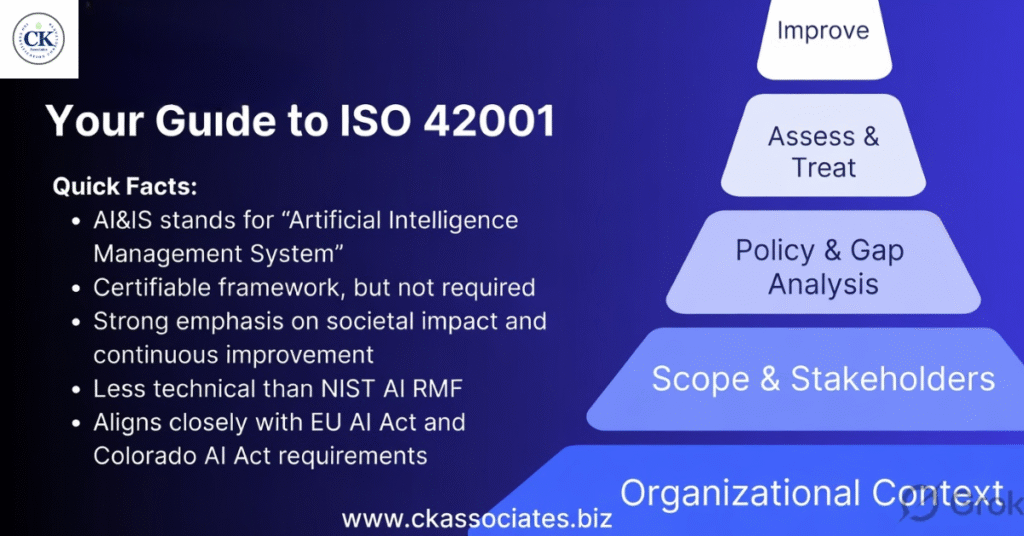
Pro Tip: Create a Statement of Applicability (SoA) table that lists every one of the 38 controls, your decision (apply/exclude), justification, and implementation status.
Download Tip: Copy this entire blog into a Word document, add your company logo, and turn it into your official Gap Analysis Report.
CK Associates has already helped 10+ organizations in Hyderabad, Telangana, Andhra Pradesh, and across India complete their ISO 42001 gap analysis and achieve certification.
Our Gap Analysis Package includes:
Typical outcome: Organizations discover 60–70% of requirements are new and close the gaps in 3–6 months.
Contact us today for a free 30-minute scoping call and we’ll show you exactly what your gap analysis would look like.
Frequently Asked Questions
Q: How long does a proper gap analysis take? A: 1–2 weeks for most mid-sized companies.
Q: Is this guide enough or do I still need a consultant? A: This guide is excellent for self-assessment and small teams. For faster, audit-ready results, professional help is recommended.
Q: Does it cover the latest 2023 version? A: Yes – fully aligned with ISO/IEC 42001:2023 requirements as of 2026.
