
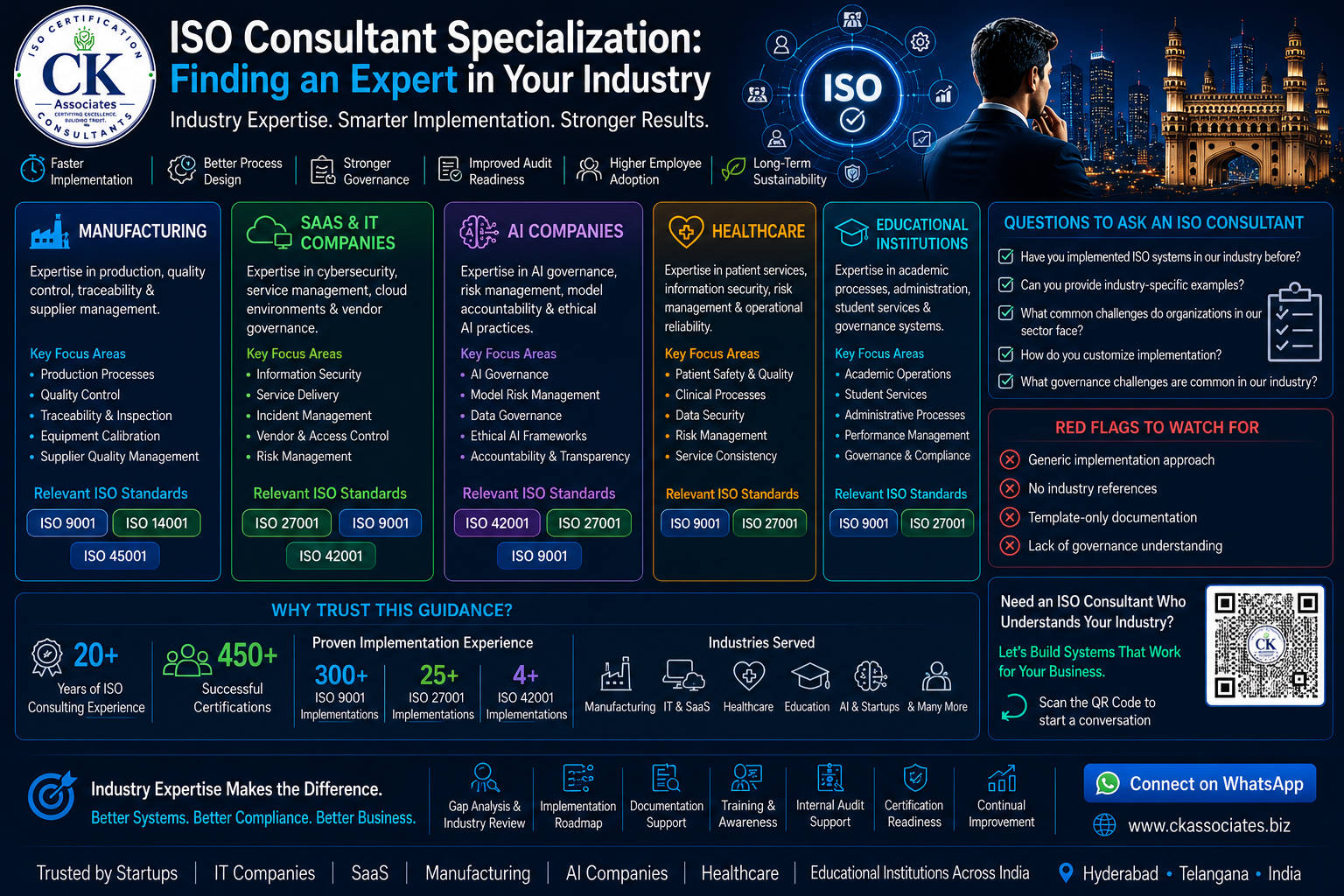
Not all ISO consultants have the same expertise.
While many consultants understand ISO requirements, the best consultants combine ISO knowledge with deep industry-specific operational understanding.
Industry-specialized consultants can help organizations:
- Implement faster
- Reduce operational disruption
- Improve employee adoption
- Strengthen governance systems
- Improve audit readiness
- Avoid common industry-specific mistakes
- Build sustainable management systems
For example:
- Manufacturing businesses need process control and traceability expertise.
- SaaS companies need cybersecurity governance understanding.
- AI companies require AI accountability and governance frameworks.
- Healthcare providers require patient-data and operational reliability controls.
Choosing a consultant with industry-specific expertise often results in stronger long-term outcomes than choosing a generalist consultant.
Why is industry-specific ISO consulting important?
Industry-specific ISO consultants understand operational realities, regulatory expectations, common risks, and implementation challenges unique to your sector. This enables faster implementation, stronger governance systems, improved audit readiness, and better long-term sustainability compared to generic ISO consulting approaches.
Why Industry Experience Matters More Than Most Businesses Realize
Many organizations choose consultants based on:
- Lowest cost
- Fastest timeline
- Certification promises
However, one of the most important selection factors is often overlooked:
Industry expertise.
Two organizations may both pursue ISO 9001 certification, but their implementation requirements can be dramatically different.
For example:
A manufacturing company requires:
- Production controls
- Calibration systems
- Traceability
- Supplier quality management
While a SaaS company requires:
- Service delivery governance
- Customer support processes
- Cybersecurity integration
- Incident management
The ISO standard may be the same, but implementation requirements are completely different.
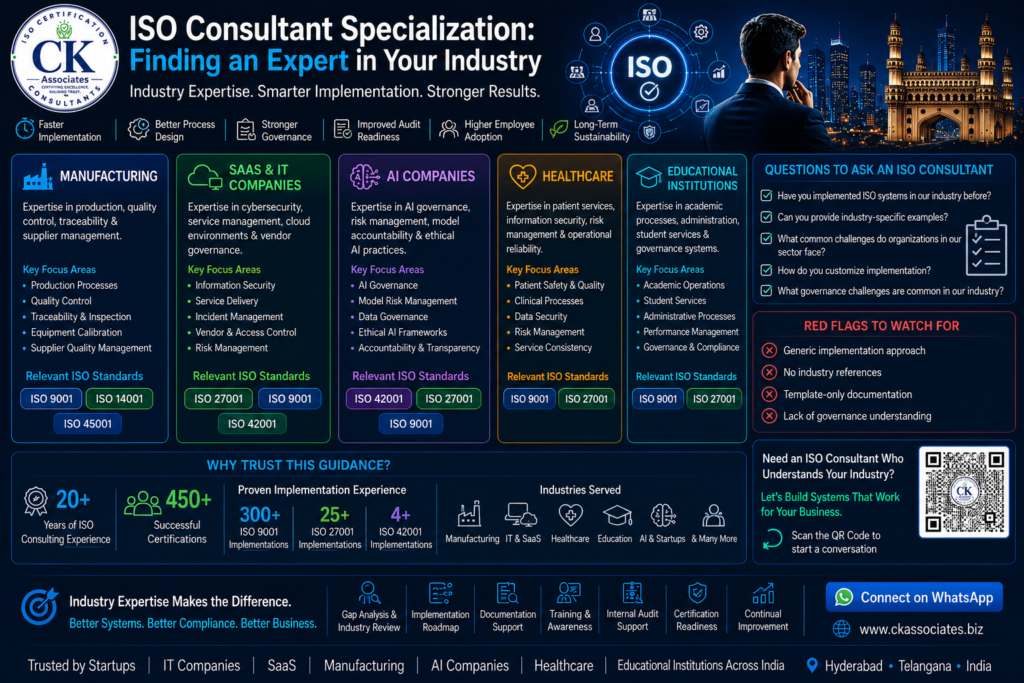
What Industry-Specialized Consultants Bring
Faster Gap Analysis
Experienced industry consultants quickly identify:
- Common operational weaknesses
- Industry-specific risks
- Documentation gaps
- Compliance expectations
This reduces implementation delays.
Better Process Design
Generic consultants often apply standard templates.
Specialized consultants build systems aligned with:
- Real workflows
- Existing operations
- Industry practices
- Growth objectives
This improves adoption and sustainability.
Stronger Employee Engagement
Employees are more likely to embrace systems that reflect their actual work environment.
Industry-aware consultants understand:
- Daily operational challenges
- Employee responsibilities
- Workflow realities
This creates more practical implementation.
Manufacturing Industry Expertise
Manufacturing organizations require consultants familiar with:
- Production processes
- Quality control
- Supplier management
- Inspection systems
- Traceability
- Equipment calibration
Common certifications include:
Without manufacturing knowledge, consultants often create documentation that fails to support production realities.
SaaS and IT Industry Expertise
Technology companies operate differently from traditional businesses.
Strong IT consultants understand:
- Cloud environments
- Service management
- Information security
- Vendor governance
- Incident management
Most relevant certifications:
Technology businesses increasingly require governance frameworks beyond traditional quality systems.
AI Industry Expertise
AI governance is becoming a strategic priority.
Consultants working with AI organizations should understand:
- Model governance
- AI accountability
- Risk management
- Ethical AI principles
- Data governance
Relevant standards include:
AI implementation requires specialized governance expertise that many traditional consultants lack.
Healthcare Industry Expertise
Healthcare organizations require strong operational discipline around:
- Patient services
- Documentation control
- Information security
- Risk management
- Service consistency
Industry experience becomes particularly important when balancing quality, compliance, and operational effectiveness.
Educational Institutions
Educational organizations benefit from consultants experienced in:
- Student services
- Academic operations
- Administrative processes
- Performance measurement
- Governance systems
Relevant certifications often include:
Questions to Ask an ISO Consultant About Industry Experience
Before selecting a consultant, ask:
Have you implemented ISO systems in our industry before?
Experience reduces implementation risk.
Can you provide industry-specific examples?
Real examples demonstrate practical capability.
What common challenges do organizations in our sector face?
Strong consultants should answer confidently.
How do you customize implementation?
Avoid consultants relying solely on templates.
What governance challenges are common in our industry?
Governance understanding often separates strong consultants from average consultants.
Red Flags to Watch For
Generic Implementation Approach
Every industry has unique operational requirements.
Beware of consultants who use identical systems across all industries.
No Industry References
Strong consultants should demonstrate prior industry experience.
Template-Only Documentation
Documentation should support operations, not simply satisfy auditors.
Lack of Governance Understanding
Modern ISO implementation increasingly focuses on:
- Risk management
- Accountability
- Cybersecurity
- Operational resilience
- AI governance
Consultants should understand these evolving expectations.
Why Industry Expertise Improves Audit Success
Industry-specialized consultants help organizations:
- Generate stronger evidence
- Improve process alignment
- Strengthen employee awareness
- Reduce nonconformities
- Improve audit confidence
Certification becomes smoother because systems reflect actual operational practices.
Why Trust This Guidance?
CK Associates has supported more than 450+ certification projects across India.
Our implementation experience includes:
- 400+ ISO 9001 implementations
- 25+ ISO 27001 implementations
- 4+ ISO 42001 implementations
- 45+ ISO 14001 Implementations
- 45+ ISO 45001 Implementations
- 4+ CMMi Implementations
- and rest other certifications
Over the last 20+ years, we have worked with:
- Manufacturing companies
- IT organizations
- SaaS businesses
- Educational institutions
- Healthcare providers
- Engineering firms
- Startups and SMEs
This practical experience has consistently shown that industry-specific expertise significantly improves implementation quality and long-term sustainability.
Hyderabad and India Market Trends
Across Hyderabad and India, organizations increasingly prioritize consultants who understand:
- Industry operations
- Governance maturity
- Cybersecurity requirements
- AI governance expectations
- Operational resilience
Businesses are moving beyond certification-only consulting and seeking long-term implementation partners.
Conclusion
Choosing an ISO consultant is not simply about selecting someone who understands the standard.
It is about selecting someone who understands your business, your industry, and your operational challenges.
Industry specialization improves:
- Implementation speed
- Employee adoption
- Governance maturity
- Audit readiness
- Long-term sustainability
The strongest ISO systems are built by consultants who combine ISO expertise with real-world industry experience.
About the Author
Sirish K is the Founder and Lead ISO Consultant at CK Associates, serving organizations across Hyderabad, Telangana, Andhra Pradesh, and India.
With 20+ years of ISO consulting experience and 450+ successful certification projects, he and his team of members has guided businesses through the implementation of internationally recognized management systems.
Implementation experience includes:
- ISO 9001 – 300+ organizations
- ISO 27001 – 25+ organizations
- ISO 42001 – 4+ organizations
He has worked with organizations across manufacturing, IT, SaaS, healthcare, education, engineering, AI, retail, and startup sectors, focusing on governance maturity, operational excellence, cybersecurity readiness, and sustainable compliance systems.