Choosing the right ISO consultant is one of the most important decisions during your certification journey.
Many businesses assume ISO certification is simply about preparing documents and passing an audit.
However, a professional ISO implementation project affects:
- operational governance,
- process maturity,
- risk management,
- customer trust,
- cybersecurity readiness,
- compliance culture,
- and long-term business scalability.
The consultant you select directly influences:
- implementation quality,
- audit preparedness,
- employee adoption,
- certification success,
- and the long-term sustainability of the management system.
Unfortunately, many organizations in India select ISO consultants based only on:
- lowest pricing,
- fastest promises,
- or generic package offers.
This often results in:
- weak implementation,
- impractical documentation,
- audit failures,
- poor operational adoption,
- and systems that employees never actually use.
Whether your organization is:
- a startup,
- IT company,
- SaaS provider,
- manufacturing business,
- educational institution,
- or growth-stage enterprise,
selecting the right ISO consultant is critical for long-term value.
This complete guide explains:
- how to evaluate ISO consultants,
- what questions to ask,
- common red flags,
- pricing models,
- implementation expectations,
- and how businesses can choose a reliable ISO consulting partner in India.
Quick Answer: How Do You Choose the Right ISO Consultant?
The best ISO consultant is not necessarily:
- the cheapest,
- the fastest,
- or the one promising guaranteed certification.
A professional ISO consultant should help your organization:
- build practical systems,
- improve operational maturity,
- strengthen compliance,
- support employees,
- and prepare for sustainable certification success.
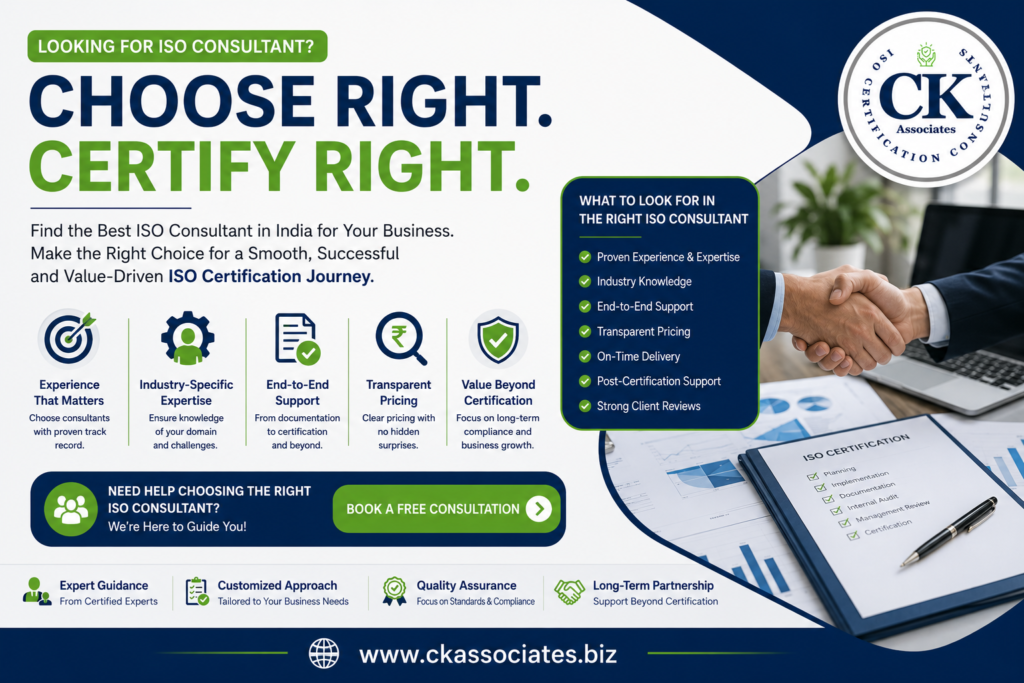
When evaluating ISO consultants, businesses should assess:
- industry experience,
- implementation approach,
- audit readiness capability,
- practical understanding,
- training support,
- scalability,
- and long-term usability.
Why Choosing the Right ISO Consultant Matters
ISO certification impacts much more than audit documentation.
A properly implemented management system can improve:
- operational consistency,
- quality management,
- cybersecurity governance,
- AI governance,
- process accountability,
- customer confidence,
- and business credibility.
A weak implementation may create:
- documentation overload,
- employee resistance,
- poor adoption,
- audit nonconformities,
- and operational inefficiency.
The consultant’s role is not just to create files.
A strong ISO consultant helps organizations:
- understand risks,
- improve governance,
- align processes,
- strengthen controls,
- and prepare for long-term operational maturity.
What an ISO Consultant Actually Does
Before selecting a consultant, businesses should understand the scope of professional ISO consulting.
1. Gap Analysis
The consultant evaluates:
- current business processes,
- operational maturity,
- documentation readiness,
- compliance gaps,
- and implementation risks.
This helps create the implementation roadmap.
2. Implementation Planning
A professional consultant develops:
- implementation timelines,
- responsibility structures,
- process frameworks,
- department coordination plans,
- and audit preparation schedules.
3. Documentation Support
Documentation may include:
- policies,
- SOPs,
- manuals,
- risk registers,
- audit records,
- operational controls,
- compliance evidence.
However, documentation should always remain:
- practical,
- scalable,
- and aligned with business operations.
4. Training and Awareness
ISO implementation requires employee involvement.
Consultants may conduct:
- awareness training,
- internal auditor training,
- process workshops,
- cybersecurity awareness sessions,
- governance training.
5. Internal Audit Support
Internal audits help organizations:
- identify gaps,
- improve controls,
- and prepare for certification audits.
6. Certification Audit Coordination
The consultant may support:
- audit preparation,
- evidence review,
- certification coordination,
- and nonconformity closure.
Common Mistakes Businesses Make While Selecting ISO Consultants
Many organizations unknowingly select the wrong consulting partner.
Choosing Only Based on Lowest Price
Low-cost consultants often:
- use generic templates,
- provide minimal implementation support,
- avoid operational involvement,
- and focus only on documentation.
This may reduce long-term implementation effectiveness.
Expecting Guaranteed Certification
Professional consultants should never guarantee certification outcomes.
Certification decisions belong to accredited certification bodies.
Guaranteed certification claims are often a major warning sign.
Ignoring Industry Expertise
ISO implementation differs significantly across industries.
For example:
Manufacturing Companies
Require:
- production process controls,
- quality inspections,
- supplier management,
- calibration systems,
- maintenance procedures.
IT Companies
May require:
- cybersecurity governance,
- access controls,
- asset management,
- cloud security processes,
- incident management.
AI Startups
ISO 42001 implementations may involve:
- AI governance,
- AI accountability,
- ethical AI controls,
- AI lifecycle management.
A consultant without relevant industry understanding may struggle to create practical systems.
Key Qualities of a Good ISO Consultant
1. Practical Implementation Approach
The best consultants focus on:
- usability,
- operational adoption,
- process practicality,
- and long-term sustainability.
The management system should support business operations rather than create unnecessary bureaucracy.
2. Industry-Specific Experience
Different industries require different implementation strategies.
Businesses should evaluate whether the consultant has experience with:
- startups,
- SaaS companies,
- manufacturing organizations,
- educational institutions,
- healthcare environments,
- or enterprise operations.
3. Audit Readiness Capability
A professional consultant should support:
- internal audits,
- evidence preparation,
- audit readiness,
- corrective actions,
- and certification coordination.
4. Scalability Understanding
Startups and growing businesses need systems that scale.
Overcomplicated documentation can create operational friction.
A strong consultant designs:
- practical controls,
- scalable governance,
- and sustainable processes.
5. Communication and Training Skills
ISO implementation requires organizational participation.
Employees should understand:
- process responsibilities,
- operational controls,
- risk management,
- compliance expectations.
Good consultants help simplify complex standards.
Questions to Ask Before Hiring an ISO Consultant
1. Do You Support Full Implementation or Only Documentation?
This is extremely important.
Some consultants provide only templates without helping organizations:
- implement controls,
- train employees,
- or prepare for audits.
2. Which Industries Have You Worked With?
Industry relevance matters.
A consultant experienced in:
- manufacturing,
- IT,
- startups,
- cybersecurity,
- or AI governance
may better understand operational realities.
3. Do You Conduct Internal Audits?
Internal audit support improves:
- implementation quality,
- audit readiness,
- and corrective action management.
4. How Is Pricing Structured?
Professional consultants often use:
manday-based implementation pricing.
This is generally more transparent than vague package quotations.
At CK Associates, implementation consulting is commonly structured around:
approximately ₹9,000 per manday
depending on:
- implementation complexity,
- organization size,
- operational maturity,
- and certification scope.
5. Will the System Be Practical to Maintain?
Long-term usability matters more than short-term certification.
Businesses should avoid:
- unnecessary paperwork,
- excessive bureaucracy,
- and impractical controls.
6. Do You Provide Post-Certification Support?
Organizations may require support for:
- surveillance audits,
- management reviews,
- corrective actions,
- system improvements,
- ongoing compliance.
Understanding ISO Consultant Pricing Models
ISO consultants in India may use different pricing approaches.
Fixed Package Pricing
Some consultants offer fixed-cost packages.
However, this may not always reflect actual implementation complexity.
Manday-Based Pricing
Many professional consultants use:
manday-based pricing.
A manday represents:
one consultant working for one business day.
This model is often more transparent because implementation effort varies across organizations.
Scope-Based Pricing
Some projects are priced based on:
- locations,
- departments,
- operational complexity,
- audit scope,
- and implementation effort.
Red Flags When Evaluating ISO Consultants
Extremely Low Pricing
Very low pricing may indicate:
- template-only documentation,
- minimal implementation support,
- weak audit preparation,
- or poor operational understanding.
Guaranteed Certification Claims
Professional consultants should never guarantee certification.
Certification decisions belong to certification bodies.