Choosing an ISO consultant is one of the most important strategic decisions during your certification journey.
Unfortunately, many businesses across India — especially startups, IT companies, manufacturing firms, and rapidly scaling organizations — unknowingly select consultants based purely on:
lowest price,
fastest timeline,
unrealistic promises,
or “guaranteed certification” marketing.
This often creates severe long-term problems including:
weak implementation,
audit failures,
operational inefficiencies,
cybersecurity gaps,
employee resistance,
documentation overload,
and management systems that are never actually used.
ISO implementation is not just about passing an audit.
Modern ISO standards including:
ISO 9001,
ISO 27001,
ISO 42001,
ISO 14001,
ISO 45001,
and ISO 21001
directly influence:
governance maturity,
operational consistency,
cybersecurity readiness,
AI governance,
compliance culture,
customer trust,
and long-term business scalability.
This is why choosing the wrong consultant can become significantly more expensive than choosing the right one from the beginning.
This comprehensive guide explains the biggest red flags businesses should avoid when selecting an ISO consultant in India and Hyderabad.
Why Businesses Fall Into ISO Consultant Traps
Many organizations are unfamiliar with how professional ISO implementation actually works.
This creates opportunities for poor-quality consultants to oversell unrealistic promises.
Common business assumptions include:
“ISO certification is just paperwork.”
“Any consultant can do it.”
“The cheapest consultant saves money.”
“Certification is guaranteed.”
“Implementation only matters during the audit.”
In reality, poorly implemented systems often create:
Problem
Business Impact
Generic documentation
Employees ignore processes
Weak implementation
Audit nonconformities
No governance alignment
Operational confusion
No training
Low employee adoption
Fake certification guidance
Business credibility damage
No cybersecurity structure
Increased operational risk
Overcomplicated systems
Scalability challenges
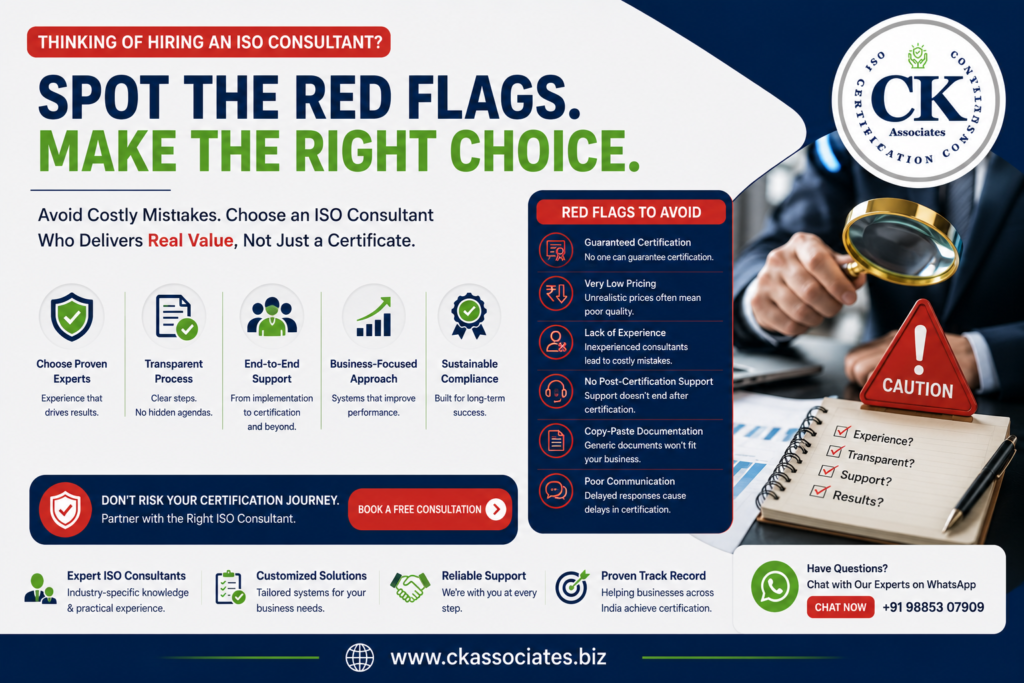
Red Flag #1 — Guaranteed Certification Claims
This is one of the biggest warning signs in the ISO consulting industry.
No Genuine Consultant Can Guarantee Certification
Certification decisions belong to accredited certification bodies — not consultants.
Any consultant claiming:
“100% guaranteed certification”
“No audit risk”
“Guaranteed pass”
“Instant certification approval”
should immediately raise concerns.
Professional consultants can help organizations:
prepare properly,
improve controls,
close gaps,
train employees,
and improve audit readiness.
However, final certification decisions are always made independently by certification auditors.
Why This Is Dangerous
Guaranteed certification promises often indicate:
weak ethics,
poor governance understanding,
fake certification partnerships,
shortcut-based implementation,
or superficial documentation-only projects.
For businesses pursuing:
enterprise contracts,
international expansion,
cybersecurity compliance,
or AI governance maturity,
this creates long-term reputational risk.
Red Flag #2 — Extremely Low Pricing
Many organizations unknowingly choose consultants purely based on price.
This is one of the most common reasons ISO implementations fail operationally.
Why Extremely Cheap ISO Consulting Is Risky
Very low pricing often means:
template reuse,
no business customization,
limited implementation support,
minimal employee training,
weak audit preparation,
or outsourced junior consultants.
In many cases, businesses receive:
generic policies,
copied SOPs,
irrelevant controls,
and documentation employees never use.
Understanding Professional ISO Pricing
Professional implementation consulting is typically effort-based.
At CK Associates, implementation consulting is generally structured around:
approximately ₹9,000 per manday
depending on:
organization size,
operational complexity,
industry requirements,
implementation maturity,
certification scope,
and multi-location operations.
A “manday” means: one consultant working for one business day on implementation activities.
Professional implementation requires:
process understanding,
governance mapping,
employee coordination,
risk assessment,
internal audits,
and operational alignment.
Extremely low-cost proposals rarely provide this depth.
Red Flag #3 — Template-Only Documentation
One of the biggest operational problems in ISO projects is template-driven implementation.
Signs of Template-Based Consulting
Warning signs include:
instant document delivery,
no process discussions,
no department interaction,
no operational assessment,
no workflow mapping,
and identical documentation for multiple companies.
Why Generic Templates Fail
Every organization operates differently.
For example:
Manufacturing Businesses
Need:
supplier controls,
inspection procedures,
calibration systems,
maintenance planning,
production traceability.
IT & SaaS Companies
Require:
access management,
cybersecurity governance,
cloud controls,
incident response,
data classification.
AI Companies
May require:
AI governance structures,
ethical AI controls,
lifecycle accountability,
AI risk management,
bias mitigation frameworks.
Generic templates fail because they do not reflect actual operations.
Red Flag #4 — No Internal Audit Support
Internal audits are critical for ISO maturity.
A consultant that ignores internal audits is a major risk.
Why Internal Audits Matter
Internal audits help organizations:
identify implementation gaps,
detect weak controls,
improve compliance,
strengthen operational maturity,
and prepare for certification audits.
Without internal audits:
hidden problems remain unresolved,
employees remain unprepared,
evidence becomes inconsistent,
and audit failures become more likely.
Red Flag #5 — Lack of Industry Experience
ISO implementation differs significantly across industries.
Why Industry Understanding Matters
Startups
Need:
scalable governance,
lightweight operational structure,
rapid implementation flexibility.
Manufacturing Companies
Need:
process controls,
operational traceability,
supplier quality systems.
IT Companies
Need:
cybersecurity maturity,
access governance,
cloud process management.
AI Companies
Need:
AI accountability,
ethical governance,
algorithm lifecycle controls.
A consultant without industry understanding may create:
impractical controls,
excessive bureaucracy,
operational bottlenecks,
or weak compliance structures.
Red Flag #6 — No Employee Training or Awareness Programs
ISO systems fail when employees do not understand them.
Common Signs of Weak Training Support
No awareness sessions
No process workshops
No department engagement
No audit preparation coaching
No operational training
Why Training Is Essential
Employees are responsible for:
process execution,
operational controls,
compliance evidence,
risk management,
and continual improvement.
Without awareness:
systems remain unused,
documentation becomes disconnected,
and audit readiness weakens.
Red Flag #7 — Fake Accreditation or Misleading Certification Claims
This is becoming increasingly common in India.
Fake Certification Warning Signs
Be cautious if:
certification bodies are unknown,
accreditation details are unclear,
logos appear suspicious,
certificates cannot be verified,
consultants avoid accreditation discussions.
Important Clarification
A consultant is NOT the certification body.
Professional consultants help organizations prepare.
Certification must be conducted independently by accredited bodies.
Businesses should always verify:
accreditation status,
certification legitimacy,
and auditor independence.
Red Flag #8 — “Fastest Certification” Sales Pressure
Many consultants market unrealistic timelines.
Examples:
“Get certified in 7 days”
“Instant ISO approval”
“Same-week certification”
This often results in:
weak implementation,
poor employee understanding,
incomplete controls,
governance gaps,
and unsustainable systems.
Realistic ISO Timelines Depend On
organization size,
operational complexity,
employee readiness,
process maturity,
locations,
and implementation scope.
Professional consultants focus on:
sustainable implementation,
operational adoption,
and audit readiness.
Red Flag #9 — No Focus on Operational Improvement
ISO implementation should improve business maturity.
A consultant focused only on “audit passing” is a major risk.
Strong Consultants Focus On
governance improvement,
process consistency,
operational accountability,
cybersecurity resilience,
risk management,
continual improvement.
The goal should not simply be “getting a certificate.”
The real value comes from:
operational maturity,
stronger customer confidence,
reduced risks,
and scalable governance.
Red Flag #10 — No Post-Certification Support
Certification is not the end of the journey.
Organizations require ongoing support for:
surveillance audits,
management reviews,
corrective actions,
process updates,
compliance improvements.
Consultants offering no long-term support may leave businesses struggling after certification.
Fake ISO Consultant Scam Warning Signs
Immediate Warning Indicators
Scam Indicator
Why It’s Risky
Guaranteed certification
Ethically questionable
Ultra-low pricing
Template-only delivery
No accreditation clarity
Possible fake certification
No internal audits
Weak implementation
No industry expertise
Impractical systems
No training
Poor employee adoption
No process discussions
Generic documentation
“Instant certification” promises
Unsustainable implementation
Questions Every Business Should Ask Before Hiring an ISO Consultant
1. How do you customize implementation for our industry?
2. Do you conduct internal audits?
3. How do you train employees?
4. What implementation methodology do you use?
5. Do you support post-certification activities?
6. How do you structure pricing?
7. Can you explain the difference between consulting and certification?
8. How do you ensure long-term maintainability?
How Professional ISO Consultants Actually Work
Professional consultants generally follow:
Gap Analysis
Implementation Planning
Documentation Alignment
Process Integration
Employee Training
Internal Audits
Corrective Actions
Audit Readiness Preparation
Certification Coordination
Continual Improvement Support
This creates systems that support operational maturity rather than audit-only compliance.
Hyderabad & India Business Perspective
Businesses across Hyderabad, Telangana, Andhra Pradesh, Bengaluru, Pune, Chennai, Mumbai, and other growing markets are increasingly pursuing:
ISO 9001
ISO 27001
ISO 42001
ISO 14001
ISO 45001
because enterprise customers now evaluate:
governance maturity,
cybersecurity readiness,
AI governance,
supplier compliance,
operational reliability.
This means organizations need consultants capable of: