
A good ISO consultant does far more than create documentation or prepare businesses for audits.
The best ISO consultants help organizations improve:
- Operational maturity
- Governance visibility
- Risk management
- Process consistency
- Employee awareness
- Continual improvement
- Long-term sustainability
Strong ISO consultants typically demonstrate:
- Industry-specific experience
- Practical implementation capability
- Governance-focused thinking
- Strong communication skills
- Internal audit expertise
- Sustainable implementation strategies
- Operational integration understanding
Businesses should avoid consultants focused only on “fast certification” or template-heavy documentation approaches.
The strongest ISO implementations improve business operations long after certification.
What makes a good ISO consultant?
A good ISO consultant combines implementation expertise, governance understanding, industry experience, operational maturity thinking, and sustainable process design. Strong consultants help businesses improve operational effectiveness, risk management, employee awareness, and long-term compliance readiness rather than focusing only on certification audits.
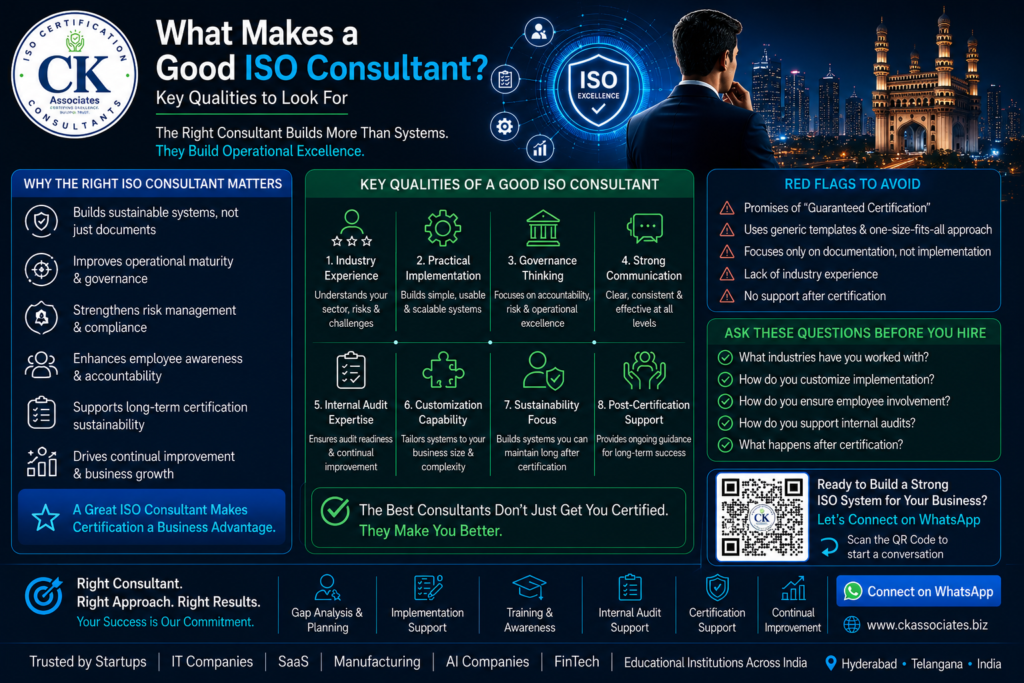
Why Choosing the Right ISO Consultant Matters
An ISO consultant significantly influences whether implementation becomes:
- A sustainable governance system
- An operational improvement framework
- A strategic business asset
—or merely:
- A documentation burden
- A short-term audit exercise
- A compliance headache
Across Hyderabad, Telangana, Andhra Pradesh, and India, businesses increasingly recognize that consultant quality directly affects:
- Operational maturity
- Certification sustainability
- Employee adoption
- Governance effectiveness
- Long-term compliance success
What the Best ISO Consultants Actually Do
Strong ISO consultants do not simply “prepare documents.”
They help businesses:
- Understand operational risks
- Improve governance systems
- Build scalable workflows
- Develop process accountability
- Improve internal controls
- Strengthen continual improvement culture
The best consultants act as governance and operational maturity advisors.
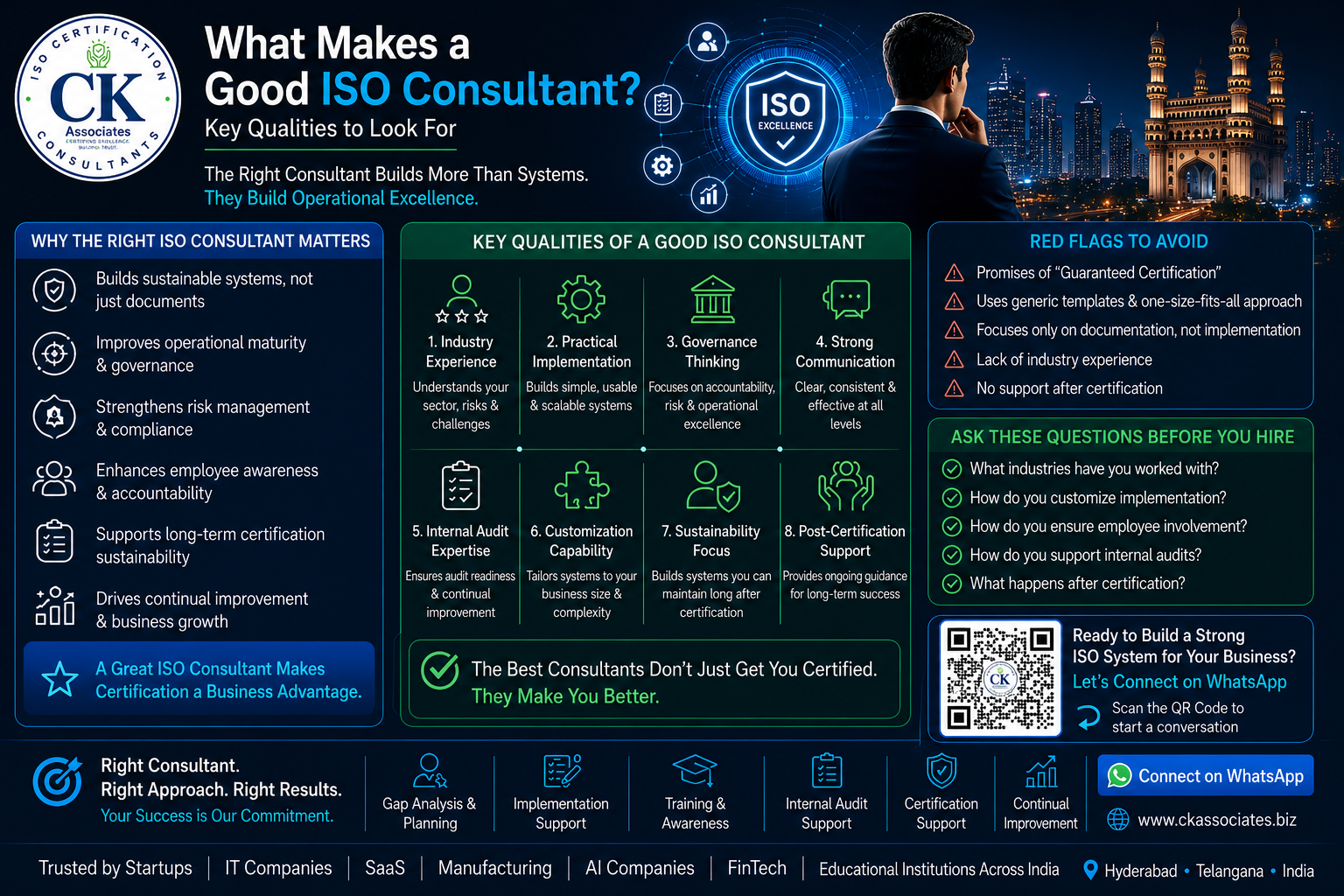
Key Qualities of a Good ISO Consultant
1. Industry Experience
Industry expertise matters significantly.
A consultant working with:
- SaaS companies
- Manufacturing businesses
- Educational institutions
- AI companies
- Healthcare organizations
must understand operational realities specific to those sectors.
For example:
- Manufacturing requires process consistency and traceability
- SaaS businesses require cybersecurity governance maturity
- AI companies require governance accountability frameworks
- Educational institutions require operational standardization
Generic consulting approaches rarely work effectively.
2. Practical Implementation Capability
A strong consultant builds systems employees can actually use.
Weak consultants often create:
- Excessive documentation
- Complicated workflows
- Audit-only systems
- Template-heavy implementations
Practical implementation focuses on:
- Operational usability
- Simplicity
- Process alignment
- Employee adoption
- Sustainability
The best ISO systems support operations naturally.
3. Governance-Focused Thinking
Modern ISO implementation is increasingly governance-driven.
Good consultants improve:
- Accountability
- Risk visibility
- Leadership involvement
- Process ownership
- Continual improvement
- Operational resilience
This is especially important for:
- ISO 27001 cybersecurity governance
- ISO 42001 AI governance
- Enterprise operational maturity
4. Strong Communication Skills
Implementation requires continuous collaboration.
Good consultants should communicate clearly with:
- Leadership teams
- Employees
- Department heads
- Auditors
- Operations teams
Strong communication improves:
- Employee awareness
- Audit confidence
- Process adoption
- Implementation speed
5. Internal Audit Expertise
Internal audits are essential for sustainable certification.
Strong consultants support:
- Internal audit planning
- Audit execution
- Corrective actions
- Continual improvement
- Operational monitoring
Businesses should avoid consultants who disappear after documentation delivery.
6. Customization Capability
Every organization operates differently.
Strong consultants customize implementation based on:
- Organization size
- Industry risks
- Operational maturity
- Business workflows
- Governance complexity
Template-based implementations often fail long-term.
7. Sustainability Focus
The best ISO consultants build systems organizations can maintain internally.
Sustainable systems should:
- Scale with growth
- Support operational efficiency
- Improve accountability
- Remain usable after certification
Certification is only the beginning.
Red Flags to Avoid
Guaranteed Certification Claims
No ethical consultant can guarantee certification outcomes because certification bodies make independent decisions.
Overcomplicated Documentation
Excessive paperwork often reduces employee adoption.
Generic Templates
Weak customization creates operational disconnects.
Lack of Employee Involvement
Strong implementation requires organization-wide awareness.
No Long-Term Support
ISO systems require continual maintenance and improvement.
Questions Businesses Should Ask ISO Consultants
What industries have you worked with?
Industry expertise improves implementation relevance.
How do you customize systems?
Customization capability determines sustainability.
How do you support internal audits?
Internal audit capability is critical for long-term success.
How do you build employee awareness?
Employee adoption strongly affects implementation quality.
How do you ensure sustainability after certification?
Sustainability planning should begin during implementation.
Why Governance Expertise Matters More Today
Modern businesses increasingly require governance maturity around:
- Cybersecurity
- AI systems
- Vendor management
- Risk management
- Operational resilience
- Compliance visibility
This is why governance-focused ISO consulting is becoming increasingly important.
Especially for:
- SaaS companies
- AI startups
- IT organizations
- FinTech businesses
- Enterprise suppliers
Industry-Specific Examples
SaaS Companies
Strong consultants improve:
- Information security governance
- Incident response workflows
- Vendor risk management
- Operational scalability
Manufacturing Businesses
Strong consultants improve:
- Process consistency
- Supplier management
- Traceability systems
- Quality control workflows
AI Companies
Strong consultants help organizations establish:
- AI governance accountability
- Risk visibility
- Ethical governance frameworks
- Operational oversight mechanisms
Hyderabad and India ISO Consulting Trends
Businesses across Hyderabad and India increasingly prioritize consultants who provide:
- Governance-focused implementation
- Sustainable operational systems
- Cybersecurity maturity support
- Long-term scalability
- Practical implementation strategies
Organizations increasingly prefer operational maturity over “certificate-only” approaches.
ISO Consulting Is Becoming Strategic
The best ISO consultants no longer function only as compliance advisors.
They increasingly support:
- Governance transformation
- Operational maturity
- Cybersecurity readiness
- AI governance preparedness
- Enterprise resilience
This shift is changing how organizations evaluate ISO implementation partners.
ISO Consulting Cost Considerations
Implementation consulting is commonly structured around approximately ₹9,000 per manday depending on:
- Organization size
- Operational complexity
- Governance maturity
- Industry risks
- Number of departments
- Scope of implementation
What Is a Manday?
A manday refers to one consultant working day dedicated to activities such as:
- Gap analysis
- Documentation support
- Internal audits
- Employee training
- Governance workshops
- Audit preparation
Certification body fees are generally separate from implementation consulting fees.