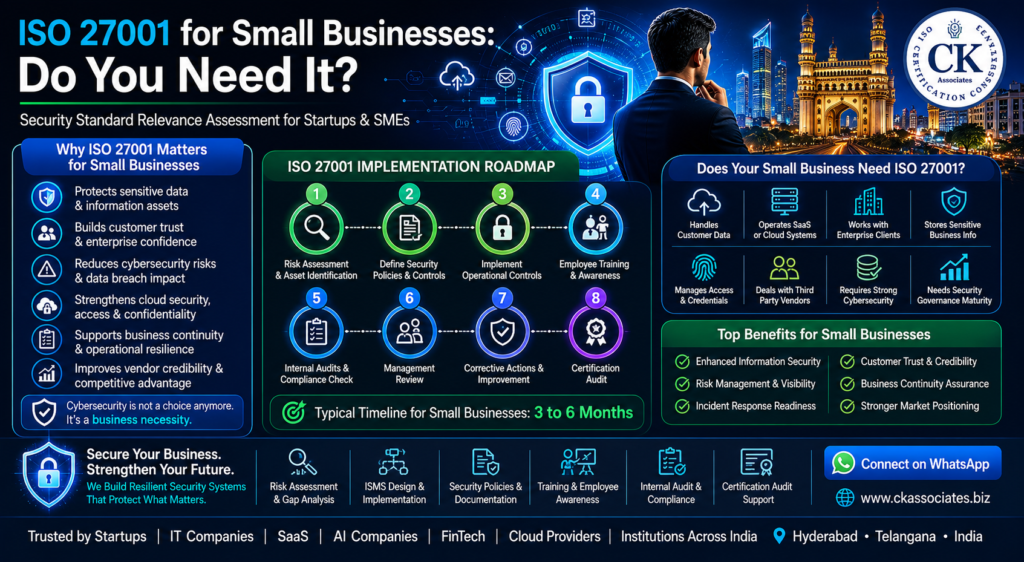
ISO 27001 helps small businesses establish structured information security governance systems to protect sensitive data, reduce cybersecurity risks, improve customer trust, and strengthen operational resilience.
Small businesses should strongly consider ISO 27001 if they:
- Handle customer data
- Operate SaaS platforms
- Store sensitive business information
- Work with enterprise clients
- Manage cloud infrastructure
- Handle financial or healthcare data
- Require cybersecurity governance maturity
ISO 27001 is especially valuable for:
- Startups
- SaaS companies
- IT businesses
- AI companies
- FinTech organizations
- Cloud-based service providers
The standard helps organizations implement structured controls around:
- Access management
- Risk assessment
- Incident response
- Data protection
- Vendor security
- Governance accountability
Why Small Businesses Are Increasingly Considering ISO 27001
Cybersecurity is no longer only an enterprise concern.
Today, even small businesses face:
- Ransomware attacks
- Data leaks
- Vendor security assessments
- Customer trust challenges
- Regulatory pressure
- Third-party security reviews
Across Hyderabad, Telangana, Andhra Pradesh, and India, startups and SMEs increasingly recognize that information security governance directly affects business growth.
Customers now evaluate small businesses based on:
- Security maturity
- Governance controls
- Risk management capability
- Data protection practices
- Operational resilience
ISO 27001 helps small businesses demonstrate structured cybersecurity governance.
Does a small business need ISO 27001?
A small business should consider ISO 27001 if it handles sensitive customer data, operates cloud systems, works with enterprise clients, or requires stronger cybersecurity governance. ISO 27001 helps businesses improve information security maturity, operational resilience, and customer trust.
What Is ISO 27001?
ISO 27001 is an internationally recognized Information Security Management System (ISMS) standard.
It helps organizations establish systematic controls for:
- Data protection
- Cybersecurity governance
- Risk management
- Incident response
- Access management
- Vendor security
- Business continuity
- Operational resilience
ISO 27001 is not just an IT framework.
It is a governance framework.
Do Small Businesses Really Need ISO 27001?
The answer depends on operational exposure and business goals.
Some organizations urgently need ISO 27001.
Others may not yet require full implementation.
The key is understanding risk exposure and customer expectations.
Small Businesses That Strongly Benefit from ISO 27001
SaaS Companies
SaaS organizations often store:
- Customer information
- Login credentials
- Financial data
- API access
- Cloud infrastructure data
Enterprise clients increasingly require security governance visibility before onboarding vendors.
ISO 27001 strengthens enterprise trust.
IT Service Providers
IT businesses often manage:
- Client systems
- Infrastructure access
- Managed services
- Cloud administration
- Development environments
Weak security governance creates major operational risks.
AI Companies
AI-focused organizations increasingly manage:
- Sensitive datasets
- Training data
- Proprietary algorithms
- Model governance
- AI accountability frameworks
ISO 27001 supports broader AI governance maturity.
FinTech & Financial Services
Financial businesses handle highly sensitive information including:
- Transactions
- Payment systems
- Customer identity data
- Financial records
Strong cybersecurity governance becomes operationally critical.
Healthcare & EdTech Platforms
Organizations handling:
- Student information
- Patient records
- Health data
- Identity records
often face growing compliance expectations around information security.
Small Businesses That May Not Immediately Need ISO 27001
Some businesses may not require full ISO 27001 implementation initially if:
- Minimal sensitive data is handled
- Operations are entirely offline
- Customer security requirements are low
- Risk exposure is limited
However, even these businesses increasingly face cybersecurity expectations as digital adoption grows.
Common Reasons Small Businesses Pursue ISO 27001
Enterprise Client Requirements
Many large organizations now require vendors to demonstrate security maturity.
ISO 27001 improves:
- Vendor credibility
- Procurement eligibility
- Enterprise trust
- Security assurance
Customer Trust
Customers increasingly evaluate how organizations protect data.
ISO 27001 demonstrates:
- Governance maturity
- Security accountability
- Risk management capability
- Operational resilience
Cybersecurity Risk Reduction
Small businesses are often targeted because attackers assume controls are weaker.
ISO 27001 helps organizations establish structured defenses around:
- Access control
- Risk assessments
- Monitoring
- Incident response
- Vendor security
Regulatory Readiness
Global privacy and cybersecurity expectations continue increasing.
ISO 27001 helps businesses prepare for:
- Security assessments
- Client audits
- Governance reviews
- Compliance expectations
Common Myths About ISO 27001 for Small Businesses
“ISO 27001 Is Only for Large Enterprises”
False.
Small businesses often benefit significantly because governance systems are easier to establish early.
“Cybersecurity Is Only an IT Responsibility”
ISO 27001 involves:
- Leadership
- HR
- Operations
- Vendor management
- Governance oversight
Information security is an organizational responsibility.
“Antivirus Software Is Enough”
Cybersecurity governance requires much more than technical tools.
Organizations need:
- Risk management
- Incident response
- Access controls
- Employee awareness
- Governance accountability
“ISO 27001 Is Too Complex”
Weak implementations become overly complex.
Strong implementations focus on practical operational security controls aligned with business size and maturity.
Step-by-Step ISO 27001 Implementation for Small Businesses
Step 1: Conduct a Risk Assessment
Organizations identify:
- Information assets
- Security risks
- Vulnerabilities
- Threat exposure
- Operational impact
Risk assessment forms the foundation of ISO 27001.
Step 2: Define Security Policies
Organizations establish governance around:
- Access management
- Password policies
- Device security
- Vendor controls
- Incident response
- Data handling
Step 3: Implement Operational Controls
This includes:
- Access restrictions
- Backup systems
- Monitoring
- MFA controls
- Security awareness
- Endpoint management
Step 4: Employee Awareness Training
Employees are often the biggest cybersecurity risk exposure area.
Training improves:
- Phishing awareness
- Password discipline
- Incident reporting
- Security accountability
Step 5: Internal Audits
Internal audits evaluate whether controls are:
- Operationally effective
- Consistently followed
- Sustainable
- Properly documented
Step 6: Certification Audit
The certification body evaluates:
- Security governance maturity
- Risk management processes
- Operational controls
- Evidence records
- Incident management capability
What Small Businesses Should Look for in an ISO 27001 Consultant
Governance-Focused Implementation
Strong consultants improve:
- Security maturity
- Risk visibility
- Operational resilience
- Governance accountability
Practical Security Controls
Small businesses need lean and scalable systems — not enterprise-level bureaucracy.
Sustainability Focus
The system should remain manageable after certification.
Industry Understanding
Different industries face different security risks.
For example:
- SaaS businesses require cloud governance depth
- AI companies require model governance visibility
- Financial firms require stronger access controls
Common ISO 27001 Challenges for Small Businesses
Limited Security Resources
Small businesses often lack dedicated cybersecurity teams.
Rapid Growth
Fast-growing startups often scale faster than governance systems.
Employee Awareness Gaps
Weak awareness increases phishing and operational risks.
Vendor Security Risks
Cloud providers and third-party integrations increase attack surfaces.
Hyderabad and India ISO 27001 Trends
Demand for ISO 27001 is growing rapidly across:
- Hyderabad IT companies
- SaaS startups
- AI businesses
- FinTech organizations
- Managed service providers
Enterprise customers increasingly prioritize vendor cybersecurity maturity.
This trend is accelerating across India.
ISO 27001 Is Becoming a Business Growth Enabler
Many businesses initially pursue ISO 27001 because customers request it.
However, the long-term value includes:
- Stronger operational resilience
- Better governance visibility
- Improved customer confidence
- Reduced cybersecurity risk
- Better enterprise positioning
ISO 27001 is increasingly becoming a competitive advantage.
ISO Consulting Cost Considerations
Implementation consulting is commonly structured around approximately ₹9,000 per manday depending on:
- Organization size
- Technical complexity
- Risk exposure
- Existing security maturity
- Scope of implementation
What Is a Manday?
A manday refers to one consultant working day dedicated to implementation activities such as:
- Risk assessments
- Documentation support
- Security workshops
- Internal audits
- Employee training
- Governance reviews
Certification body fees are generally separate from implementation consulting fees.
Is ISO 27001 worth it for startups?
Yes. Many startups use ISO 27001 to strengthen cybersecurity governance and improve enterprise customer trust.
Do SaaS companies need ISO 27001?
Many SaaS companies pursue ISO 27001 because enterprise customers increasingly require vendor security assurance.
What does ISO 27001 improve?
ISO 27001 improves risk management, information security governance, operational resilience, and incident response capability.
