
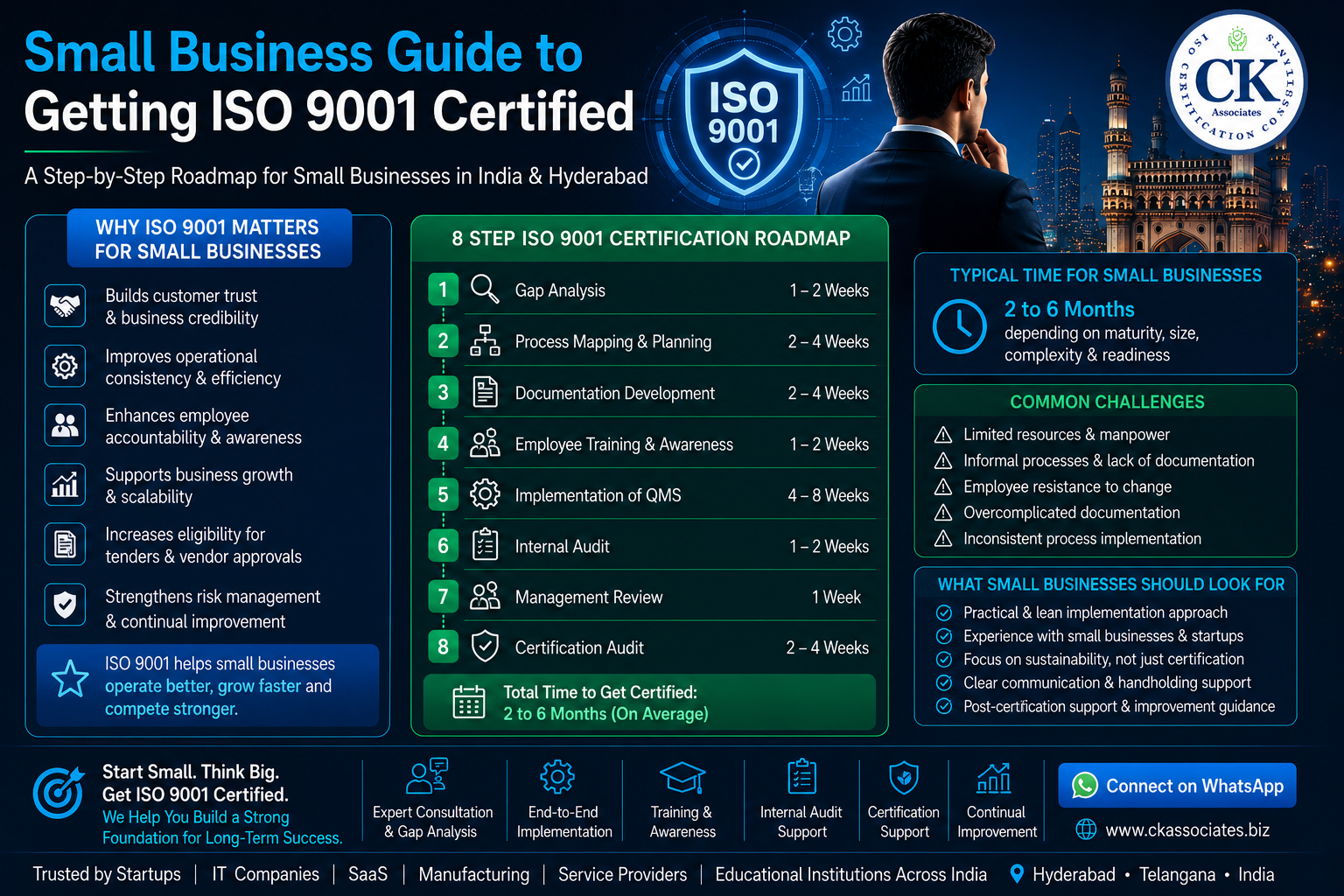
ISO 9001 certification helps small businesses improve operational consistency, customer satisfaction, process control, and business credibility through a structured Quality Management System (QMS).
Small businesses can typically achieve ISO 9001 certification within 2–6 months depending on:
- Existing operational maturity
- Leadership involvement
- Employee awareness
- Documentation readiness
- Process consistency
- Scope complexity
The implementation journey usually includes:
- Gap Analysis
- Process Mapping
- Documentation Development
- Employee Training
- Internal Audits
- Management Review
- Certification Audit
The most successful small business implementations focus on practical operational improvement rather than excessive documentation.
How can a small business get ISO 9001 certified?
A small business can achieve ISO 9001 certification by conducting a gap analysis, defining processes, creating practical documentation, training employees, implementing workflows, conducting internal audits, and completing certification audits through an accredited certification body.
Is ISO 9001 worth it for small businesses?
Yes. ISO 9001 helps small businesses improve operational consistency, customer trust, and scalability.
How long does ISO 9001 take for small businesses?
Most small businesses achieve certification within 2–6 months depending on operational maturity and implementation readiness.
Do startups need ISO 9001?
Many startups use ISO 9001 to strengthen governance, improve customer trust, and support enterprise sales growth.
Why ISO 9001 Matters for Small Businesses
Many small businesses assume ISO 9001 is designed only for large corporations.
That is no longer true.
Across Hyderabad, Telangana, Andhra Pradesh, and India, startups and small businesses are increasingly using ISO 9001 to strengthen:
- Customer trust
- Operational consistency
- Vendor credibility
- Tender eligibility
- Process maturity
- Scalability
- Risk visibility
- Business growth readiness
ISO 9001 helps small businesses build operational discipline early instead of fixing governance problems later during growth.
For growing businesses, this creates a major competitive advantage.
What Is ISO 9001?
ISO 9001 is an internationally recognized Quality Management System (QMS) standard.
It helps organizations create structured processes for:
- Customer satisfaction
- Operational consistency
- Risk-based thinking
- Continual improvement
- Process monitoring
- Accountability
- Leadership involvement
ISO 9001 is not just documentation.
It is a governance framework that helps organizations improve operational maturity.
Why Small Businesses Should Consider ISO 9001 Early
Stronger Customer Trust
Many enterprise customers prefer working with businesses that demonstrate structured operational controls.
ISO 9001 signals:
- Reliability
- Process consistency
- Governance maturity
- Quality commitment
This becomes especially valuable for:
- SaaS startups
- IT companies
- Manufacturing units
- Service providers
- Educational institutions
Better Operational Discipline
Small businesses often operate informally in the early stages.
As growth accelerates, this creates problems such as:
- Process inconsistency
- Employee confusion
- Customer complaints
- Delivery delays
- Lack of accountability
ISO 9001 introduces structured operational workflows that reduce chaos during scaling.
Improved Tender & Vendor Eligibility
Many government tenders and enterprise procurement systems prefer or require ISO-certified vendors.
ISO 9001 improves credibility during:
- Vendor onboarding
- Client evaluations
- Partnership discussions
- Procurement assessments
Easier Scaling
Businesses that implement operational governance early usually scale more effectively.
ISO 9001 supports:
- Process standardization
- Role clarity
- KPI visibility
- Risk management
- Continual improvement
Common Myths About ISO 9001 for Small Businesses
“ISO 9001 Is Only for Large Companies”
False.
Small businesses often benefit more because operational structure becomes easier to establish early.
“ISO Means Too Much Documentation”
Weak implementations create unnecessary paperwork.
Strong implementations focus on practical workflows and operational usability.
“ISO Certification Is Too Expensive”
Implementation costs vary based on:
- Organization size
- Complexity
- Existing maturity
- Scope
- Industry risks
Small businesses can implement ISO 9001 progressively and sustainably.
“ISO Is Just for Audits”
ISO 9001 should strengthen operations — not simply help businesses pass audits.
The best implementations improve:
- Customer satisfaction
- Accountability
- Process efficiency
- Operational visibility
Step-by-Step ISO 9001 Implementation Guide for Small Businesses
Step 1: Conduct a Gap Analysis
Gap analysis evaluates your current operational maturity against ISO 9001 requirements.
This identifies:
- Missing processes
- Documentation gaps
- Governance weaknesses
- Operational inconsistencies
- Improvement opportunities
Gap analysis creates implementation clarity and reduces delays.
Step 2: Define Business Processes
Small businesses should clearly define:
- Sales workflows
- Customer handling
- Service delivery
- Procurement
- Operations
- Complaint handling
- Corrective actions
The goal is operational consistency.
Step 3: Create Practical Documentation
ISO documentation should support operations — not complicate them.
Typical documents include:
- Quality Policy
- Quality Objectives
- SOPs
- Risk registers
- Process workflows
- Records formats
Avoid excessive documentation.
Practicality matters more than paperwork volume.
Step 4: Train Employees
Employees should understand:
- Their responsibilities
- Operational procedures
- Quality objectives
- Risk controls
- Escalation workflows
Employee awareness is critical for sustainability.
Step 5: Implement the System
This phase includes:
- Using operational procedures
- Generating records
- Monitoring processes
- Tracking KPIs
- Managing corrective actions
Implementation is where actual operational maturity develops.
Step 6: Conduct Internal Audits
Internal audits help businesses identify gaps before certification audits.
They evaluate whether processes are:
- Implemented correctly
- Followed consistently
- Operationally effective
- Sustainable
Step 7: Conduct Management Review
Leadership reviews:
- System performance
- Customer feedback
- Audit findings
- Risks
- Improvement opportunities
Management involvement is a major ISO success factor.
Step 8: Certification Audit
The certification body performs:
Stage 1 Audit
Review of:
- Documentation
- Scope
- Readiness
- Governance structure
Stage 2 Audit
Evaluation of:
- Operational implementation
- Employee awareness
- Evidence records
- Process effectiveness
How Long Does ISO 9001 Certification Take for Small Businesses?
Typical timelines:
- Small startups: 2–4 months
- Growing small businesses: 3–6 months
- Multi-location small businesses: 6–8 months
Timeline depends on:
- Existing maturity
- Leadership involvement
- Employee participation
- Operational complexity
- Documentation readiness
Common Challenges Small Businesses Face
Limited Resources
Small teams often manage multiple responsibilities simultaneously.
This can delay implementation.
Informal Processes
Many small businesses rely on verbal instructions instead of structured workflows.
ISO 9001 requires better process visibility.
Employee Resistance
Employees may initially view ISO as additional work.
Strong awareness programs reduce resistance.
Overcomplicated Consulting Approaches
Some consultants create enterprise-level systems that are too complex for small businesses.
Small businesses need lean, scalable governance systems.
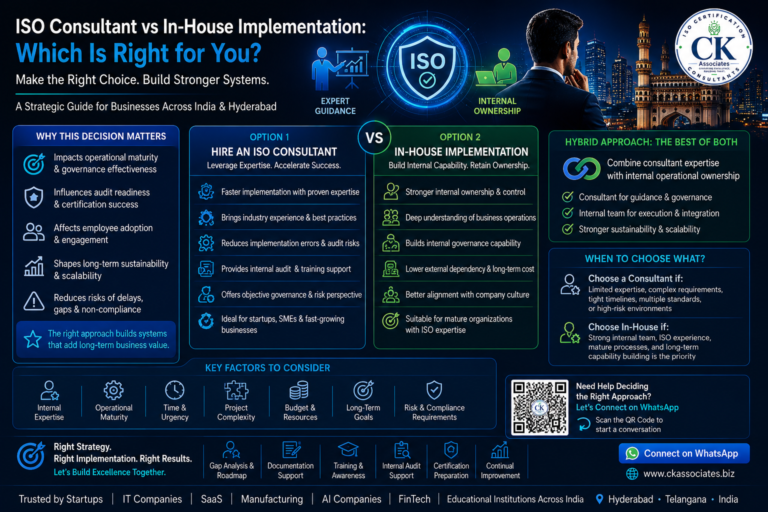
What Small Businesses Should Look for in an ISO Consultant
Practical Implementation Approach
The system should match actual business operations.
Small Business Experience
Small businesses require:
- Simpler workflows
- Lean documentation
- Faster implementation
- Scalable governance
Sustainability Focus
The best consultants build systems businesses can maintain internally after certification.
Governance Thinking
Strong consultants improve:
- Accountability
- Risk visibility
- Process ownership
- Operational maturity
Industry-Specific Examples
SaaS Startups
ISO 9001 helps SaaS businesses improve:
- Customer onboarding
- Support consistency
- Incident management
- Service quality
- Process scalability
Manufacturing Businesses
Manufacturing companies improve:
- Production consistency
- Traceability
- Supplier management
- Quality control
- Corrective action systems
Educational Institutions
Educational organizations use ISO 9001 to improve:
- Administrative consistency
- Student service quality
- Process accountability
- Operational standardization
Hyderabad and India ISO 9001 Trends
Businesses across Hyderabad and India increasingly use ISO 9001 to strengthen:
- Enterprise trust
- Vendor credibility
- Operational maturity
- Export readiness
- Governance visibility
Demand is especially increasing among:
- Startups
- SaaS businesses
- IT companies
- Manufacturing SMEs
- Educational institutions
ISO 9001 Is About Operational Maturity
The best ISO 9001 implementations are not audit-driven.
They are governance-driven.
Strong implementations help businesses:
- Scale sustainably
- Improve accountability
- Strengthen operations
- Improve customer confidence
- Reduce operational risk
This is why practical implementation matters.
ISO Consulting Cost Considerations
Implementation consulting is commonly structured around approximately ₹9,000 per manday depending on:
- Organization size
- Process complexity
- Operational maturity
- Number of departments
- Scope of implementation
What Is a Manday?
A manday refers to one consultant working day dedicated to implementation activities such as:
- Gap analysis
- Documentation support
- Internal audits
- Training
- Process workshops
- Audit preparation
Certification body fees are generally separate from consulting fees.
Build a Sustainable ISO 9001 System for Your Business
CK Associates helps startups and small businesses across Hyderabad and India implement scalable ISO 9001 systems focused on operational maturity, governance effectiveness, and long-term growth.