
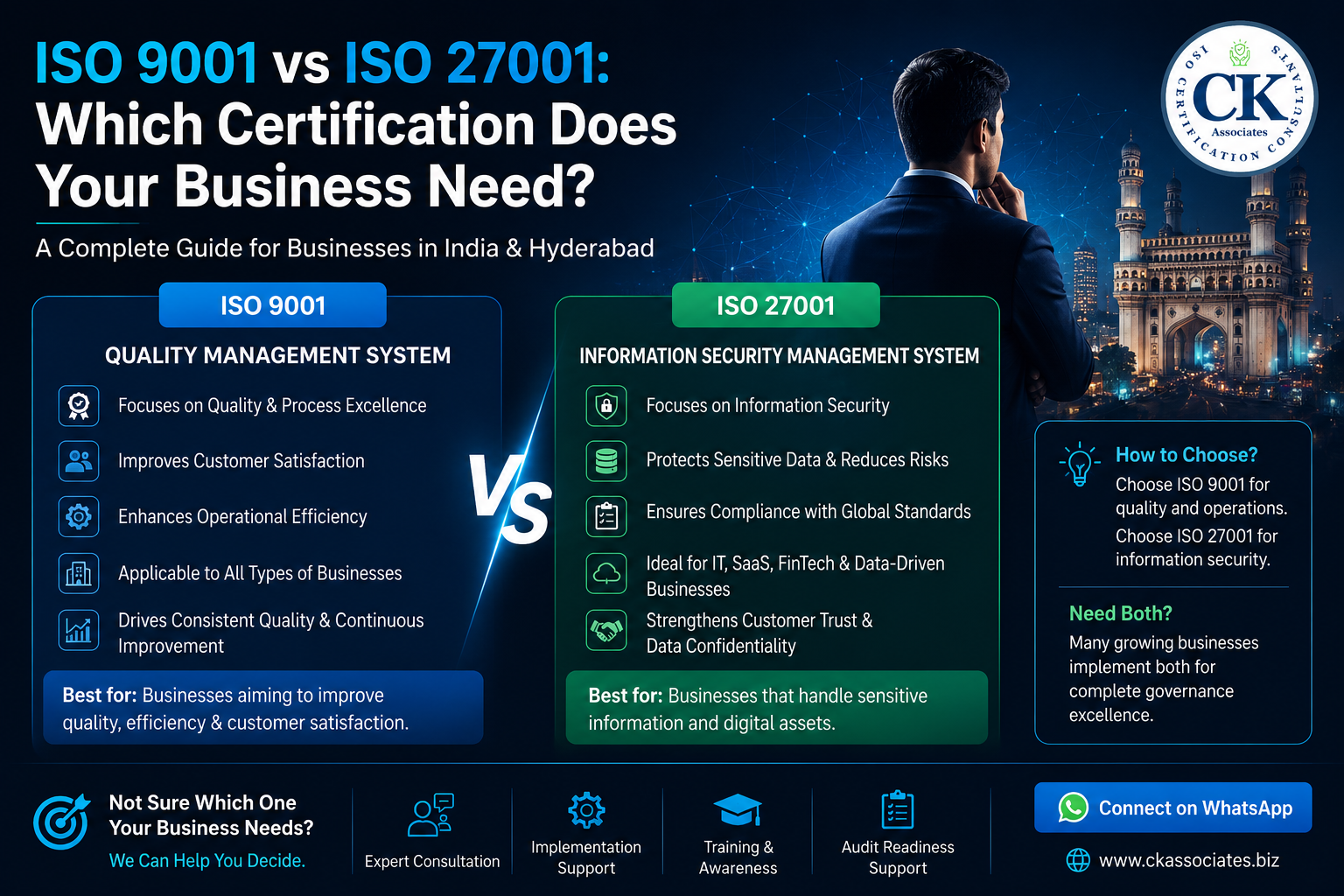
What Is the Difference Between ISO 9001 and ISO 27001?
ISO 9001 focuses on quality management, operational consistency, customer satisfaction, and process improvement.
ISO 27001 focuses on information security management, cybersecurity governance, risk management, and data protection.
Businesses choose ISO 9001 when they want to improve operational quality and business processes.
Businesses choose ISO 27001 when they need to protect sensitive information, improve cybersecurity maturity, and strengthen information security governance.
Many modern organizations eventually implement both standards together.
Introduction
One of the most common questions businesses ask before starting ISO certification is:
“Should we choose ISO 9001 or ISO 27001?”
This decision is increasingly important for:
- startups,
- SaaS companies,
- manufacturing businesses,
- IT organizations,
- cloud platforms,
- AI companies,
- and enterprise service providers.
Both ISO 9001 and ISO 27001 are globally recognized standards.
However, they solve very different business problems.
Choosing the wrong standard — or delaying the right one — can impact:
- customer trust,
- enterprise sales,
- operational maturity,
- cybersecurity readiness,
- compliance positioning,
- and long-term scalability.
This complete guide explains:
- the difference between ISO 9001 and ISO 27001,
- which industries typically require each standard,
- implementation complexity,
- pricing considerations,
- business benefits,
- and how organizations can decide which certification is most appropriate.
What Is ISO 9001?
ISO 9001 is the world’s most widely adopted Quality Management System (QMS) standard.
It focuses on:
- operational consistency,
- customer satisfaction,
- process control,
- continual improvement,
- governance maturity,
- and quality management.
ISO 9001 helps businesses build structured operational systems that improve:
- service delivery,
- production quality,
- process accountability,
- employee alignment,
- and organizational efficiency.
Core Focus Areas of ISO 9001
Process Standardization
Ensures processes are:
- repeatable,
- measurable,
- and controlled.
Customer Satisfaction
Helps organizations improve:
- customer experience,
- complaint management,
- and service consistency.
Continual Improvement
Organizations continuously evaluate:
- inefficiencies,
- operational risks,
- and improvement opportunities.
Operational Governance
ISO 9001 strengthens:
- accountability,
- departmental coordination,
- and process maturity.
What Is ISO 27001?
ISO 27001 is an Information Security Management System (ISMS) standard.
It focuses on:
- cybersecurity governance,
- information security,
- risk management,
- access control,
- incident response,
- and data protection.
ISO 27001 helps organizations systematically protect:
- customer data,
- business information,
- cloud infrastructure,
- digital assets,
- and operational systems.
Core Focus Areas of ISO 27001
Information Security Risk Management
Organizations identify:
- cybersecurity threats,
- vulnerabilities,
- and operational security risks.
Access Control
Controls who can access:
- systems,
- applications,
- customer data,
- and critical information assets.
Incident Management
Businesses establish processes for:
- security incidents,
- breach response,
- and recovery management.
Security Governance
ISO 27001 improves:
- organizational security maturity,
- compliance readiness,
- and cybersecurity accountability.
ISO 9001 vs ISO 27001 — Key Differences
| Area | ISO 9001 | ISO 27001 |
|---|---|---|
| Primary Focus | Quality Management | Information Security |
| Main Objective | Operational consistency | Cybersecurity governance |
| Ideal For | Manufacturing, operations, service businesses | IT, SaaS, cloud, fintech, AI companies |
| Core Risk Area | Process inefficiency | Security threats |
| Customer Benefit | Consistent quality | Data protection |
| Governance Focus | Process maturity | Security maturity |
| Standard Type | QMS | ISMS |
| Main Concern | Operational performance | Information protection |
Which Businesses Typically Need ISO 9001?
ISO 9001 is commonly suitable for:
- manufacturing companies,
- construction businesses,
- logistics companies,
- educational institutions,
- hospitals,
- service providers,
- retail businesses,
- and operationally intensive organizations.
Manufacturing Example
A Hyderabad manufacturing company may implement ISO 9001 to improve:
- production quality,
- supplier management,
- inspection controls,
- calibration systems,
- and customer satisfaction.
Which Businesses Typically Need ISO 27001?
ISO 27001 is commonly suitable for:
- IT companies,
- SaaS businesses,
- cloud platforms,
- fintech companies,
- AI startups,
- healthcare technology providers,
- outsourcing companies,
- and organizations handling sensitive information.
SaaS Example
A SaaS company serving enterprise clients may implement ISO 27001 to strengthen:
- cybersecurity governance,
- cloud security,
- customer trust,
- access management,
- and compliance maturity.
Can Businesses Implement Both ISO 9001 and ISO 27001?
Yes.
Many organizations eventually implement both standards together.
This is especially common for:
- SaaS companies,
- enterprise technology providers,
- managed service providers,
- AI companies,
- and scaling startups.
Benefits of Integrated Implementation
Organizations implementing both standards can improve:
- operational quality,
- cybersecurity governance,
- customer trust,
- risk management,
- compliance maturity,
- and enterprise readiness.
ISO 9001 vs ISO 27001 for Startups
Startups should evaluate:
- customer requirements,
- investor expectations,
- operational maturity,
- cybersecurity risks,
- and growth plans.
Startups Usually Choose ISO 9001 When:
- operational processes are inconsistent,
- service delivery needs improvement,
- quality management is weak,
- or customer complaints are increasing.
Startups Usually Choose ISO 27001 When:
- handling customer data,
- operating cloud platforms,
- selling to enterprise clients,
- or managing sensitive information.
ISO 9001 vs ISO 27001 for Manufacturing Businesses
Manufacturing businesses often prioritize ISO 9001 first.
Why?
Because manufacturing environments typically require:
- process consistency,
- production controls,
- supplier quality,
- operational traceability,
- and customer satisfaction systems.
However, manufacturers implementing:
- smart manufacturing,
- IoT systems,
- cloud ERP,
- or digital operations
may also require ISO 27001 later.
ISO 9001 vs ISO 27001 for IT & SaaS Companies
IT companies often prioritize ISO 27001 because enterprise customers increasingly evaluate:
- cybersecurity maturity,
- risk management,
- access controls,
- and data protection.
However, many IT companies later implement ISO 9001 to improve:
- service delivery,
- operational scalability,
- customer support processes,
- and governance maturity.
ISO 9001 vs ISO 27001 for AI Companies
AI companies increasingly require:
- operational governance,
- cybersecurity governance,
- ethical AI frameworks,
- and AI accountability.
Many AI businesses eventually pursue:
- ISO 9001,
- ISO 27001,
- and ISO 42001.
This combination supports:
- quality management,
- information security,
- and AI governance maturity.
Implementation Complexity Comparison
| Factor | ISO 9001 | ISO 27001 |
| Documentation Complexity | Medium | High |
| Technical Requirements | Moderate | Higher |
| Cybersecurity Focus | Low | Very High |
| Operational Process Mapping | High | Medium |
| Risk Management Depth | Medium | High |
| Employee Awareness | Important | Critical |
| IT Involvement | Moderate | Significant |
ISO 9001 vs ISO 27001 Cost Considerations
Implementation pricing depends on:
- organization size,
- operational maturity,
- number of departments,
- locations,
- and implementation complexity.
At CK Associates, implementation consulting is commonly structured around:
- approximately ₹9,000 per manday
A “manday” means: one consultant working for one business day.
Certification body fees are generally separate.
Common Mistakes Businesses Make
Choosing ISO 9001 Only Because Competitors Have It
Businesses should evaluate:
- operational risks,
- cybersecurity exposure,
- customer requirements,
- and growth strategy.
Delaying ISO 27001 Until Enterprise Customers Demand It
Many SaaS businesses wait too long before strengthening cybersecurity governance.
This can delay:
- enterprise sales,
- procurement approvals,
- and customer onboarding.
Treating ISO Certification as Only Documentation
Professional implementation should improve:
- governance maturity,
- operational sustainability,
- cybersecurity resilience,
- and organizational accountability.
Questions Businesses Should Ask Before Choosing Between ISO 9001 and ISO 27001
1. What operational risks are most important?
2. Are enterprise customers asking about cybersecurity?
3. Is process inconsistency affecting operations?
4. Do we handle sensitive customer information?
5. Are we scaling rapidly?
6. Do we require stronger g