Hiring an ISO consultant is not simply about finding someone who can prepare documents or help pass an audit.
The consultant you select directly impacts:
- operational maturity,
- governance effectiveness,
- cybersecurity readiness,
- employee adoption,
- audit preparedness,
- customer trust,
- and long-term scalability.
Unfortunately, many organizations across India choose consultants based only on:
- lowest pricing,
- unrealistic promises,
- or fastest certification timelines.
This often leads to:
- weak implementation,
- impractical systems,
- employee resistance,
- operational confusion,
- audit nonconformities,
- and management systems that are never actually used.
Whether your organization is:
- a startup,
- SaaS company,
- manufacturing business,
- educational institution,
- AI company,
- or enterprise operation,
asking the right questions before hiring an ISO consultant is critical.
This guide explains:
- the most important questions businesses should ask,
- how to evaluate consultant capabilities,
- warning signs to watch for,
- and how organizations can select a consultant capable of supporting long-term operational success.
Why Businesses Must Properly Evaluate ISO Consultants
ISO implementation affects far more than certification.
Modern standards such as:
directly influence:
- governance maturity,
- process consistency,
- cybersecurity controls,
- AI governance,
- operational accountability,
- and enterprise trust.
A weak consultant may create:
- documentation overload,
- unnecessary bureaucracy,
- disconnected processes,
- poor employee understanding,
- and ineffective operational controls.
A professional consultant should help businesses:
- improve governance,
- strengthen compliance culture,
- align operational processes,
- and build sustainable management systems.
The Difference Between Documentation Vendors and Real ISO Consultants
One of the biggest mistakes businesses make is assuming all ISO consultants provide the same value.
They do not.
| Documentation Vendor |
Professional ISO Consultant |
| Generic templates |
Customized implementation |
| Audit-only mindset |
Governance maturity focus |
| Minimal business involvement |
Deep operational alignment |
| No employee training |
Organizational adoption support |
| Fast document delivery |
Sustainable implementation |
| No internal audits |
Audit readiness support |
| Reactive approach |
Risk-based governance thinking |
Professional implementation requires:
- process understanding,
- operational mapping,
- risk evaluation,
- department coordination,
- and long-term governance planning.
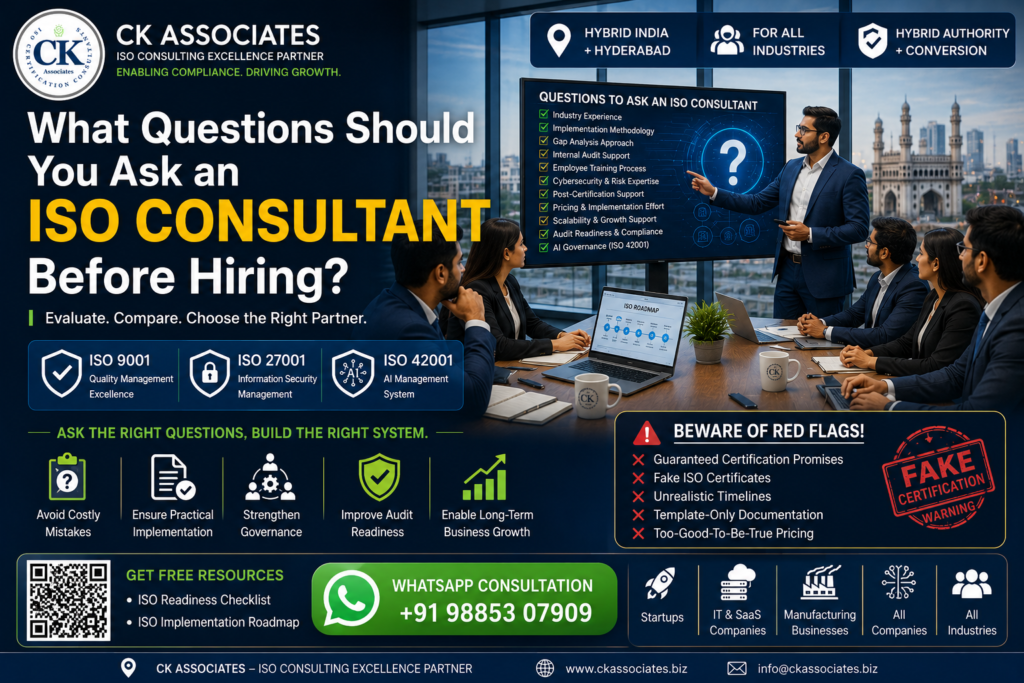
The Most Important Questions to Ask an ISO Consultant
1. What Industries Do You Specialize In?
Industry expertise matters significantly.
Different sectors require different implementation approaches.
Manufacturing Companies
Need:
- supplier quality systems,
- calibration controls,
- production traceability,
- maintenance planning.
IT & SaaS Companies
Require:
- cybersecurity governance,
- cloud security controls,
- access management,
- incident response frameworks.
AI Companies
May require:
- ethical AI governance,
- AI lifecycle management,
- accountability frameworks,
- ISO 42001 alignment.
A consultant with relevant industry understanding can create more practical systems.
2. How Do You Customize ISO Implementation?
This is one of the most important evaluation questions.
Be cautious if the consultant:
- immediately shares templates,
- avoids process discussions,
- or uses identical documentation for multiple organizations.
Professional consultants should:
- understand workflows,
- evaluate operational maturity,
- identify business risks,
- and align systems with real operations.
3. Do You Conduct Gap Analysis?
Gap analysis is critical before implementation begins.
A professional consultant should evaluate:
- existing processes,
- documentation maturity,
- operational risks,
- compliance gaps,
- and implementation readiness.
Without gap analysis:
- implementation becomes reactive,
- controls become disconnected,
- and audit preparation weakens.
4. Do You Conduct Internal Audits?
Internal audits are essential for operational maturity.
Businesses should confirm whether the consultant supports:
- internal audits,
- audit planning,
- corrective actions,
- evidence verification,
- and audit readiness preparation.
Internal audits help identify:
- hidden implementation gaps,
- weak controls,
- process inconsistencies,
- and compliance risks.
5. How Do You Train Employees?
ISO systems fail when employees do not understand them.
Businesses should ask:
- How are awareness sessions conducted?
- Will departments receive process training?
- How are internal auditors trained?
- How is operational adoption encouraged?
Professional implementation requires employee involvement.
Without awareness:
- documentation becomes disconnected from operations,
- employees resist processes,
- and audits become difficult.
6. What Is Your Implementation Methodology?
A professional consultant should clearly explain their implementation framework.
Typical professional implementation stages include:
- Gap Analysis
- Planning
- Documentation Alignment
- Process Integration
- Training & Awareness
- Internal Audits
- Corrective Actions
- Certification Readiness
- Certification Coordination
- Continual Improvement
If the consultant cannot clearly explain their methodology, this is a warning sign.
7. How Do You Support Audit Readiness?
Certification audits require preparation.
Businesses should ask:
- How is evidence reviewed?
- How are employees prepared?
- How are nonconformities handled?
- How are audit findings resolved?
Professional consultants help organizations:
- strengthen confidence,
- reduce audit risks,
- and improve preparedness.
8. Do You Provide Post-Certification Support?
Certification is not the end of the journey.
Organizations require ongoing support for:
- surveillance audits,
- management reviews,
- corrective actions,
- process improvements,
- compliance updates.
Long-term support improves sustainability.
9. How Is Pricing Structured?
This question is extremely important.
Professional implementation consulting is usually:
- effort-based,
- complexity-driven,
- and operationally scoped.
At CK Associates, implementation consulting is commonly structured around:
- approximately ₹9,000 per manday
depending on:
- implementation complexity,
- organization size,
- operational maturity,
- number of locations,
- and certification scope.
A “manday” means:
one consultant working for one business day.
Businesses should avoid vague:
- “instant package pricing”
- or unrealistically low-cost promises.
10. How Will the System Scale as Our Business Grows?
This question is especially important for:
- startups,
- SaaS companies,
- and rapidly scaling organizations.
Poorly designed systems create:
- operational friction,
- documentation overload,
- employee resistance,
- and governance inefficiencies.
Professional consultants build:
- scalable governance,
- sustainable controls,
- and operationally practical systems.
11. How Do You Support Cybersecurity Governance?
For:
- IT companies,
- SaaS businesses,
- cloud platforms,
- fintech companies,
- and AI organizations,
cybersecurity governance is critical.
Businesses should ask:
- How do you address ISO 27001 controls?
- How do you support risk management?
- How are access controls implemented?
- How are incidents managed?
- How do you support cloud governance?
12. Do You Support AI Governance and ISO 42001?
AI governance is becoming increasingly important.
Organizations developing:
- AI systems,
- machine learning platforms,
- automation products,
- or intelligent SaaS solutions
should evaluate whether the consultant understands:
- AI governance,
- ethical AI,
- AI accountability,
- AI lifecycle controls,
- and ISO 42001 implementation.
Questions Startups Should Specifically Ask
Startups require:
- scalability,
- flexibility,
- lean governance,
- and operational agility.
Important startup-focused questions include:
- How do you avoid overcomplicated systems?
- How can implementation scale with growth?
- How do you balance compliance with agility?
- How do you support investor-facing governance maturity?
Questions Manufacturing Companies Should Ask
Manufacturing businesses should evaluate:
- production controls,
- supplier management,
- quality governance,
- maintenance systems,
- calibration management.
Questions include:
- How do you manage production traceability?
- How do you structure supplier controls?
- How do you support inspection processes?
Questions IT & SaaS Companies Should Ask
IT companies should evaluate:
- cybersecurity maturity,
- cloud governance,
- data security,
- incident response,
- access management.
Questions include:
- How do you align ISO 27001 controls?
- How do you support cloud governance?
- How do you structure access controls?
Questions AI Companies Should Ask
AI companies should ask:
- How do you support ethical AI governance?
- How do you address AI accountability?
- How do you manage AI risk frameworks?
- How do you support ISO 42001 implementation?
Be cautious if the consultant:
- guarantees certification,
- avoids technical questions,
- cannot explain methodology,
- provides unrealistic timelines,
- avoids internal audits,
- lacks industry examples,
- or focuses only on documentation.
These are major warning signs.
Fixed Package Pricing
Some consultants use fixed-cost packages.
However, implementation complexity varies significantly between organizations.
Manday-Based Pricing
Professional consultants often use:
This is generally more transparent because implementation effort depends on:
- operational complexity,
- number of departments,
- governance maturity,
- and implementation scope.
Hyderabad & India Business Perspective
Businesses across:
- Hyderabad,
- Telangana,
- Andhra Pradesh,
- Bengaluru,
- Pune,
- Chennai,
- and Mumbai
are increasingly pursuing ISO standards to improve:
- operational credibility,
- cybersecurity maturity,
- enterprise trust,
- and governance capability.
Enterprise customers now evaluate suppliers based on:
- compliance maturity,
- operational reliability,
- risk management,
- and governance structure.
This makes consultant selection even more important.
Before hiring an ISO consultant, businesses should verify:
✔ Industry expertise
✔ Gap analysis capability
✔ Internal audit support
✔ Employee training process
✔ Governance understanding
✔ Cybersecurity knowledge
✔ AI governance awareness
✔ Operational scalability approach
✔ Post-certification support
✔ Transparent pricing structure
✔ Practical implementation methodology
FAQ Section
What is the most important question to ask an ISO consultant?
Businesses should ask how the consultant customizes implementation based on operational realities and industry requirements.
Can an ISO consultant guarantee certification?
No. Certification decisions are made independently by accredited certification bodies.
Why does industry experience matter?
Different industries require different operational controls, governance structures, and compliance approaches.
What should startups look for in an ISO consultant?
Startups should prioritize scalability, practical implementation, and lightweight governance structures.
Why are internal audits important?
Internal audits help organizations identify gaps before certification audits and improve operational maturity.
Looking for a Practical ISO Implementation Partner?
If your organization is evaluating:
- ISO 9001,
- ISO 27001,
- ISO 42001,
- ISO 14001,
- or ISO 45001
connect with CK Associates for governance-focused ISO implementation designed for operational sustainability and long-term compliance maturity.
Free Resources