
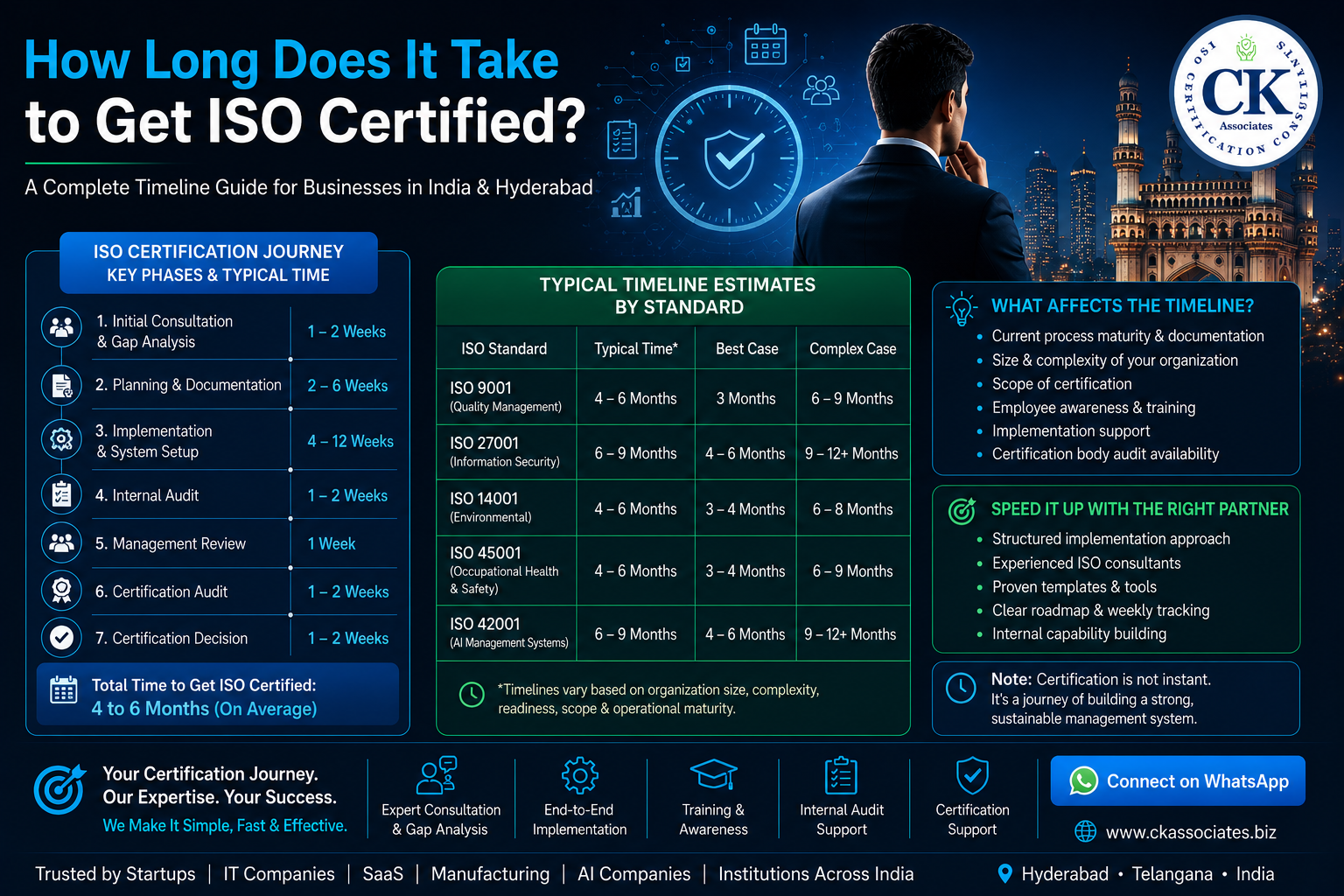
The time required to get ISO certified depends on several factors including organization size, operational maturity, industry complexity, employee readiness, and the specific ISO standard being implemented.
Typical timelines are:
- Small businesses: 2–4 months
- Medium organizations: 4–8 months
- Large enterprises: 6–12+ months
ISO 9001 implementations are often faster than ISO 27001 because information security governance requires deeper risk assessments, technical controls, and operational monitoring.
The certification journey generally includes:
- Gap Analysis
- Documentation Development
- Implementation
- Employee Awareness & Training
- Internal Audits
- Management Review
- Certification Audit
- Corrective Actions
Organizations with strong operational maturity usually achieve certification faster because many governance processes already exist.
Understanding ISO Certification Timelines
One of the most common questions businesses ask before beginning ISO implementation is:
“How long will it take to get ISO certified?”
The answer depends on far more than documentation.
ISO certification timelines are influenced by:
- Organizational maturity
- Leadership involvement
- Employee awareness
- Existing operational controls
- Industry complexity
- Number of departments
- Regulatory exposure
- Risk management maturity
- Scope of implementation
Many organizations assume ISO certification is simply a paperwork exercise.
In reality, certification evaluates whether governance systems are operationally effective.
That means timelines vary significantly between organizations.
Average ISO Certification Timelines
Small Businesses
Typical timeline: 2–4 months
This usually applies to:
- Small startups
- Small IT companies
- Early-stage SaaS businesses
- Small service organizations
These businesses often have:
- Fewer employees
- Simpler operations
- Smaller implementation scope
- Faster decision-making
However, small companies may still face delays if:
- Processes are undocumented
- Leadership involvement is low
- Employees resist implementation
- Risk management is immature
Medium-Sized Businesses
Typical timeline: 4–8 months
This category often includes:
- Manufacturing companies
- Mid-sized IT firms
- Educational institutions
- Healthcare organizations
- Multi-department businesses
Implementation complexity increases because:
- More departments require alignment
- Operational risks increase
- Documentation volume expands
- Internal coordination becomes harder
Large Enterprises
Typical timeline: 6–12+ months
Large organizations usually require:
- Multi-location implementation
- Enterprise governance integration
- Department-wide controls
- Advanced internal audit structures
- Larger evidence collection systems
ISO certification at enterprise scale becomes a governance transformation initiative rather than a simple compliance exercise.
ISO Standard-Specific Timelines
ISO 9001 Certification Timeline
ISO 9001 implementations are generally faster because quality management systems are often already partially embedded in operations.
Typical timeline:
- Small organizations: 2–4 months
- Medium organizations: 4–6 months
- Large organizations: 6–10 months
Key activities include:
- Process mapping
- Quality objectives
- SOP development
- Internal audits
- Corrective action systems
- Continual improvement mechanisms
ISO 27001 Certification Timeline
ISO 27001 usually takes longer because information security governance is more technically intensive.
Typical timeline:
- Small IT/SaaS businesses: 4–6 months
- Medium businesses: 6–9 months
- Enterprise implementations: 9–15 months
Additional complexity comes from:
- Risk assessments
- Asset inventories
- Security controls
- Access management
- Incident response
- Supplier security reviews
- Technical monitoring
Cybersecurity governance requires deeper operational integration.
ISO 42001 Timeline
AI governance systems are emerging rapidly.
Organizations implementing ISO 42001 may require additional time for:
- AI governance structures
- Risk identification
- Ethical AI controls
- Data governance
- Accountability frameworks
- Bias mitigation systems
This is especially relevant for:
- AI startups
- SaaS platforms
- Enterprise AI teams
- Data-driven organizations
The 8 Stages of ISO Certification
Stage 1: Gap Analysis
The implementation journey begins with understanding current maturity.
Gap analysis identifies:
- Missing controls
- Documentation gaps
- Governance weaknesses
- Compliance risks
- Operational inconsistencies
This stage usually takes:
- 1–2 weeks for small businesses
- 2–4 weeks for medium organizations
- Longer for enterprise operations
Stage 2: Documentation Development
Organizations create and structure:
- Policies
- Procedures
- SOPs
- Risk registers
- Process workflows
- Governance records
Documentation timelines depend on:
- Existing process maturity
- Number of departments
- Standard complexity
- Customization requirements
Stage 3: Operational Implementation
This is the most important phase.
Implementation includes:
- Process adoption
- Employee awareness
- Operational controls
- Monitoring systems
- KPI tracking
- Risk management
This stage often determines whether certification becomes sustainable.
Stage 4: Employee Training & Awareness
Employees must understand:
- Policies
- Procedures
- Responsibilities
- Escalation processes
- Risk controls
Auditors frequently interview employees to verify implementation effectiveness.
Stage 5: Internal Audits
Internal audits evaluate whether processes are:
- Implemented correctly
- Followed consistently
- Measurable
- Effective
Internal audits also help identify corrective actions before certification audits.
Stage 6: Management Review
Leadership evaluates:
- System effectiveness
- Performance trends
- Risk status
- Audit results
- Improvement opportunities
Management review demonstrates governance involvement.
Stage 7: Certification Audit
The certification body performs:
Stage 1 Audit
Review of:
- Documentation
- Scope
- Readiness
- Governance structure
Stage 2 Audit
Evaluation of:
- Operational implementation
- Employee awareness
- Evidence records
- Process effectiveness
Stage 8: Corrective Actions
If nonconformities are identified, organizations must:
- Investigate root causes
- Implement corrections
- Provide evidence
- Demonstrate effectiveness
The speed of corrective action closure affects final certification timelines.
What Delays ISO Certification?
Lack of Leadership Involvement
Without leadership engagement:
- Decisions slow down
- Employees lose direction
- Priorities shift
- Governance weakens
Poor Documentation Quality
Generic templates often create:
- Process confusion
- Operational mismatch
- Audit findings
- Sustainability problems
Employee Resistance
Implementation slows when employees:
- Do not understand the system
- Resist changes
- Ignore procedures
- Avoid documentation practices
Weak Operational Controls
Organizations without defined controls often require more implementation time.
This is especially common in:
- Fast-growing startups
- Informal operations
- Rapidly scaling SaaS businesses
- Multi-location operations
Delayed Evidence Generation
Auditors require objective evidence.
Organizations need time to generate:
- Monitoring records
- Audit reports
- Training records
- Risk reviews
- KPI data
- Management review evidence
How Businesses Can Accelerate ISO Certification
Start with a Gap Analysis
Gap analysis creates implementation clarity and avoids unnecessary delays.
Involve Leadership Early
Leadership support accelerates:
- Resource allocation
- Employee participation
- Decision-making
- Governance adoption
Build Practical Systems
The best ISO systems are operationally usable.
Avoid overcomplicated documentation.
Train Employees Continuously
Awareness programs improve implementation consistency.
Conduct Strong Internal Audits
Internal audits reduce certification surprises.
Industry-Specific Examples
SaaS Companies
SaaS organizations often move quickly operationally but may lack structured governance.
ISO 27001 implementation may take longer because organizations need:
- Asset inventories
- Security policies
- Access controls
- Risk treatment plans
- Incident response systems
Manufacturing Companies
Manufacturing businesses often already have operational controls but may require:
- Better traceability
- Calibration systems
- Supplier monitoring
- Documentation consistency
ISO 9001 timelines are often faster in mature manufacturing environments.
Educational Institutions
Educational organizations may require additional alignment across:
- Academic departments
- Administration
- IT operations
- Student data governance
Hyderabad and India ISO Certification Trends
Across Hyderabad, Telangana, Andhra Pradesh, and India, businesses are increasingly pursuing ISO certifications to strengthen:
- Vendor credibility
- Enterprise trust
- Export readiness
- Cybersecurity governance
- AI governance maturity
- Operational consistency
The strongest demand is visible among:
- IT companies
- SaaS startups
- Pharma manufacturers
- Educational institutions
- AI-focused businesses
Organizations are increasingly prioritizing governance maturity over certificate-focused implementation.
ISO Certification Is a Maturity Journey
Businesses should avoid unrealistic expectations like:
- “One-week certification”
- “Instant ISO approval”
- “Documentation-only certification”
Sustainable certification req