
How Much Does ISO Certification Cost?
ISO certification costs vary depending on company size, ISO standard, business complexity, employee count, locations, consultant involvement, and certification body fees.
For small businesses in India, ISO certification projects may start from basic implementation budgets, while larger enterprises with complex operations may require significantly higher investments.
The total cost generally includes:
- Consultant fees
- Certification body audit charges
- Documentation support
- Employee training
- Internal audits
- Corrective actions
- Surveillance audits
- System maintenance
Introduction
One of the biggest concerns businesses have before starting ISO certification is:
“How much will ISO certification actually cost?”
Unfortunately, many organizations receive confusing quotations without understanding:
- What is included
- What is excluded
- Hidden expenses
- Long-term maintenance costs
- Certification body pricing differences
- Consultant pricing models
This creates uncertainty and sometimes leads businesses to select the cheapest option instead of the right implementation strategy.
The truth is:
ISO certification should not be viewed as only a compliance expense.
It should be viewed as a business investment in:
- Operational efficiency
- Governance maturity
- Customer trust
- Risk reduction
- International credibility
- Process consistency
- Long-term scalability
However, businesses still need clear cost visibility.
This guide explains the real ISO certification cost structure for businesses across Hyderabad and India.
What Factors Affect ISO Certification Costs?
ISO certification costs depend on the ISO standard, organization size, employee count, operational complexity, number of business locations, consultant involvement, audit duration, and certification body pricing.
Small businesses usually have lower implementation costs, while multi-location enterprises and highly regulated industries require larger compliance investments.
What Is Included in ISO Certification Costs?
ISO certification costs usually include consultant fees, certification body audit charges, implementation support, employee training, documentation development, internal audits, corrective actions, and surveillance audit maintenance.
Businesses should evaluate both short-term certification expenses and long-term compliance sustainability costs.
Main Components of ISO Certification Costs
1. ISO Consultant Fees
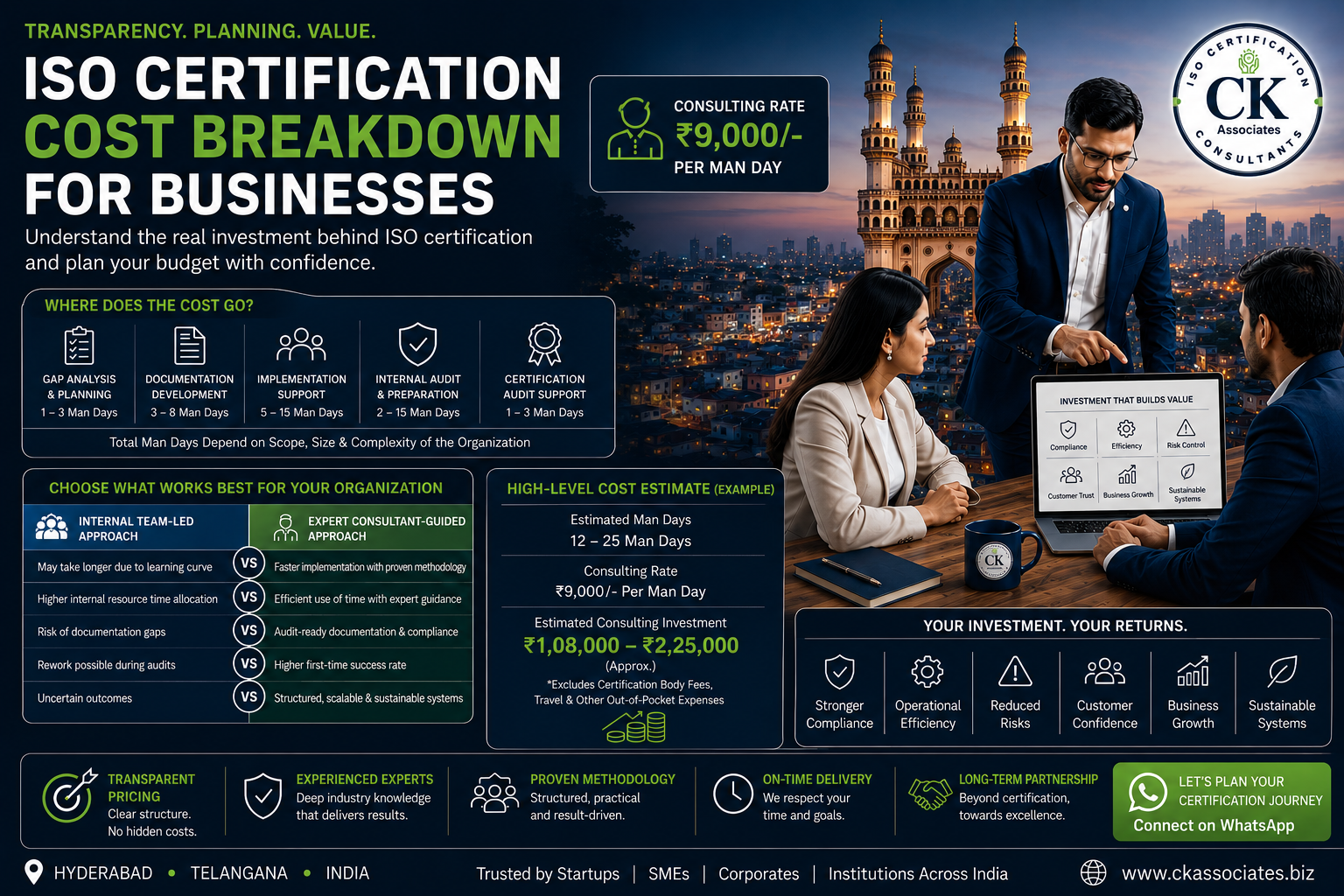
At CK Associates, ISO consulting support is typically structured around a professional consulting rate of ₹9,000 per man day depending on:
- ISO standard scope
- Industry complexity
- Operational maturity
- Number of departments
- Employee count
- Multi-location requirements
- Timeline expectations
Professional ISO consulting support generally includes:
- GAP analysis
- Documentation guidance
- Process mapping
- Employee awareness training
- Internal audits
- Certification readiness support
- Governance alignment
- Post-certification guidance
Businesses should avoid selecting consultants based only on the lowest price.
Cheap implementations often create:
- Poor documentation
- Audit failures
- Sustainability problems
- Employee confusion
- Rework costs
2. Certification Body Audit Charges
Certification bodies charge separately for:
- Stage 1 audit
- Stage 2 audit
- Surveillance audits
- Recertification audits
Audit pricing depends on:
- Employee count
- Business locations
- Industry risk
- Audit duration
- Standard type
Accredited certification bodies may charge more but usually provide stronger market credibility.
3. Documentation and Implementation Costs
Some organizations require:
- SOP development
- Policy creation
- Risk registers
- Compliance templates
- Digital documentation systems
Complex industries generally require more extensive documentation support.
4. Employee Training Costs
Training may include:
- ISO awareness sessions
- Internal auditor training
- Process owner training
- Risk management training
Employee awareness directly impacts implementation success.
5. Internal Audit Costs
Businesses may:
- Train internal auditors OR
- Outsource internal audits
Internal audits are mandatory for most ISO standards.
6. Corrective Action Costs
If nonconformities occur during audits, organizations may need:
- Process corrections
- Documentation updates
- Additional training
- System redesign
Poor implementation increases these costs.
7. Surveillance Audit Costs
ISO certification is not permanent.
Most certifications require:
- Annual surveillance audits
- Ongoing compliance monitoring
- Continuous improvement activities
Businesses should budget for long-term maintenance.
High-Level ISO Certification Cost Estimates
Small Businesses
Typical Characteristics
- 5–25 employees
- Single location
- Simple operations
Estimated Cost Range
Lower to moderate implementation budgets depending on standard and consultant scope.
Medium Businesses
Typical Characteristics
- 25–200 employees
- Multiple departments
- Moderate operational complexity
Estimated Cost Range
Moderate to advanced implementation investment depending on risk profile and audit duration.
Large Enterprises
Typical Characteristics
- Multiple locations
- Complex governance structures
- International operations
- Regulatory exposure
Estimated Cost Range
Higher enterprise-level investment due to operational scale and audit complexity.
ISO Standards and Cost Differences
ISO 9001
Generally considered one of the most affordable standards for implementation.
ISO 27001
Usually higher due to:
- Risk assessments
- Information security controls
- Technical governance requirements
ISO 14001
Environmental compliance may require:
- Legal registers
- Impact assessments
- Monitoring systems
ISO 45001
Health and safety implementation often involves:
- Hazard identification
- Safety controls
- Worker participation programs
ISO 42001
AI governance frameworks may involve:
- Data governance
- Risk assessments
- AI lifecycle controls
- Responsible AI policies
Hidden Costs Businesses Often Ignore
Operational Time Investment
Internal teams spend significant time on:
- Meetings
- Documentation reviews
- Training
- Audits
Employee Productivity Impact
Poorly managed implementation may temporarily affect operations.
Rework Costs
Weak implementations create:
- Audit failures
- Process redesign
- Corrective action expenses
Consultant Dependency
Some consultants create systems businesses cannot maintain independently.
This increases long-term dependency costs.
ISO Implementation Approaches Comparison
| Factor | Internal Team-Led Approach | Expert Consultant-Guided Approach |
|---|---|---|
| Initial Investment | Lower upfront consulting involvement | Structured professional investment |
| Implementation Speed | Usually slower | Faster and more organized |
| Audit Readiness | Depends on internal expertise | Higher preparedness |
| Documentation Quality | Variable | More structured and practical |
| Employee Training | Limited | Guided implementation support |
| Sustainability | Depends on governance maturity | Usually stronger and scalable |
| Risk of Rework | Higher | Lower |
| Long-Term Governance | Inconsistent | Better operational alignment |
Real-World Balance
Real Client-Oriented Implementation Perspective
Several growing IT, SaaS, manufacturing, healthcare, and educational organizations across Hyderabad have successfully implemented ISO systems through structured consultant-guided governance models.
Businesses similar to:
- Startup technology companies
- Manufacturing exporters
- SaaS organizations
- Educational institutions
- Healthcare providers
Often benefit from:
- Faster certification readiness
- Better documentation clarity
- Reduced operational disruption
- Improved employee awareness
- Stronger surveillance audit performance
Organizations with strong internal governance teams may handle parts of implementation internally, while still leveraging professional ISO consulting expertise for strategic alignment and audit preparedness.
Poor Implementation Risk Example
Some businesses select low-cost implementation models that focus only on obtaining certificates quickly.
This often creates:
- Generic documentation
- Weak employee adoption
- Audit stress
- Long-term compliance gaps
- Difficult surveillance audits
- System sustainability issues
The lowest quotation is rarely the smartest long-term business decision.
Organizations should evaluate:
- Consultant experience
- Governance capability
- Industry understanding
- Sustainability approach
- Post-certification support
- Client implementation quality
How Businesses Can Reduce ISO Certification Costs
Build Internal Ownership
Employee involvement improves sustainability.
Avoid Over-Documentation
Complex systems increase maintenance costs.
Choose the Right Consultant
Experienced consultants reduce rework.
Select Accredited Certification Bodies Carefully
Not all certification bodies offer the same market value.
Plan Long-Term Governance
Certification is an ongoing process.
What Businesses Should Ask Before Approving ISO Quotations
Important Questions
What is included in the consultant fee?
Are surveillance audits included?
Will employee training be provided?
Is documentation customized?
What happens if nonconformities occur?
Are certification body charges separate?
What post-certification support is available?
Will the system remain maintainable?
These questions improve pricing transparency.
The CK Associates Approach
At CK Associates, ISO consulting is not treated as a documentation exercise or a short-term certification project.
Our approach focuses on building scalable, practical, and governance-driven management systems that strengthen long-term business performance.
We help organizations across Hyderabad and India implement ISO frameworks that are:
- Practical for daily operations
- Easy for teams to adopt
- Scalable with business growth
- Audit-ready and sustainable
- Focused on operational excellence
- Built for long-term compliance maturity
Our implementation methodology emphasizes:
✔ GAP Analysis & Strategic Planning
✔ Customized Documentation Support
✔ Employee Awareness & Training
✔ Risk-Based Governance Frameworks
✔ Internal Audit & Compliance Readiness
✔ Sustainable Process Integration
✔ Post-Certification Support & Improvement
Rather than creating complex systems that become operational burdens, CK Associates focuses on building maintainable compliance frameworks aligned with real business workflows.
With over 20+ years of experience and 450+ successful certifications, our objective is to help businesses transform ISO certification into a strategic operational advantage — not just an audit requirement.
Why Businesses Choose CK Associates
- Governance-Focused Implementation
- Industry-Specific Expertise
- Practical & Maintainable Systems
- Transparent Consulting Approach
- Faster Audit Readiness
- Long-Term Compliance Support
- Scalable Documentation Structures
- Strong Client-Centric Engagement
Industries We Support
- Manufacturing
- IT & SaaS
- Healthcare
- Educational Institutions
- Startups
- Logistics
- Engineering
- Infrastructure
- Service Organizations
- MSMEs & Enterprises
Our Vision
To help organizations build future-ready governance systems that improve operational maturity, customer confidence, compliance strength, and sustainable business growth.
CTA
Build a smarter ISO system with CK Associates.