
How Do Businesses Choose the Best ISO Certification Body?
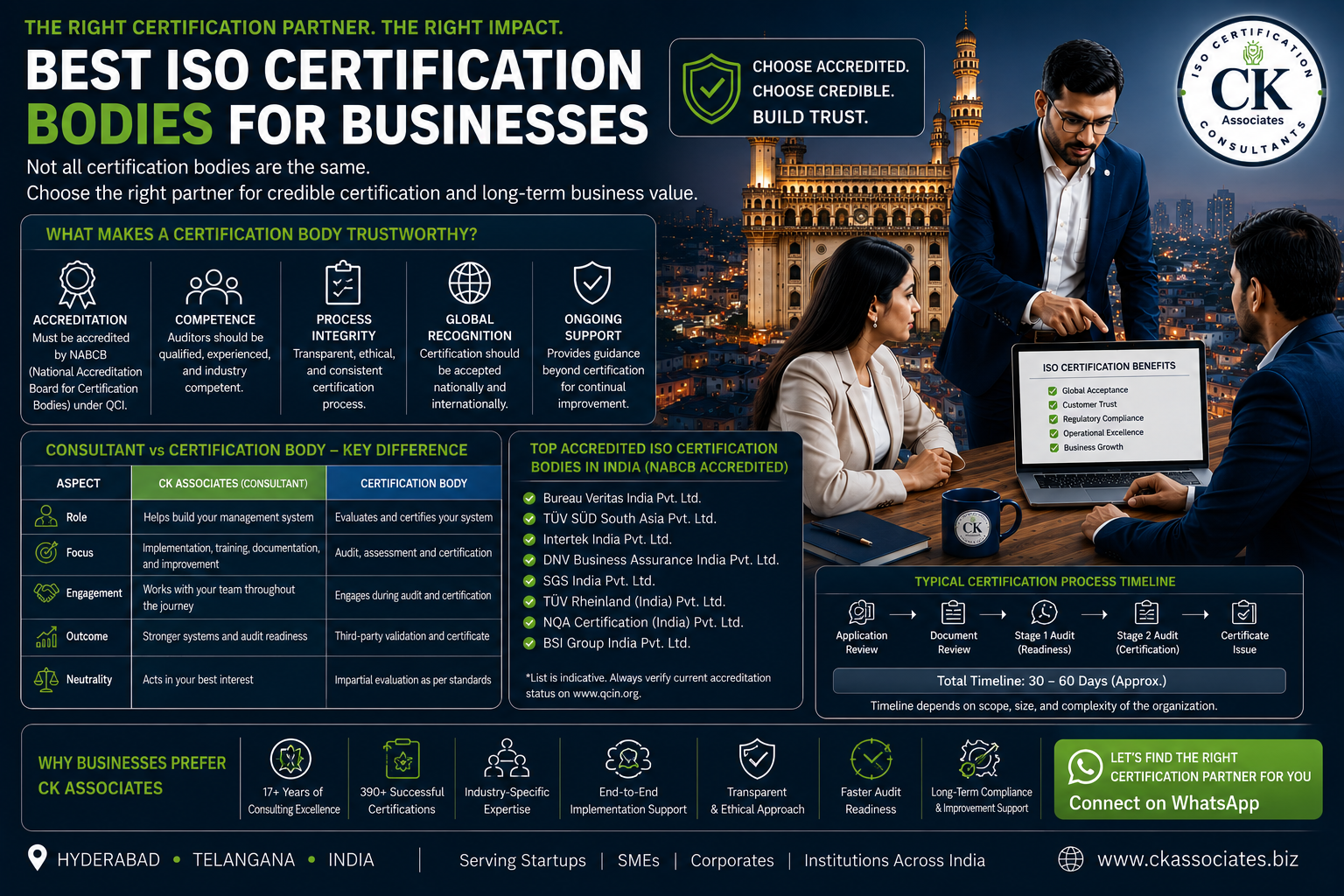
Businesses should choose ISO certification bodies based on accreditation, industry credibility, auditor competence, international recognition, transparency, audit quality, and long-term support.
An accredited certification body improves customer trust, vendor acceptance, compliance credibility, and global business recognition.
Introduction
Many businesses spend weeks selecting ISO consultants.
But they overlook another critical decision:
Choosing the right ISO certification body.
This decision directly impacts:
- Market credibility
- Customer trust
- Vendor acceptance
- International recognition
- Audit quality
- Long-term compliance experience
Unfortunately, many organizations select certification bodies only based on low pricing.
This often creates problems such as:
- Weak audit quality
- Poor credibility
- Limited international acceptance
- Customer rejection
- Re-certification complications
The right certification body strengthens business credibility.
The wrong one may weaken it.
What Is the Best ISO Certification Body?
The best ISO certification body is an accredited organization recognized for professional audit quality, international credibility, industry experience, transparency, and strong compliance governance.
Businesses should prioritize accreditation, reputation, auditor competence, and long-term business acceptance instead of selecting only the cheapest option.
What Does an ISO Certification Body Do?
An ISO certification body independently audits businesses to verify whether their management systems comply with ISO standard requirements.
If the organization successfully meets compliance requirements, the certification body issues the ISO certificate and conducts ongoing surveillance audits to maintain certification validity.
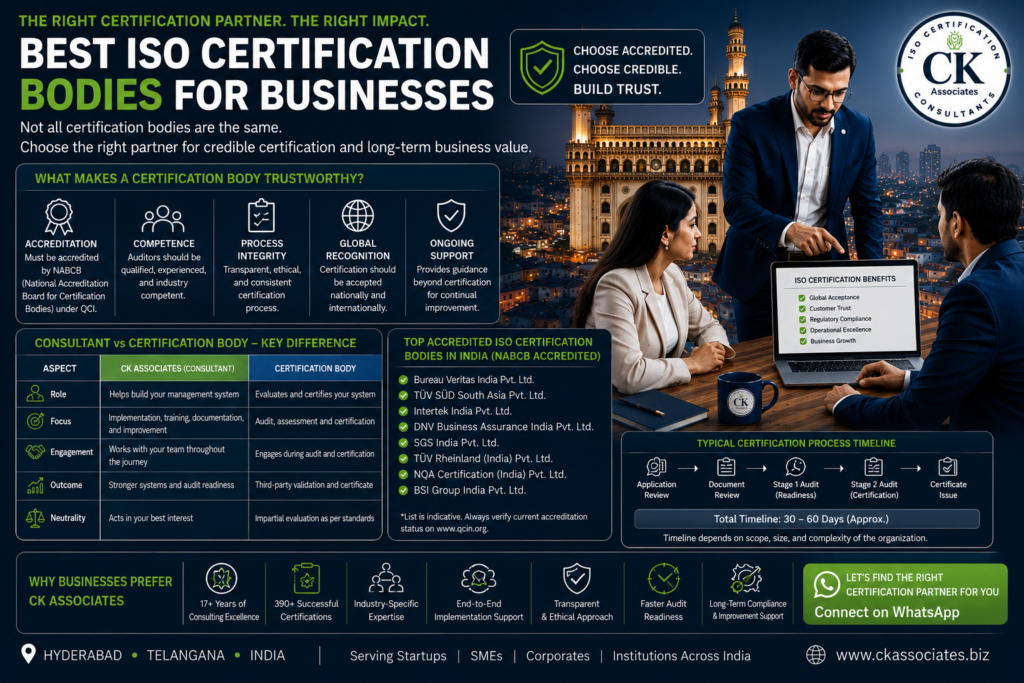
What Is an ISO Certification Body?
A certification body is an independent organization responsible for:
- Conducting ISO audits
- Verifying compliance
- Reviewing documentation
- Evaluating implementation effectiveness
- Issuing ISO certificates
- Conducting surveillance audits
Certification bodies do not build your ISO system.
Their role is to independently evaluate whether your organization meets ISO standard requirements.
Difference Between Consultants and Certification Bodies
| ISO Consultant | Certification Body |
|---|---|
| Helps implement the system | Audits the system |
| Provides guidance | Provides independent evaluation |
| Supports documentation | Verifies compliance |
| Conducts internal readiness reviews | Conducts certification audits |
| Helps improve governance | Issues ISO certificates |
Businesses should understand this distinction clearly.
Why Accreditation Matters
What Is Accreditation?
Accreditation means the certification body itself has been officially approved and monitored by a recognized accreditation authority.
This improves:
- International acceptance
- Customer trust
- Regulatory recognition
- Market credibility
- Audit reliability
Risks of Non-Accredited Certification Bodies
Some low-cost providers issue certificates without proper accreditation.
This creates serious risks:
- Customers may reject the certificate
- Tenders may disqualify the organization
- International clients may not recognize the certification
- Re-certification may become necessary
- Business credibility may suffer
Choosing a non-accredited certification body can become an expensive mistake.
What Businesses Should Evaluate Before Choosing a Certification Body
1. Accreditation Status
Always verify:
- Accreditation authority recognition
- International acceptance
- Scope validity
- Standard coverage
2. Industry Experience
Businesses should ask:
- Have they audited companies in our sector?
- Do auditors understand industry risks?
- Are they experienced with our operational complexity?
Industry knowledge improves audit quality.
3. Auditor Competence
Professional auditors should demonstrate:
- Process understanding
- Risk-based thinking
- Business communication skills
- Governance awareness
- Objective evaluation methods
Strong auditors add value beyond compliance.
4. Global Recognition
Organizations working with:
- International clients
- Global vendors
- Export markets
- Overseas partners
Should prioritize globally respected certification bodies.
5. Transparency
Businesses should clearly understand:
- Audit process
- Audit duration
- Certification validity
- Surveillance requirements
- Re-certification expectations
- Fee structures
Transparent communication matters.
Common Mistakes Businesses Make
Choosing Based Only on Price
Low-cost certifications may create:
- Weak audit quality
- Credibility concerns
- Customer trust issues
- Future re-certification problems
Ignoring Accreditation
Some organizations realize too late that their certificate lacks market acceptance.
Selecting Bodies Without Industry Understanding
Industry-specific operational risks matter.
Generic audits may overlook critical compliance gaps.
Focusing Only on the Certificate
The audit process itself should improve:
- Governance maturity
- Operational awareness
- Risk visibility
- Continuous improvement
The best certification bodies add strategic value.
High-Level Certification Audit Timeline
Stage 1 Audit
Focus areas:
- Documentation review
- Readiness evaluation
- Scope verification
Stage 2 Audit
Focus areas:
- Operational implementation
- Employee awareness
- Process effectiveness
- Compliance evidence
Surveillance Audits
Usually conducted annually to verify:
- Ongoing compliance
- System sustainability
- Continuous improvement
Real-World Business Perspective
Strong Certification Experience
Organizations that work with experienced consultants and credible certification bodies generally experience:
- Smoother audits
- Better operational alignment
- Higher customer confidence
- Reduced compliance stress
- Better long-term sustainability
Poor Certification Experience
Businesses choosing low-cost or weakly recognized certification providers often face:
- Rejected certificates
- Audit inconsistencies
- Weak customer trust
- Repeat certification expenses
- Operational confusion
The cheapest certification path is rarely the most strategic.
Questions Businesses Should Ask Certification Bodies
Important Questions
Is your certification body accredited?
Which accreditation authority recognizes you?
Do you have experience in our industry?
How long does the audit process take?
What are the surveillance audit requirements?
How are auditors assigned?
What support is available during certification?
How widely accepted is your certification internationally?
The CK Associates Approach
At CK Associates, we help businesses not only implement ISO systems but also choose certification bodies strategically.
Our approach focuses on:
- Accreditation credibility
- Industry suitability
- Governance alignment
- Long-term sustainability
- Audit preparedness
- Business reputation
We help organizations across Hyderabad and India avoid low-quality certification risks and select certification pathways that support long-term operational maturity.
Rather than focusing only on obtaining certificates, we help businesses build credible compliance ecosystems recognized by customers, vendors, and global stakeholders.
Why Hyderabad Businesses Need Strong Certification Credibility
Businesses across Hyderabad increasingly work with:
- International customers
- Enterprise procurement teams
- Global supply chains
- Information security programs
- Vendor qualification systems
This makes certification credibility more important than ever.
A poorly recognized certificate may damage business trust.
A credible certification strengthens competitive positioning.
Common Questions Businesses Ask
What is the difference between accreditation and certification?
Are all ISO certificates internationally accepted?
Can customers reject ISO certificates?
How do businesses verify certification bodies?
Why do certification body prices vary?
Are surveillance audits mandatory?
What happens if audits fail?
FAQ Section
Can businesses choose any certification body?
Yes, but organizations should prioritize accredited and credible certification bodies.
Why is accreditation important?
Accreditation improves international recognition, trust, and certificate acceptance.
Are cheaper certification bodies risky?
Sometimes. Extremely low-cost providers may lack credibility or proper accreditation.
How long is ISO certification valid?
Most ISO certifications remain valid for three years with annual surveillance audits.
Do certification bodies help implement ISO systems?
No. Certification bodies independently audit systems. Consultants typically support implementation.
Can businesses change certification bodies later?
Yes, but transition audits and additional evaluations may be required.
Get Free GAP Analysis