
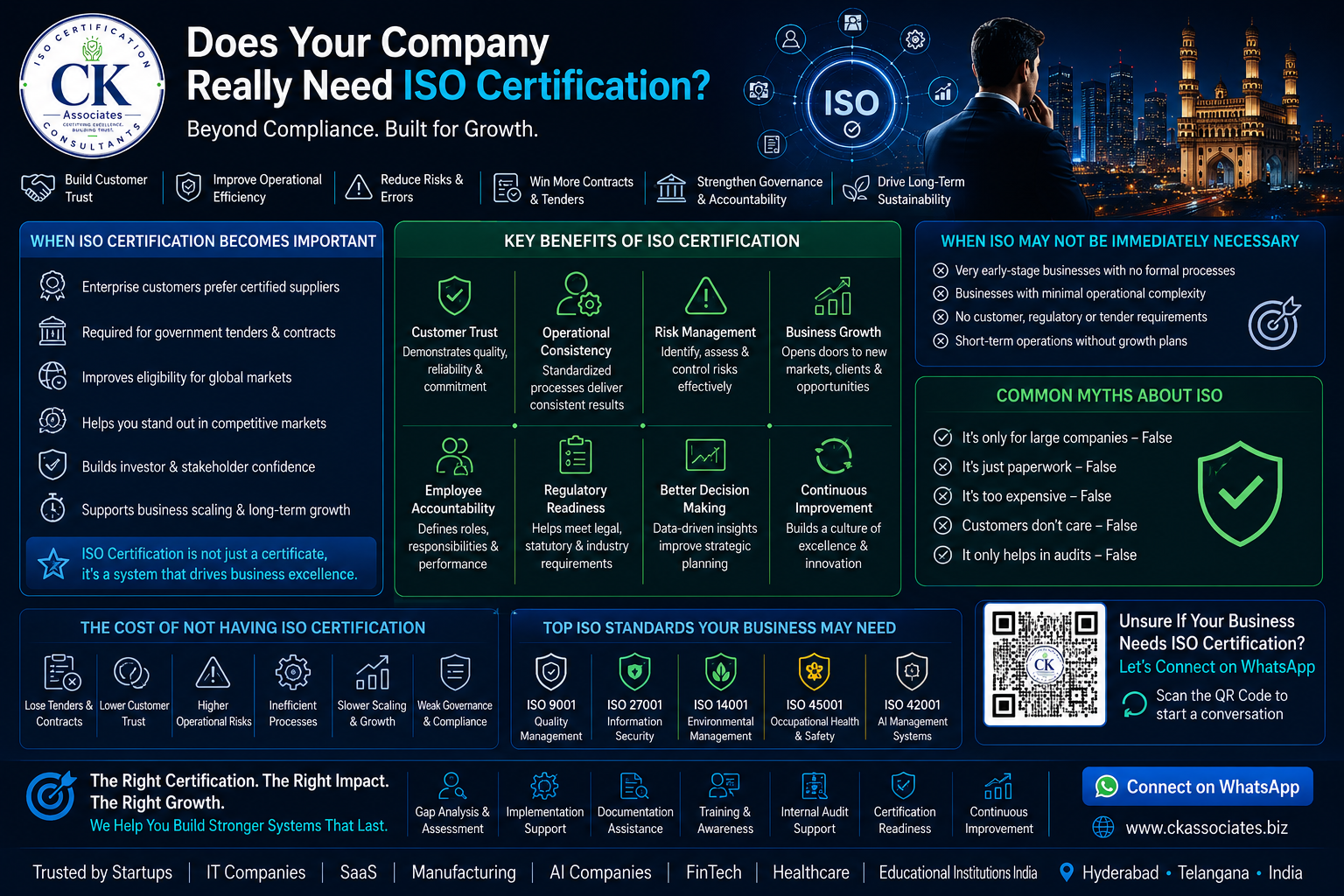
Not every company legally requires ISO certification.
However, many businesses choose ISO certification because it improves:
- Customer trust
- Operational consistency
- Risk management
- Market competitiveness
- Tender eligibility
- Enterprise sales opportunities
- Governance maturity
- Long-term scalability
Whether your company needs ISO certification depends on:
- Industry requirements
- Customer expectations
- Growth plans
- Operational complexity
- Regulatory pressures
- Competitive positioning
For many organizations, ISO certification is no longer just a compliance exercise—it has become a strategic business tool that supports operational excellence and sustainable growth.
Does a company really need ISO certification?
A company may not legally require ISO certification, but many businesses pursue it to improve customer trust, operational efficiency, governance maturity, risk management, and eligibility for tenders and enterprise contracts. The need for ISO certification depends on business goals, industry requirements, and growth strategy.
Why Businesses Ask This Question
One of the most common questions business owners ask is:
“Do we really need ISO certification, or is it just another certificate?”
The answer depends on what the business is trying to achieve.
For some organizations, ISO certification is essential.
For others, it may not be immediately necessary.
The key is understanding the business value behind ISO implementation.
What ISO Certification Actually Does
Many people think ISO certification is simply a document on the wall.
In reality, ISO standards help businesses create structured systems for:
- Quality management
- Information security
- Risk management
- Operational consistency
- Environmental responsibility
- Workplace safety
- Governance accountability
The certification is merely evidence that those systems exist and operate effectively.
The real value comes from the management system itself.
Situations Where ISO Certification Becomes Important
Enterprise Customers Require It
Many large organizations prefer working with suppliers that demonstrate operational maturity.
ISO certification often becomes a requirement during:
- Vendor onboarding
- Supplier evaluations
- Enterprise procurement
- Strategic partnerships
Without certification, businesses may lose opportunities before discussions even begin.
Government Tenders and Contracts
Many government departments and public-sector projects require ISO-certified suppliers.
This is particularly common in:
- Infrastructure projects
- IT contracts
- Manufacturing procurement
- Service contracts
ISO certification can improve eligibility and competitiveness.
Export and International Markets
International buyers often view ISO certification as evidence of operational reliability.
Export-oriented businesses frequently use ISO certification to:
- Build trust
- Reduce buyer concerns
- Improve supplier credibility
- Strengthen global market access
Competitive Markets
When multiple companies offer similar products or services, ISO certification can help differentiate the business.
Customers often perceive certified organizations as:
- More reliable
- Better organized
- More accountable
- Lower risk
When ISO Certification May Not Be Immediately Necessary
Very Early-Stage Businesses
A startup with:
- No employees
- No formal processes
- Limited customers
may not need immediate certification.
However, building governance maturity early can create advantages during growth.
Businesses with Minimal Operational Complexity
Organizations with very simple operational models may initially focus on business development before pursuing certification.
Still, governance planning should not be ignored.
Businesses Without Customer or Market Pressure
If customers, regulators, or partners do not require certification, implementation may be a strategic decision rather than an immediate necessity.
The Real Business Benefits of ISO Certification
Improved Customer Trust
Customers increasingly evaluate suppliers based on operational maturity.
ISO certification demonstrates:
✔ Commitment to quality
✔ Accountability
✔ Governance discipline
✔ Risk management
Trust often translates into stronger business relationships.
Better Operational Consistency
Many growing organizations struggle with:
- Process inconsistency
- Employee dependency
- Quality variation
- Communication gaps
ISO systems create repeatable processes that improve consistency.
Reduced Operational Risks
Strong ISO systems help organizations identify:
- Process weaknesses
- Security vulnerabilities
- Operational risks
- Compliance gaps
Risk visibility improves decision-making.
Stronger Employee Accountability
ISO frameworks define:
- Responsibilities
- Ownership
- Escalation processes
- Performance expectations
This improves operational discipline.
Easier Business Scaling
Many businesses grow faster than their internal systems.
ISO certification supports:
- Standardized workflows
- Governance maturity
- Process visibility
- Organizational scalability
Which ISO Standard Might Your Company Need?
ISO 9001
Best for:
- Manufacturers
- Service providers
- Startups
- Educational institutions
- Healthcare organizations
Focus:
- Quality management
- Customer satisfaction
- Operational consistency
ISO 27001
Best for:
- SaaS companies
- IT firms
- AI businesses
- FinTech organizations
Focus:
- Information security
- Cybersecurity governance
- Data protection
ISO 14001
Best for:
- Manufacturing
- Industrial operations
- Construction
Focus:
- Environmental management
- Sustainability
ISO 45001
Best for:
- Manufacturing
- Construction
- Engineering
- Logistics
Focus:
- Occupational health & safety
ISO 42001
Best for:
- AI companies
- SaaS businesses
- Technology platforms
Focus:
- AI governance
- Accountability
- Risk management
Cost of Not Having ISO Certification
Businesses often ask about certification costs.
A more important question is:
What is the cost of not having certification?
Potential impacts include:
- Lost tenders
- Lost enterprise clients
- Lower customer trust
- Increased operational risks
- Slower scaling
- Governance weaknesses
For many organizations, these costs exceed implementation investment.
Common Myths About ISO Certification
“ISO Is Only for Large Companies”
False.
Many SMEs and startups benefit significantly from structured governance systems.
“ISO Is Just Documentation”
Documentation supports the system.
The real objective is operational effectiveness.
“Customers Don’t Care About ISO”
Many enterprise customers increasingly evaluate governance maturity before purchasing decisions.
“ISO Certification Is Too Expensive”
Strong implementation often generates operational benefits that offset investment over time.
Hyderabad and India Market Trends
Across Hyderabad, Telangana, Andhra Pradesh, and India, demand for ISO certification continues to increase because businesses face:
- Greater customer expectations
- Cybersecurity requirements
- Governance pressures
- Tender competition
- Global market opportunities
Organizations increasingly view ISO certification as a strategic growth investment.
ISO Certification Is Becoming a Business Growth Strategy
The strongest organizations do not pursue ISO certification simply to obtain a certificate.
They use ISO frameworks to improve:
- Governance maturity
- Operational resilience
- Customer confidence
- Risk management
- Business scalability
Certification becomes a by-product of operational excellence.
ISO Consulting Cost Considerations
Implementation consulting is commonly structured around approximately ₹9,000 per manday depending on:
- Organization size
- Industry complexity
- Governance maturity
- Scope of implementation
- Existing operational readiness
What Is a Manday?
A manday refers to one consultant working day dedicated to:
- Gap analysis
- Documentation support
- Internal audits
- Training
- Governance workshops
- Audit preparation
Certification body fees are generally separate from consulting fees.
Does every company need ISO certification?
No. Not every company legally requires ISO certification, but many businesses pursue it to improve trust, governance, and competitiveness.
Is ISO certification worth it for small businesses?
Yes. Many SMEs use ISO certification to improve operational consistency, customer confidence, and growth readiness.
Can a company grow without ISO certification?
Yes. However, ISO certification often helps businesses scale more efficiently by improving governance and process maturity.
Why do customers ask for ISO certification?
Customers often use ISO certification as evidence of quality, reliability, security, and operational discipline.
FAQ Section
Is ISO certification mandatory?
Most ISO certifications are voluntary unless required by customers, tenders, contracts, or industry-specific regulations.
What are the benefits of ISO certification?
Benefits include customer trust, operational consistency, governance maturity, risk reduction, and improved market competitiveness.
Which businesses benefit most from ISO certification?
Manufacturers, SaaS companies, IT firms, healthcare providers, exporters, educational institutions, and growing SMEs often benefit significantly.
Is ISO certification expensive?
Costs vary depending on organization size, scope, and complexity, but many businesses view it as a long-term operational investment.
Can startups get ISO certified?
Yes. Many startups pursue ISO certification to strengthen governance, improve credibility, and support enterprise sales growth.