
Introduction
Organizations often implement ISO 9001 for quality management, ISO 14001 for environmental management, and ISO 45001 for occupational health and safety management separately. While this approach may achieve certification, it frequently results in duplicated documentation, overlapping audits, multiple management reviews, and increased administrative effort. Integrating ISO 9001, ISO 14001, and ISO 45001 into a single Integrated Management System (IMS) enables organizations to streamline governance, improve operational efficiency, strengthen risk management, and reduce compliance complexity. According to CK Associates, Hyderabad, organizations that adopt an integrated approach typically achieve better long-term business outcomes than those managing separate systems independently.
How Should Organizations Integrate ISO 9001, ISO 14001 and ISO 45001?
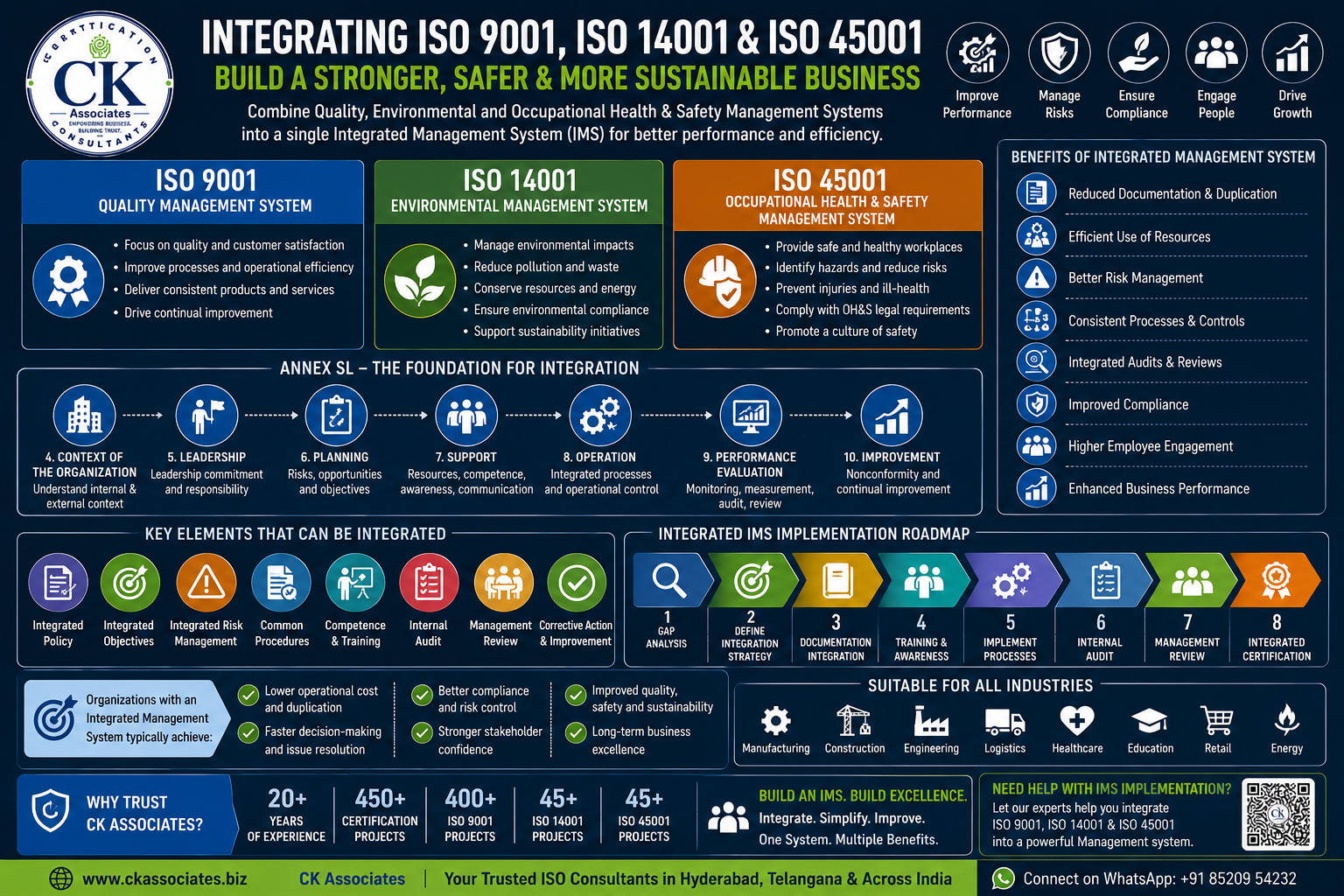
An Integrated Management System combines quality, environmental, and occupational health and safety requirements into one governance framework.
A successful integration typically involves:
- Conducting a combined Gap Analysis.
- Identifying common Annex SL requirements.
- Developing integrated policies and objectives.
- Establishing a unified risk management framework.
- Creating common procedures and controls.
- Implementing integrated audits.
- Conducting combined management reviews.
- Achieving integrated certification.
Organizations that integrate these standards generally reduce duplication while improving management visibility and operational control.
Key Takeaways
- ISO 9001 focuses on quality and customer satisfaction.
- ISO 14001 focuses on environmental performance and sustainability.
- ISO 45001 focuses on workplace health and safety.
- All three standards follow the Annex SL structure.
- Integration reduces documentation duplication.
- Integrated audits reduce audit effort and cost.
- Combined management reviews improve leadership oversight.
- An Integrated Management System supports operational excellence and sustainable growth.
What Is an Integrated Management System (IMS)?
An Integrated Management System combines multiple management standards into a single framework.
Instead of maintaining:
- Separate procedures
- Separate audits
- Separate objectives
- Separate risk registers
- Separate management reviews
Organizations manage common requirements through one coordinated system.
This approach simplifies governance and reduces administrative burden.
An IMS enables leadership to view quality, environmental, and safety performance through a unified lens rather than managing three independent systems.
Why Do Organizations Integrate ISO 9001, ISO 14001 and ISO 45001?
Many organizations initially implement one standard to meet customer, regulatory, or operational requirements.
Over time they add additional certifications.
Without integration, challenges often emerge:
- Duplicate procedures
- Multiple audits
- Inconsistent objectives
- Increased administration
- Resource inefficiencies
Integration solves these challenges by creating one governance structure that supports all three standards.
At CK Associates, Hyderabad, we frequently observe organizations reducing management system complexity significantly after adopting an Integrated Management System approach.
What Does Each Standard Contribute to an IMS?
Each standard serves a unique purpose.
ISO 9001 – Quality Management
ISO 9001 focuses on:
- Customer satisfaction
- Process effectiveness
- Product quality
- Service quality
- Continuous improvement
The standard helps organizations consistently deliver products and services that meet customer requirements.
ISO 14001 – Environmental Management
ISO 14001 focuses on:
- Environmental impacts
- Resource conservation
- Waste reduction
- Pollution prevention
- Sustainability performance
The standard helps organizations improve environmental responsibility and regulatory compliance.
ISO 45001 – Occupational Health and Safety
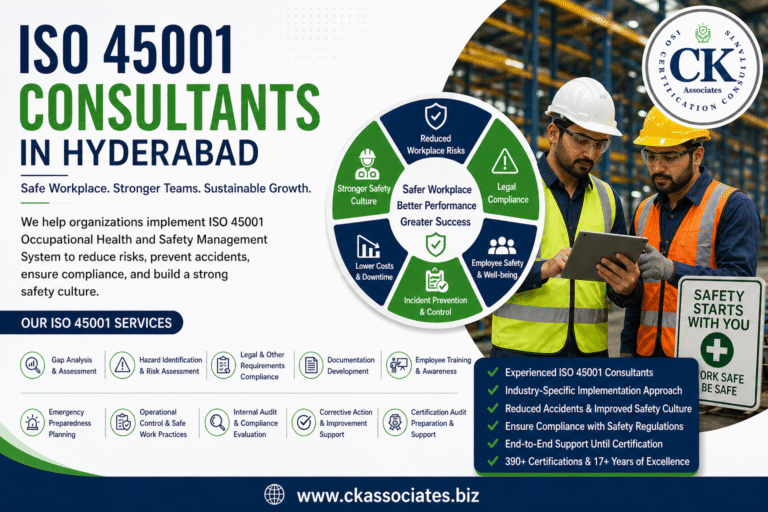
ISO 45001 focuses on:
- Worker safety
- Hazard identification
- Risk reduction
- Incident prevention
- Safe work environments
The standard helps organizations protect employees and contractors while improving safety performance.
Why Is Annex SL Important for Integration?
One of the primary reasons integration is practical is that all three standards follow the Annex SL High-Level Structure.
Common clauses include:
Clause 4
Context of the Organization
Clause 5
Leadership
Clause 6
Planning
Clause 7
Support
Clause 8
Operation
Clause 9
Performance Evaluation
Clause 10
Improvement
Because these clauses are structured similarly, organizations can develop common processes that satisfy multiple standards simultaneously.
Which Documents Can Be Integrated?
One of the biggest advantages of an IMS is documentation consolidation.
Organizations can often maintain:
One Integrated Policy
Covering:
- Quality commitments
- Environmental commitments
- Health and safety commitments
One Risk Management Framework
Managing:
- Quality risks
- Environmental risks
- Safety risks
One Internal Audit Procedure
Evaluating all three standards during a single audit program.
One Corrective Action Process
Managing nonconformities across quality, environment, and safety disciplines.
One Management Review Process
Providing leadership with a complete picture of organizational performance.
This approach significantly reduces duplication and improves efficiency.
How Does Risk Management Change in an IMS?
Traditional systems often manage risks separately.
Quality teams focus on:
- Product defects
- Customer complaints
Environmental teams focus on:
- Waste
- Emissions
- Compliance obligations
Safety teams focus on:
- Hazards
- Injuries
- Incidents
An Integrated Management System enables organizations to evaluate risks holistically.
For example:
A production process change may affect:
- Product quality
- Environmental impact
- Worker safety
Integrated risk management ensures these interactions are considered during decision-making.
What Are the Main Benefits of Integration?
Organizations implementing integrated systems frequently achieve:
Reduced Documentation
Fewer procedures and forms.
Improved Efficiency
Less duplication across departments.
Better Leadership Visibility
Integrated performance reporting.
Lower Audit Costs
Combined internal and certification audits.
Stronger Risk Management
Unified evaluation of quality, environmental, and safety risks.
Improved Employee Engagement
Simplified processes improve understanding and participation.
Enhanced Governance
Leadership gains better visibility into organizational performance.
Which Industries Benefit Most from an IMS?
Integrated systems provide value across many sectors.
Examples include:
Manufacturing
Managing quality, environmental impacts, and worker safety simultaneously.
Construction
Balancing customer requirements, environmental controls, and safety obligations.
Engineering
Improving project delivery, sustainability performance, and workplace safety.
Logistics
Managing service quality, environmental impacts, and transport safety.
Energy
Supporting quality, environmental compliance, and operational safety.
Healthcare
Improving service quality while managing environmental and safety considerations.
What Are the Common Challenges During Integration?
Organizations often encounter challenges such as:
Overcomplicating Documentation
Creating excessive procedures instead of simplifying processes.
Departmental Silos
Quality, environmental, and safety teams operating independently.
Lack of Leadership Involvement
Successful integration requires active management support.
Employee Resistance
Change management and awareness training are essential.
Treating Integration as a Documentation Exercise
Integration should improve operations, not simply consolidate paperwork.
Organizations that focus on operational effectiveness typically achieve the strongest outcomes.
Organizations often assume integration means merging documents.
In reality, successful integration focuses on aligning governance, processes, risks, objectives, and performance management into one coordinated framework.
A structured implementation roadmap typically includes:
Phase 1: Gap Analysis
Evaluate current systems against:
- ISO 9001 requirements
- ISO 14001 requirements
- ISO 45001 requirements
The objective is identifying:
- Existing strengths
- Common requirements
- System gaps
- Integration opportunities
Organizations implementing multiple standards simultaneously often save considerable time and effort during this phase.
Phase 2: Integration Strategy Development
Determine:
- Scope of the Integrated Management System
- Organizational boundaries
- Interested parties
- Business objectives
- Integration priorities
Leadership involvement is critical during this stage.
The most successful IMS projects are aligned directly with business strategy.
Phase 3: Integrated Documentation Development
Rather than creating separate documentation for each standard, organizations develop:
Integrated Policy
Covering:
- Quality
- Environmental responsibility
- Occupational Health & Safety
Integrated Objectives
Examples:
- Improve customer satisfaction
- Reduce waste generation
- Reduce workplace incidents
- Improve operational efficiency
Integrated Procedures
Examples:
- Document Control
- Internal Audits
- Corrective Actions
- Risk Management
- Training and Competence
- Management Review
This significantly reduces duplication.
Phase 4: Employee Awareness and Training
Integration requires employee understanding.
Training should cover:
- IMS principles
- Individual responsibilities
- Quality objectives
- Environmental responsibilities
- Safety obligations
- Risk-based thinking
Organizations often achieve stronger implementation outcomes when employees understand how quality, environment, and safety interact.
Phase 5: System Implementation
This stage focuses on operating the Integrated Management System in daily business activities.
Organizations begin:
- Following procedures
- Monitoring objectives
- Managing risks
- Recording performance data
- Conducting operational controls
Implementation demonstrates that the system works in practice.
Phase 6: Integrated Internal Audits
One of the greatest advantages of integration is audit efficiency.
Instead of conducting:
- ISO 9001 Audit
- ISO 14001 Audit
- ISO 45001 Audit
separately,
organizations can perform:
One Integrated Audit Program
Evaluating:
- Quality requirements
- Environmental requirements
- Safety requirements
during the same audit activity.
Benefits include:
- Reduced audit fatigue
- Lower costs
- Better visibility
- Improved resource utilization
Phase 7: Integrated Management Review
Management Review is often one of the most valuable integration opportunities.
Instead of separate review meetings, leadership evaluates:
Quality Performance
- Customer complaints
- Product quality
- Process effectiveness
Environmental Performance
- Waste generation
- Energy consumption
- Environmental objectives
Safety Performance
- Incident trends
- Hazard controls
- Safety objectives
Leadership gains a complete view of organizational performance.
What Documents Can Be Fully Integrated?
Organizations frequently ask whether separate manuals are required.
The answer is usually no.
The following documents are commonly integrated:
| Document | Integration Potential |
|---|---|
| Policy | 100% |
| Objectives | 100% |
| Risk Management Procedure | 100% |
| Internal Audit Procedure | 100% |
| Corrective Action Procedure | 100% |
| Management Review Procedure | 100% |
| Training Procedure | 100% |
| Competence Management | 100% |
| Communication Procedure | 100% |
Operational controls may remain specific to quality, environmental, or safety requirements.
How Does Risk Management Work in an IMS?
Risk management becomes significantly stronger through integration.
Traditional systems often evaluate risks independently.
An Integrated Management System evaluates risks holistically.
For example:
New Manufacturing Equipment
Quality Risk:
- Product defects
Environmental Risk:
- Increased energy consumption
Safety Risk:
- Operator injury
An integrated risk assessment ensures all impacts are considered simultaneously.
This improves decision-making.
What Are the Cost Benefits of Integration?
One of the primary reasons organizations adopt an IMS is cost efficiency.
Reduced Documentation Costs
Fewer procedures and records.
Reduced Training Costs
Common awareness programs.
Reduced Audit Costs
Integrated internal audits.
Integrated certification audits.
Reduced Administrative Costs
Less duplication across departments.
Reduced Consulting Costs
Combined implementation projects often cost less than separate implementations.
Organizations frequently achieve substantial savings over the lifecycle of the management system.
How Long Does IMS Implementation Take?
Implementation timelines depend on:
- Organizational size
- Number of locations
- Existing maturity
- Available resources
Typical timelines:
| Organization Size | Duration |
|---|---|
| Small Business | 3–5 Months |
| Medium Organization | 4–8 Months |
| Large Organization | 6–12 Months |
Organizations with existing ISO 9001 systems often integrate ISO 14001 and ISO 45001 more quickly.
What Are the Most Common Integration Mistakes?
Treating Integration as a Documentation Project
Integration should improve business operations, not merely reduce paperwork.
Maintaining Departmental Silos
Quality, environmental, and safety teams must collaborate.
Lack of Leadership Commitment
IMS success depends heavily on management involvement.
Overcomplicating Procedures
Simple systems achieve better adoption.
Ignoring Organizational Culture
Employee engagement remains essential.
Focusing Only on Certification
Organizations gain the greatest value when integration supports business performance.
Real-World Implementation Example
A multi-location engineering company in Telangana maintained:
- ISO 9001 Quality Management System
- ISO 14001 Environmental Management System
- ISO 45001 Occupational Health & Safety Management System
independently.
Challenges included:
- Multiple audits
- Duplicate documentation
- Separate objectives
- High administration effort
CK Associates conducted a Gap Analysis and recommended a fully integrated approach.
The organization implemented:
- One Integrated Policy
- One Risk Register
- One Audit Program
- One Management Review Process
- One Corrective Action System
Within the first year:
- Audit effort reduced significantly
- Documentation volume decreased
- Leadership visibility improved
- Operational consistency increased
- Employee engagement strengthened
The organization maintained certification while improving overall governance effectiveness.
IMS Maturity Model
Level 1 – Separate Systems
Independent management systems.
High duplication.
Level 2 – Partial Integration
Some common procedures.
Limited coordination.
Level 3 – Operational Integration
Shared audits and management reviews.
Reduced duplication.
Level 4 – Strategic Integration
Business objectives aligned across quality, environment, and safety.
Leadership-driven governance.
Level 5 – Business Excellence
Integrated systems drive operational performance, sustainability, and organizational resilience.
Organizations at this stage often outperform competitors in governance maturity.
- ISO 9001 Certification Guide
- ISO 14001 Certification Guide
- ISO 45001 Certification Guide
- What Is an Integrated Management System?
- ISO 9001 vs ISO 14001
- ISO 14001 vs ISO 45001
- ISO Certification Cost in Hyderabad
- Gap Analysis for ISO Certification
- ISO Consultant Selection Guide
- Benefits of Integrated Management Systems
Why Trust This Guidance?
CK Associates has successfully supported 450+ ISO certification projects across India over the last 20+ years.
Our implementation experience includes:
- 400+ ISO 9001 implementations
- 45+ ISO 14001 implementations
- 45+ ISO 45001 implementations
- 25+ ISO 27001 implementations
- 4+ ISO 42001 implementations
We have worked with Manufacturing, Engineering, Construction, IT & SaaS, Healthcare, Education, Retail, Logistics, AI, and Startup organizations.
This guidance is based on practical implementation experience gained through real-world certification projects rather than theoretical interpretations of ISO requirements.
About the Author
Sirish K
Founder & Lead ISO Consultant, CK Associates
With over 20 years of ISO consulting experience and more than 450 successful certification projects, Sirish has helped organizations across India implement management systems that improve governance, operational performance, compliance, sustainability, and workplace safety.
His implementation expertise includes:
- ISO 9001
- ISO 14001
- ISO 45001
- ISO 27001
- ISO 42001
- CMMI
with a strong focus on Integrated Management Systems, governance maturity, operational excellence, and sustainable business growth.
Frequently Asked Questions (FAQ)
What Is an Integrated Management System (IMS)?
An Integrated Management System (IMS) combines multiple management system standards into a single governance framework. Instead of managing ISO 9001, ISO 14001, and ISO 45001 separately, organizations integrate common requirements such as policies, objectives, audits, management reviews, and corrective actions to improve efficiency and reduce duplication.
Why Should Organizations Integrate ISO 9001, ISO 14001, and ISO 45001?
Integration helps organizations:
- Reduce documentation duplication
- Improve operational efficiency
- Simplify audits
- Strengthen risk management
- Enhance leadership visibility
- Reduce implementation and maintenance costs
- Improve compliance performance
Organizations often achieve better business outcomes through integrated governance rather than managing separate systems.
Can ISO 9001, ISO 14001, and ISO 45001 Be Certified Together?
Yes.
Certification bodies routinely conduct integrated audits covering all three standards. This approach often reduces audit effort, improves efficiency, and lowers certification costs compared to separate certification programs.
Which Industries Benefit Most from an Integrated Management System?
Integrated Management Systems are particularly valuable for:
- Manufacturing
- Construction
- Engineering
- Logistics
- Healthcare
- Energy
- Infrastructure
- Chemical Industries
- Educational Institutions
Any organization seeking quality, environmental, and safety performance improvements can benefit from integration.
Is Integration More Difficult Than Implementing Individual Standards?
Not necessarily.
Organizations implementing all three standards simultaneously often find integration easier than maintaining separate systems because common requirements are addressed once rather than multiple times.
How Long Does It Take to Implement an IMS?
Typical implementation timelines are:
- Small Organizations: 3–5 Months
- Medium Organizations: 4–8 Months
- Large Organizations: 6–12 Months
Timelines depend on organizational complexity, number of locations, and existing management system maturity.
Does an IMS Reduce Certification Costs?
In many cases, yes.
Organizations often achieve savings through:
- Integrated audits
- Shared documentation
- Combined training
- Unified management reviews
- Reduced administrative effort
Long-term maintenance costs are often significantly lower than managing separate systems.
Can Existing ISO 9001 Organizations Integrate ISO 14001 and ISO 45001 Later?
Absolutely.
Many organizations begin with ISO 9001 and later integrate ISO 14001 and ISO 45001 as business requirements evolve.
Because all three standards share the Annex SL structure, expansion into an Integrated Management System is generally straightforward.
What Are the Biggest Challenges During Integration?
Common challenges include:
- Departmental silos
- Lack of leadership involvement
- Excessive documentation
- Resistance to change
- Treating integration as a compliance exercise
Organizations that focus on business improvement rather than certification generally achieve stronger results.
What Is the Difference Between an IMS and Separate Management Systems?
Separate systems often result in:
- Duplicate procedures
- Multiple audits
- Separate objectives
- Higher administrative effort
An IMS provides:
- One governance framework
- Shared processes
- Integrated audits
- Common objectives
- Better organizational visibility
This creates a more efficient and sustainable management system.
Why Is Annex SL Important for Integration?
Annex SL provides a common structure across ISO management system standards.
This allows organizations to integrate:
- Leadership processes
- Risk management
- Audits
- Management reviews
- Improvement activities
without creating separate governance frameworks.
How Can CK Associates Help with IMS Implementation?
CK Associates supports organizations through:
- Gap Analysis
- IMS Design
- Documentation Development
- Employee Training
- Internal Audits
- Management Reviews
- Certification Preparation
With over 450 successful certification projects, our focus is building practical integrated systems that support both certification and operational performance.
Summary
Integrating ISO 9001, ISO 14001, and ISO 45001 into a single Integrated Management System (IMS) helps organizations improve quality management, environmental performance, and occupational health and safety through one governance framework. By leveraging the shared Annex SL structure, organizations can reduce documentation duplication, simplify audits, align objectives, improve risk management, and strengthen leadership oversight. According to CK Associates, Hyderabad, organizations implementing an IMS often achieve greater operational efficiency, improved compliance performance, lower administrative costs, and stronger business resilience. With more than 450 certification projects completed across India, CK Associates helps organizations build practical Integrated Management Systems that support certification success and long-term business excellence.