
Introduction
Organizations pursuing ISO certification often encounter two of the world’s most widely implemented management system standards: ISO 9001 and ISO 14001. While both standards follow a similar management framework and share the Annex SL structure, they serve different business objectives. ISO 9001 focuses on improving quality, customer satisfaction, and operational consistency, whereas ISO 14001 focuses on environmental management, sustainability, and reducing environmental impacts. According to CK Associates, Hyderabad, understanding the differences between ISO 9001 and ISO 14001 helps organizations select the right certification strategy while aligning management systems with business goals, customer expectations, and regulatory requirements.
How Should You Compare ISO 9001 and ISO 14001?
The simplest way to compare these standards is by understanding their primary purpose.
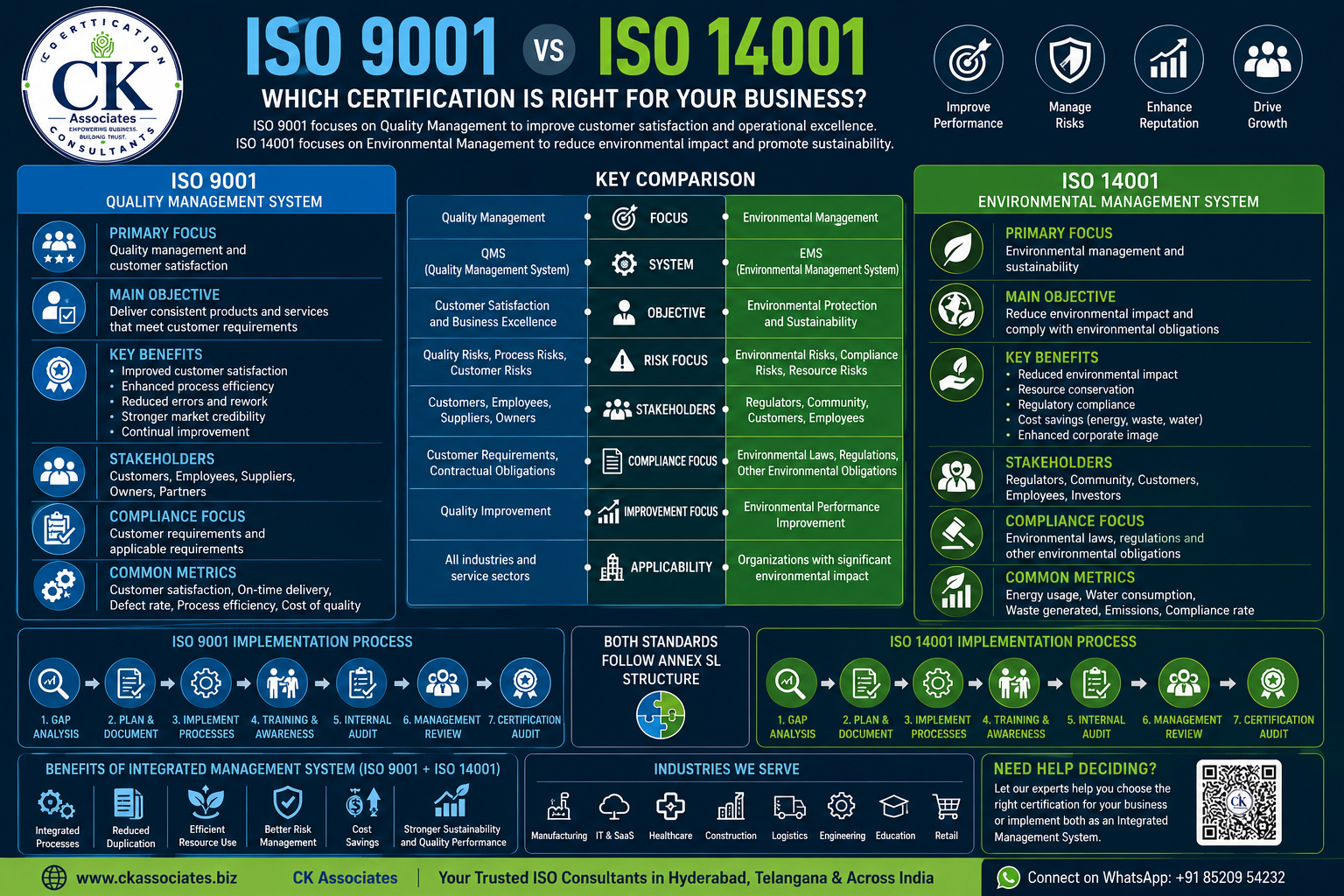
| Area | ISO 9001 | ISO 14001 |
|---|---|---|
| Primary Focus | Quality Management | Environmental Management |
| Objective | Customer Satisfaction | Environmental Performance |
| Management System | QMS | EMS |
| Main Concern | Product & Service Quality | Environmental Impact |
| Risk Focus | Quality Risks | Environmental Risks |
| Stakeholder Focus | Customers | Regulators, Community, Customers |
| Compliance Focus | Customer Requirements | Environmental Regulations |
| Continuous Improvement | Quality Improvement | Environmental Improvement |
Both standards can be implemented independently or as part of an Integrated Management System.
Key Takeaways
- ISO 9001 focuses on quality management and customer satisfaction.
- ISO 14001 focuses on environmental management and sustainability.
- Both standards follow the Annex SL structure.
- ISO 9001 is often implemented first because it provides a strong management foundation.
- ISO 14001 helps organizations manage environmental impacts and compliance obligations.
- Many organizations implement both standards together.
- Integration reduces duplication and improves governance efficiency.
What Is ISO 9001?
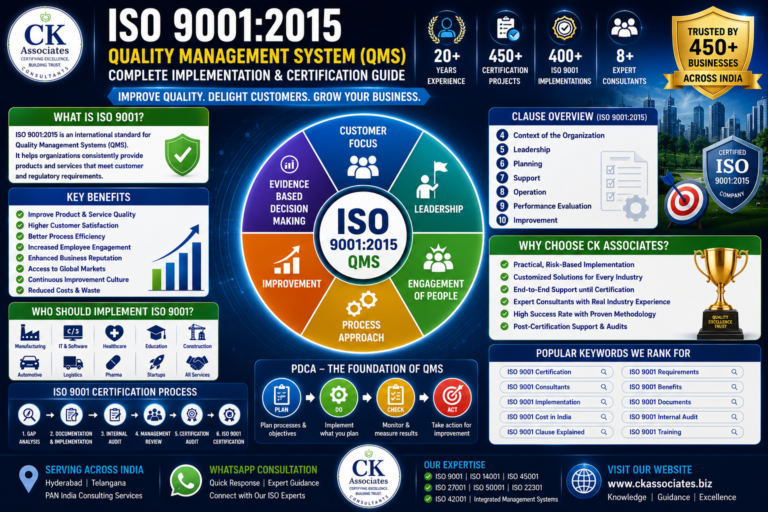
ISO 9001 is the international standard for Quality Management Systems (QMS).
Its purpose is to help organizations:
- Deliver consistent products and services
- Improve customer satisfaction
- Enhance operational efficiency
- Reduce errors and rework
- Drive continual improvement
The standard applies to virtually every industry and organization size.
From manufacturing companies to software firms, healthcare providers, educational institutions, logistics companies, and engineering organizations, ISO 9001 provides a framework for managing quality systematically.
At CK Associates, Hyderabad, ISO 9001 remains the most commonly requested certification because quality directly influences customer trust and business performance.
What Is ISO 14001?
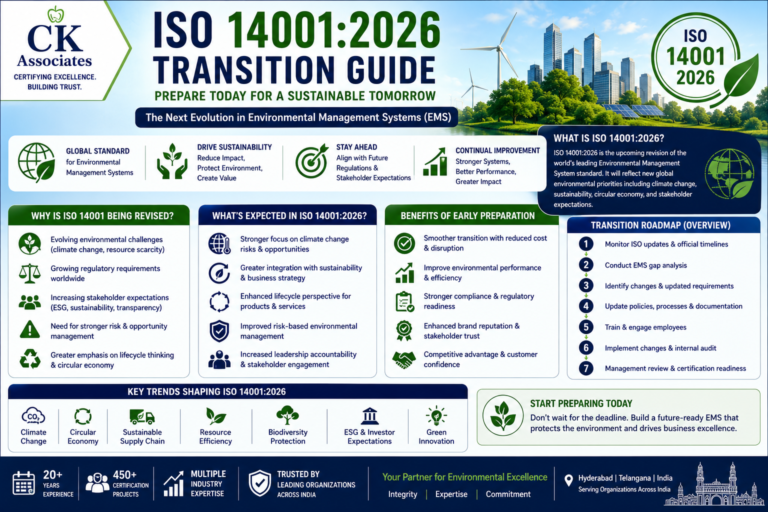
ISO 14001 is the international standard for Environmental Management Systems (EMS).
Its purpose is to help organizations:
- Identify environmental impacts
- Reduce environmental risks
- Improve resource efficiency
- Meet environmental compliance obligations
- Support sustainability initiatives
- Enhance environmental performance
The standard encourages organizations to proactively manage environmental aspects rather than react to environmental issues after they occur.
ISO 14001 is particularly valuable for organizations whose activities, products, or services can significantly affect the environment.
Why Do Organizations Choose ISO 9001?
Organizations usually implement ISO 9001 to improve operational performance and customer satisfaction.
Common drivers include:
Customer Requirements
Many customers prefer working with ISO 9001-certified suppliers.
Certification provides confidence that structured quality processes are in place.
Process Consistency
Organizations often struggle with inconsistent outcomes.
ISO 9001 helps establish repeatable processes that produce predictable results.
Competitive Advantage
Certification can improve credibility during tenders, procurement evaluations, and business development activities.
Business Growth
As organizations expand, process standardization becomes increasingly important.
ISO 9001 provides a framework that supports scalability.
Why Do Organizations Choose ISO 14001?
Environmental responsibility has become an important business consideration.
Organizations implement ISO 14001 for several reasons.
Regulatory Compliance
Environmental regulations continue evolving.
ISO 14001 helps organizations identify and manage compliance obligations systematically.
Sustainability Goals
Many organizations have sustainability commitments.
ISO 14001 supports structured environmental performance improvement.
Stakeholder Expectations
Customers, investors, regulators, and communities increasingly evaluate environmental performance.
Certification demonstrates commitment to environmental responsibility.
Resource Efficiency
Organizations often achieve reductions in:
- Energy consumption
- Water usage
- Waste generation
- Raw material usage
These improvements frequently generate operational savings.
What Are the Main Differences Between ISO 9001 and ISO 14001?
Although both standards use a similar management system structure, they focus on different outcomes.
ISO 9001 Focuses on Quality
Questions addressed include:
- Are customer requirements being met?
- Are processes effective?
- Are products and services consistent?
- Are quality objectives achieved?
The primary objective is customer satisfaction and business performance.
ISO 14001 Focuses on Environmental Impact
Questions addressed include:
- What environmental impacts exist?
- How can impacts be reduced?
- Are environmental obligations met?
- Are environmental objectives achieved?
The primary objective is environmental protection and sustainability.
Which Industries Benefit Most from ISO 9001?
ISO 9001 provides value across nearly all sectors.
Common industries include:
Manufacturing
Improving product quality and production consistency.
IT & SaaS
Enhancing service delivery and customer experience.
Healthcare
Improving patient service quality and operational control.
Education
Strengthening academic and administrative processes.
Engineering
Managing project quality and customer requirements.
Logistics
Improving delivery reliability and operational performance.
Which Industries Benefit Most from ISO 14001?
ISO 14001 is particularly valuable where environmental impacts are significant.
Examples include:
Manufacturing
Managing emissions, waste, and resource consumption.
Construction
Controlling environmental impacts associated with projects.
Chemical Industries
Managing environmental risks and compliance obligations.
Engineering Operations
Reducing environmental footprint and improving sustainability.
Logistics
Managing fuel consumption and environmental impacts.
Energy Sector
Supporting environmental performance and sustainability initiatives.
Can ISO 9001 and ISO 14001 Be Implemented Together?
Yes.
In fact, many organizations implement both standards through an Integrated Management System.
The benefits include:
- Shared documentation
- Common audits
- Integrated management reviews
- Unified objectives
- Reduced duplication
- Improved governance
Because both standards follow the Annex SL High-Level Structure, integration is relatively straightforward.
Organizations often achieve better results by managing quality and environmental performance through a single governance framework.
Which Standard Should Organizations Implement First?
For many organizations, ISO 9001 serves as the starting point.
Reasons include:
- Broad applicability
- Customer-driven demand
- Strong governance foundation
- Process management focus
Once quality management systems mature, organizations frequently expand into:
- ISO 14001
- ISO 45001
- ISO 27001
- ISO 42001
However, organizations facing significant environmental obligations may prioritize ISO 14001 earlier in their certification journey.
How Do ISO 9001 and ISO 14001 Differ in Implementation?
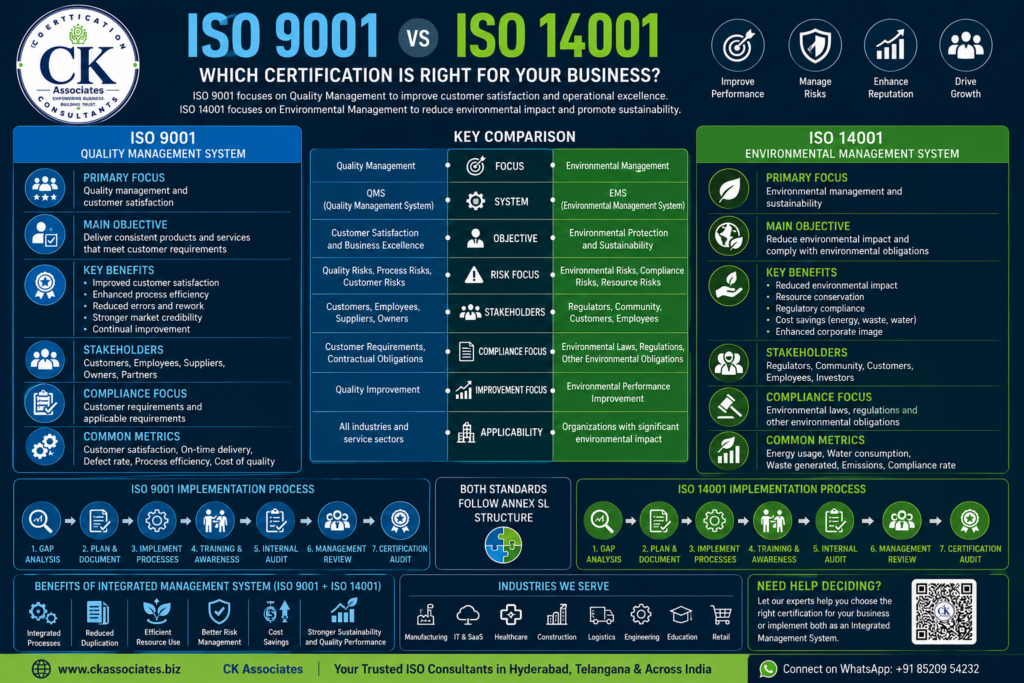
Although ISO 9001 and ISO 14001 share the Annex SL High-Level Structure, the implementation focus differs significantly.
ISO 9001 focuses on:
- Customer satisfaction
- Product quality
- Service quality
- Process performance
- Operational efficiency
- Continuous improvement
ISO 14001 focuses on:
- Environmental aspects
- Environmental impacts
- Resource conservation
- Pollution prevention
- Legal compliance
- Sustainability performance
Organizations implementing both standards often discover that governance structures can be shared while operational controls remain different.
What Are the Main Documentation Requirements?
Both standards require documented information, but the content differs.
ISO 9001 Documentation
Typical documents include:
- Quality Policy
- Quality Objectives
- Process Maps
- Customer Feedback Records
- Supplier Evaluation Records
- Internal Audit Reports
- Corrective Action Records
- Management Review Records
The primary purpose is ensuring consistent quality and customer satisfaction.
ISO 14001 Documentation
Typical documents include:
- Environmental Policy
- Environmental Objectives
- Aspect-Impact Register
- Legal Compliance Register
- Environmental Monitoring Records
- Waste Management Records
- Emergency Preparedness Plans
- Internal Audit Reports
The primary purpose is managing environmental impacts and regulatory obligations.
What Risks Are Addressed by Each Standard?
Risk-based thinking exists within both standards.
However, the risk categories are different.
ISO 9001 Risk Examples
- Customer complaints
- Product defects
- Supplier failures
- Service interruptions
- Process inefficiencies
- Missed delivery commitments
These risks directly affect customer satisfaction and business performance.
ISO 14001 Risk Examples
- Environmental spills
- Waste disposal issues
- Air emissions
- Water contamination
- Resource consumption
- Environmental legal violations
These risks affect environmental performance and regulatory compliance.
How Do Performance Metrics Differ?
Organizations measure different outcomes under each standard.
ISO 9001 KPIs
Common metrics include:
- Customer Satisfaction Scores
- Complaint Rates
- On-Time Delivery
- Process Efficiency
- Product Defect Rates
- Rework Levels
The objective is improving quality performance.
ISO 14001 KPIs
Common metrics include:
- Energy Consumption
- Water Usage
- Waste Generation
- Recycling Rates
- Carbon Emissions
- Environmental Incidents
The objective is improving environmental performance.
Which Certification Delivers Faster Business Benefits?
For many organizations, ISO 9001 often delivers visible benefits more quickly because improvements directly affect customers and operations.
Common outcomes include:
- Reduced rework
- Better process control
- Improved customer satisfaction
- Increased operational efficiency
- Enhanced employee accountability
These benefits are often measurable within the first year of implementation.
ISO 14001 benefits may develop over a longer period but can create significant value through:
- Reduced resource consumption
- Lower waste disposal costs
- Improved environmental compliance
- Better corporate reputation
- Increased sustainability performance
Organizations pursuing ESG initiatives frequently see substantial long-term value from ISO 14001.
Which Standard Is More Suitable for Small Businesses?
Many small businesses start with ISO 9001.
Reasons include:
- Strong customer focus
- Broad market recognition
- Easier justification of investment
- Improved operational consistency
However, small organizations operating in environmentally sensitive sectors may find ISO 14001 equally important.
Examples include:
- Manufacturing
- Construction
- Chemicals
- Engineering
- Waste Management
- Energy Services
The decision should align with business objectives and stakeholder expectations.
Can ISO 9001 and ISO 14001 Be Integrated?
Absolutely.
In fact, integration is one of the most common implementation approaches.
Both standards share requirements relating to:
- Context of the Organization
- Leadership
- Planning
- Support
- Performance Evaluation
- Improvement
Organizations can create:
- One Management System Manual
- One Internal Audit Program
- One Management Review Process
- One Corrective Action System
- One Risk Management Framework
while maintaining separate operational controls where necessary.
This significantly reduces duplication and administrative effort.
Real-World Implementation Example
A manufacturing organization in Hyderabad approached CK Associates after experiencing:
- Increasing customer complaints
- Rising waste disposal costs
- Environmental compliance challenges
- Process inconsistencies
Initially, the company planned to implement ISO 9001 and ISO 14001 separately.
Following a Gap Analysis, an Integrated Management System approach was recommended.
The implementation included:
- Process mapping
- Environmental aspect identification
- Risk assessments
- Employee awareness programs
- Integrated internal audits
- Combined management reviews
Within twelve months, the organization achieved:
- Improved customer satisfaction
- Reduced production rework
- Better waste management
- Improved environmental compliance
- Enhanced operational visibility
Most importantly, leadership gained a unified governance framework supporting both quality and environmental objectives.
Which Standard Should You Choose?
The answer depends on your business priorities.
Choose ISO 9001 If Your Primary Goal Is:
✅ Improving customer satisfaction
✅ Standardizing business processes
✅ Enhancing service quality
✅ Reducing operational inefficiencies
✅ Improving product consistency
✅ Meeting customer certification requirements
Choose ISO 14001 If Your Primary Goal Is:
✅ Improving environmental performance
✅ Managing environmental risks
✅ Supporting sustainability initiatives
✅ Meeting environmental compliance obligations
✅ Reducing environmental impacts
✅ Strengthening ESG performance
Choose Both Standards If Your Organization Wants:
✅ Operational excellence
✅ Environmental responsibility
✅ Strong governance
✅ Competitive differentiation
✅ Integrated management systems
✅ Long-term sustainable growth
For many organizations, implementing both standards together provides the greatest strategic value.
ISO 9001 vs ISO 14001 Comparison Table
| Area | ISO 9001 | ISO 14001 |
|---|---|---|
| Full Name | Quality Management System | Environmental Management System |
| Focus | Quality | Environment |
| Main Objective | Customer Satisfaction | Environmental Protection |
| Primary Stakeholders | Customers | Regulators & Community |
| Risk Focus | Quality Risks | Environmental Risks |
| Performance Metrics | Quality KPIs | Environmental KPIs |
| Common Industries | All Industries | Environmentally Impacting Industries |
| Certification Demand | Customer Driven | Regulatory & Sustainability Driven |
| Integration Potential | High | High |
ISO 14001 Certification Guide
Integrated Management System Guide
ISO Certification Cost in Hyderabad
Gap Analysis for ISO Certification
ISO Consultant Selection Guide
Why Trust This Guidance?
CK Associates has successfully supported 450+ ISO certification projects across India over the last 20+ years.
Our implementation experience includes:
- 400+ ISO 9001 implementations
- 45+ ISO 14001 implementations
- 45+ ISO 45001 implementations
- 25+ ISO 27001 implementations
- 4+ ISO 42001 implementations
We have worked with organizations across Manufacturing, IT & SaaS, Healthcare, Engineering, Education, Retail, Logistics, Startups, and AI-driven businesses.
This guidance is based on practical implementation experience across real certification projects rather than theoretical interpretation of ISO requirements.
About the Author
Sirish K is the Founder and Lead ISO Consultant at CK Associates, Hyderabad.
With more than 20 years of ISO consulting experience and over 450 successful certification projects, he has helped organizations across India implement management systems that improve governance, operational performance, compliance, and business growth.
His implementation expertise includes:
with a strong focus on practical implementation, governance maturity, and sustainable business improvement.
Frequently Asked Questions (FAQ)
What is the main difference between ISO 9001 and ISO 14001?
ISO 9001 focuses on Quality Management and customer satisfaction, while ISO 14001 focuses on Environmental Management and reducing environmental impacts. ISO 9001 helps organizations improve products, services, and operational performance, whereas ISO 14001 helps organizations manage environmental responsibilities and sustainability initiatives.
Which certification should a company implement first: ISO 9001 or ISO 14001?
For most organizations, ISO 9001 is typically implemented first because it establishes a strong management system foundation focused on process control, customer satisfaction, and continual improvement. Organizations with significant environmental obligations may prioritize ISO 14001 depending on regulatory or stakeholder requirements.
Can ISO 9001 and ISO 14001 be implemented together?
Yes. Both standards follow the Annex SL High-Level Structure, making integration straightforward. Organizations can combine documentation, audits, management reviews, corrective actions, and risk management processes into a single Integrated Management System (IMS).
Is ISO 14001 mandatory?
No. ISO 14001 is a voluntary certification standard. However, many customers, regulators, investors, and procurement teams increasingly value organizations that demonstrate environmental responsibility and sustainability commitments.
Which standard is more beneficial for manufacturing companies?
Manufacturing organizations often benefit from implementing both standards. ISO 9001 improves product quality and operational consistency, while ISO 14001 helps manage waste, emissions, resource consumption, and environmental compliance.
Does ISO 14001 help reduce operational costs?
Yes. Many organizations implementing ISO 14001 achieve reductions in:
- Energy consumption
- Water usage
- Waste disposal costs
- Raw material usage
These improvements can generate measurable financial savings over time.
Which certification is more recognized globally?
Both standards are globally recognized. However, ISO 9001 remains the world’s most widely implemented management system standard and is often requested by customers during supplier evaluations.
How long does it take to implement ISO 9001 and ISO 14001?
Typical implementation timelines are:
- Small Organizations: 2–4 months
- Medium Organizations: 3–6 months
- Large Organizations: 4–8 months
Integrated implementation often reduces overall project duration compared to separate certification projects.
Do ISO 9001 and ISO 14001 require internal audits?
Yes. Both standards require organizations to conduct internal audits at planned intervals to evaluate management system effectiveness and compliance with ISO requirements.
Can small businesses implement ISO 14001?
Absolutely. ISO 14001 is scalable and can be implemented by organizations of any size. Small businesses often use ISO 14001 to improve environmental performance, reduce resource consumption, and enhance market credibility.
Why are customers increasingly asking for ISO 14001 certification?
Customers are placing greater emphasis on sustainability and Environmental, Social, and Governance (ESG) performance. ISO 14001 certification demonstrates a structured commitment to environmental responsibility and continual improvement.
Can CK Associates help implement both ISO 9001 and ISO 14001?
Yes. CK Associates supports organizations through Gap Analysis, documentation development, implementation, training, internal audits, management reviews, and certification preparation for both ISO 9001 and ISO 14001, including integrated implementation projects.
Conclusion: Choosing Between ISO 9001 and ISO 14001
ISO 9001 and ISO 14001 serve different but complementary purposes. ISO 9001 helps organizations improve quality, customer satisfaction, operational consistency, and business performance. ISO 14001 helps organizations manage environmental impacts, improve sustainability performance, and meet environmental obligations.
For many organizations, ISO 9001 serves as the starting point because of its broad applicability and strong focus on operational excellence. However, organizations facing environmental risks, sustainability objectives, or regulatory pressures may benefit equally from ISO 14001.
Organizations seeking long-term governance maturity often achieve the greatest value by integrating both standards into a unified management framework.
Summary
ISO 9001 and ISO 14001 are internationally recognized management system standards that address different organizational objectives. ISO 9001 focuses on quality management, customer satisfaction, process performance, and continual improvement. ISO 14001 focuses on environmental management, sustainability, compliance, and reducing environmental impacts. While organizations can implement either standard independently, many choose to integrate both to create a stronger governance framework. According to CK Associates, Hyderabad, organizations that combine quality management and environmental management often achieve improved operational efficiency, stronger stakeholder confidence, better compliance performance, and sustainable business growth.