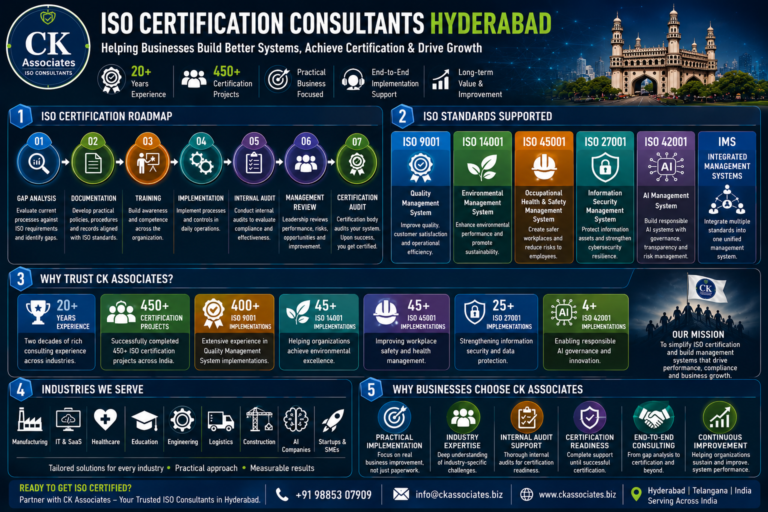

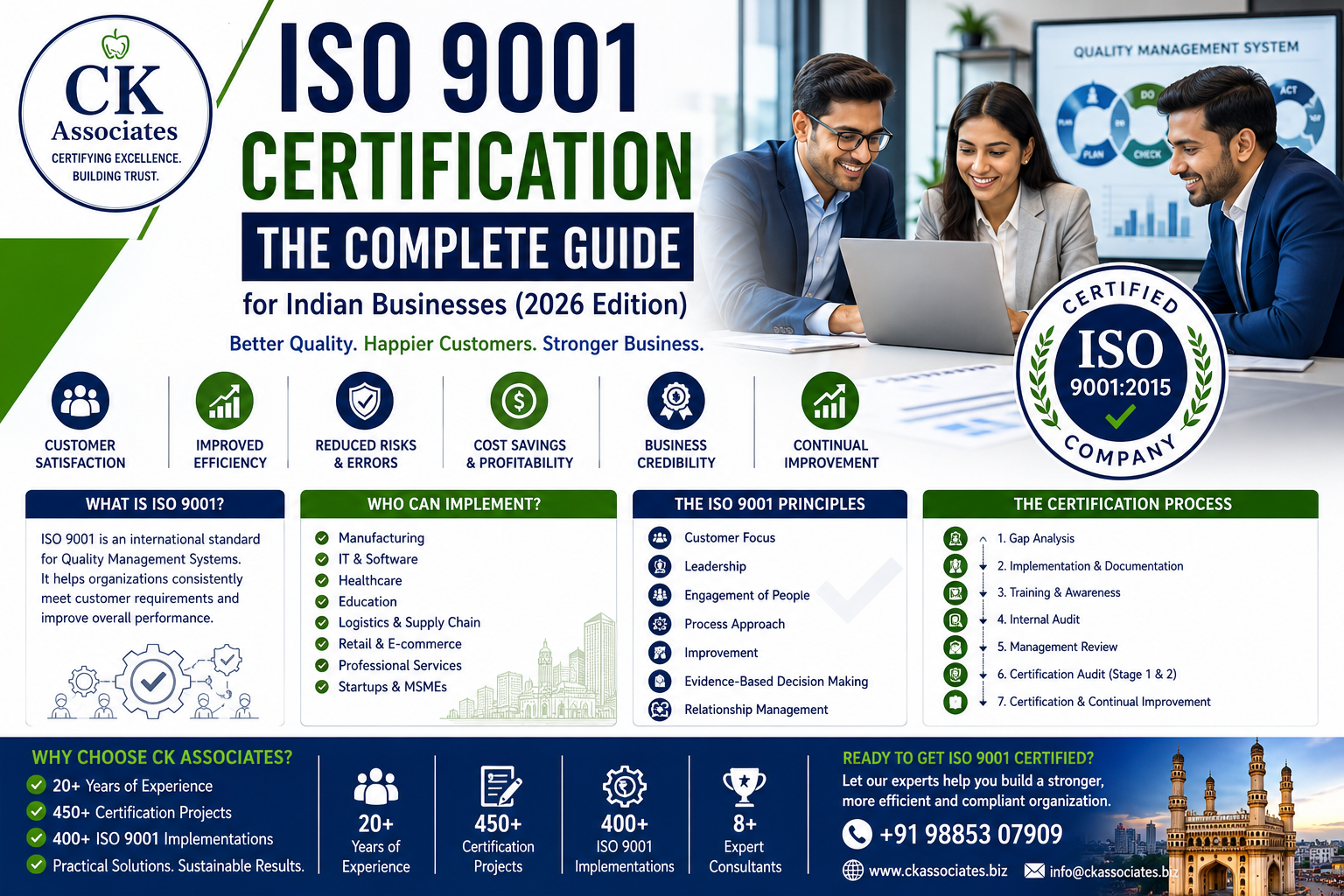
ISO 9001 Certification is the world’s most widely adopted Quality Management System (QMS) standard, published by the International Organization for Standardization (ISO). It helps organizations consistently deliver products and services that meet customer, statutory and regulatory requirements while driving continual improvement. ISO 9001 is suitable for organizations of all sizes and sectors, including manufacturing, IT, healthcare, education, logistics, retail, food processing and professional services. Certification typically involves gap analysis, implementation, employee training, internal audits, management review and an independent certification audit conducted by an accredited certification body.
What is ISO 9001 Certification?
ISO 9001 Certification demonstrates that an organization has implemented a Quality Management System (QMS) aligned with ISO 9001 requirements. The standard emphasizes customer focus, process management, leadership, risk-based thinking and continual improvement. Certification is awarded by an independent accredited certification body after successful completion of Stage 1 and Stage 2 audits.
If your organization wants to improve quality, reduce operational inefficiencies, increase customer confidence, qualify for tenders or expand into new markets, ISO 9001 provides a globally recognized management framework. This guide explains what ISO 9001 is, who should implement it, how certification works, implementation timelines, cost considerations and best practices for successful certification.
Key Takeaways
- ISO 9001 is the world’s most widely recognized Quality Management System standard.
- It is applicable to organizations of all sizes and industries.
- Certification demonstrates a commitment to consistent quality and continual improvement.
- ISO 9001 can improve operational efficiency, customer satisfaction and business credibility.
- The standard can be integrated with ISO 14001, ISO 45001, ISO/IEC 27001, ISO/IEC 42001 and other ISO management systems.
- Successful implementation requires leadership commitment, employee involvement and evidence-based decision-making.
- CK Associates has supported 400+ ISO 9001 implementation projects across multiple industries.
Why Read This Guide?
Many organizations assume ISO 9001 is simply about creating documents or passing an audit.
In reality, ISO 9001 is a management system that helps organizations establish repeatable, measurable and continually improving business processes.
When implemented correctly, ISO 9001 can help organizations:
- Improve product and service quality
- Reduce process variation
- Increase customer satisfaction
- Improve operational efficiency
- Strengthen risk management
- Enhance supplier performance
- Support business growth
- Improve decision-making through data
- Build confidence with customers and stakeholders
This guide explains ISO 9001 from both a strategic and practical implementation perspective, making it valuable for business owners, quality managers, consultants and decision-makers.
What is ISO 9001?
ISO 9001 is an internationally recognized standard that specifies requirements for establishing, implementing, maintaining and continually improving a Quality Management System (QMS).
Rather than prescribing how a business should operate, ISO 9001 provides a framework that enables organizations to design processes suited to their objectives while maintaining consistency and control.
The standard applies equally to:
- Manufacturers
- Service providers
- IT companies
- SaaS organizations
- Hospitals
- Educational institutions
- Government organizations
- NGOs
- Logistics companies
- Retail businesses
- Startups
- Large multinational enterprises
Whether an organization has 10 employees or 10,000, the principles of ISO 9001 can be adapted to its size, complexity and business environment.
What is a Quality Management System (QMS)?
A Quality Management System (QMS) is the collection of policies, processes, procedures, resources and responsibilities that an organization uses to consistently meet customer and regulatory requirements.
A well-designed QMS helps ensure that:
- Customer requirements are understood.
- Processes are documented where appropriate.
- Responsibilities are clearly assigned.
- Risks and opportunities are managed.
- Performance is measured using relevant indicators.
- Problems are addressed through corrective actions.
- Improvement becomes an ongoing organizational objective.
Rather than relying on individual effort, a QMS creates repeatable systems that support consistent results.
The Evolution of ISO 9001
The ISO 9000 family has evolved significantly since its introduction, reflecting changes in business practices and quality management philosophy.
| Year | Key Development |
|---|---|
| 1987 | First edition of ISO 9001 published |
| 1994 | Increased emphasis on preventive actions |
| 2000 | Introduced the process approach and customer focus |
| 2008 | Clarified existing requirements and improved consistency |
| 2015 | Adopted the Harmonized Structure, risk-based thinking and organizational context |
Today, ISO 9001:2015 remains the current published edition and is the basis for certification worldwide.
The Seven Quality Management Principles
ISO 9001 is built on seven fundamental Quality Management Principles (QMPs), which guide organizations in establishing an effective management system.
1. Customer Focus
Organizations should understand current and future customer needs, meet customer requirements and strive to exceed customer expectations.
Examples include:
- Measuring customer satisfaction
- Addressing complaints promptly
- Monitoring customer feedback
- Understanding changing market needs
2. Leadership
Top management establishes the organization’s direction, quality policy and strategic objectives while creating an environment that supports employee engagement and continual improvement.
Leadership responsibilities include:
- Defining the quality policy
- Allocating resources
- Promoting a quality culture
- Supporting improvement initiatives
3. Engagement of People
Employees at all levels contribute to organizational success when they understand their responsibilities and are actively involved in achieving quality objectives.
Organizations should encourage:
- Competence development
- Training
- Open communication
- Employee participation
- Continuous learning
4. Process Approach
Organizations achieve more consistent and predictable results by managing activities as interconnected processes rather than isolated functions.
Typical business processes include:
- Sales
- Purchasing
- Production
- Service delivery
- Customer support
- Human resources
- Maintenance
Understanding the interactions between these processes improves overall performance.
5. Improvement
Continual improvement is a permanent objective of an effective Quality Management System.
Organizations should:
- Monitor performance
- Analyze results
- Identify opportunities
- Implement corrective actions
- Improve processes continuously
6. Evidence-Based Decision Making
Effective decisions should be based on the analysis and evaluation of reliable data rather than assumptions.
Organizations commonly use:
- Customer satisfaction data
- Audit findings
- Process performance indicators
- Supplier evaluations
- Production metrics
- Nonconformity trends
7. Relationship Management
Long-term success depends on effective relationships with suppliers, partners, customers and other interested parties.
Organizations should:
- Evaluate suppliers
- Monitor supplier performance
- Maintain effective communication
- Build mutually beneficial partnerships
Benefits of ISO 9001 Certification
Although organizations often pursue certification because of customer or tender requirements, the operational benefits frequently provide greater long-term value.
Improved Customer Satisfaction
By understanding customer needs and consistently meeting requirements, organizations can strengthen customer relationships and improve retention.
Better Process Control
Documented and monitored processes reduce variation, minimize errors and improve consistency.
Improved Operational Efficiency
Clearly defined responsibilities and standardized workflows reduce duplication, delays and unnecessary activities.
Enhanced Business Reputation
ISO 9001 certification demonstrates a commitment to quality and can strengthen confidence among customers, suppliers, regulators and investors.
Improved Risk Management
Risk-based thinking encourages organizations to identify potential issues before they affect customers or operations.
Greater Employee Engagement
Defined roles, structured training and clear objectives help employees understand how their work contributes to organizational success.
Stronger Supplier Performance
Supplier evaluation and monitoring improve the reliability of purchased products and services.
Better Decision-Making
Performance indicators, internal audits and management reviews provide leadership with objective information for strategic planning.
Competitive Advantage
Many customers and procurement processes prefer or require suppliers with certified Quality Management Systems.
Which Organizations Should Implement ISO 9001?
ISO 9001 is suitable for virtually any organization seeking to improve quality, consistency and customer satisfaction.
Common sectors include:
Manufacturing
- Engineering
- Automotive
- Electrical
- Electronics
- Chemical
- Packaging
- Fabrication
Information Technology
- Software development
- SaaS providers
- Cloud services
- Cybersecurity
- AI companies
- Managed service providers
Healthcare
- Hospitals
- Clinics
- Diagnostic laboratories
- Medical device manufacturers
- Healthcare service providers
Food & FMCG
- Food manufacturers
- Packaging companies
- Beverage producers
- Retail chains
- Distribution companies
Educational Institutions
- Schools
- Colleges
- Universities
- Training providers
- Skill development centers
Logistics & Supply Chain
- Warehousing
- Transportation
- Freight forwarding
- Distribution
- Inventory management
Professional Services
- Consultancy firms
- Financial services
- Legal firms
- Marketing agencies
- HR service providers
Why ISO 9001 Matters for Indian Businesses
India’s business landscape is becoming increasingly competitive, with organizations expected to meet higher quality standards to access domestic and international markets.
ISO 9001 helps Indian businesses:
- Meet customer and contractual requirements.
- Improve eligibility for government and private-sector tenders.
- Enhance export readiness.
- Standardize operations across multiple locations.
- Build trust with global customers.
- Support digital transformation and process maturity.
- Improve resilience in a rapidly changing market.
For startups and SMEs, ISO 9001 can also serve as a foundation for future certifications such as ISO 14001, ISO 45001 or ISO/IEC 27001.
ISO 9001 in Hyderabad’s Business Ecosystem
Hyderabad is home to a diverse range of industries, including IT, pharmaceuticals, biotechnology, manufacturing, aerospace, logistics, healthcare and education. Many organizations in these sectors pursue ISO 9001 certification to strengthen quality management, meet customer requirements and improve operational performance.
Businesses in areas such as HITEC City, Gachibowli, Madhapur, Jeedimetla, Nacharam, Cherlapally, Patancheru and Medchal often combine ISO 9001 with other standards such as ISO 14001, ISO 45001 or ISO/IEC 27001 to create integrated management systems.
For organizations seeking practical implementation support, choosing an experienced consultant familiar with both the standard and local industry requirements can significantly improve project outcomes.
Why Trust This Guidance?
CK Associates has been helping organizations implement management systems for over 20 years, supporting businesses across manufacturing, IT, healthcare, education, food, logistics and professional services.
Our experience includes:
- 20+ Years of Consulting Experience
- 450+ Certification Projects
- 400+ ISO 9001 Implementations
- 25+ ISO/IEC 27001 Implementations
- 4+ ISO/IEC 42001 Implementations
- 45+ ISO 14001 Implementations
- 45+ ISO 45001 Implementations
- 8+ Experienced Consultants
This guide combines internationally recognized ISO requirements with practical implementation experience gained from real-world consulting engagements.
Understanding the ISO 9001 Structure
ISO 9001 follows the Harmonized Structure (HS) used across many ISO management system standards. This common structure makes it easier to integrate ISO 9001 with standards such as ISO 14001, ISO 45001, ISO/IEC 27001, ISO/IEC 42001, and ISO 22000.
The certification requirements are contained within Clauses 4 to 10, while Clauses 1 to 3 provide the scope, normative references, and terms and definitions.
| Clause | Topic |
|---|---|
| 1 | Scope |
| 2 | Normative References |
| 3 | Terms & Definitions |
| 4 | Context of the Organization |
| 5 | Leadership |
| 6 | Planning |
| 7 | Support |
| 8 | Operation |
| 9 | Performance Evaluation |
| 10 | Improvement |
Clause 4 – Context of the Organization
This clause establishes the foundation of the Quality Management System by requiring organizations to understand both their internal and external environment.
Organizations must identify:
- Business objectives
- Regulatory obligations
- Market conditions
- Customer expectations
- Interested parties
- Risks affecting quality
- Opportunities for improvement
Practical Example
A pharmaceutical manufacturer in Hyderabad may identify:
Internal Issues
- Skilled workforce
- Equipment maintenance
- Production capacity
- Laboratory capability
External Issues
- CDSCO regulations
- Export requirements
- Customer expectations
- Raw material availability
Understanding these factors helps define an effective Quality Management System.
Clause 5 – Leadership
ISO 9001 places significant responsibility on top management. Quality cannot be delegated solely to the Quality Department.
Leadership must:
- Establish Quality Policy
- Define Quality Objectives
- Allocate resources
- Promote customer focus
- Assign responsibilities
- Support continual improvement
Leadership in Practice
Effective leadership includes:
- Participating in Management Reviews
- Reviewing KPIs
- Supporting employee training
- Removing operational barriers
- Demonstrating commitment through actions
Organizations with active leadership involvement generally experience smoother implementation and better audit outcomes.
Clause 6 – Planning
Planning focuses on achieving intended results while managing risks and opportunities.
Organizations should:
- Identify risks
- Evaluate opportunities
- Set measurable quality objectives
- Develop action plans
- Allocate responsibilities
- Monitor progress
Example Quality Objectives
Manufacturing
- Reduce customer complaints by 20%
- Improve first-pass yield
- Reduce rejection rates
IT Company
- Improve project delivery timelines
- Increase customer satisfaction scores
- Reduce software defects
Hospital
- Improve patient satisfaction
- Reduce reporting errors
- Improve response times
Risk-Based Thinking
One of the major enhancements introduced in ISO 9001:2015 is Risk-Based Thinking.
Rather than reacting after problems occur, organizations identify potential risks in advance and plan appropriate controls.
Example Risks
Manufacturing
- Machine breakdown
- Supplier delays
- Product defects
Healthcare
- Medication errors
- Equipment failure
- Patient identification mistakes
IT
- Data loss
- Delayed delivery
- Resource shortages
Risk-Based Thinking promotes proactive decision-making and preventive actions.
Clause 7 – Support
Support ensures the organization has the necessary resources to operate its Quality Management System effectively.
Requirements include:
- Human resources
- Infrastructure
- Work environment
- Monitoring and measuring equipment
- Organizational knowledge
- Competence
- Awareness
- Communication
- Documented Information
Employee Competence
Organizations should:
- Identify competency requirements
- Provide training
- Evaluate effectiveness
- Maintain training records
Training should be linked directly to job responsibilities and organizational objectives.
Documented Information
ISO 9001 replaced the terms “documents” and “records” with the broader concept of Documented Information.
This includes:
- Policies
- Procedures
- Work Instructions
- Forms
- Registers
- Reports
- Audit records
- Meeting minutes
- Performance reports
Documentation should support effective process control rather than become an administrative burden.
Clause 8 – Operation
This clause governs the organization’s operational processes, from understanding customer requirements through product or service delivery.
Operational controls include:
- Customer communication
- Design and development (where applicable)
- Purchasing
- Supplier management
- Production
- Service delivery
- Product identification
- Traceability
- Preservation
- Release of products and services
- Control of nonconforming outputs
Example
A precision engineering company may establish documented controls for:
- Incoming inspection
- CNC machining
- Final inspection
- Packaging
- Dispatch
- Customer acceptance
Each stage contributes to consistent quality outcomes.
Supplier Management
Supplier performance has a direct impact on product and service quality.
Organizations should:
- Evaluate suppliers
- Define selection criteria
- Monitor supplier performance
- Review supplier risks
- Maintain approved supplier lists
Performance indicators may include:
- On-time delivery
- Product conformity
- Complaint rates
- Responsiveness
- Corrective action effectiveness
Customer Focus Throughout Operations
Customer requirements should be reviewed before accepting orders.
Organizations should verify:
- Product specifications
- Delivery timelines
- Regulatory obligations
- Special customer requirements
- Resource availability
Changes requested by customers should be communicated internally and implemented through controlled processes.
Clause 9 – Performance Evaluation
Organizations must monitor the effectiveness of their Quality Management System.
Performance evaluation includes:
- KPI monitoring
- Customer satisfaction
- Internal audits
- Process performance
- Management Review
- Data analysis
Common KPIs
Manufacturing
- Rejection Rate
- Rework Percentage
- Production Efficiency
- Customer Complaints
IT
- Project Delivery
- Defect Density
- SLA Compliance
- Customer Satisfaction
Healthcare
- Patient Satisfaction
- Incident Reporting
- Waiting Time
- Clinical Quality Indicators
Internal Audit
Internal audits determine whether the Quality Management System:
- Conforms to ISO 9001 requirements
- Meets organizational requirements
- Is effectively implemented
- Is maintained over time
Audits should be:
- Planned
- Independent
- Objective
- Risk-based
- Documented
Internal audits are opportunities for improvement rather than fault-finding exercises.
Management Review
Top Management should periodically review the effectiveness of the QMS.
Typical agenda includes:
- Previous actions
- Customer feedback
- Audit results
- KPI performance
- Supplier performance
- Risks
- Opportunities
- Resource needs
- Improvement initiatives
Outputs include decisions related to strategic improvements and resource allocation.
Clause 10 – Improvement
Continual Improvement is central to ISO 9001.
Organizations should:
- Identify improvement opportunities
- Investigate nonconformities
- Perform root cause analysis
- Implement corrective actions
- Evaluate effectiveness
- Prevent recurrence
Popular improvement methods include:
- PDCA Cycle
- Lean
- Six Sigma
- Kaizen
- 5 Why Analysis
- Fishbone Diagram
The PDCA Cycle
ISO 9001 is built around the Plan-Do-Check-Act (PDCA) methodology.
| Stage | Description |
|---|---|
| Plan | Establish objectives, risks, processes and resources |
| Do | Implement the planned processes |
| Check | Monitor, measure and evaluate performance |
| Act | Correct issues and drive continual improvement |
This cycle ensures that quality management is an ongoing process rather than a one-time project.
Typical ISO 9001 Documentation
Documentation requirements vary depending on the organization’s size, complexity and business model. Common documented information includes:
Core Documents
- Quality Policy
- Quality Objectives
- Scope of the QMS
- Process Map
- Risk & Opportunity Register
- Context Analysis
- Interested Parties Register
Operational Documents
- SOPs
- Work Instructions
- Inspection Plans
- Calibration Records
- Maintenance Records
- Supplier Evaluation Records
- Customer Feedback Records
- Complaint Register
- Corrective Action Register
Performance Records
- Internal Audit Reports
- Management Review Minutes
- KPI Dashboard
- Training Records
- Competency Matrix
- Nonconformity Reports
ISO 9001 Implementation Roadmap
Phase 1 – Gap Analysis
Assess the current system against ISO 9001 requirements and identify improvement areas.
Phase 2 – Project Planning
Define the project scope, implementation team, timeline and responsibilities.
Phase 3 – Documentation
Develop and update documented information necessary to support the Quality Management System.
Phase 4 – Implementation
Roll out processes, train employees and begin operating the QMS in day-to-day activities.
Phase 5 – Internal Audit
Evaluate whether the implemented system conforms to ISO 9001 and organizational requirements.
Phase 6 – Management Review
Top management reviews audit results, KPIs and system performance to ensure readiness.
Phase 7 – Certification Audit
An accredited Certification Body conducts:
- Stage 1 Audit: Documentation and readiness review.
- Stage 2 Audit: On-site assessment of implementation and effectiveness.
Successful completion leads to ISO 9001 certification.
Typical Project Timeline
| Organization Size | Estimated Duration |
|---|---|
| Startup | 6–8 weeks |
| Small Business | 2–3 months |
| Medium Enterprise | 3–4 months |
| Large Enterprise | 4–6 months |
| Multi-site Organization | 6–9 months |
The timeline depends on process maturity, resource availability and management commitment.
Factors Affecting Implementation Cost
The cost of ISO 9001 implementation varies based on:
- Organization size
- Number of employees
- Number of locations
- Business complexity
- Existing process maturity
- Consultancy scope
- Certification body fees
- Employee training requirements
Rather than focusing solely on certification costs, organizations should consider the long-term operational benefits achieved through improved quality and efficiency.
Common Implementation Mistakes
Avoid these frequently observed issues:
- Treating ISO 9001 as a documentation exercise.
- Lack of leadership involvement.
- Copying procedures from other organizations.
- Ignoring organizational risks.
- Conducting superficial internal audits.
- Failing to monitor KPIs.
- Treating certification as the end goal instead of continual improvement.
- Not engaging employees during implementation.
Practical Consultant Insight
One of the most common reasons organizations struggle with ISO 9001 is not the standard itself—it is attempting to fit business operations into generic templates.
An effective Quality Management System should reflect how the organization actually operates, not how another company operates. Practical implementation, process ownership, employee involvement and leadership commitment consistently lead to better audit performance and stronger business outcomes than excessive documentation alone.
Why Trust CK Associates?
For more than 20 years, CK Associates has helped organizations across manufacturing, IT, healthcare, education, logistics, food processing and professional services implement practical management systems that align with business objectives.
Our implementation experience includes:
- 450+ Certification Projects
- 400+ ISO 9001 Implementations
- 25+ ISO/IEC 27001 Projects
- 45+ ISO 14001 Projects
- 45+ ISO 45001 Projects
- 4+ ISO/IEC 42001 Projects
- Experienced Lead Auditors and Consultants
We focus on building management systems that support operational excellence and continual improvement—not simply achieving certification.
Frequently Asked Questions (FAQs)
1. What is ISO 9001 Certification?
ISO 9001 Certification is an internationally recognized certification demonstrating that an organization has implemented an effective Quality Management System (QMS). It helps organizations consistently meet customer requirements while improving operational efficiency and driving continual improvement.
2. Who can apply for ISO 9001 Certification?
Any organization can apply, regardless of its size or industry.
Examples include:
- Manufacturing
- IT & Software
- Healthcare
- Educational Institutions
- Food Industry
- Logistics
- Construction
- Professional Services
- Retail
- Startups
- NGOs
- Government Organizations
3. Is ISO 9001 mandatory in India?
No.
ISO 9001 is generally voluntary. However, many customers, government tenders and multinational organizations require suppliers to have ISO 9001 certification as a business qualification.
4. How long does ISO 9001 Certification take?
Typical implementation timelines are:
| Organization | Timeline |
|---|---|
| Startup | 6–8 Weeks |
| Small Company | 2–3 Months |
| Medium Company | 3–4 Months |
| Large Enterprise | 4–6 Months |
| Multi-site Organization | 6–9 Months |
The duration depends on business complexity, existing processes and management commitment.
5. How much does ISO 9001 Certification cost?
The cost depends on factors such as:
- Organization size
- Number of employees
- Number of locations
- Industry
- Business complexity
- Consultancy requirements
- Certification body fees
- Audit duration
A detailed assessment is usually required to provide an accurate estimate.
6. What documents are required for ISO 9001?
Common documented information includes:
- Quality Policy
- Quality Objectives
- Process Map
- Risk Register
- SOPs
- Work Instructions
- Internal Audit Reports
- Management Review Minutes
- Corrective Action Records
- Supplier Evaluation Records
- Customer Complaint Register
- Training Records
Documentation should be appropriate to the organization’s size and operations.
7. How long is an ISO 9001 certificate valid?
Certification is valid for three years, subject to successful annual surveillance audits conducted by the certification body.
8. What is the difference between ISO 9001 implementation and certification?
Implementation involves designing and operating a Quality Management System that meets ISO 9001 requirements.
Certification is the independent verification by an accredited Certification Body that the implemented system conforms to the standard.
9. Can ISO 9001 be integrated with other ISO standards?
Yes.
ISO 9001 can be integrated with:
- ISO 14001
- ISO 45001
- ISO/IEC 27001
- ISO/IEC 42001
- ISO 22000
- ISO 50001
- ISO 22301
An Integrated Management System (IMS) reduces duplication and improves efficiency.
10. Does ISO 9001 improve business performance?
When implemented effectively, ISO 9001 can help organizations:
- Improve customer satisfaction
- Reduce operational errors
- Standardize processes
- Increase productivity
- Improve supplier performance
- Strengthen decision-making
- Reduce costs associated with poor quality
The benefits depend on how well the system is integrated into daily operations.
11. What are the main stages of ISO 9001 certification?
The typical process includes:
- Gap Analysis
- Planning
- Documentation
- Implementation
- Internal Audit
- Management Review
- Stage 1 Audit
- Stage 2 Audit
- Certification
- Annual Surveillance Audits
12. Is employee training necessary for ISO 9001?
Yes.
Employees should understand:
- Their responsibilities
- Relevant processes
- Quality objectives
- Customer requirements
- Applicable procedures
Competence and awareness are important requirements of ISO 9001.
13. Why do ISO 9001 projects fail?
Common reasons include:
- Lack of leadership commitment
- Poor employee involvement
- Copy-paste documentation
- Inadequate planning
- Weak internal audits
- Failure to monitor KPIs
- Viewing certification as the end goal rather than continual improvement
14. What happens after certification?
Organizations continue to:
- Monitor KPIs
- Conduct Internal Audits
- Hold Management Reviews
- Address Nonconformities
- Improve Processes
- Complete Annual Surveillance Audits
Continual improvement remains a core requirement throughout the certification cycle.
15. Why choose CK Associates for ISO 9001 implementation?
CK Associates offers practical implementation support backed by:
- 20+ Years of Consulting Experience
- 450+ Certification Projects
- 400+ ISO 9001 Implementations
- Experienced Lead Auditors
- Industry-specific implementation expertise
- Support from Gap Analysis through Certification Readiness
Our focus is on building management systems that improve business performance, not just achieving certification.
What is ISO 9001 Certification in simple terms?
ISO 9001 Certification confirms that a business follows an internationally recognized Quality Management System to consistently deliver quality products or services and improve customer satisfaction.
Is ISO 9001 worth it for small businesses?
Yes. Small businesses can benefit from improved processes, stronger customer confidence, better tender eligibility and a structured approach to continual improvement.
How much time is required for ISO 9001 implementation?
Most organizations complete implementation within two to four months, although timelines vary based on size, complexity and readiness.
Can a startup obtain ISO 9001 Certification?
Yes. ISO 9001 is scalable and can be implemented by startups, SMEs and large enterprises alike.
What is the difference between ISO certification and ISO implementation?
Implementation is the process of establishing and operating the management system. Certification is the independent assessment confirming that the implemented system meets ISO requirements.
Who issues ISO 9001 certificates?
ISO itself does not issue certificates. Certification is provided by accredited Certification Bodies after successful completion of the required audits.
How often are ISO 9001 audits conducted?
After initial certification, organizations typically undergo annual surveillance audits and a recertification audit every three years.
Can ISO 9001 increase customer satisfaction?
Yes. By standardizing processes, monitoring performance and focusing on customer requirements, ISO 9001 can contribute to improved customer satisfaction and service consistency.
Summary
One-Minute Summary
ISO 9001 is the world’s most widely adopted Quality Management System standard. It helps organizations improve consistency, customer satisfaction and operational efficiency through a structured framework based on leadership, risk-based thinking, process management and continual improvement. Certification involves gap analysis, implementation, internal audits, management review and independent certification audits. Organizations of all sizes and sectors can implement ISO 9001, and it can be integrated with other standards such as ISO 14001, ISO 45001 and ISO/IEC 27001. Businesses seeking long-term operational improvement should view ISO 9001 as a management system rather than simply a certification.