
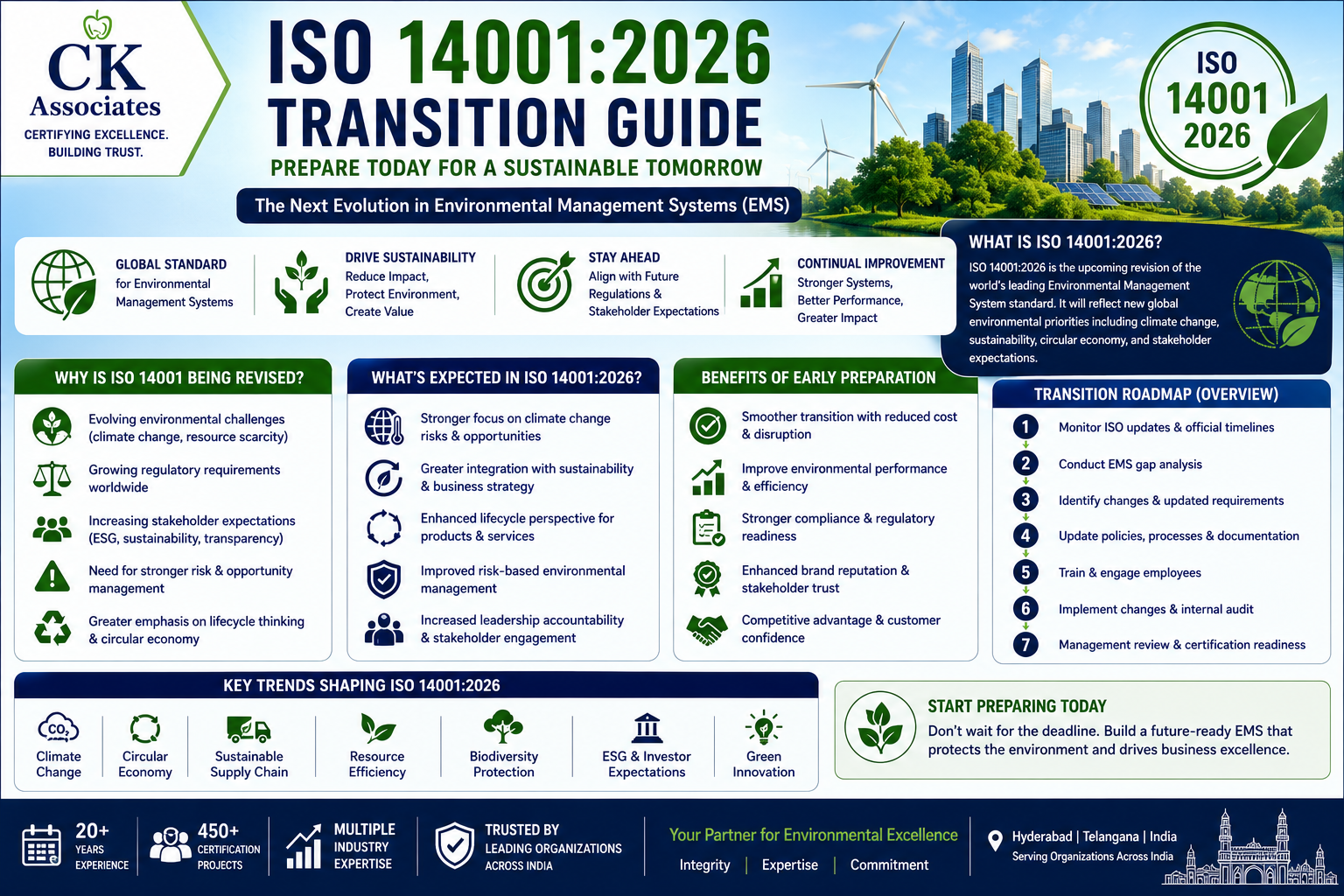
ISO 14001:2026 Transition Guide – Everything Organizations Need to Know.
ISO 14001:2026 is expected to update the internationally recognized Environmental Management System (EMS) standard to reflect evolving environmental priorities, climate change considerations, sustainability expectations, circular economy principles, and global regulatory developments. Organizations currently certified to ISO 14001:2015 should begin preparing for the transition by reviewing environmental risks, strengthening leadership involvement, evaluating climate-related impacts, improving lifecycle thinking, and updating environmental objectives. While certification bodies will announce formal transition timelines after publication, early preparation can reduce implementation effort and ensure continued certification with minimal disruption.
How Should Organizations Prepare for ISO 14001:2026?
Organizations should begin by reviewing their existing Environmental Management System, conducting a transition gap analysis, identifying anticipated changes between ISO 14001:2015 and ISO 14001:2026, evaluating climate-related risks and opportunities, updating environmental objectives, engaging leadership, and preparing employees for future certification requirements.
If your organization is certified to ISO 14001:2015:
✅ Monitor the publication of ISO 14001:2026.
✅ Conduct a transition gap analysis.
✅ Strengthen climate-related risk management.
✅ Review lifecycle and sustainability practices.
✅ Prepare documentation and employee awareness.
Key Takeaways
- ISO 14001:2026 is expected to modernize Environmental Management Systems.
- Climate change and sustainability are expected to receive greater emphasis.
- Organizations should begin transition planning before formal publication.
- Existing ISO 14001:2015 certifications will likely require transition within the timeframe announced after publication.
- Integrated Management Systems will simplify transition activities.
- Early preparation reduces certification risks and implementation costs.
- Leadership engagement will be critical for successful transition.
- Organizations demonstrating proactive environmental governance gain competitive advantages.
Introduction
Environmental sustainability has become a strategic business priority rather than simply a regulatory obligation.
Governments, investors, customers, multinational corporations, and consumers increasingly expect organizations to demonstrate measurable environmental responsibility. Issues such as climate change, resource efficiency, biodiversity protection, pollution prevention, carbon emissions, circular economy practices, and sustainable supply chains are now influencing procurement decisions, investment strategies, and corporate reputation.
As these expectations evolve, international management system standards must also evolve.
ISO 14001 has long been the world’s most widely adopted Environmental Management System (EMS) standard, helping organizations systematically identify environmental aspects, manage impacts, comply with legal requirements, and continually improve environmental performance.
The anticipated ISO 14001:2026 revision is expected to strengthen the standard by aligning it with modern environmental challenges, climate resilience, sustainability initiatives, and emerging stakeholder expectations.
Organizations that prepare early will be better positioned to achieve a smooth transition while improving operational efficiency and environmental performance.
What is ISO 14001?
ISO 14001 is an internationally recognized Environmental Management System (EMS) standard published by the International Organization for Standardization (ISO).
It provides a structured framework that enables organizations to:
- Identify environmental aspects and impacts.
- Meet environmental legal obligations.
- Prevent pollution.
- Improve resource efficiency.
- Reduce environmental risks.
- Continually improve environmental performance.
Unlike regulations that prescribe specific environmental limits, ISO 14001 focuses on establishing an effective management system that enables organizations to manage their environmental responsibilities systematically.
Why is ISO 14001 Being Revised?
International standards are periodically reviewed to ensure they remain relevant to changing business environments, technological advancements, regulatory developments, and stakeholder expectations.
Environmental priorities have changed significantly since ISO 14001:2015 was published.
Today’s organizations must address issues such as:
- Climate change adaptation and mitigation.
- Carbon footprint reduction.
- Circular economy practices.
- Sustainable resource management.
- ESG (Environmental, Social and Governance) expectations.
- Green supply chains.
- Biodiversity protection.
- Sustainable procurement.
- Renewable energy adoption.
The upcoming revision is expected to reflect these global priorities while maintaining compatibility with other ISO management system standards.
What is Expected in ISO 14001:2026?
Although the final published requirements will determine the exact content, organizations can reasonably anticipate increased emphasis on:
Climate Change
Organizations are expected to demonstrate stronger consideration of climate-related risks, opportunities, resilience, and adaptation strategies.
Sustainability Integration
Environmental management is likely to become more closely aligned with broader sustainability objectives and long-term organizational strategy.
Lifecycle Perspective
Organizations may be expected to strengthen lifecycle thinking when evaluating products, services, procurement, manufacturing, use, and end-of-life impacts.
Risk-Based Environmental Management
Greater emphasis is expected on identifying emerging environmental risks, evaluating opportunities, and integrating environmental considerations into business decision-making.
Stakeholder Expectations
Interested parties—including customers, regulators, investors, employees, and communities—are increasingly influencing environmental management decisions.
Organizations should actively understand and respond to these expectations.
Benefits of Preparing Early
Organizations that begin transition planning before the revised standard is published can realize several advantages.
Improved Environmental Performance
Early preparation enables organizations to identify opportunities for reducing waste, improving energy efficiency, conserving resources, and minimizing environmental impacts.
Reduced Transition Costs
Planning ahead minimizes last-minute documentation changes, employee training requirements, and certification disruptions.
Stronger Competitive Position
Customers increasingly prefer suppliers demonstrating proactive environmental stewardship and sustainability leadership.
Improved Regulatory Readiness
Organizations that maintain mature Environmental Management Systems are generally better positioned to respond to future environmental legislation and customer requirements.
Enhanced ESG Performance
Many organizations use ISO 14001 as a foundation for achieving broader Environmental, Social, and Governance (ESG) objectives.
Which Organizations Should Prepare?
The anticipated ISO 14001:2026 transition is relevant for organizations across all sectors, including:
- Manufacturing
- Automotive
- Aerospace
- Construction
- Pharmaceuticals
- Healthcare
- Information Technology
- Data Centres
- Food Processing
- Logistics
- Warehousing
- Educational Institutions
- Government Organizations
- Energy Companies
- Chemical Industries
- Electronics Manufacturers
- Engineering Companies
- Infrastructure Projects
- Service Organizations
Regardless of size, any organization certified to ISO 14001:2015 should begin planning for future transition activities.
Why ISO 14001 Matters for Hyderabad Businesses
Hyderabad continues to grow as one of India’s leading industrial, pharmaceutical, information technology, biotechnology, electronics, and manufacturing hubs.
With this growth comes increasing expectations related to:
- Environmental compliance.
- Sustainable manufacturing.
- Energy efficiency.
- Pollution prevention.
- Responsible resource management.
- Customer sustainability requirements.
- ESG reporting.
- Supply chain environmental performance.
Organizations in Hyderabad seeking to maintain competitiveness, attract multinational clients, and strengthen environmental governance should proactively prepare for the transition to ISO 14001:2026.
Global Environmental Trends Driving ISO 14001:2026
Several worldwide developments are shaping the future of environmental management.
These include:
- Net-zero commitments.
- Climate change mitigation.
- Carbon reduction initiatives.
- Circular economy adoption.
- Sustainable supply chains.
- Renewable energy integration.
- Green procurement.
- Biodiversity conservation.
- ESG reporting expectations.
- Responsible resource management.
The revised ISO 14001 standard is expected to better support organizations in addressing these emerging priorities.
Preparing Today for Tomorrow
Waiting until the revised standard is officially published may leave organizations with limited time to implement changes before certification transition deadlines.
Organizations that begin evaluating their Environmental Management Systems today can transition more efficiently while strengthening environmental performance and demonstrating leadership in sustainability.
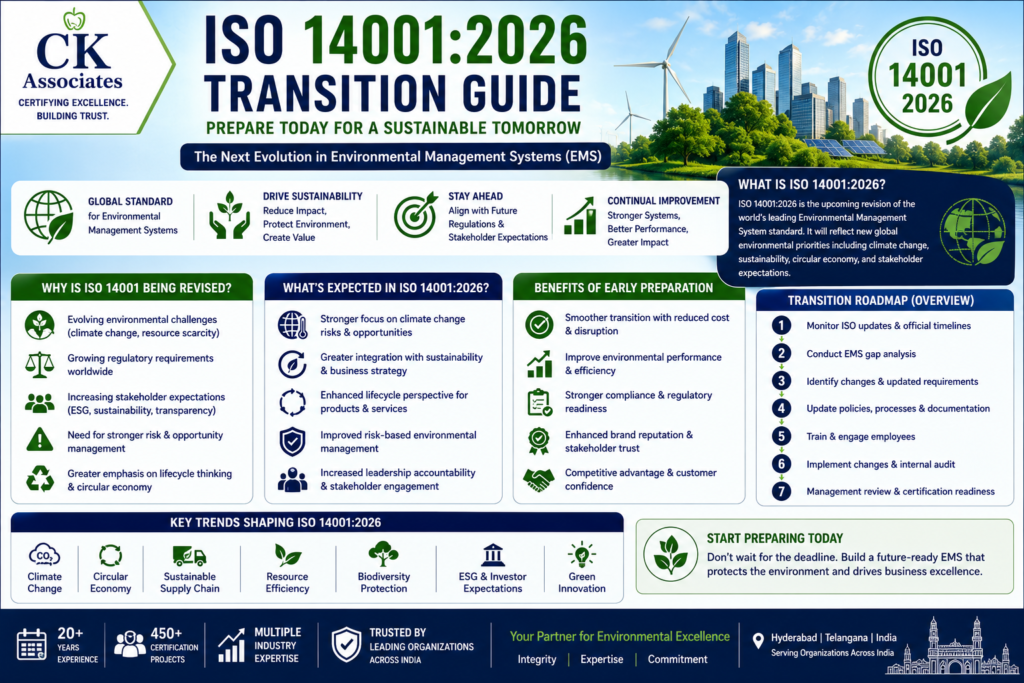
ISO 14001:2015 vs ISO 14001:2026 – Expected Changes, Transition Strategy & Gap Analysis
Important Note:
At the time of writing, ISO 14001:2026 has not yet been officially published. The information below discusses expected transition areas based on the ongoing revision process, ISO committee work, and current environmental management trends. Organizations should review the final published standard and guidance from accredited certification bodies once available.
Why is ISO 14001 Being Revised?
The environmental landscape has changed significantly since ISO 14001:2015 was released.
Organizations now face increasing expectations regarding:
- Climate Change
- Carbon Neutrality
- Net Zero Commitments
- ESG Reporting
- Circular Economy
- Sustainable Procurement
- Resource Scarcity
- Biodiversity Protection
- Green Supply Chains
- Environmental Transparency
The revised standard is expected to better align Environmental Management Systems (EMS) with these evolving global priorities.
ISO 14001:2015 vs ISO 14001:2026 Comparison
| Area | ISO 14001:2015 | Expected ISO 14001:2026 Direction |
|---|---|---|
| Climate Change | Limited explicit emphasis | Greater integration into EMS planning |
| Sustainability | Environmental focus | Stronger sustainability alignment |
| Leadership | EMS commitment | Increased strategic accountability |
| Risk Management | Environmental risks | Climate, resilience & ESG considerations |
| Lifecycle Perspective | Recommended | Greater implementation emphasis |
| Circular Economy | Limited | Expected stronger integration |
| Interested Parties | Existing requirement | Expanded stakeholder expectations |
| Environmental Objectives | Existing | More measurable & strategic |
| Compliance | Legal compliance | Wider sustainability obligations |
| Continual Improvement | Required | Enhanced performance monitoring |
Expected Clause-by-Clause Changes
Clause 4 – Context of the Organization
Organizations may need to broaden their understanding of environmental context.
Expected additional considerations include:
- Climate Change
- Sustainability Strategy
- Carbon Reduction
- Biodiversity
- ESG Expectations
- Supply Chain Impacts
Typical Outputs
✔ Climate Context Analysis
✔ Sustainability Register
✔ Environmental Risk Register
✔ Interested Party Analysis
Clause 5 – Leadership
Leadership is expected to play a more active role in environmental governance.
Top Management should demonstrate commitment by:
- Integrating environmental objectives into business strategy.
- Supporting climate initiatives.
- Allocating environmental resources.
- Promoting sustainability culture.
- Monitoring environmental performance.
Environmental management is increasingly becoming a Board-level responsibility.
Clause 6 – Planning
Planning is expected to expand beyond traditional environmental risks.
Organizations should evaluate:
- Climate Risks
- Transition Risks
- Physical Risks
- Environmental Opportunities
- ESG Expectations
- Resource Availability
- Energy Efficiency
- Carbon Reduction Opportunities
Risk-based thinking will become even more important.
Clause 7 – Support
Organizations should strengthen:
- Employee Awareness
- Climate Change Competence
- Sustainability Training
- Environmental Communication
- Environmental Documentation
- Knowledge Management
Employees should understand environmental responsibilities beyond legal compliance.
Clause 8 – Operation
Operational controls are expected to emphasize:
- Energy Management
- Waste Reduction
- Circular Economy
- Sustainable Procurement
- Pollution Prevention
- Resource Efficiency
- Green Supply Chains
Organizations should demonstrate operational environmental improvement rather than documentation alone.
Clause 9 – Performance Evaluation
Performance measurement is expected to become more data-driven.
Organizations should monitor:
- Carbon Emissions
- Energy Consumption
- Water Usage
- Waste Generation
- Recycling Performance
- Environmental Objectives
- Legal Compliance
- Sustainability KPIs
Management Reviews should evaluate long-term environmental performance.
Clause 10 – Improvement
Organizations should continually improve:
- Environmental Performance
- Sustainability Programs
- Climate Initiatives
- Carbon Reduction Plans
- Environmental Objectives
- EMS Effectiveness
Continual Improvement remains the cornerstone of ISO management systems.
Climate Change Integration
Climate change has become one of the most significant environmental challenges affecting organizations worldwide.
Future Environmental Management Systems are expected to integrate:
- Climate Adaptation
- Climate Mitigation
- Carbon Footprint
- Greenhouse Gas Management
- Extreme Weather Preparedness
- Resource Resilience
Organizations should begin evaluating these areas before formal transition requirements are published.
Circular Economy
One of the strongest expected themes is the Circular Economy.
Organizations should evaluate opportunities to:
- Reduce Waste
- Reuse Materials
- Improve Recycling
- Extend Product Life
- Reduce Resource Consumption
- Improve Sustainable Procurement
Circular economy principles support both environmental performance and operational efficiency.
ESG Alignment
Environmental Management Systems increasingly support ESG objectives.
ISO 14001 contributes to:
Environmental
✔ Carbon Reduction
✔ Waste Management
✔ Pollution Prevention
✔ Energy Efficiency
✔ Resource Conservation
Social
✔ Community Responsibility
✔ Health & Safety Integration
✔ Sustainable Supply Chains
Governance
✔ Leadership
✔ Compliance
✔ Accountability
✔ Performance Monitoring
Risk-Based Environmental Management
Organizations should evaluate:
Environmental Risks
- Pollution
- Resource Depletion
- Waste Generation
- Chemical Management
Climate Risks
- Flooding
- Heat Stress
- Water Scarcity
- Supply Chain Disruption
Business Risks
- Regulatory Changes
- Customer Expectations
- Investor Pressure
- Reputation
Operational Risks
- Energy Costs
- Resource Availability
- Environmental Incidents
Lifecycle Perspective
ISO 14001 introduced lifecycle thinking.
Future revisions are expected to strengthen implementation throughout:
Design
↓
Raw Materials
↓
Manufacturing
↓
Transportation
↓
Customer Use
↓
End-of-Life
↓
Recycling
↓
Recovery
↓
Circular Economy
Organizations should evaluate environmental impacts at every stage.
Environmental Objectives
Future objectives should become more measurable.
Examples include:
- Reduce electricity consumption by 12%
- Reduce water usage by 8%
- Reduce landfill waste by 25%
- Increase recycling rate to 90%
- Reduce greenhouse gas emissions
- Increase renewable energy usage
Objectives should align with organizational strategy.
ISO 14001 Transition Roadmap
Step 1
Review Existing EMS
↓
Step 2
Conduct Gap Analysis
↓
Step 3
Identify New Requirements
↓
Step 4
Update Documentation
↓
Step 5
Employee Awareness
↓
Step 6
Implementation
↓
Step 7
Internal Audit
↓
Step 8
Management Review
↓
Step 9
Certification Transition Audit
Key Industry Statistics
Climate Commitments
Organizations worldwide continue to adopt climate targets, renewable energy initiatives, and sustainability programs.
Why it matters: Environmental Management Systems provide structured governance to achieve these commitments.
ESG Investment
Investors increasingly evaluate environmental performance alongside financial performance.
Why it matters: Organizations with mature EMS frameworks are better positioned to demonstrate environmental governance.
Sustainable Supply Chains
Large organizations increasingly require suppliers to demonstrate environmental responsibility.
Why it matters: ISO 14001 certification strengthens supplier credibility and competitiveness.
Real-World Implementation Example
Organization
A Hyderabad-based pharmaceutical manufacturer certified to ISO 14001:2015.
Challenge
The organization sought to prepare for the anticipated revision while improving sustainability performance and meeting increasing customer expectations.
CK Associates Approach
- EMS Gap Analysis
- Climate Risk Assessment
- Environmental Aspect Review
- Lifecycle Evaluation
- Documentation Updates
- Sustainability KPI Development
- Internal Auditor Training
- Management Review Enhancement
Outcome
The organization improved environmental governance, strengthened sustainability initiatives, enhanced environmental performance monitoring, and positioned itself for a smoother transition once the revised standard becomes available.
Why Trust This Guidance?
Environmental management is evolving rapidly, requiring organizations to balance regulatory compliance, sustainability objectives, operational efficiency, and stakeholder expectations.
CK Associates Authority
✅ 20+ Years Experience
✅ 450+ Certification Projects
✅ 400+ ISO 9001 Implementations
✅ 45+ ISO 14001 Implementations
✅ 45+ ISO 45001 Implementations
✅ Integrated Management System Specialists
Our consultants help organizations implement practical Environmental Management Systems that improve compliance, reduce environmental risks, strengthen sustainability performance, and prepare businesses for future standards and regulatory developments.
About the Author
Sirish K
Founder & Lead ISO Consultant – CK Associates
With over 20 years of experience and 450+ certification projects, Sirish K specializes in Environmental Management Systems, Quality Management Systems, Occupational Health & Safety, Information Security, AI Governance, and Integrated Management Systems.
He has supported manufacturing industries, pharmaceutical companies, healthcare organizations, IT firms, food manufacturers, infrastructure projects, and service organizations in implementing practical ISO solutions that improve compliance, sustainability, operational performance, and business resilience.
<h2>About the Author</h2>

<p><strong>Sirish K</strong> is the Founder & Lead ISO Consultant at CK Associates. With over 20 years of experience and 450+ certification projects completed, he specializes in ISO 9001, ISO 27001, ISO 27701, ISO 42001, ISO 14001, ISO 45001, ISO 22301 and Integrated Management Systems.</p>

<p><a href="https://ckassociates.biz/sirish-k/">View Full Author Profile</a></p>
Frequently Asked Questions (FAQ)
1. What is ISO 14001:2026?
ISO 14001:2026 is the anticipated next revision of the internationally recognized Environmental Management System (EMS) standard. It is expected to strengthen environmental governance by incorporating emerging sustainability priorities, climate change considerations, circular economy principles, and evolving stakeholder expectations. Organizations should verify the final published requirements once the revision is officially released.
2. Is ISO 14001:2026 officially published?
At the time of writing, ISO 14001:2026 has not yet been officially published.
Organizations should monitor announcements from ISO and their accredited Certification Bodies regarding publication dates, transition guidance, and certification timelines.
3. What happens to ISO 14001:2015 certificates?
Existing ISO 14001:2015 certificates will generally remain valid during the transition period announced after the new edition is published.
Organizations are expected to transition to the revised standard within the timeframe specified by the International Accreditation Forum (IAF) and Certification Bodies.
4. Should organizations start preparing now?
Yes.
Organizations should begin:
- EMS Gap Analysis
- Climate Risk Assessment
- Documentation Review
- Leadership Awareness
- Employee Training
- Sustainability Planning
Early preparation reduces implementation effort and transition risk.
5. What are the expected major changes?
Expected areas of emphasis include:
- Climate Change
- Sustainability
- Circular Economy
- Environmental Risk Management
- Lifecycle Thinking
- ESG Alignment
- Leadership Engagement
- Stakeholder Expectations
- Environmental Performance Measurement
The exact requirements will depend on the final published standard.
6. Will the clause structure change?
ISO 14001 is expected to continue following the ISO Harmonized Structure (HS), maintaining compatibility with:
- ISO 9001
- ISO 45001
- ISO 27001
- ISO 27701
- ISO 42001
This helps organizations maintain Integrated Management Systems (IMS).
7. How long will the transition take?
Formal transition timelines will be confirmed after publication by ISO, the IAF, and accredited Certification Bodies.
Organizations that begin preparation early typically experience a smoother transition with fewer operational disruptions.
8. How can organizations prepare?
Recommended preparation activities include:
- EMS Gap Analysis
- Reviewing Environmental Aspects
- Updating Risk Registers
- Evaluating Climate Risks
- Reviewing Environmental Objectives
- Updating Documentation
- Employee Awareness Programs
- Internal Audits
- Management Reviews
9. What industries should prepare?
ISO 14001 remains relevant for:
- Manufacturing
- Pharmaceutical
- Healthcare
- Construction
- Food Processing
- Automotive
- Electronics
- Logistics
- Warehousing
- IT Companies
- Infrastructure
- Government Organizations
- Educational Institutions
10. Will climate change become more important?
Yes.
Climate-related risks and opportunities are expected to receive greater emphasis within Environmental Management Systems.
Organizations should begin evaluating:
- Carbon Emissions
- Climate Adaptation
- Climate Resilience
- Energy Efficiency
- Sustainable Operations
11. How does ISO 14001 support ESG?
ISO 14001 strengthens the Environmental pillar of ESG by improving:
- Pollution Prevention
- Waste Reduction
- Resource Efficiency
- Environmental Compliance
- Sustainability Performance
- Environmental Governance
12. Can ISO 14001 integrate with ISO 9001 and ISO 45001?
Yes.
All three standards share the ISO Harmonized Structure, allowing organizations to build an Integrated Management System (IMS).
Benefits include:
- Common Documentation
- Unified Audits
- Shared Objectives
- Reduced Duplication
- Lower Certification Costs
13. What documents may require updating?
Organizations should review:
- EMS Manual (if maintained)
- Environmental Policy
- Environmental Objectives
- Aspect & Impact Register
- Risk & Opportunity Register
- Compliance Obligations Register
- Operational Controls
- Emergency Preparedness Procedures
- Internal Audit Program
- Management Review Records
Updates should be based on the final published requirements.
14. How can CK Associates help?
CK Associates provides:
- Transition Gap Analysis
- Documentation Review
- EMS Implementation
- Internal Auditor Training
- Climate Risk Assessment
- Environmental Aspect Review
- Internal Audits
- Certification Readiness Support
- Integrated Management System Consulting
15. Why should organizations transition early?
Organizations preparing early can:
- Minimize transition risks.
- Improve environmental performance.
- Reduce implementation costs.
- Enhance customer confidence.
- Strengthen ESG performance.
- Improve regulatory readiness.
- Maintain uninterrupted certification.
ISO 14001:2026 Transition Checklist
Phase 1 – Preparation
✅ Monitor ISO publication updates
✅ Review transition guidance
✅ Inform leadership
✅ Define transition team
Phase 2 – Gap Analysis
✅ Compare current EMS with new requirements
✅ Review climate-related considerations
✅ Review sustainability objectives
Phase 3 – Documentation
✅ Update EMS procedures
✅ Revise policies
✅ Update operational controls
✅ Review registers
Phase 4 – Implementation
✅ Employee Awareness
✅ Process Improvements
✅ Operational Changes
Phase 5 – Verification
✅ Internal Audit
✅ Management Review
✅ Corrective Actions
Phase 6 – Certification
✅ Transition Audit
✅ Certification Body Review
✅ Continuous Improvement
EMS Documentation Update Checklist
Organizations should review:
| Document | Review Required |
|---|---|
| Environmental Policy | ✔ |
| EMS Scope | ✔ |
| Environmental Aspects Register | ✔ |
| Risk & Opportunity Register | ✔ |
| Legal Compliance Register | ✔ |
| Operational Controls | ✔ |
| Emergency Preparedness | ✔ |
| Environmental Objectives | ✔ |
| KPI Dashboard | ✔ |
| Internal Audit Procedure | ✔ |
| Management Review Procedure | ✔ |
| Corrective Action Process | ✔ |
ISO 14001 Integrated Clause Mapping
| ISO 14001 | ISO 9001 | ISO 45001 | Integration Opportunity |
|---|---|---|---|
| Context | ✔ | ✔ | Shared Context Analysis |
| Leadership | ✔ | ✔ | Common Policy & Objectives |
| Planning | ✔ | ✔ | Unified Risk Management |
| Support | ✔ | ✔ | Shared Competence & Training |
| Operation | Partial | Partial | Integrated Operational Controls |
| Performance Evaluation | ✔ | ✔ | Combined Internal Audits |
| Improvement | ✔ | ✔ | Unified Continual Improvement |
Transition Readiness Assessment Matrix
| Area | Readiness |
|---|---|
| Leadership Commitment | □ Low □ Medium □ High |
| Climate Risk Assessment | □ Low □ Medium □ High |
| Environmental Objectives | □ Low □ Medium □ High |
| EMS Documentation | □ Low □ Medium □ High |
| Internal Audits | □ Low □ Medium □ High |
| Employee Awareness | □ Low □ Medium □ High |
| Sustainability Integration | □ Low □ Medium □ High |
| Certification Readiness | □ Low □ Medium □ High |
Summary
The anticipated ISO 14001:2026 revision is expected to strengthen Environmental Management Systems by placing greater emphasis on climate change, sustainability, lifecycle thinking, circular economy principles, environmental risk management, and stakeholder expectations. Organizations certified to ISO 14001:2015 should begin preparing through gap analyses, climate risk assessments, documentation reviews, and leadership engagement. Because the standard has not yet been officially published, organizations should verify final requirements and transition timelines once they are released by ISO and accredited Certification Bodies.