
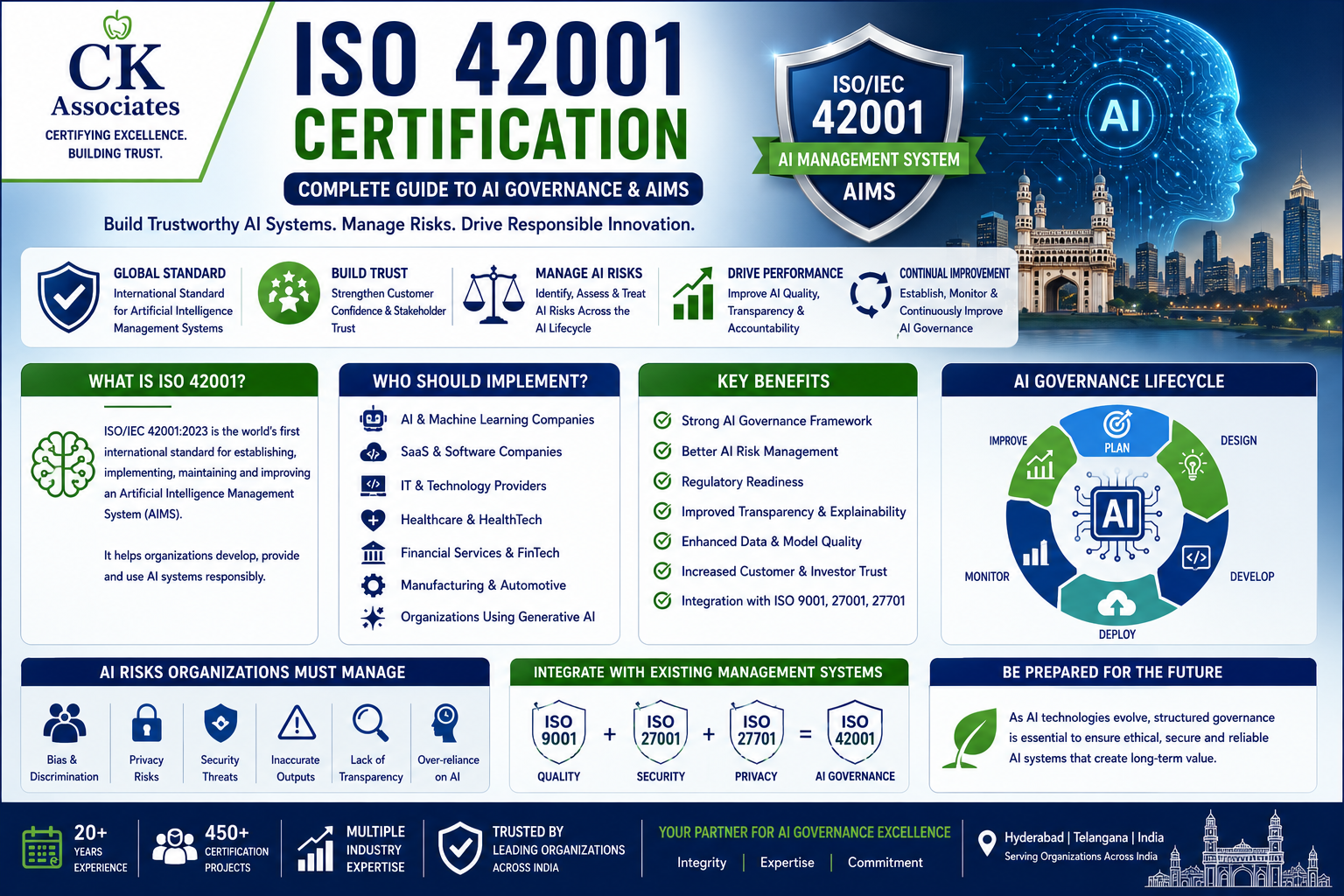
SO/IEC 42001:2023 is an international management system standard for organizations that develop, provide or use artificial intelligence systems. It establishes requirements for creating, implementing, maintaining and continually improving an Artificial Intelligence Management System, or AIMS. The standard helps organizations define AI governance responsibilities, identify and treat AI risks, assess system impacts, manage data and third-party dependencies, establish human oversight, monitor AI performance and respond to incidents. ISO 42001 certification can help AI companies, SaaS providers, technology businesses and other AI users demonstrate structured and responsible AI governance. It can also be integrated with ISO 9001, ISO/IEC 27001 and ISO/IEC 27701 to create a unified framework for quality, information security, privacy and artificial intelligence governance.
How Should Organizations Implement ISO 42001?
Organizations should begin ISO 42001 implementation by identifying the AI systems within scope, understanding relevant stakeholders, establishing an AI policy, assigning governance responsibilities, conducting AI risk and impact assessments, implementing lifecycle controls, defining human oversight, training employees, monitoring AI performance, conducting internal audits and completing management reviews. The organization should then address identified nonconformities before proceeding to an independent certification audit.
5. Key Takeaways
- ISO/IEC 42001 is an international standard for Artificial Intelligence Management Systems.
- It applies to organizations that develop, provide or use AI-based products and services.
- The standard establishes governance across the complete AI system lifecycle.
- AI risk management, impact assessment, accountability and human oversight are central requirements.
- ISO 42001 can be integrated with quality, security and privacy management systems.
- Certification can strengthen customer confidence and enterprise procurement readiness.
- ISO 42001 can support regulatory preparedness, but it does not automatically establish compliance with every AI law.
- Early implementation helps organizations create repeatable governance before AI usage expands further.
What Is ISO/IEC 42001:2023?
ISO/IEC 42001:2023 is an international standard specifying requirements for establishing, implementing, maintaining and continually improving an Artificial Intelligence Management System within an organization.
It was developed for organizations involved in the provision or use of AI systems. This includes businesses that:
- Develop AI models
- Build AI-enabled software
- Integrate third-party AI platforms
- Deploy generative AI tools
- Use AI for operational or customer-facing decisions
- Provide AI infrastructure or managed services
- Procure AI systems from external vendors
An Artificial Intelligence Management System is not simply a set of technical model controls. It is an enterprise governance framework connecting AI activities with organizational strategy, risk management, accountability, legal obligations, operational processes and continual improvement.
ISO describes the standard as applicable to organizations providing or using AI-based products or services and intended to support the responsible development and use of AI systems.
Why Is ISO 42001 Important?
Artificial intelligence is increasingly embedded in business processes, products and services. Organizations now use AI for:
- Customer service
- Fraud detection
- Recruitment screening
- Medical decision support
- Predictive maintenance
- Credit analysis
- Marketing personalization
- Cybersecurity monitoring
- Software development
- Document analysis
- Supply-chain forecasting
- Generative content production
These applications can create substantial value, but they can also create risks that traditional IT controls may not fully address.
Potential AI-related risks include:
- Algorithmic bias
- Incorrect or misleading outputs
- Hallucinations from generative AI
- Data-quality failures
- Privacy violations
- Weak transparency
- Inadequate human oversight
- Model drift
- Security vulnerabilities
- Third-party AI dependency
- Intellectual-property exposure
- Regulatory noncompliance
- Reputational damage
ISO 42001 gives organizations a repeatable governance model for identifying, evaluating, treating, monitoring and improving controls around these risks.
What Is an Artificial Intelligence Management System?
An Artificial Intelligence Management System, commonly abbreviated as AIMS, is the collection of policies, responsibilities, processes, controls, records and improvement mechanisms used to govern artificial intelligence within an organization.
A practical AIMS may include:
- AI governance policy
- AI system inventory
- AI ownership and accountability matrix
- AI risk-assessment methodology
- AI impact-assessment process
- Data-governance controls
- AI lifecycle procedures
- Third-party AI evaluation
- Human-oversight requirements
- AI incident management
- AI monitoring and measurement
- Internal audit
- Management review
- Corrective action
- Continual improvement
The management system approach is valuable because AI governance cannot be managed effectively by the technology team alone. It requires coordinated participation from leadership, legal, compliance, security, privacy, quality, risk, human resources, procurement and relevant business functions.
Who Should Implement ISO 42001?
ISO 42001 is relevant to organizations that develop, supply, procure, operate or substantially rely on AI systems.
AI and Machine-Learning Companies
Companies building models, AI platforms or AI-enabled products can use ISO 42001 to formalize development governance, risk assessment and customer assurance.
SaaS Companies
SaaS providers embedding generative AI, predictive analytics or automated decision-making can use the standard to demonstrate responsible AI governance to enterprise customers.
IT and Software Development Companies
Software businesses using AI in development, testing, customer support or product functionality can establish consistent controls across teams and projects.
Healthcare and HealthTech Organizations
AI used in clinical support, diagnostics, workflow prioritization or patient engagement may require enhanced oversight, impact assessment and data governance.
Financial Services and FinTech Companies
Organizations using AI for fraud detection, underwriting, credit decisions, trading or customer profiling can improve accountability and explainability.
Manufacturing Companies
Manufacturers using AI for predictive maintenance, inspection, process optimization or autonomous systems can manage AI-related operational risks.
Educational Institutions and EdTech Companies
AI-powered learning, assessment, student profiling and content generation require appropriate controls for fairness, privacy and human review.
Government and Public-Sector Organizations
Public bodies deploying AI in citizen services or administrative decisions may need particularly strong transparency, accountability and impact controls.
Organizations Using Third-Party Generative AI
A company does not need to develop its own AI model to benefit from ISO 42001. Businesses using external AI tools can still face risks involving confidential information, data retention, inaccurate outputs, intellectual property and inappropriate reliance.
What Business Problems Does ISO 42001 Address?
Organizations often adopt AI rapidly through multiple departments without a common governance structure. This creates fragmented decision-making and inconsistent controls.
Common problems include:
- No complete inventory of AI systems
- Employees using unapproved AI platforms
- Unclear ownership of AI decisions
- Inconsistent AI risk assessment
- Weak controls over training or input data
- Lack of supplier due diligence
- Unclear human-oversight rules
- No formal AI incident process
- Limited performance monitoring
- Difficulty responding to customer questionnaires
- Inadequate evidence for regulators or auditors
ISO 42001 helps convert these fragmented activities into an organized governance system.
What Are the Main Benefits of ISO 42001 Certification?
Stronger AI Governance
The standard helps leadership define how AI may be developed, acquired, deployed, monitored and improved.
Improved Accountability
Roles can be formally assigned to AI system owners, risk owners, data owners, technical teams, business users and oversight functions.
Better AI Risk Management
Organizations establish a structured method for identifying risks to individuals, groups, the organization and society.
Increased Customer Confidence
Enterprise customers increasingly ask suppliers how AI systems are controlled. Certification can provide independent assurance that a documented management system is operating.
Improved Procurement Readiness
Organizations may respond more effectively to customer due-diligence questionnaires involving AI governance, security, privacy, data sources and human oversight.
Regulatory Preparedness
ISO 42001 can help create the governance infrastructure needed to respond to applicable AI regulation. However, organizations must separately evaluate the laws applying to their specific activities and jurisdictions.
Improved AI Lifecycle Control
The standard supports governance from planning and design through deployment, monitoring, modification and retirement.
Easier Integration with Existing ISO Systems
Organizations already certified to ISO 9001 or ISO/IEC 27001 can reuse common management-system processes such as document control, competence management, internal audit, management review and corrective action.
What Are the Core Components of Responsible AI Governance?
Responsible AI governance commonly involves several interconnected principles.
Accountability
The organization should establish clear accountability for AI systems and their outcomes. Responsibility cannot be transferred entirely to a model, vendor or automated process.
Transparency
Relevant stakeholders should receive appropriate information about AI usage, limitations and decision-making, depending on the context and applicable obligations.
Fairness
Organizations should evaluate whether AI systems could create unjustified bias or unequal impacts.
Human Oversight
Human review, intervention, escalation or override should be defined where appropriate to the level of risk and consequence.
Data Governance
AI performance depends heavily on the quality, provenance, relevance and control of data.
Reliability and Performance
AI systems should be tested, validated and monitored against defined requirements and intended use.
Privacy
Personal information used within AI systems should be managed according to applicable privacy obligations and organizational controls.
Security
AI systems require protection against threats such as data poisoning, prompt injection, unauthorized access, model theft and manipulation.
Continual Improvement
Organizations should use monitoring, incidents, audits, feedback and changing conditions to continually improve AI governance.
What Is the Relationship Between ISO 42001 and NIST AI RMF?
The NIST Artificial Intelligence Risk Management Framework is a voluntary framework designed to help organizations manage risks associated with AI and improve trustworthiness considerations across AI products, services and systems. Its core functions are Govern, Map, Measure and Manage.
ISO 42001 and the NIST AI RMF are complementary:
| Area | ISO 42001 | NIST AI RMF |
|---|---|---|
| Type | Management-system standard | Voluntary risk framework |
| Certification | Third-party certification possible | No certification under the framework itself |
| Governance | Formal management-system requirements | Governance outcomes and recommended actions |
| Risk approach | Integrated into AIMS | Govern, Map, Measure and Manage |
| Internal audit | Required | Not structured as a certification requirement |
| Management review | Required | Not structured as an ISO management-system requirement |
| Best use | Enterprise governance and assurance | AI risk analysis and operational guidance |
Organizations can use ISO 42001 as the certifiable governance structure and NIST AI RMF as a detailed risk-management resource.
How Does ISO 42001 Relate to the EU AI Act?
The EU AI Act is a legally binding regulatory framework, while ISO 42001 is a voluntary international management-system standard.
The two should not be treated as interchangeable.
ISO 42001 can help organizations establish governance processes relevant to areas such as:
- Risk management
- Accountability
- Documentation
- Human oversight
- Monitoring
- Incident response
- Transparency
- Continual improvement
However, certification does not automatically prove compliance with every EU AI Act requirement. Legal applicability depends on factors such as the organization’s role, AI system classification, intended use and market presence.
The EU AI Act entered into force after publication in the Official Journal in 2024, with requirements becoming applicable in stages. Organizations operating in or supplying the EU market should therefore perform a separate legal applicability assessment alongside ISO 42001 implementation.
Why ISO 42001 Matters for Hyderabad and Indian Technology Companies
Hyderabad has a strong concentration of:
- Global Capability Centres
- IT and IT-enabled service providers
- SaaS companies
- Artificial-intelligence startups
- FinTech businesses
- HealthTech companies
- Pharmaceutical technology operations
- Cybersecurity firms
- Cloud-service providers
- Data and analytics companies
These organizations increasingly serve enterprise customers in India, Europe, North America and other international markets. Their customers may request evidence of responsible AI, information security, privacy protection and supplier governance.
ISO 42001 can help Hyderabad technology businesses:
- Strengthen enterprise-sales credibility
- Improve customer due diligence
- Formalize internal AI usage
- Create governance for generative AI
- Prepare for international regulatory expectations
- Integrate AI governance with ISO 27001 and ISO 9001
- Differentiate themselves in competitive procurement processes
Early Lead-Generation CTA
Does your organization develop or use AI but lack a formal governance framework?
CK Associates can conduct an ISO 42001 and AI Governance Gap Analysis to identify:
- AI systems within scope
- Governance gaps
- Risk-assessment priorities
- Required documentation
- Integration opportunities with ISO 9001, ISO 27001 and ISO 27701
- Certification-readiness actions
ISO 42001 Clauses Explained – Clause-by-Clause Guide
ISO/IEC 42001 follows the ISO Harmonized Structure (HS), making it easy to integrate with ISO 9001, ISO 27001, ISO 27701, ISO 14001, and ISO 45001.
The standard contains ten clauses, of which Clauses 4–10 define the mandatory requirements for establishing, implementing, maintaining, and continually improving an Artificial Intelligence Management System (AIMS).
Clause 4 – Context of the Organization
Organizations must understand both internal and external factors that influence AI governance.
This includes identifying:
- AI business objectives
- Regulatory obligations
- Interested parties
- AI stakeholders
- Ethical considerations
- Organizational risks
- Business opportunities
Typical Outputs
✔ AI Context Analysis
✔ Interested Party Register
✔ Scope of AIMS
✔ AI Governance Objectives
Clause 5 – Leadership
Leadership plays a critical role in successful AI governance.
Top Management must demonstrate commitment by:
- Establishing AI Policies
- Allocating responsibilities
- Promoting ethical AI
- Supporting continual improvement
- Providing necessary resources
Without leadership commitment, AI governance cannot be effectively implemented.
Clause 6 – Planning
Planning ensures organizations proactively manage AI-related risks.
Organizations should:
- Identify AI risks
- Identify AI opportunities
- Conduct AI Risk Assessments
- Define AI Objectives
- Develop Risk Treatment Plans
This clause introduces risk-based thinking throughout AI governance.
Clause 7 – Support
Support provides the foundation for maintaining an effective Artificial Intelligence Management System.
Organizations should establish:
- Competence
- Awareness
- Training
- Communication
- Documented Information
- Knowledge Management
Employees using AI systems should understand:
- AI Risks
- Ethical Responsibilities
- Data Privacy
- AI Bias
- Human Oversight
Clause 8 – Operation
Clause 8 forms the operational core of ISO 42001.
Organizations should control AI throughout its lifecycle.
Activities include:
- AI Design
- AI Development
- AI Testing
- AI Validation
- AI Deployment
- AI Monitoring
- AI Retirement
This ensures AI systems remain trustworthy throughout their operational life.
Clause 9 – Performance Evaluation
Organizations should continually evaluate AI performance through:
- Internal Audits
- AI Monitoring
- KPI Measurement
- Management Reviews
- Performance Analysis
- Compliance Reviews
Regular evaluation helps organizations identify improvement opportunities before problems occur.
Clause 10 – Improvement
Continuous improvement ensures AI governance evolves alongside technological change.
Organizations should:
- Correct Nonconformities
- Perform Root Cause Analysis
- Improve AI Controls
- Update Documentation
- Learn from Incidents
Continual improvement is essential because AI technologies evolve rapidly.
Annex A Controls Explained
Annex A provides guidance on implementing effective AI governance controls.
Key control areas include:
AI Policies
Develop documented AI governance policies that define responsibilities, ethical principles, and organizational expectations.
AI Roles & Responsibilities
Clearly assign:
- AI Owners
- AI Developers
- AI Reviewers
- Risk Owners
- Compliance Officers
- Business Owners
AI Risk Assessment
Organizations should assess risks including:
- Bias
- Hallucinations
- Privacy Risks
- Security Risks
- Ethical Risks
- Regulatory Risks
- Operational Risks
Data Governance
AI quality depends on data quality.
Organizations should manage:
- Data Sources
- Data Accuracy
- Data Quality
- Data Ownership
- Data Security
- Data Retention
Human Oversight
AI should not replace human judgment in critical decisions.
Organizations should define:
- Human Approval Requirements
- Escalation Processes
- Override Mechanisms
- Accountability
Transparency
Organizations should ensure AI decisions can be understood by stakeholders wherever appropriate.
Transparency improves:
- Customer Trust
- Regulatory Compliance
- Ethical Decision Making
AI Lifecycle Management
ISO 42001 emphasizes governance throughout the complete AI lifecycle.
Phase 1
Planning
↓
Business Objectives
↓
AI Strategy
Phase 2
Design
↓
Requirements
↓
Architecture
↓
Data Governance
Phase 3
Development
↓
Model Development
↓
Training
↓
Validation
Phase 4
Deployment
↓
Production Release
↓
Monitoring
↓
Human Oversight
Phase 5
Operation
↓
Performance Monitoring
↓
Incident Management
↓
Model Updates
Phase 6
Retirement
↓
Controlled Decommissioning
↓
Knowledge Retention
AI Governance Framework
An effective AI Governance Framework includes:
Leadership
↓
Policies
↓
Risk Management
↓
Data Governance
↓
Model Governance
↓
Human Oversight
↓
Monitoring
↓
Internal Audit
↓
Continual Improvement
ISO 42001 vs ISO 27001
| Feature | ISO 42001 | ISO 27001 |
|---|---|---|
| Focus | AI Governance | Information Security |
| Management System | AIMS | ISMS |
| AI Risks | ✔ | Limited |
| Cybersecurity | Partial | ✔ |
| Data Governance | ✔ | Partial |
| AI Ethics | ✔ | ✘ |
| AI Lifecycle | ✔ | ✘ |
| Security Controls | Limited | Comprehensive |
Integration Opportunity
Organizations developing AI solutions should integrate ISO 42001 with ISO 27001 to manage both AI governance and information security.
ISO 42001 vs ISO 27701
| Feature | ISO 42001 | ISO 27701 |
|---|---|---|
| Focus | AI Governance | Privacy Information Management |
| AI Ethics | ✔ | Limited |
| Personal Information | Partial | ✔ |
| Privacy Risk | Partial | ✔ |
| Data Subject Rights | Limited | ✔ |
| AI Transparency | ✔ | Partial |
ISO 42001 vs ISO 9001
| Feature | ISO 42001 | ISO 9001 |
|---|---|---|
| AI Governance | ✔ | ✘ |
| Quality Management | Partial | ✔ |
| Continual Improvement | ✔ | ✔ |
| Leadership | ✔ | ✔ |
| Risk-Based Thinking | ✔ | ✔ |
| Customer Satisfaction | Partial | ✔ |
ISO 42001 vs NIST AI RMF
| ISO 42001 | NIST AI RMF |
|---|---|
| International Standard | U.S. Framework |
| Certifiable | Guidance Framework |
| Management System | Risk Management Framework |
| Internal Audits | Not Required |
| Certification Possible | No Certification |
ISO 42001 vs EU AI Act
| ISO 42001 | EU AI Act |
|---|---|
| Voluntary International Standard | European Regulation |
| Global Application | EU Legal Requirement |
| AI Governance | Regulatory Compliance |
| Management System | Legal Obligations |
| Continuous Improvement | Mandatory Compliance |
Organizations operating in Europe can use ISO 42001 to support compliance efforts with the EU AI Act, though it does not automatically confer legal compliance.
AI Risk Management
AI introduces several categories of organizational risk.
Ethical Risks
- Bias
- Discrimination
- Lack of Fairness
Operational Risks
- Incorrect Decisions
- AI Hallucinations
- Poor Data Quality
Regulatory Risks
- Privacy Violations
- AI Compliance Failures
- Consumer Protection Issues
Security Risks
- Prompt Injection
- Model Theft
- Data Poisoning
- Adversarial Attacks
Reputational Risks
- Loss of Customer Trust
- Negative Publicity
- Brand Damage
ISO 42001 provides a structured framework to identify, evaluate, treat, and monitor these risks.
ISO 42001 Implementation Roadmap
Step 1
AI Governance Gap Analysis
↓
Step 2
Context & Scope Definition
↓
Step 3
AI Policy Development
↓
Step 4
Risk Assessment
↓
Step 5
Documentation Development
↓
Step 6
Training & Awareness
↓
Step 7
Implementation
↓
Step 8
Internal Audit
↓
Step 9
Management Review
↓
Step 10
Certification Audit
Key Industry Statistics
Global AI Market
The global AI market continues to expand rapidly as organizations invest in automation, analytics, generative AI, and intelligent decision-making.
Why it matters: As AI adoption accelerates, governance becomes a business necessity rather than an optional practice.
Enterprise AI Adoption
Organizations across industries are integrating AI into customer service, cybersecurity, healthcare, finance, manufacturing, and software development.
Why it matters: Greater AI adoption increases the need for structured governance frameworks such as ISO 42001.
AI Regulation
Governments and regulators worldwide are introducing AI-specific policies and regulations.
Why it matters: Organizations with established AI governance will be better prepared to respond to evolving legal and customer requirements.
Real-World Implementation Example
Organization
A Hyderabad-based SaaS company developing AI-powered customer support solutions.
Challenge
The company experienced rapid AI adoption but lacked formal governance over model development, data quality, ethical considerations, and AI-related risks.
Enterprise customers began requesting evidence of responsible AI practices.
CK Associates Approach
- Conducted an AI Governance Gap Analysis
- Defined the scope of the Artificial Intelligence Management System
- Developed AI policies and governance procedures
- Performed AI risk assessments
- Established model lifecycle controls
- Delivered employee awareness training
- Conducted internal audits
- Prepared the organization for certification
Outcome
The organization established a structured AI governance framework that improved customer confidence, strengthened internal oversight, and enhanced readiness for future regulatory and contractual requirements.
Why Trust This Guidance?
AI governance requires more than understanding technology—it requires expertise in management systems, risk management, regulatory expectations, and organizational implementation.
CK Associates Authority
✅ 20+ Years Experience
✅ 450+ Certification Projects
✅ 400+ ISO 9001 Implementations
✅ 25+ ISO 27001 Implementations
✅ 4+ ISO 42001 Implementations
✅ Integrated Management System Specialists
Our consulting approach focuses on helping organizations implement practical, scalable AI governance frameworks that support innovation while managing risk responsibly.
About the Author
Sirish K
Founder & Lead ISO Consultant – CK Associates
With over 20 years of experience and 450+ certification projects, Sirish K has guided organizations across information security, privacy, quality management, AI governance, and integrated management systems.
He specializes in helping organizations implement ISO 42001, ISO 27001, ISO 27701, ISO 9001, and integrated governance frameworks that improve compliance, operational excellence, and stakeholder confidence.
<h2>About the Author</h2>

<p><strong>Sirish K</strong> is the Founder & Lead ISO Consultant at CK Associates. With over 20 years of experience and 450+ certification projects completed, he specializes in ISO 9001, ISO 27001, ISO 27701, ISO 42001, ISO 14001, ISO 45001, ISO 22301 and Integrated Management Systems.</p>

<p><a href="https://ckassociates.biz/sirish-k/">View Full Author Profile</a></p>
ISO 42001 Certification: Complete AI Governance Guide
Part 3 — FAQs, Schema, LinkedIn, GBP & AI Search Optimization
Frequently Asked Questions (FAQs)
1. What is ISO 42001?
ISO/IEC 42001:2023 is the world’s first international management system standard for Artificial Intelligence Management Systems (AIMS). It helps organizations establish governance for the responsible development, deployment, operation and continual improvement of AI systems.
2. Who should implement ISO 42001?
The standard is suitable for organizations that:
- Develop AI systems
- Use generative AI
- Provide AI-enabled software
- Deploy machine learning solutions
- Integrate third-party AI
- Use AI for business decisions
- Operate AI-powered SaaS platforms
It applies to organizations of all sizes and sectors.
3. Is ISO 42001 mandatory?
No.
ISO 42001 is a voluntary international standard.
However, many organizations pursue certification to strengthen AI governance, build customer confidence and demonstrate responsible AI practices. It can also support preparation for evolving AI regulations, although it does not by itself establish legal compliance.
4. What is an Artificial Intelligence Management System (AIMS)?
An AIMS is a structured management system that helps an organization govern AI throughout its lifecycle.
It typically includes:
- AI policies
- AI inventory
- Risk assessments
- Impact assessments
- Lifecycle controls
- Human oversight
- Monitoring
- Internal audits
- Management reviews
- Continual improvement
5. How long does ISO 42001 implementation take?
Implementation time depends on the organization’s size, AI maturity and scope.
Typical durations are:
- Small organizations: 3–4 months
- Medium organizations: 4–6 months
- Large enterprises: 6–9 months
- Complex multi-site programs: 6–12 months
Organizations with existing ISO 9001 or ISO/IEC 27001 systems may reduce effort by integrating common management-system processes.
6. Can ISO 42001 integrate with ISO 27001?
Yes.
ISO 42001 and ISO/IEC 27001 share the ISO Harmonized Structure, allowing organizations to integrate:
- Leadership
- Risk management
- Internal audits
- Management reviews
- Document control
- Competence
- Continual improvement
ISO 27001 focuses on information security, while ISO 42001 focuses on responsible AI governance.
7. What are the main benefits of ISO 42001?
Organizations may achieve:
- Better AI governance
- Improved customer trust
- Structured AI risk management
- Stronger human oversight
- Better supplier governance
- Improved AI lifecycle management
- Enhanced regulatory preparedness
- Increased enterprise credibility
- Better integration with other ISO standards
8. Does ISO 42001 replace the EU AI Act?
No.
The EU AI Act is a legal regulation, while ISO 42001 is a voluntary management-system standard.
ISO 42001 can support governance practices relevant to regulatory compliance, but organizations must separately assess the legal requirements applicable to their AI systems and markets.
9. What documents are required?
Typical documented information includes:
- AI Policy
- AIMS Scope
- AI Inventory
- AI Risk Register
- AI Impact Assessments
- Statement of Applicability
- Roles & Responsibilities
- Supplier Evaluation Records
- Internal Audit Reports
- Management Review Minutes
- Corrective Action Records
The exact documentation should reflect the organization’s scope, context and AI activities.
10. What is Annex A?
Annex A provides reference control objectives and controls covering:
- AI policies
- Internal organization
- Resources
- AI impact assessments
- AI lifecycle
- Data governance
- Information for interested parties
- Responsible AI use
- Third-party relationships
Organizations determine which controls apply based on their risks and context.
11. Is certification suitable for startups?
Yes.
AI startups often benefit because enterprise customers increasingly request evidence of structured AI governance.
A management-system approach can also help startups scale governance as products and teams grow.
12. How often should AI risks be reviewed?
Risk reviews should occur:
- Before deployment
- After significant changes
- Following AI incidents
- During management reviews
- At planned intervals defined by the organization
Additional reviews may be necessary when regulations, suppliers or intended uses change.
13. What industries benefit most?
Industries commonly implementing AI governance include:
- Information Technology
- SaaS
- Healthcare
- Banking
- Financial Services
- Insurance
- Manufacturing
- Retail
- Education
- Government
- Telecommunications
- Logistics
14. How does CK Associates support ISO 42001?
CK Associates provides:
- Gap Analysis
- AI Governance Assessment
- Documentation Development
- AI Risk Assessment
- AI Impact Assessment Frameworks
- Internal Auditor Training
- Internal Audits
- Certification Readiness Reviews
- Integrated Management System Consulting
15. Why start implementation now?
Organizations that begin early can:
- Build governance before AI adoption expands
- Respond more effectively to customer requirements
- Reduce implementation pressure later
- Improve procurement readiness
- Strengthen stakeholder confidence
- Prepare for evolving regulatory expectations
- Establish repeatable governance practices
ISO 42001 Implementation Checklist
Phase 1 – Planning
✅ Define AI governance objectives
✅ Appoint implementation team
✅ Define AIMS scope
✅ Identify interested parties
Phase 2 – Assessment
✅ Inventory AI systems
✅ Identify AI suppliers
✅ Conduct gap analysis
✅ Perform AI risk assessments
Phase 3 – Design
✅ Develop AI policy
✅ Assign responsibilities
✅ Define impact-assessment process
✅ Prepare Statement of Applicability
Phase 4 – Implementation
✅ Deploy controls
✅ Train employees
✅ Conduct impact assessments
✅ Establish monitoring
Phase 5 – Verification
✅ Internal audit
✅ Management review
✅ Corrective actions
Phase 6 – Certification
✅ Stage 1 Audit
✅ Stage 2 Audit
✅ Certification
ISO 42001 Readiness Assessment Matrix
| Area | Readiness |
|---|---|
| Leadership Commitment | □ Low □ Medium □ High |
| AI Inventory | □ Low □ Medium □ High |
| AI Risk Assessment | □ Low □ Medium □ High |
| Impact Assessment | □ Low □ Medium □ High |
| AI Policy | □ Low □ Medium □ High |
| Data Governance | □ Low □ Medium □ High |
| Supplier Governance | □ Low □ Medium □ High |
| Human Oversight | □ Low □ Medium □ High |
| Internal Audit | □ Low □ Medium □ High |
| Certification Readiness | □ Low □ Medium □ High |
Conclusion
Artificial Intelligence is rapidly becoming a strategic capability for organizations across every sector. As AI adoption expands, governance must evolve alongside technology.
ISO/IEC 42001 provides a structured, internationally recognized framework for establishing responsible AI governance through clear leadership, risk management, lifecycle controls, human oversight and continual improvement.
Organizations that invest in AI governance today will be better positioned to build customer trust, support innovation, respond to regulatory change and manage AI-related risks effectively.
Whether you are an AI startup, SaaS provider, enterprise IT organization or established business integrating AI into operations, implementing ISO 42001 can help transform responsible AI from an aspiration into a measurable management practice.
Final Call to Action
Ready to build a robust AI Governance Framework?
CK Associates offers:
- ✅ ISO 42001 Gap Analysis
- ✅ Artificial Intelligence Management System (AIMS) Implementation
- ✅ AI Risk & Impact Assessments
- ✅ Documentation Development
- ✅ Internal Auditor Training
- ✅ Integrated ISO 42001 + ISO 27001 + ISO 27701 Consulting
- ✅ Certification Readiness Support
📍 Serving Hyderabad, Telangana, Andhra Pradesh and organizations across India