
What is ISO 27001?
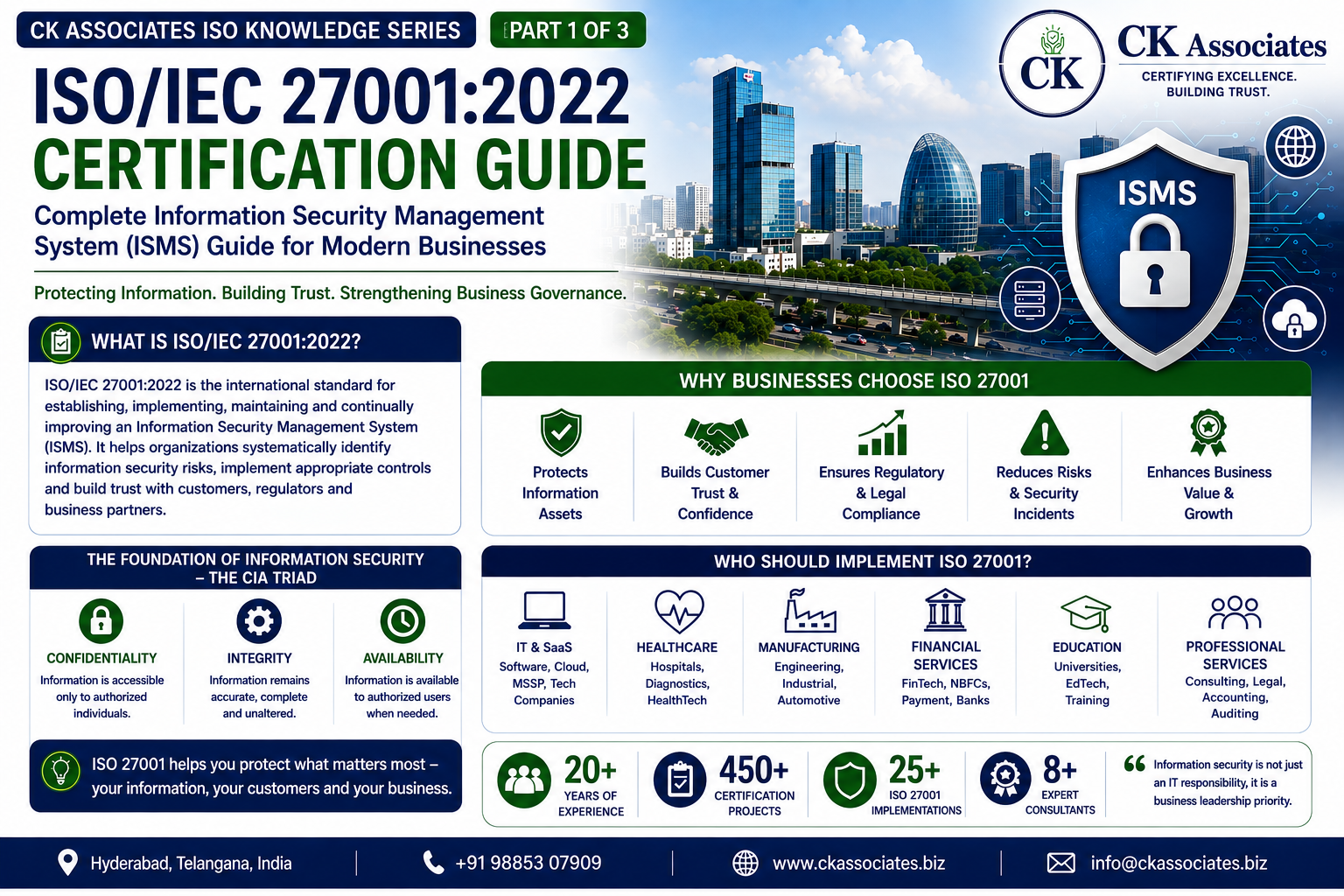
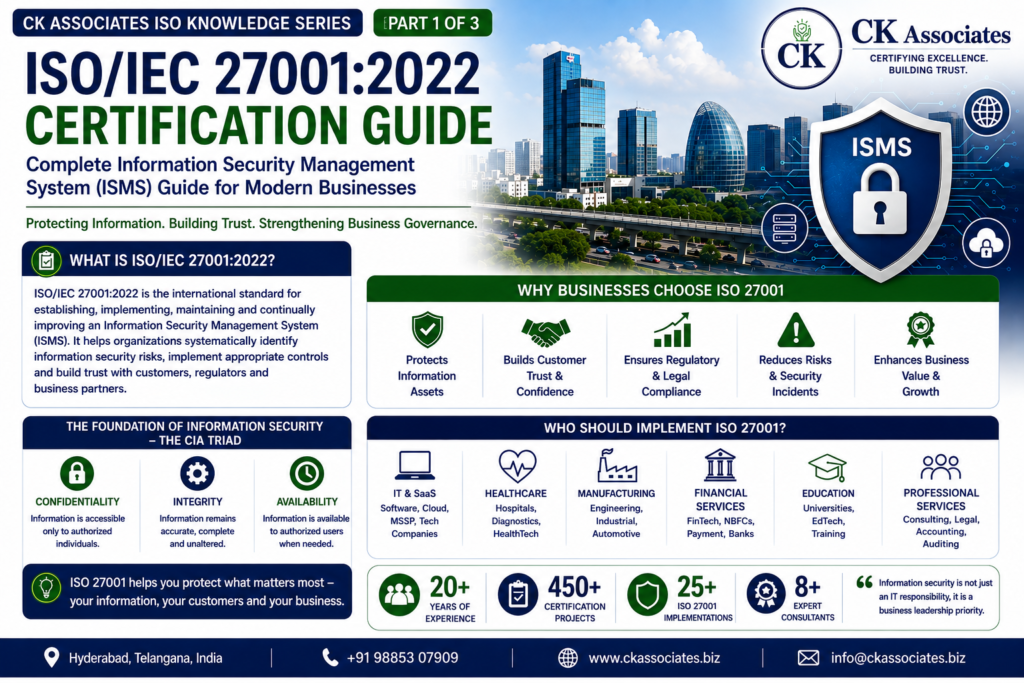
ISO/IEC 27001:2022 is the international standard for establishing, implementing, maintaining and continually improving an Information Security Management System (ISMS). It helps organizations systematically identify information-security risks, implement appropriate controls and build trust with customers, regulators and business partners through a structured risk-based management approach.
CK Associates+1
Why Every Business Is Becoming a Data Business
Ten years ago, information security was often viewed as an IT department responsibility.
Today, nearly every organization has become a data business.
Whether you’re a manufacturing company in Jeedimetla, a SaaS startup in HITEC City, a healthcare provider in Hyderabad or a financial services firm serving global clients, your business depends on information.
Consider the assets organizations manage every day:
- Customer records
- Employee information
- Financial data
- Contracts
- Intellectual property
- Cloud applications
- Source code
- Vendor information
- Business strategies
A single security incident affecting these assets can create operational disruption, customer distrust and contractual consequences.
This is exactly why ISO 27001 has evolved from an IT-focused standard into a business governance standard.
What Is ISO/IEC 27001:2022?
ISO/IEC 27001 is the internationally recognized standard for creating an Information Security Management System (ISMS).
An ISMS is not simply a collection of cybersecurity tools.
Instead, it provides a structured management framework that helps organizations answer questions like:
- What information do we own?
- What risks threaten that information?
- Which controls are appropriate?
- Who is responsible?
- How do we know the controls are working?
- How do we continually improve security?
This risk-based approach is one of the reasons ISO 27001 has become widely adopted across industries worldwide.
CK Associates+1
The Current Version
As of today, organizations implementing the standard should work with:
ISO/IEC 27001:2022
This edition modernized several areas, including the Annex A control structure, while maintaining compatibility with modern management-system principles.
CK Associates+1
Information Security Is More Than Cybersecurity
One of the biggest misconceptions is assuming that cybersecurity and information security mean exactly the same thing.
They don’t.
Cybersecurity
Primarily focuses on protecting digital systems from cyber attacks.
Examples include:
- Firewalls
- Endpoint protection
- Multi-factor authentication
- Network security
- Malware protection
Information Security
ISO 27001 takes a broader view.
It protects information regardless of whether it’s:
- Digital
- Paper-based
- Verbal
- Stored in the cloud
- Shared with suppliers
The standard is built around three fundamental principles.
The CIA Triad
Every ISO 27001 implementation revolves around protecting:
Confidentiality
Information should only be accessible to authorized people.
Examples:
- Customer records
- Payroll data
- Contracts
Integrity
Information should remain accurate and protected from unauthorized modification.
Examples:
- Financial reports
- Engineering drawings
- Medical records
Availability
Authorized users should be able to access information when they need it.
Examples:
- ERP systems
- Customer portals
- Business applications
These three principles form the foundation of an effective Information Security Management System.
Why Businesses Are Adopting ISO 27001
Organizations pursue ISO 27001 for different reasons.
Some respond to customer requirements.
Others prepare for enterprise procurement.
Many want stronger governance.
Common drivers include:
Customer Trust
Enterprise customers increasingly ask vendors how they protect information.
Business Growth
Many tenders and supplier assessments require structured information-security management.
Risk Reduction
A systematic approach helps organizations identify vulnerabilities before they become major problems.
Governance
Leadership gains better visibility into information-security risks across the business.
A Practical Example
Imagine a Hyderabad-based SaaS company.
It stores:
- Customer databases
- Source code
- Cloud configurations
- Employee credentials
- Support tickets
Without a structured ISMS, security activities can become fragmented.
Different departments may handle risks differently.
ISO 27001 creates one coordinated framework where:
- risks are identified,
- responsibilities are defined,
- controls are monitored,
- leadership reviews performance,
- improvements become continuous.
This transforms security from isolated technical activities into organizational governance.
Who Should Implement ISO 27001?
Many people assume ISO 27001 is only for IT companies.
The standard itself is applicable across organizations of all sizes and sectors.
CK Associates+1
Examples include:
IT & SaaS
- Software companies
- Cloud providers
- Managed service providers
Healthcare
- Hospitals
- Diagnostic centers
- Healthcare technology companies
Manufacturing
- Engineering firms
- Industrial manufacturers
- Automotive suppliers
Financial Services
- FinTech
- NBFCs
- Payment companies
Education
- Universities
- EdTech companies
- Training organizations
Professional Services
- Law firms
- Consulting firms
- Accounting firms
If your organization handles valuable information, ISO 27001 becomes increasingly relevant.
The Biggest Mistake Organizations Make
One of the most common mistakes is treating ISO 27001 as a documentation project.
Some organizations think implementation simply means writing:
- Information Security Policy
- Password Policy
- Access Procedure
- Incident Procedure
Documentation is important.
But documentation alone does not create an ISMS.
A functioning management system requires:
- Leadership involvement
- Risk assessment
- Employee awareness
- Operational implementation
- Internal audits
- Management review
- Continual improvement
The documents should describe how the organization actually operates—not become paperwork that nobody follows.
What Makes ISO 27001 Different from Other ISO Standards?
Many ISO standards focus on improving business performance.
ISO 27001 specifically focuses on protecting information through risk management.
For example:
| Standard | Primary Focus |
|---|---|
| ISO 9001 | Quality Management |
| ISO 14001 | Environmental Management |
| ISO 45001 | Occupational Health & Safety |
| ISO 27001 | Information Security |
| ISO 27701 | Privacy Information |
| ISO 42001 | AI Governance |
This makes ISO 27001 particularly important for organizations participating in today’s digital economy.
The Risk-Based Thinking Approach
Rather than asking:
“Which security software should we buy?”
ISO 27001 asks a better question.
“What risks threaten our information, and what controls are appropriate?”
A simplified implementation flow looks like this.
Information Assets
↓
Threats
↓
Vulnerabilities
↓
Risk Assessment
↓
Risk Treatment
↓
Controls
↓
Monitoring
↓
Continual Improvement
This creates an ongoing security management cycle rather than a one-time compliance exercise.
Hyderabad’s Growing Information Security Landscape
Hyderabad has become one of India’s strongest technology ecosystems.
The city hosts:
- Global Capability Centres
- AI startups
- SaaS companies
- Pharmaceutical technology organizations
- Financial technology companies
- Engineering firms
Enterprise customers increasingly ask vendors:
- How is customer information protected?
- How are suppliers evaluated?
- How are security incidents managed?
- Who has access to sensitive data?
Organizations that can answer these questions through a structured management system often enter procurement discussions with greater confidence.
Consultant’s Perspective
At CK Associates, we’ve observed a significant shift.
Several years ago, many organizations viewed ISO 27001 primarily as a certification requirement.
Today, leadership teams increasingly see it as a business governance framework.
The conversation has moved from:
“Can we get certified?”
to
“Can we build an information security system that customers trust?”
That change is important because sustainable security comes from governance—not documentation alone.
Key Takeaways
- ISO/IEC 27001 establishes an Information Security Management System (ISMS).
- The standard protects confidentiality, integrity and availability.
- Information security extends beyond cybersecurity technology.
- Organizations across industries can implement ISO 27001.
- Leadership involvement is essential.
- Risk-based thinking forms the foundation of implementation.
- Customer trust increasingly depends on structured information-security governance.
Why Trust This Guidance?
CK Associates has delivered practical governance-focused implementations across multiple industries.
20+ Years of Consulting Experience
450+ Certification Projects
25+ ISO 27001 Implementations
8+ Expert Consultants
Our implementation philosophy emphasizes practical adoption, audit readiness and long-term management-system effectiveness rather than documentation-heavy compliance.
Author: Sirish K — Founder & Lead ISO Consultant
💬 Knowledge Question
What creates stronger customer trust today?
- A. More cybersecurity software
- B. A structured Information Security Management System
- C. Both working together
In our experience, technology becomes significantly more effective when it’s supported by clear governance, defined responsibilities and continual improvement.
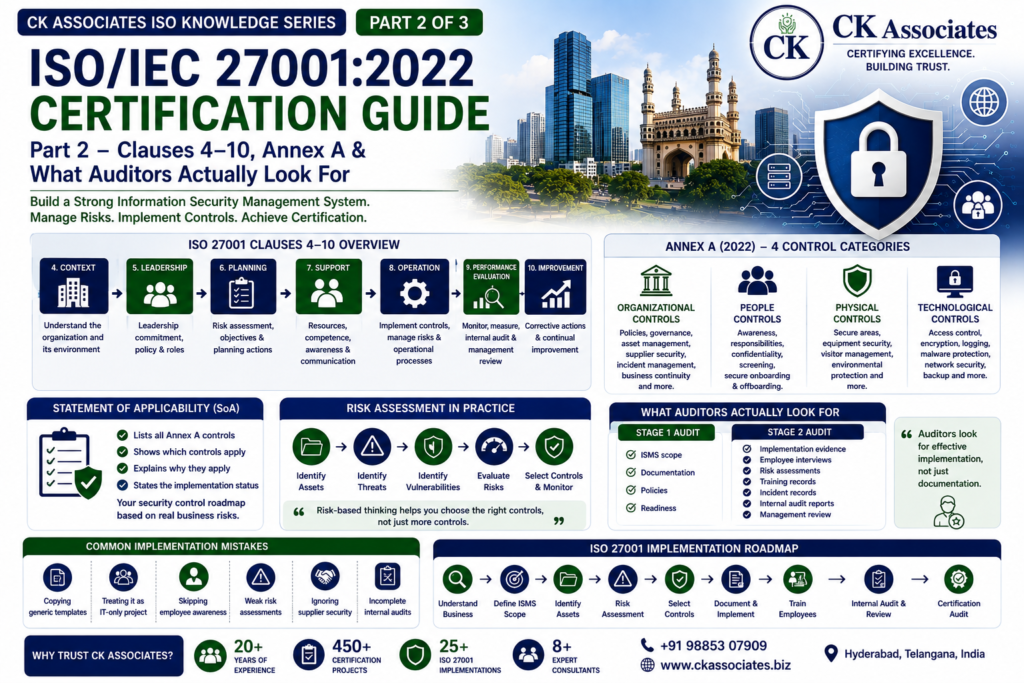
Understanding the ISO 27001 Framework
ISO 27001 follows the High-Level Structure (HLS) used across modern ISO management systems.
Instead of treating security as isolated IT activities, the standard embeds information security into organizational governance.
Each clause builds upon the previous one.
Clause 4 – Context of the Organization
Every implementation begins by understanding the business itself.
Organizations identify:
- Internal issues
- External issues
- Interested parties
- Information assets
- ISMS scope
Example
A Hyderabad SaaS company may include:
- Cloud infrastructure
- Customer portals
- Source code
- Support systems
Defining the correct ISMS scope is one of the most important early implementation decisions.
Clause 5 – Leadership
ISO 27001 places significant responsibility on top management.
Leadership should:
- Establish an Information Security Policy
- Define responsibilities
- Provide resources
- Demonstrate commitment
- Support continual improvement
Common Auditor Question
“How is top management involved in information security?”
Auditors expect leadership participation—not simply signatures on documents.
Clause 6 – Planning
Planning introduces one of ISO 27001’s defining principles:
Risk-based thinking.
Organizations identify:
- Information assets
- Threats
- Vulnerabilities
- Business impacts
Then they determine appropriate treatment.
Typical Risk Examples
- Unauthorized access
- Phishing
- Data leakage
- Ransomware
- Insider threats
- Supplier risks
Rather than eliminating every risk, organizations learn how to manage risks appropriately.
Clause 7 – Support
A secure organization depends on capable people.
This clause focuses on:
- Competence
- Awareness
- Communication
- Documented information
Employee Awareness Matters
Employees should understand:
- Password practices
- Phishing awareness
- Incident reporting
- Access responsibilities
- Information handling
Many security incidents originate from human behavior rather than technology alone.
Clause 8 – Operation
This is where implementation becomes operational.
Organizations begin applying security controls across daily activities.
Examples include:
- Access management
- Backup procedures
- Supplier security
- Asset management
- Incident response
- Change management
Security becomes part of business operations rather than an isolated project.
Clause 9 – Performance Evaluation
Organizations must verify whether the ISMS is actually working.
Key activities include:
- Internal audits
- Monitoring
- Management review
- Performance evaluation
Internal Audits
Internal audits help identify:
- Missing controls
- Documentation gaps
- Nonconformities
- Improvement opportunities
A good internal audit prepares the organization for certification—not just compliance.
Clause 10 – Improvement
No management system remains perfect.
ISO 27001 expects organizations to improve continuously.
Typical improvement cycle:
Security Issue
↓
Investigation
↓
Root Cause
↓
Corrective Action
↓
Verification
↓
Continual Improvement
This ongoing cycle keeps the ISMS effective as the business evolves.
Understanding Annex A (2022)
One of ISO 27001’s most recognizable features is Annex A.
The 2022 edition organizes controls into four categories.
| Category | Focus |
|---|---|
| Organizational Controls | Governance |
| People Controls | Human Security |
| Physical Controls | Facilities |
| Technological Controls | IT Security |
Instead of memorizing control numbers, organizations should understand how these categories strengthen overall security.
Organizational Controls
These controls establish governance.
Examples include:
- Information Security Policies
- Asset Ownership
- Supplier Relationships
- Information Classification
- Incident Management
- Business Continuity Planning
These controls create accountability across the organization.
People Controls
Technology alone cannot secure information.
People controls include:
- Awareness
- Responsibilities
- Confidentiality obligations
- Screening
- Secure offboarding
These controls help reduce human-related security risks.
Physical Controls
Information also requires physical protection.
Examples include:
- Office access
- Equipment security
- Visitor management
- Environmental protection
- Secure work areas
Even cloud-first companies still manage physical security risks.
Technological Controls
These are often the most familiar controls.
Examples include:
- Authentication
- Encryption
- Logging
- Malware protection
- Network security
- Backup
- Monitoring
These technical controls support—but do not replace—the management system itself.
What Is the Statement of Applicability (SoA)?
The Statement of Applicability (SoA) is one of the most important ISO 27001 documents.
It explains:
- Which Annex A controls apply
- Why they apply
- Which controls are excluded
- The implementation status
Think of it as the organization’s security control roadmap.
Example
A cloud-based SaaS company may justify controls differently than a manufacturing facility with physical production environments.
The SoA should always reflect actual business risks—not copied templates.
Risk Assessment in Practice
A practical risk assessment follows this logic.
| Step | Activity |
|---|---|
| Identify Assets | Customer database |
| Identify Threat | Unauthorized access |
| Identify Vulnerability | Weak authentication |
| Evaluate Risk | High |
| Select Control | Multi-factor authentication |
| Monitor | Review effectiveness |
This structured approach demonstrates the risk-based philosophy that auditors expect to see.
A Practical Implementation Roadmap
A typical ISO 27001 implementation follows this sequence.
Understand the Business
↓
Define ISMS Scope
↓
Identify Information Assets
↓
Conduct Risk Assessment
↓
Select Controls
↓
Develop Documentation
↓
Train Employees
↓
Implement Controls
↓
Conduct Internal Audit
↓
Management Review
↓
Certification Audit
This roadmap helps organizations move from planning to operational maturity.
What Auditors Actually Look For
Many organizations worry that auditors will primarily inspect documentation.
In reality, auditors evaluate whether the management system actually works.
During Stage 1
Auditors typically review:
- ISMS scope
- Documentation
- Policies
- Readiness
During Stage 2
Auditors verify implementation.
They often interview employees and examine evidence such as:
- Risk assessments
- Training records
- Access controls
- Incident records
- Internal audit reports
- Management review evidence
Consistency between documented processes and actual practices matters significantly.
Common ISO 27001 Implementation Mistakes
Organizations can avoid several common pitfalls.
Mistake 1
Copying generic templates without adapting them.
Mistake 2
Treating implementation as an IT-only project.
Mistake 3
Skipping employee awareness.
Mistake 4
Weak risk assessments.
Mistake 5
Ignoring supplier security.
Mistake 6
Incomplete internal audits.
Better Approach
Build a management system that employees actually use.
Hyderabad Technology Example
Consider a software company in HITEC City.
Instead of managing security through isolated IT activities, the company creates an ISMS covering:
- Cloud infrastructure
- Customer information
- Employee access
- Third-party vendors
- Security incidents
- Leadership oversight
When enterprise customers ask security questions during vendor assessments, the organization already has documented governance processes to demonstrate.
This often strengthens procurement confidence.
Consultant’s Perspective
One of the biggest differences between successful and struggling ISO 27001 projects isn’t documentation.
It’s ownership.
Organizations that involve:
- leadership,
- process owners,
- HR,
- IT,
- operations
typically build stronger Information Security Management Systems than organizations that delegate everything to one department.
ISO 27001 works best when security becomes part of everyday business governance.
Key Takeaways
- Clauses 4–10 build the ISMS governance framework.
- Leadership involvement is essential.
- Risk assessment drives implementation decisions.
- Annex A organizes controls into four practical categories.
- The Statement of Applicability becomes a key implementation document.
- Internal audits prepare organizations for certification.
- Auditors verify implementation—not just paperwork.
- Practical governance creates stronger long-term security.
Why Trust This Guidance?
CK Associates has helped organizations build practical Information Security Management Systems across multiple industries.
- 20+ Years of Consulting Experience
- 450+ Certification Projects
- 25+ ISO 27001 Implementations
- 8+ Expert Consultants
Our implementation philosophy focuses on governance, practical adoption and audit readiness.
Author: Sirish K – Founder & Lead ISO Consultant
💬 Knowledge Question
What do you think contributes most to a successful ISO 27001 implementation?
- A. Strong technology controls
- B. Leadership involvement
- C. Employee awareness
- D. A combination of all three
The strongest Information Security Management Systems usually succeed when governance, technology and people work together.
Frequently Asked Questions
1. What is ISO/IEC 27001:2022?
ISO/IEC 27001:2022 is the international standard for establishing, implementing, maintaining and continually improving an Information Security Management System (ISMS). It helps organizations manage information security risks using a structured governance framework.
2. Who should implement ISO 27001?
Any organization that handles valuable information can benefit.
Examples include:
- IT companies
- SaaS startups
- Healthcare organizations
- Manufacturers
- Financial services
- Educational institutions
- Professional service firms
The standard applies regardless of organization size.
3. Is ISO 27001 only for IT companies?
No.
While technology companies frequently adopt ISO 27001, the standard protects information across every industry—not just IT.
4. How long does ISO 27001 implementation take?
The implementation timeline depends on:
- Organization size
- Existing processes
- Documentation maturity
- Resource availability
For many organizations, implementation typically takes 3–4 months, while larger or more complex organizations may require additional time.
5. What is the Statement of Applicability (SoA)?
The SoA documents:
- applicable Annex A controls,
- excluded controls,
- justification for decisions,
- implementation status.
It is one of the most important documents during certification.
6. What is Annex A?
Annex A organizes information security controls into four categories:
- Organizational Controls
- People Controls
- Physical Controls
- Technological Controls
These controls help organizations manage identified risks.
7. What happens during the certification audit?
Certification generally involves:
Stage 1
- Documentation review
- ISMS scope verification
- Readiness assessment
Stage 2
- Employee interviews
- Implementation verification
- Risk assessment review
- Evidence collection
- Management review verification
Auditors evaluate whether the ISMS actually operates effectively.
8. Is employee training mandatory?
Employee awareness plays a critical role in successful implementation.
Organizations typically train employees on:
- information handling,
- password practices,
- phishing awareness,
- incident reporting,
- access responsibilities.
9. Can ISO 27001 work with ISO 42001?
Yes.
Many organizations integrate both standards.
- ISO 27001 governs information security.
- ISO 42001 governs AI management systems.
Together they strengthen digital governance.
10. How do I choose the right ISO 27001 consultant?
Look beyond certification promises.
Evaluate:
- implementation experience,
- industry knowledge,
- audit support,
- practical governance expertise,
- long-term support.
The strongest consultants help organizations build sustainable management systems—not simply prepare documents.
Quick Answer
What is an ISMS?
An Information Security Management System (ISMS) is a structured framework that helps organizations identify information security risks, implement appropriate controls and continually improve security governance.
What does ISO 27001 protect?
ISO 27001 protects the confidentiality, integrity and availability of information through risk-based management.
What is the difference between ISO 27001 and cybersecurity?
Cybersecurity focuses primarily on protecting digital systems, while ISO 27001 governs information security across people, processes, technology and physical assets.
What is Annex A in ISO 27001?
Annex A contains four categories of security controls that organizations select based on their risk assessment.
Why is leadership important in ISO 27001?
Leadership establishes policies, allocates resources, defines responsibilities and demonstrates commitment to continual improvement throughout the ISMS.
Audit Readiness Checklist
Before certification, organizations should verify that these activities have been completed.
| Checklist Item | Ready |
|---|---|
| ISMS Scope Defined | ✓ |
| Risk Assessment Completed | ✓ |
| Statement of Applicability Prepared | ✓ |
| Security Policies Approved | ✓ |
| Employee Training Conducted | ✓ |
| Internal Audit Completed | ✓ |
| Management Review Held | ✓ |
| Corrective Actions Addressed | ✓ |
Completing this checklist significantly improves certification readiness.
Common Questions Auditors May Ask
During interviews, auditors often ask practical questions rather than theoretical ones.
Examples include:
Leadership
- How does management review security performance?
Employees
- How do you report a security incident?
- What information should remain confidential?
IT Teams
- How is access granted and removed?
- How are backups managed?
Process Owners
- How do you identify security risks in your department?
Employees don’t need scripted answers—they should understand the organization’s actual processes.
Why Businesses Choose ISO 27001
Organizations increasingly pursue ISO 27001 because it supports both governance and commercial growth.
Benefits often include:
- stronger customer trust,
- improved vendor confidence,
- structured risk management,
- enterprise procurement readiness,
- better regulatory preparedness,
- continual improvement.
For Hyderabad’s growing technology ecosystem, these outcomes have become increasingly valuable.
Why Trust This Guidance?
CK Associates has supported organizations across Hyderabad, Telangana and India with practical governance-focused implementation.
Our Experience
- 20+ Years of Consulting
- 450+ Certification Projects
- 25+ ISO 27001 Implementations
- 8+ Expert Consultants
Our implementation philosophy focuses on:
- practical adoption,
- leadership involvement,
- audit readiness,
- sustainable management systems.
About the Author
Sirish K
Founder & Lead ISO Consultant
Sirish K has over 20 years of experience implementing international management systems across IT, SaaS, manufacturing, healthcare, education, financial services and emerging AI-driven organizations.
His expertise includes:
- ISO 27001
- ISO 42001
- ISO 9001
- ISO 14001
- ISO 45001
- Integrated Management Systems
- Governance and Risk Management
Key Takeaways
- ISO 27001 is a governance framework—not just an IT standard.
- Leadership, risk assessment and continual improvement are central to success.
- An effective ISMS protects confidentiality, integrity and availability.
- Annex A controls should reflect actual business risks.
- Internal audits prepare organizations for certification.
- Practical implementation creates stronger long-term business value than documentation alone.
Discussion Question
As organizations become increasingly digital, what should leadership prioritize first?
- A. Stronger cybersecurity tools
- B. Information Security Governance
- C. AI Governance
- D. An Integrated Governance System combining Quality, Security, Privacy and AI
Share your perspective—every industry approaches information security differently.