
Looking for an ISO Consultant in HITEC City, Hyderabad?
If your IT company, SaaS startup or Global Capability Centre (GCC) is looking for an ISO Consultant in HITEC City, the right consulting partner should help you implement practical management systems—not just prepare documents. Standards like ISO 27001, ISO 42001, ISO 9001 and ISO 22301 help technology businesses strengthen customer trust, enterprise procurement readiness and governance while supporting certification through structured implementation.
Why HITEC City Has Become Hyderabad’s Compliance Hub
HITEC City isn’t just another commercial area.
It has become one of India’s most influential technology ecosystems.
The region brings together:
- Global Capability Centres (GCCs)
- SaaS startups
- AI companies
- Cloud service providers
- Cybersecurity firms
- Software development companies
- Engineering design organizations
- Enterprise technology vendors
Many of these organizations work with international customers who increasingly ask questions like:
- How do you protect customer data?
- How do you manage AI risks?
- Do you follow internationally recognized management systems?
- How do you demonstrate operational consistency?
This is where ISO standards become business enablers—not just compliance requirements.
Why Technology Companies Need ISO Certification
Many growing businesses initially assume ISO certification is only required for large enterprises.
In reality, many technology companies pursue ISO implementation much earlier because customers, investors and enterprise procurement teams expect structured governance.
Common business drivers include:
- Enterprise client onboarding
- Vendor qualification
- Information security assurance
- AI governance
- Quality consistency
- Business continuity planning
- International expansion
- Customer trust
Instead of becoming reactive later, organizations build stronger operational foundations earlier.
Why Choosing the Right ISO Consultant Matters
Two companies can pursue the same ISO standard.
Their results can be completely different.
Why?
Because implementation quality matters more than simply obtaining a certificate.
A practical consultant helps organizations:
- Understand business processes
- Identify compliance gaps
- Design workable documentation
- Train employees
- Conduct internal audits
- Prepare leadership
- Support certification
- Improve systems after certification
The goal should always be building a management system that employees actually use.
Which ISO Standards Are Most Relevant for HITEC City Companies?
Different organizations require different governance priorities.
Here’s how many technology companies approach implementation.
ISO 27001
Information Security Management
ISO 42001
AI Management System
ISO 9001
Quality Management
ISO 22301
Business Continuity
Let’s explore where each standard creates business value.
ISO 27001 for SaaS & Technology Companies
Information security has become one of the biggest procurement conversations in HITEC City.
Enterprise customers often evaluate:
- Access controls
- Risk management
- Incident response
- Vendor security
- Governance processes
ISO 27001 helps organizations demonstrate structured information security management through an Information Security Management System (ISMS).
This becomes particularly valuable when working with global customers.
ISO 42001 for AI Companies
Hyderabad’s AI ecosystem continues expanding rapidly.
Organizations developing AI solutions increasingly need governance around:
- AI risk management
- Human oversight
- Transparency
- Accountability
- AI lifecycle management
ISO 42001 provides an internationally recognized framework specifically designed for AI Management Systems.
For AI-first organizations, this standard represents more than compliance—it supports responsible innovation.
ISO 9001 for Growing Startups
Many startups focus heavily on product development.
As teams grow, consistency becomes increasingly important.
ISO 9001 helps organizations strengthen:
- Process management
- Customer satisfaction
- Quality governance
- Continual improvement
For rapidly scaling companies, standardized processes often reduce operational friction.
ISO 22301 for Business Continuity
Technology businesses cannot assume uninterrupted operations.
Unexpected events can affect:
- Cloud infrastructure
- Supply chains
- Office operations
- Customer services
ISO 22301 helps organizations prepare structured business continuity planning that improves organizational resilience.
Why GCCs Prioritize ISO Governance
Global Capability Centres frequently operate within international governance environments.
Head offices may expect consistent management practices across multiple countries.
ISO standards help create common governance language between:
- Headquarters
- Regional offices
- Customers
- Suppliers
- Regulators
This consistency often simplifies enterprise governance conversations.
Practical Example
Imagine a software company operating from HITEC City.
The organization manages:
- Customer data
- Cloud applications
- Source code
- AI development projects
- Vendor relationships
- International clients
Different teams could manage these activities differently.
ISO implementation creates one structured governance framework where responsibilities become clearer and continual improvement becomes measurable.
Why Local Expertise Matters
An ISO consultant familiar with Hyderabad’s technology ecosystem understands common implementation realities.
Examples include:
- Hybrid work environments
- Cloud-first operations
- SaaS delivery models
- Enterprise procurement expectations
- GCC governance requirements
- Startup scaling challenges
Rather than applying generic templates, implementation should reflect how the business actually operates.
Consultant’s Perspective
One trend stands out across Hyderabad’s technology ecosystem.
The conversation has shifted.
Organizations increasingly ask:
“How can ISO strengthen customer trust?”
instead of
“How quickly can we get certified?”
That shift creates stronger long-term outcomes because governance becomes part of business strategy.
💬 Discussion Question
If you’re running a technology company in HITEC City, which challenge is becoming more important?
- A. Information Security
- B. AI Governance
- C. Customer Trust
- D. Enterprise Compliance
Share your perspective—Hyderabad’s technology ecosystem is evolving rapidly, and governance expectations continue to grow.
How IT Companies, SaaS Startups & GCCs Can Successfully Implement ISO Standards
For technology companies in HITEC City, ISO implementation is no longer just about passing an audit. It’s about building governance that scales with rapid business growth, international clients, cloud infrastructure, AI adoption, and increasingly demanding procurement requirements.
In this section, we’ll explore how successful companies approach implementation—and where many organizations make avoidable mistakes.
A Practical ISO Implementation Roadmap
A successful ISO project follows a structured sequence rather than treating documentation as the starting point.

Step 1 – Gap Analysis
Every implementation begins with one question.
Where are we today compared to the ISO requirements?
A proper gap analysis typically reviews:
- Existing processes
- Policies
- Risk management
- Documentation
- Employee responsibilities
- Compliance obligations
For many HITEC City companies, this stage often reveals that several good practices already exist—they simply haven’t been formalized.
Step 2 – Define the Scope
One of the biggest implementation decisions is defining the certification scope.
Examples:
SaaS Startup
- Product development
- Customer support
- Cloud infrastructure
GCC
- Shared services
- Information security
- Business processes
AI Company
- AI development lifecycle
- Risk management
- Human oversight
A well-defined scope makes later implementation much smoother.
Step 3 – Build Practical Documentation
Many businesses fear documentation.
In reality, documentation should describe how the organization actually works.
Examples include:
- Policies
- Procedures
- Risk registers
- Roles and responsibilities
- Operational records
The goal isn’t creating paperwork.
The goal is creating consistency.
Step 4 – Employee Awareness
Technology companies often invest heavily in technical controls.
But employees remain one of the biggest factors influencing compliance.
Training typically covers:
- Information handling
- Password practices
- Incident reporting
- Data protection
- AI governance awareness
- Business continuity responsibilities
Employees should understand practical responsibilities—not memorize policies.
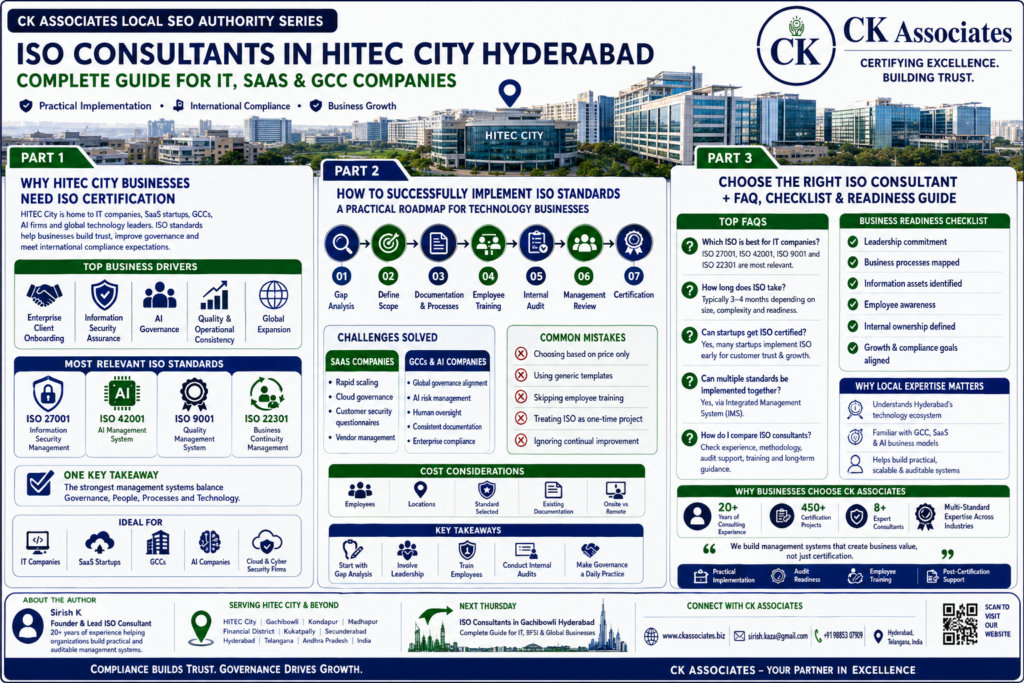
Step 5 – Internal Audit
Internal audits help organizations identify improvement opportunities before certification.
They commonly verify:
- Process implementation
- Documentation
- Employee awareness
- Control effectiveness
- Corrective actions
A good internal audit prepares leadership—not surprises leadership.
Step 6 – Management Review
ISO standards expect leadership involvement.
Management reviews typically evaluate:
- Performance
- Risks
- Objectives
- Audit findings
- Improvement opportunities
This reinforces that ISO governance belongs at the leadership level—not only within compliance teams.
Common Challenges for SaaS Companies
SaaS companies in HITEC City often grow rapidly.
Growth creates new governance challenges.
Challenge 1 – Rapid Scaling
Teams expand faster than documented processes.
Challenge 2 – Cloud Governance
Multiple cloud platforms increase complexity.
Challenge 3 – Customer Security Questionnaires
Enterprise customers expect structured responses.
Challenge 4 – Vendor Management
Third-party services become increasingly important.
ISO implementation helps create consistency across these areas.
GCC Compliance Expectations
Global Capability Centres frequently operate under international governance expectations.
Parent organizations may expect alignment across:
- Security
- Quality
- Risk management
- Business continuity
- Documentation
- Internal audits
A structured ISO implementation helps regional teams demonstrate consistent governance.
Why AI Companies Need Structured Governance
AI organizations face additional questions.
Examples include:
- How are AI risks identified?
- Who approves AI systems?
- How is human oversight maintained?
- How are decisions documented?
ISO 42001 complements technology governance by providing structured AI management practices.
Many HITEC City AI companies increasingly combine:
- ISO 27001
- ISO 42001
- ISO 9001
to strengthen enterprise readiness.
Cost Considerations for HITEC City Businesses
One of the most common questions is:
“How much will implementation cost?”
The answer depends on several factors.
Key Cost Drivers
| Factor | Impact |
|---|---|
| Employees | Higher effort |
| Locations | More complexity |
| Standard | Different implementation effort |
| Existing documentation | Lower implementation effort |
| Remote vs Onsite | Changes delivery model |
Organizations should compare implementation scope—not simply the lowest quotation.
Common Implementation Mistakes
Many organizations can avoid these mistakes.
Mistake 1
Choosing consultants based only on price.
Mistake 2
Copying generic templates.
Mistake 3
Skipping employee awareness.
Mistake 4
Treating ISO as a one-time project.
Mistake 5
Ignoring continual improvement.
The strongest implementations become part of everyday business operations.
A Practical Example
Imagine a cloud software company in HITEC City.
Initially, different teams manage:
- customer access,
- cloud configurations,
- incident reporting,
- documentation.
After ISO implementation:
- responsibilities become clearer,
- reviews become structured,
- audits become easier,
- enterprise customers receive more confident compliance responses.
This is where governance creates operational value.
Why Local Expertise Makes a Difference
An ISO consultant familiar with Hyderabad’s technology ecosystem understands practical realities such as:
- hybrid work
- cloud-first operations
- GCC governance
- startup growth
- enterprise procurement
- AI adoption
Instead of forcing generic templates, implementation can reflect how technology companies actually operate.
Consultant’s Perspective
One pattern appears consistently across successful HITEC City projects.
Organizations that involve:
- leadership,
- engineering,
- HR,
- operations,
- security teams
typically build stronger management systems than organizations where compliance remains isolated.
Governance works best when it becomes shared responsibility.
💬 Discussion Question
What creates the biggest compliance challenge for growing technology companies?
- A. Rapid Scaling
- B. Customer Security Requirements
- C. AI Governance
- D. Internal Process Consistency
Every growing business experiences these challenges differently—but structured governance often makes them much easier to manage.
How to Choose the Right ISO Consultant + FAQ, Audit Readiness & Local Business Checklist
If your business is based in HITEC City, Gachibowli, Kondapur, Madhapur or Financial District, choosing the right ISO consultant can influence not only your certification journey but also your long-term governance maturity.
In this final section, we’ll answer the most searched questions, provide practical decision-making guidance and help technology companies evaluate ISO readiness before certification.
Frequently Asked Questions (FAQ)
1. Which ISO certification is best for an IT company in HITEC City?
The answer depends on your business objectives.
- ISO 27001 — Information Security Management
- ISO 42001 — AI Management Systems
- ISO 9001 — Quality Management
- ISO 22301 — Business Continuity
Many growing technology companies eventually combine multiple standards through an Integrated Management System (IMS).
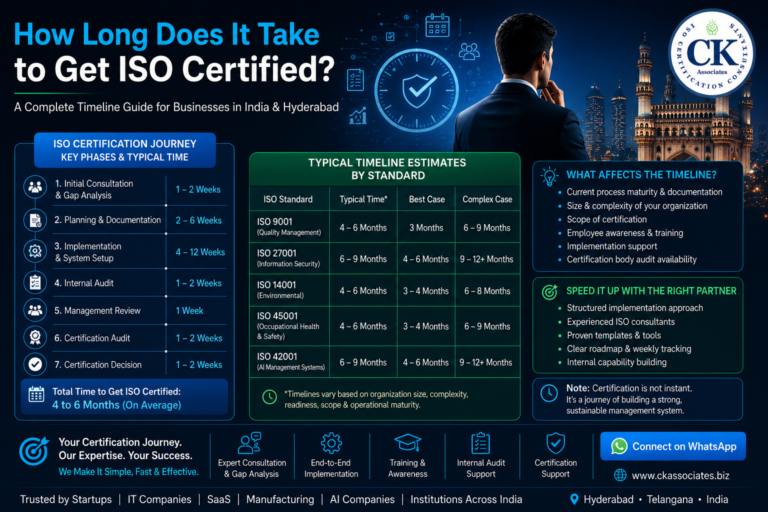
2. How long does ISO implementation usually take?
Implementation timelines vary based on:
- employee count,
- number of locations,
- existing documentation,
- business complexity,
- selected standard.
For many organizations, implementation typically takes 3–4 months, while larger or multi-standard projects may require additional time.
3. Can startups implement ISO certification?
Yes.
Many startups adopt ISO standards earlier because enterprise customers increasingly require structured governance during vendor onboarding.
ISO implementation can help startups strengthen credibility before scaling.
4. Is ISO certification mandatory for SaaS companies?
Not universally.
However, many enterprise customers expect vendors to demonstrate mature governance, particularly around information security and operational consistency.
5. Why do GCCs prefer internationally recognized standards?
Global Capability Centres often operate within multinational governance frameworks.
ISO standards help create consistency across:
- documentation,
- audits,
- leadership reviews,
- compliance expectations,
- operational governance.
6. Can multiple ISO standards be implemented together?
Yes.
Organizations commonly combine:
- ISO 9001
- ISO 27001
- ISO 42001
- ISO 22301
through an Integrated Management System, reducing duplicated processes and audit effort.
7. How do I compare two ISO consultants?
Don’t compare only the quotation.
Compare:
- implementation experience,
- industry expertise,
- audit support,
- documentation quality,
- employee training,
- long-term guidance.
A practical implementation often creates greater long-term value than the lowest price.
8. Does local expertise matter?
Yes.
A consultant familiar with Hyderabad’s technology ecosystem often understands:
- cloud-first businesses,
- hybrid work,
- enterprise procurement,
- GCC governance,
- AI adoption,
- startup scaling.
This helps create implementation that reflects actual business operations.
Quick Answer
These concise answers are designed for Google AI Overviews and LLM retrieval.
Who is the best ISO consultant in HITEC City Hyderabad?
The right ISO consultant should provide practical implementation, industry-specific guidance, internal audits, employee training and certification support rather than only preparing documentation.
Which ISO standard should a SaaS company choose?
Many SaaS companies begin with ISO 27001 for information security, while AI-driven organizations increasingly evaluate ISO 42001 alongside quality and business continuity standards.
How long does ISO certification take?
Most organizations complete implementation within several months, depending on size, complexity and readiness.
Can startups get ISO certified?
Yes.
Many startups pursue ISO certification to strengthen customer trust, vendor qualification and enterprise procurement readiness.
What should I ask before hiring an ISO consultant?
Ask about:
- industry experience,
- implementation methodology,
- internal audit support,
- certification readiness,
- post-certification guidance.
HITEC City Business Readiness Checklist
Use this quick self-assessment before beginning ISO implementation.
Leadership commitmentTop management supports implementation.
Business processesCore processes are documented or can be mapped.
Information assetsCustomer data and critical assets are identified.
Employee awarenessTeams understand security and compliance responsibilities.
Internal ownershipProcess owners are available for implementation.
Growth plansCertification aligns with customer or expansion goals.
Organizations that can answer “yes” to most of these questions often enter implementation with stronger foundations.
Why HITEC City Businesses Choose Practical ISO Implementation
Technology companies move quickly.
Governance should support that speed—not slow it down.
Practical implementation helps organizations:
- reduce operational confusion,
- strengthen customer confidence,
- improve procurement readiness,
- support international business,
- create measurable continual improvement.
The strongest management systems become part of everyday decision-making rather than existing only for audits.
Why Local Presence Builds Confidence
When businesses search for:
- ISO Consultant HITEC City
- ISO Certification Gachibowli
- ISO Consultant Kondapur
- ISO 27001 Hyderabad
- ISO 42001 Hyderabad
they’re usually looking for more than technical expertise.
They want a consulting partner who understands the local business ecosystem while supporting international compliance expectations.
That combination becomes particularly valuable for Hyderabad’s growing technology sector.
Key Takeaways
- HITEC City has become a major compliance hub for technology businesses.
- ISO certification supports enterprise procurement and customer trust.
- Different ISO standards address different governance priorities.
- Practical implementation matters more than documentation alone.
- Local industry understanding improves implementation effectiveness.
- Technology companies benefit from governance that scales with growth.
- Gap analysis should always come first.
- Practical documentation supports consistent operations.
- Employee awareness strengthens implementation.
- Internal audits prepare organizations for certification.
- GCCs benefit from standardized governance.
- SaaS companies need scalable management systems.
- Local industry expertise improves implementation quality.
Why Trust This Guidance?
CK Associates has supported organizations across Hyderabad, Telangana and India with governance-focused ISO implementation.
Our Experience
- 20+ Years of Consulting
- 450+ Certification Projects
- 8+ Expert Consultants
- Multi-standard expertise across ISO 27001, ISO 42001, ISO 9001, ISO 22301, ISO 14001, ISO 45001 and more.
Our implementation philosophy emphasizes practical adoption, leadership involvement and long-term business value.
About the Author
Sirish K
Founder & Lead ISO Consultant
With over 20 years of consulting experience, Sirish K has helped organizations across IT, SaaS, manufacturing, healthcare, education and AI-driven industries build practical management systems that support both certification and sustainable business growth.