
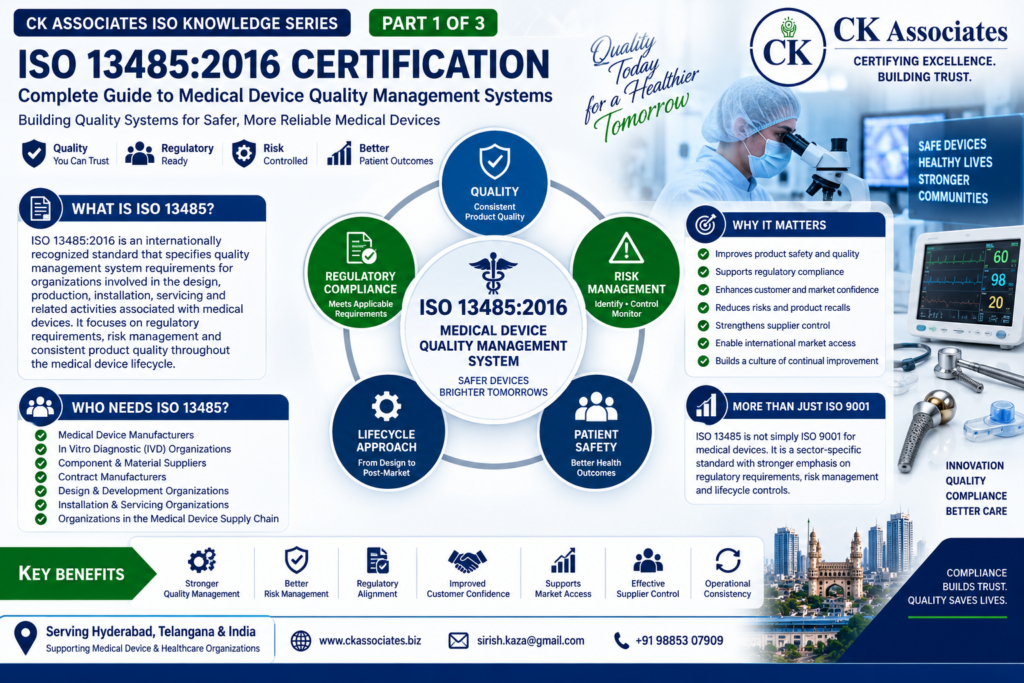
What is ISO 13485?
ISO 13485:2016 is an internationally recognized standard that specifies quality management system requirements for organizations involved in the design, production, installation, servicing and related activities associated with medical devices. It is specifically designed around the quality and regulatory needs of the medical-device industry, with strong emphasis on risk management, regulatory compliance and consistent product quality.
What Is ISO 13485?
Medical devices directly affect people’s health and safety.
That makes quality management in this industry fundamentally different from ordinary product manufacturing.
A medical-device organization must consider much more than:
“Can we manufacture this product consistently?”
It also needs to ask:
- Is the product safe for its intended use?
- Are regulatory requirements being addressed?
- Are risks identified and controlled?
- Is the manufacturing process controlled?
- Can product quality be demonstrated through objective evidence?
- Are complaints properly handled?
- Are suppliers appropriately controlled?
- Is the organization monitoring product performance after release?
ISO 13485:2016 provides a quality management framework designed specifically for these types of requirements.
ISO 13485 Is More Than “ISO 9001 for Medical Devices”
This is an important distinction.
ISO 13485 is a sector-specific quality management standard.
While ISO 9001 is designed for organizations across many industries, ISO 13485 is specifically tailored to the medical-device environment and gives greater emphasis to regulatory requirements, risk management, process validation and controls throughout the medical-device lifecycle.
So an organization should not approach ISO 13485 as simply taking an ISO 9001 system and changing the logo.
The medical-device context requires a different level of regulatory and product-safety thinking.
Why Medical Device Quality Is Different
Consider an ordinary consumer product.
A defect may result in:
- customer dissatisfaction,
- returns,
- warranty costs.
For a medical device, the consequences can potentially involve:
- patient safety,
- clinical outcomes,
- regulatory action,
- product recalls,
- loss of market authorization,
- reputational damage.
That is why medical-device quality management requires structured controls throughout the product lifecycle.
Who Needs ISO 13485?
ISO 13485 is intended for organizations involved in the design, production, installation and servicing of medical devices and related services. It can also be relevant to suppliers and external parties providing products or quality-management-system-related services to medical-device organizations.
This can include:
Medical Device Manufacturers
Organizations manufacturing:
- Diagnostic equipment
- Surgical instruments
- Monitoring devices
- Implants
- Medical equipment
- Disposable medical products
In Vitro Diagnostic Organizations
Organizations involved in:
- IVD products
- Diagnostic reagents
- Laboratory-related devices
- Diagnostic systems
Medical Device Component Suppliers
Organizations supplying:
- Critical components
- Materials
- Subassemblies
- Specialized manufacturing services
Contract Manufacturers
Organizations manufacturing medical devices on behalf of another organization.
Design & Development Organizations
Companies responsible for:
- Medical-device design
- Product development
- Engineering
- Design verification and validation
Installation & Servicing Organizations
Organizations responsible for:
- Installation
- Maintenance
- Repair
- Servicing
- Technical support
The standard’s applicability extends across organizations involved in the medical-device lifecycle.
What Does ISO 13485 Actually Achieve?
At its core, ISO 13485 helps an organization establish a controlled Medical Device Quality Management System (QMS).
The system connects:
Customer Requirements
↓
Regulatory Requirements
↓
Product & Process Requirements
↓
Risk Management
↓
Design & Development
↓
Production
↓
Verification & Validation
↓
Release
↓
Post-Market Activities
↓
Continual Quality Control
The exact processes depend on the organization’s role, products and applicable regulatory requirements.
The Regulatory Focus of ISO 13485
One of the most important characteristics of ISO 13485 is its relationship with regulatory requirements.
ISO describes the standard as establishing requirements for a QMS specific to medical devices, including the need to address applicable regulatory requirements.
This means an organization needs to understand:
- Which regulations apply to its products?
- Which markets does it serve?
- What regulatory obligations apply to those markets?
- Which requirements affect its QMS?
- How are those requirements maintained and monitored?
This makes regulatory intelligence an important part of an effective ISO 13485 implementation.
Risk Management Is Central
Medical-device organizations cannot separate quality from risk.
ISO 13485:2016 increased emphasis on risk management and risk-based decision-making, alongside stronger consideration of regulatory requirements throughout the supply chain.
A simplified model looks like this:
Identify
What could go wrong?
↓
Evaluate
How serious could the consequence be?
↓
Control
What measures can reduce the risk?
↓
Verify
Are the controls effective?
↓
Monitor
Has anything changed?
This risk-oriented thinking supports product safety and regulatory confidence.
ISO 13485 and ISO 14971
Medical-device organizations will frequently encounter another important standard:
ISO 14971
Medical devices — Application of risk management to medical devices
ISO identifies ISO 14971 as the benchmark for the medical-device risk-management process.
This creates an important relationship:
ISO 13485
→ Quality Management System
ISO 14971
→ Medical Device Risk Management
Together, they can form an important part of an organization’s overall medical-device quality and risk framework.
The Medical Device Lifecycle
ISO 13485 should be understood across the lifecycle of a medical device.
A simplified lifecycle could include:
1. Concept
Identifying user and market requirements.
2. Design
Developing product specifications.
3. Development
Creating and refining the device.
4. Verification & Validation
Confirming that requirements are appropriately addressed.
5. Manufacturing
Producing the device under controlled conditions.
6. Installation
Where applicable, ensuring proper installation.
7. Servicing
Maintaining product performance.
8. Post-Market Activities
Monitoring complaints, feedback and product performance.
The 2016 edition strengthened attention to organizations across the product lifecycle and post-market activities such as complaint handling.
Why Documentation Matters in Medical Devices
In many industries, documentation is primarily about process consistency.
In medical devices, documented information can also provide critical evidence of:
- Design decisions
- Manufacturing controls
- Product verification
- Validation activities
- Risk management
- Training
- Supplier controls
- Complaints
- Corrective actions
The objective is not to create unnecessary paperwork.
The objective is to create traceable, controlled and objective evidence.
Traceability: A Critical Concept
Imagine a manufacturer discovers a potential issue with a component.
The organization may need to determine:
- Which supplier supplied it?
- Which batch was affected?
- Which production lots used it?
- Which customers received affected products?
- What inspection records exist?
- What corrective action is necessary?
A mature quality system should make this information retrievable.
This is why traceability is so important in medical-device quality management.
Supplier Management
Medical-device manufacturers rarely operate completely alone.
They depend on:
- Component suppliers
- Contract manufacturers
- Testing laboratories
- Calibration providers
- Packaging suppliers
- Logistics providers
- Specialized service providers
A supplier’s performance can affect the final device.
Therefore, supplier evaluation and control become important components of the quality management system.
Complaint Handling
A medical-device quality system doesn’t end when the product reaches the customer.
Organizations need mechanisms for receiving and evaluating feedback and complaints.
A complaint may reveal:
- Product defects
- Usability concerns
- Manufacturing issues
- Packaging problems
- Unexpected performance
- Potential safety issues
Effective complaint handling can therefore become an important input into corrective action and post-market activities.
Corrective and Preventive Thinking
When a problem occurs, organizations need to determine:
What happened?
But a mature quality system also asks:
Why did it happen?
And then:
How do we prevent recurrence?
This creates a structured improvement cycle:
Problem
↓
Investigation
↓
Root Cause
↓
Corrective Action
↓
Effectiveness Verification
↓
Improvement
This is where a QMS becomes a management system rather than simply a collection of procedures.
Benefits of ISO 13485
Organizations implementing ISO 13485 can gain several important benefits.
1. Stronger Quality Management
Processes become more structured and controlled.
2. Better Risk Management
Risks can be identified and addressed systematically.
3. Regulatory Alignment
The QMS is structured around applicable regulatory requirements.
4. Improved Customer Confidence
Customers and business partners gain greater confidence in the organization’s quality processes.
5. Market Access Support
ISO 13485 can support organizations working toward regulatory and market-access expectations in different jurisdictions, although certification itself does not automatically establish regulatory approval.
6. Better Supplier Control
Critical suppliers can be evaluated and monitored systematically.
7. Improved Operational Consistency
Defined processes reduce uncontrolled variation.
Is ISO 13485 Certification Mandatory?
This question needs a careful answer.
ISO 13485 itself does not state that every organization must obtain third-party certification.
Organizations can implement the standard without certification.
However, third-party certification can provide evidence that an organization’s QMS conforms to the standard and may support regulatory or commercial expectations depending on the applicable market and regulatory framework. ISO itself does not perform certification.
Therefore:
ISO 13485 certification should be considered in the context of the organization’s regulatory, customer and market-access requirements.
ISO 13485 in India
For Indian medical-device organizations, ISO 13485 can form an important part of a broader quality and regulatory strategy.
Organizations may include:
- Medical device manufacturers
- IVD manufacturers
- Medical equipment companies
- Component manufacturers
- Contract manufacturers
- Healthcare technology companies with regulated products
However, ISO 13485 should not be treated as a substitute for applicable Indian regulatory requirements.
The QMS and regulatory strategy need to work together.
Hyderabad’s Medical Device & Healthcare Ecosystem
For organizations operating in Hyderabad and Telangana, medical-device quality management can be particularly relevant across:
- Medical-device manufacturing
- Healthcare technology
- Diagnostic products
- Life-sciences organizations
- Pharmaceutical support industries
- Research and development
- Contract manufacturing
A company preparing for international customers may also need to demonstrate that its quality system is structured around recognized medical-device quality principles.
ISO 13485 Implementation: Where Should a Company Start?
A common mistake is starting with documentation.
A better starting point is:
1. Understand the Organization
What does the company design, manufacture, install or service?
2. Define the QMS Scope
Which products, sites and processes are included?
3. Identify Applicable Regulations
Which regulatory requirements apply to the intended markets?
4. Map Existing Processes
What already exists?
5. Conduct a Gap Assessment
Where are the gaps?
6. Build the QMS
Develop and implement the required processes.
7. Establish Evidence
Ensure activities generate appropriate records.
8. Audit and Improve
Conduct internal audits and management review before certification.
Consultant’s Insight
For medical-device organizations, ISO 13485 should never be approached as a documentation exercise.
The strongest systems connect:
Regulatory Requirements + Risk Management + Quality Processes + Product Lifecycle + Objective Evidence
When these elements work together, the QMS becomes a practical business system that supports product quality and regulatory readiness.
That is significantly more valuable than simply obtaining a certificate.
Key Takeaways – Part 1
- ISO 13485:2016 remains the current edition, confirmed by ISO in 2025.
- It is specifically designed for medical-device quality management systems.
- It applies across organizations involved in design, production, installation, servicing and related activities.
- Regulatory requirements are a major consideration.
- Risk management is a central theme.
- ISO 14971 is an important complementary medical-device risk-management standard.
- Supplier controls, traceability and complaint handling are important quality-system considerations.
- Certification is not itself universally mandatory under ISO 13485; applicable regulatory and customer requirements determine what an organization needs.
- Effective implementation focuses on quality, risk, regulatory alignment and objective evidence, not paperwork alone.
Why Trust This Guidance?
CK Associates
20+ Years of Consulting Experience
450+ Certification Projects
8+ Expert Consultants
Our consulting approach focuses on practical management-system implementation, audit readiness and business-aligned governance across multiple ISO standards.
Medical Device Quality Management Focus
ISO 13485 implementation requires understanding the relationship between:
- Quality Management
- Regulatory Requirements
- Risk Management
- Supplier Controls
- Product Lifecycle
- Audit Evidence
Our objective is to help organizations build systems that work operationally—not merely systems that exist for certification.
About the Author
Sirish K
Founder & Lead ISO Consultant
CK Associates
With 20+ years of consulting experience, Sirish K works with organizations implementing international management systems across quality, information security, environmental management, occupational health and safety, AI governance and other specialized standards.
💬 Knowledge Question
For a medical-device organization, which area do you think creates the greatest QMS challenge?
A. Regulatory requirements
B. Risk management
C. Supplier controls
D. Traceability and documentation
E. Maintaining consistent processes as the organization grows
ISO 13485 Clauses Explained: What Does the Standard Actually Require?
For a medical device organization, understanding what ISO 13485 requires in practice is much more important than simply knowing the name of the standard.
ISO 13485:2016 establishes requirements for a quality management system specifically designed for the medical device sector. Unlike a generic quality management framework, it places strong emphasis on regulatory requirements, product safety, risk management, process control, traceability, validation and lifecycle activities. ISO confirms that the 2016 edition remains the current edition following its 2025 review.
The standard is structured around the major QMS processes an organization needs to control—from documented information and management responsibility through resources, product realization, monitoring, nonconformity and improvement.
Answer: ISO 13485 requirements cover the establishment and control of a medical-device quality management system, management responsibility, resource management, product realization and measurement, analysis and improvement. In practical implementation, organizations need documented processes for areas such as regulatory requirements, risk management, design and development where applicable, supplier control, production, process validation, identification and traceability, complaint handling, nonconformity and corrective action.
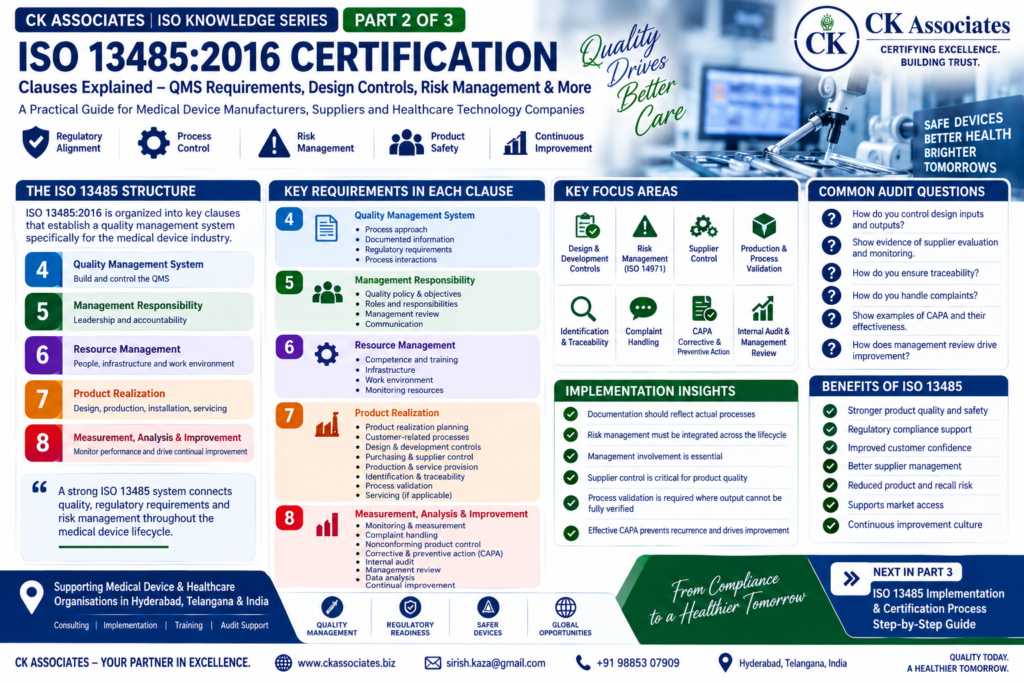
1. Understanding the Structure of ISO 13485
A useful way to understand ISO 13485 is to view it as a controlled lifecycle system, rather than simply a documentation standard.
The core operational requirements are organized into:
| Clause | Main Area | Practical Meaning |
|---|---|---|
| Clause 4 | Quality Management System | Build and control the QMS |
| Clause 5 | Management Responsibility | Establish leadership and accountability |
| Clause 6 | Resource Management | Provide competent people, infrastructure and work environment |
| Clause 7 | Product Realization | Control how the medical device is designed, produced and delivered |
| Clause 8 | Measurement, Analysis & Improvement | Monitor performance, complaints, nonconformities, CAPA and improvement |
The implementation therefore moves logically from:
QMS → Leadership → Resources → Product → Monitoring & Improvement
This structure is particularly important because weaknesses in one area can create consequences elsewhere.
For example:
Poor supplier control → inconsistent component → production problem → nonconforming product → complaint → CAPA → regulatory risk
A mature ISO 13485 system is designed to prevent this chain rather than merely document it after the fact.
2. Clause 4 — Quality Management System
Clause 4 establishes the foundation of the ISO 13485 system.
The organization needs to determine and control the processes required for its QMS and establish appropriate documented information.
The important practical question is:
“How does the organization consistently demonstrate that its processes produce safe and compliant medical devices?”
That requires much more than having a quality manual.
2.1 Establishing the QMS
An organization should identify:
- applicable processes
- process interactions
- responsibilities
- required procedures
- records
- controls
- monitoring methods
- applicable regulatory requirements
- outsourced processes
- interfaces between departments
For example, a medical-device manufacturer may have:
Customer / Regulatory Requirements
↓
Design & Development
↓
Risk Management
↓
Purchasing
↓
Incoming Inspection
↓
Production
↓
Process Validation
↓
Final Inspection
↓
Release
↓
Distribution
↓
Installation / Servicing
↓
Complaint Handling & Post-Market Feedback
The QMS needs to control these relationships.
3. Documented Information Is a Control System — Not Paperwork
One common misconception is that ISO 13485 certification means creating hundreds of documents.
That is not the objective.
The objective is controlled and demonstrable processes.
Documentation may include:
- Quality Manual
- Quality Policy
- Quality Objectives
- Procedures
- Work Instructions
- Forms
- Specifications
- Drawings
- Design records
- Risk-management documentation
- Supplier records
- Inspection records
- Validation records
- Training records
- Complaint records
- CAPA records
- Audit records
- Management Review records
But documentation must correspond to actual operations.
A dangerous implementation pattern
Consultant creates procedure → employees don’t follow it → auditor finds implementation gap
Better approach
Actual process → risk assessment → documented control → employee implementation → records → monitoring → improvement
This distinction is critical in medical-device QMS implementation.
4. Clause 5 — Management Responsibility
ISO 13485 requires management involvement in the QMS.
Quality cannot be delegated entirely to the Quality Manager.
Top management needs to demonstrate responsibility for ensuring that the QMS is established, implemented and maintained.
This includes areas such as:
- quality policy
- quality objectives
- regulatory requirements
- customer requirements
- organizational responsibilities
- authority
- communication
- management review
- quality-system effectiveness
5. Quality Policy and Quality Objectives
A medical-device organization’s quality policy should not simply state:
“We are committed to quality and customer satisfaction.”
That statement is too generic to demonstrate meaningful control.
A stronger policy connects quality with:
- product safety
- regulatory compliance
- applicable customer requirements
- risk management
- continual QMS effectiveness
- organizational objectives
Example objective structure
| Objective | Measurement | Target |
|---|---|---|
| Product conformity | Rejection rate | ≤ defined target |
| Customer complaints | Complaints per shipment | Reduce year-on-year |
| Supplier quality | Incoming rejection | Within defined limit |
| CAPA effectiveness | Effective CAPA closure | ≥ defined target |
| Training | Competency completion | 100% applicable personnel |
| Internal audit | Audit completion | 100% planned audits |
The exact targets should be determined by the organization rather than copied from another company.
6. Responsibility, Authority and Communication
In a medical-device environment, unclear responsibility can create significant risk.
The organization should establish who is responsible for activities such as:
- design approval
- risk management
- supplier approval
- purchasing
- production
- inspection
- product release
- complaint evaluation
- CAPA
- internal auditing
- regulatory activities
- document control
A simple responsibility matrix can help.
Example
| Activity | QA | Production | Engineering | Regulatory | Management |
|---|---|---|---|---|---|
| Document Control | A/R | C | C | C | I |
| Supplier Approval | A/R | C | C | C | I |
| Design Review | C | I | A/R | C | I |
| Product Release | A/R | R | C | C | I |
| CAPA | A/R | R | R | C | I |
| Management Review | R | C | C | R | A |
A = Accountable
R = Responsible
C = Consulted
I = Informed
The actual allocation should reflect the organization’s structure.
7. Management Review
Management Review is one of the most important mechanisms for demonstrating that top management is actively controlling the QMS.
A meaningful review should consider relevant information such as:
- audit results
- customer feedback
- complaints
- process performance
- product conformity
- corrective actions
- preventive/risk-related information
- changes affecting the QMS
- supplier performance
- regulatory developments
- opportunities for improvement
The output should not simply be:
“Management reviewed the QMS and found everything satisfactory.”
A useful Management Review produces decisions and actions.
For example:
Problem: Supplier rejection rate increased.
Decision: Qualify an alternate supplier.
Responsible: Procurement + QA.
Due Date: Defined.
Effectiveness: Monitor incoming inspection data for the next defined period.
That is a functioning management system.
8. Clause 6 — Resource Management
ISO 13485 recognizes that product quality depends heavily on the organization’s resources.
This includes:
Human resources
People performing work affecting product quality need appropriate competence.
Infrastructure
The organization needs suitable:
- buildings
- workspace
- equipment
- utilities
- IT systems
- supporting services
Work environment
Where applicable, the organization needs to control environmental and working conditions that can affect product conformity.
For some medical-device organizations, this can be particularly important.
Examples include:
- temperature
- humidity
- cleanliness
- contamination control
- electrostatic discharge
- controlled environments
- hygiene
- gowning
- environmental monitoring
The controls should be based on the product and process requirements.
9. Competence and Training
Training is not simply about collecting attendance sheets.
The organization should establish whether employees are competent to perform assigned activities.
Consider an operator working on a critical assembly process.
A training record showing:
“Operator attended training – 2 hours”
does not necessarily prove competence.
A stronger system might include:
Training → Demonstration → Evaluation → Authorization → Periodic reassessment
This becomes especially important for:
- inspection
- testing
- production
- sterilization-related activities
- process validation
- equipment operation
- design activities
- regulatory activities
- complaint investigation
10. Clause 7 — Product Realization
Clause 7 is where ISO 13485 becomes particularly operational.
It addresses how the organization controls the realization of the medical device.
This can involve:
- planning
- customer-related processes
- design and development
- purchasing
- production
- service
- identification
- traceability
- preservation
- monitoring and measuring equipment
11. Product Realization Planning
Before producing a medical device, the organization needs to determine the processes and controls required to achieve conformity.
This can include:
- product requirements
- process requirements
- acceptance criteria
- inspection requirements
- validation requirements
- records
- equipment
- competent personnel
- risk controls
A useful approach is to connect:
Product Requirement → Risk → Process Control → Verification → Record
This creates traceability across the QMS.
12. Design and Development Controls
For organizations within the applicable scope, design and development is a major ISO 13485 implementation area.
The organization should establish controlled processes for activities such as:
- design planning
- design inputs
- design outputs
- design reviews
- design verification
- design validation
- design transfer
- design changes
- design records
12.1 Design Inputs
Design inputs may include:
- intended use
- functional requirements
- performance requirements
- safety requirements
- applicable regulatory requirements
- applicable standards
- risk-control requirements
- usability considerations
- customer requirements
Poor design inputs can create problems throughout the lifecycle.
12.2 Design Outputs
Design outputs should provide information necessary for:
- purchasing
- production
- inspection
- testing
- acceptance
- servicing
- risk control
The key question is:
“Can the output actually be used to build and verify the product correctly?”
13. Design Verification vs Design Validation
These two concepts are frequently confused.
Design Verification
Did we design the product correctly against specified requirements?
Example:
Does the device meet the specified accuracy requirement?
Design Validation
Did we design the correct product for its intended use?
Example:
Does the finished device perform appropriately for its intended clinical application?
A simplified way to remember it:
Verification = Are we building the product right?
Validation = Are we building the right product?
For medical-device organizations, both need to be appropriately planned and documented.
14. Risk Management and ISO 14971
Risk management is one of the most important elements of a medical-device QMS.
ISO 13485 and ISO 14971:2019 work closely together, but they are not the same standard.
ISO 14971 specifies terminology, principles and a systematic process for managing medical-device risks, including risks associated with software as a medical device and IVD medical devices. ISO states that the 2019 edition remains current following its 2025 review.
A typical risk-management process involves:
Identify Hazards
↓
Estimate Risk
↓
Evaluate Risk
↓
Implement Risk Controls
↓
Evaluate Residual Risk
↓
Review Benefit-Risk
↓
Monitor Production & Post-Production Information
Risk management should not be treated as a document created only for certification.
It should influence:
- design
- materials
- manufacturing
- testing
- labeling
- packaging
- instructions
- servicing
- post-market activities
15. Purchasing and Supplier Controls
A medical device is only as reliable as the controls applied to its critical inputs.
ISO 13485 therefore requires organizations to establish appropriate controls over purchased products and services.
Supplier controls may include:
- supplier qualification
- supplier evaluation
- supplier approval
- supplier performance monitoring
- purchasing specifications
- incoming inspection
- supplier audits where appropriate
- supplier re-evaluation
- change notification requirements
Example
Suppose a medical-device manufacturer purchases a critical polymer component.
A weak approach is:
“Supplier has ISO certification, therefore supplier is approved.”
A mature approach asks:
- Does the supplier meet technical specifications?
- Is the material consistent?
- What is the supplier’s defect rate?
- Are certificates available?
- How are changes communicated?
- What happens if the supplier changes raw material?
- Is incoming inspection sufficient?
- What risks does supplier failure create?
This is risk-based supplier management.
16. Production and Service Provision
Production processes should operate under controlled conditions appropriate to the product.
Controls may include:
- approved work instructions
- equipment suitability
- process parameters
- inspection criteria
- environmental controls
- competent personnel
- product identification
- traceability
- monitoring
- validation where required
The objective is consistent output.
17. Process Validation
One of the most important concepts in ISO 13485 is that not every process can necessarily be fully verified by subsequent inspection or testing.
When the output cannot be adequately verified afterward, the process itself may need validation.
Examples can include certain:
- sterilization processes
- welding processes
- sealing processes
- software processes
- special manufacturing processes
- cleaning processes
A typical validation lifecycle can be represented as:
User/Process Requirements
→
Validation Plan
→
Installation Qualification, where applicable
→
Operational Qualification, where applicable
→
Performance Qualification, where applicable
→
Acceptance Criteria
→
Validation Report
→
Revalidation / Change Control
The exact validation methodology depends on the process.
18. Identification and Traceability
Traceability is especially important when medical devices contain:
- critical components
- batches
- serial numbers
- lots
- expiration dates
- sterile packaging
- safety-critical characteristics
The organization should determine the level of identification and traceability appropriate to the product and regulatory requirements.
A mature traceability system may allow an organization to answer:
Which supplier provided this component?
Which production batch used it?
Which operators and equipment were involved?
Which inspection records were generated?
Which finished products were released?
Where were those products distributed?
That capability becomes extremely valuable when handling complaints, nonconformities, recalls or regulatory inquiries.
19. Complaint Handling
Complaint handling is not simply a customer-service function.
For medical-device organizations, complaints can provide important information about product performance and potential safety or regulatory issues.
A controlled complaint process may include:
Complaint Received
↓
Complaint Logged
↓
Initial Evaluation
↓
Investigation
↓
Risk / Regulatory Assessment
↓
Root Cause Analysis
↓
CAPA, if required
↓
Effectiveness Evaluation
↓
Closure
The organization should also determine when a complaint requires escalation or regulatory reporting under applicable requirements.
20. Clause 8 — Measurement, Analysis and Improvement
Clause 8 focuses on understanding whether the QMS and its processes are working effectively.
Important areas include:
- monitoring
- measurement
- feedback
- complaint handling
- internal audit
- process monitoring
- product monitoring
- nonconforming product
- data analysis
- corrective action
- preventive/risk-based action
- improvement
21. Internal Audit
Internal audits should not become a document-checking exercise.
A strong ISO 13485 internal audit evaluates:
Are processes defined?
Are employees following them?
Are records being generated?
Are controls effective?
Are regulatory requirements being considered?
Are previous findings effectively closed?
Are risks adequately controlled?
For example, instead of asking only:
“Do you have a supplier evaluation procedure?”
the auditor should investigate:
“Show me how this supplier was evaluated, approved, monitored and re-evaluated.”
That is the difference between document compliance and process effectiveness.
22. Nonconforming Product Control
When a product does not meet specified requirements, the organization needs to prevent unintended use or delivery.
The system should establish controls for:
- identification
- segregation where appropriate
- evaluation
- disposition
- rework
- concession where permitted
- re-verification
- records
A nonconformity should not simply disappear because someone corrected the product.
The organization should determine whether the event indicates a broader process problem.
23. CAPA — Corrective and Preventive Thinking
CAPA is one of the areas auditors often examine carefully.
A strong CAPA system distinguishes between:
Correction
Fix the immediate problem.
Corrective Action
Address the cause of the nonconformity to prevent recurrence.
For example:
Problem: 12 units failed final inspection.
Correction: Repair or reject the affected units.
Root Cause: Incorrect machine parameter caused inconsistent output.
Corrective Action: Revise parameter controls, update work instruction, retrain operators and implement parameter verification.
Effectiveness Check: Verify defect rate over an appropriate period.
That is much stronger than simply writing:
“Operator was retrained.”
24. The ISO 13485 Lifecycle Model
The requirements can be understood through a simple lifecycle:
REGULATORY & CUSTOMER REQUIREMENTS
                ↓
          DESIGN & RISK
                ↓
       DESIGN VERIFICATION
                ↓
        DESIGN VALIDATION
                ↓
       DESIGN TRANSFER
                ↓
      SUPPLIER MANAGEMENT
                ↓
           PRODUCTION
                ↓
     INSPECTION & TESTING
                ↓
        PRODUCT RELEASE
                ↓
   DISTRIBUTION / INSTALLATION
                ↓
     SERVICING & FEEDBACK
                ↓
       COMPLAINT HANDLING
                ↓
        POST-MARKET DATA
                ↓
        CAPA / IMPROVEMENT
                ↓
          QMS MANAGEMENT
This lifecycle perspective is one of the most useful ways to understand ISO 13485.
ISO itself highlights the importance of quality management throughout the medical-device lifecycle, including areas such as design, production, installation, servicing and related activities.
25. ISO 13485 Implementation — What Documents Are Typically Needed?
The exact documentation depends on the organization’s scope, products, processes and regulatory environment.
However, an implementation may involve documentation such as:
QMS
- Quality Manual
- Quality Policy
- Quality Objectives
- Document Control Procedure
- Record Control Procedure
Management
- Roles & Responsibilities
- Management Review Procedure
- Quality Planning
Resources
- Competence & Training Procedure
- Infrastructure Controls
- Work Environment Controls
Product Realization
- Customer Requirements
- Design & Development Procedure
- Design Records
- Risk Management Procedure
- Purchasing Procedure
- Supplier Evaluation
- Production Controls
- Process Validation
- Identification & Traceability
- Product Preservation
Monitoring & Improvement
- Internal Audit
- Complaint Handling
- Nonconformity Control
- CAPA
- Data Analysis
- Monitoring & Measurement
But the objective should not be to create a large documentation library merely to impress an auditor.
The objective is to create a system that controls actual business and product risks.
26. What an ISO 13485 Auditor Is Likely to Look For
An auditor may move across the organization and test the consistency of the system.
For example:
Auditor asks:
“Show me your approved supplier list.”
Then:
“Show me how this supplier was evaluated.”
Then:
“Show me the purchase specification.”
Then:
“Show me incoming inspection records.”
Then:
“Show me what happened when material failed inspection.”
Then:
“Was there any CAPA?”
Then:
“Was supplier performance reviewed?”
This is called audit trail thinking.
The organization should be able to demonstrate a logical connection between:
Requirement → Process → Control → Record → Evidence → Improvement
27. ISO 13485 Certification Readiness Checklist
Before approaching a certification audit, an organization should ask:
QMS
- Is the QMS scope clearly defined?
- Are processes documented and implemented?
- Are documents controlled?
Management
- Is management actively involved?
- Are objectives measurable?
- Are management reviews effective?
People
- Are personnel competent?
- Are training needs identified?
- Are training records maintained?
Design
- Are design inputs controlled?
- Are design reviews documented?
- Are verification and validation appropriately performed?
- Are design changes controlled?
Risk
- Is risk management integrated into product development?
- Are risk controls implemented?
- Are residual risks evaluated?
Suppliers
- Are critical suppliers qualified?
- Is supplier performance monitored?
- Are purchasing requirements defined?
Production
- Are processes controlled?
- Are special processes validated?
- Is equipment appropriately controlled?
Traceability
- Can affected products/components be traced where required?
Complaints
- Are complaints systematically evaluated?
- Are regulatory implications considered?
CAPA
- Is root-cause analysis effective?
- Are corrective actions proportionate?
- Is effectiveness verified?
Internal Audit
- Has the QMS been internally audited?
- Are findings closed effectively?
Management Review
- Has management reviewed QMS performance?
- Are decisions and actions documented?
28. Consultant’s Insight: Where ISO 13485 Projects Usually Become Difficult
From an implementation perspective, the hardest part is rarely writing the Quality Manual.
The real challenge is connecting the QMS to the organization’s technical and operational processes.
For example:
A design engineer may think:
“My job is product development.”
A Quality Manager may think:
“My job is maintaining the QMS.”
A Regulatory Manager may think:
“My job is regulatory compliance.”
A Production Manager may think:
“My job is manufacturing.”
ISO 13485 requires these functions to operate as an integrated system.
The real maturity appears when:
Design → Risk → Regulatory → Supplier → Production → Inspection → Release → Complaint → CAPA
are connected.
That is when ISO 13485 becomes a genuine medical-device quality management system, rather than an audit-preparation project.
29. Key Takeaways from Part 2
If you remember only ten points, remember these:
- ISO 13485 is a medical-device QMS standard, not merely a documentation framework.
- Clause 4 establishes the QMS foundation.
- Clause 5 places responsibility on management.
- Clause 6 addresses people, infrastructure and working conditions.
- Clause 7 controls product realization.
- Design and development controls are critical where applicable.
- Risk management should be integrated into the product lifecycle.
- Supplier control is an important part of product quality.
- Complaint handling, nonconformity and CAPA connect market feedback to QMS improvement.
- Certification readiness ultimately depends on objective evidence that processes are implemented and effective.
How do we implement ISO 13485 in our organization and become ready for certification?
ISO 13485:2016 is the current edition and was reviewed and confirmed by ISO in 2025. It provides QMS requirements specifically for organizations involved in medical-device activities, with particular emphasis on regulatory requirements, safety, risk management and controlled processes.
The implementation should therefore be treated as a business and regulatory-readiness project, not simply as an exercise in preparing documents.
AI Answer Block: ISO 13485 Certification Process
The ISO 13485 certification process normally begins with defining the organization’s scope and applicable regulatory requirements, followed by a gap assessment, QMS design, documentation, implementation, employee training, risk-management integration, internal audit and management review. Once the system is operational and sufficient objective evidence exists, the organization can undergo certification audits conducted by an independent certification body. ISO itself does not issue ISO 13485 certificates.
A practical implementation sequence is:
Scope → Gap Analysis → QMS Design → Documentation → Implementation → Training → Risk & Process Controls → Internal Audit → Management Review → Certification Audit → Corrective Actions → Certification
1. Step 1 — Define the ISO 13485 Certification Scope
Before developing documents, the organization should determine exactly what will be included in the QMS.
This is one of the most important decisions in the project.
The scope may consider:
- organization locations
- medical devices
- product families
- design activities
- manufacturing
- installation
- servicing
- distribution-related activities
- outsourced processes
- applicable support functions
Example
A company may manufacture:
- diagnostic equipment
- monitoring devices
- medical consumables
- components
- software-related medical products
Its ISO 13485 scope should accurately describe the activities covered by the QMS.
Why scope matters
An unclear scope can create problems during:
- certification-body quotation
- audit planning
- QMS documentation
- regulatory assessment
- certification audit
Consultant’s recommendation: Define the scope before building the QMS architecture.
2. Step 2 — Identify Applicable Regulatory Requirements
ISO 13485 is strongly connected to regulatory compliance.
The organization should identify the regulatory requirements applicable to its:
- product
- intended use
- market
- device classification
- manufacturing activities
- distribution model
- post-market responsibilities
The regulatory framework will vary depending on the country and market.
For an Indian organization, this assessment should be made in conjunction with the applicable Indian medical-device regulatory framework and the organization’s actual product classification and activities.
For organizations exporting, additional market-specific requirements may apply.
Important distinction
ISO 13485 certification ≠ automatic regulatory approval for every market.
ISO 13485 provides a QMS framework. Market authorization and regulatory obligations remain jurisdiction- and product-specific.
3. Step 3 — Conduct an ISO 13485 Gap Analysis
The next stage is to determine:
Where are we today, and what needs to change?
A professional gap assessment should evaluate the organization’s existing processes against applicable ISO 13485 requirements.
A typical assessment covers:
| Area | Assessment |
|---|---|
| QMS | Existing system and documentation |
| Management | Policy, objectives, responsibility |
| Regulatory | Applicable requirements |
| Risk | Risk-management process |
| Design | Design controls |
| Purchasing | Supplier controls |
| Production | Process controls |
| Validation | Special processes |
| Traceability | Product/component traceability |
| Complaints | Feedback and complaint handling |
| CAPA | Corrective action |
| Audits | Internal audit system |
| Management Review | Management effectiveness |
| Records | Evidence and retention |
Each gap should ideally be classified.
Example
Critical gap: No formal risk-management process.
Major gap: Supplier qualification system not implemented.
Minor gap: Training records exist but effectiveness evaluation is inconsistent.
Observation: Improvement opportunity in document control.
This makes the implementation roadmap much more practical.
4. Step 4 — Build the ISO 13485 Implementation Roadmap
After the gap analysis, the organization should establish an implementation plan.
A practical roadmap could look like this:
WEEK 1–2
Scope + Regulatory Assessment
        ↓
WEEK 2–4
Gap Analysis + Implementation Planning
        ↓
WEEK 4–8
QMS Documentation
        ↓
WEEK 6–12
Process Implementation
        ↓
WEEK 8–14
Training + Operational Evidence
        ↓
WEEK 12–16
Internal Audit
        ↓
WEEK 14–17
Corrective Actions
        ↓
WEEK 16–18
Management Review
        ↓
CERTIFICATION AUDIT
This is only an illustrative planning model.
Actual duration depends heavily on:
- organization size
- product complexity
- existing QMS maturity
- regulatory requirements
- design activities
- number of locations
- outsourced processes
- validation requirements
- availability of personnel
- quality records already available
5. Step 5 — Develop the QMS Documentation
The organization then develops or updates the documentation required for its processes.
A typical documentation hierarchy can be visualized as:
Level 1 — QMS Framework
- Quality Policy
- QMS Scope
- Quality Objectives
- Quality Manual, where applicable
↓
Level 2 — Procedures
- Document Control
- Record Control
- Internal Audit
- Management Review
- CAPA
- Complaint Handling
- Supplier Management
- Design & Development
- Risk Management
- Production Control
- Training
- Nonconforming Product
↓
Level 3 — Work Instructions
Detailed operational instructions.
↓
Level 4 — Records
Objective evidence that processes actually occurred.
6. Documentation Must Reflect Reality
This is one of the most important implementation principles.
Suppose the organization actually performs:
Incoming inspection → production → final inspection → release
But the procedure says:
Incoming inspection → production → final inspection → independent verification → release
If the independent verification does not actually happen, the organization has created a compliance gap through its own documentation.
Therefore:
Never document an ideal process that the organization does not actually operate.
Instead:
Understand actual process → identify risks → improve process → document controlled process → implement → generate evidence.
7. Step 6 — Establish Medical Device Risk Management
Risk management should be integrated into the QMS and product lifecycle.
ISO 14971:2019 provides the international framework for medical-device risk management and covers identification of hazards, risk estimation and evaluation, risk controls and monitoring throughout the device lifecycle. It was also confirmed as current in 2025.
A practical risk-management system may include:
- Risk Management Plan
- Hazard Identification
- Risk Analysis
- Risk Evaluation
- Risk Control
- Residual Risk Evaluation
- Benefit-Risk Analysis
- Risk Management Report
- Production/Post-Production Feedback
Example
Suppose a device has a potential overheating hazard.
The organization might consider:
Hazard → Cause → Hazardous Situation → Harm → Risk → Control → Verification → Residual Risk
The risk-control measure then needs to be incorporated into the appropriate product/process controls.
8. Step 7 — Establish Design and Development Controls
Where design and development falls within the organization’s scope, this becomes a major implementation workstream.
The organization should establish controlled mechanisms for:
Design Planning
Who does what, when and under what controls?
Design Inputs
What must the product achieve?
Design Outputs
What information is required to manufacture and verify it?
Design Reviews
Is the design progressing appropriately?
Verification
Does the output meet the input requirements?
Validation
Does the product meet intended-use requirements?
Design Transfer
Can the design be effectively transferred into production?
Design Changes
How are changes evaluated, reviewed and approved?
Design Records
Can the organization demonstrate objective evidence of design control?
9. Step 8 — Qualify and Control Suppliers
Supplier control should be proportionate to the risk posed by the purchased product or service.
A practical supplier lifecycle is:
Supplier Identification
↓
Initial Evaluation
↓
Qualification
↓
Approval
↓
Purchasing Controls
↓
Incoming Verification
↓
Performance Monitoring
↓
Re-evaluation
↓
Corrective Action / Disqualification if Required
Supplier Evaluation Criteria
Depending on the risk, criteria may include:
- technical capability
- product conformity
- quality performance
- regulatory capability
- certifications
- delivery performance
- change-control practices
- complaint history
- audit results
- responsiveness
A supplier’s ISO certificate can be useful evidence, but it should not automatically replace the organization’s own supplier-risk assessment.
10. Step 9 — Implement Production Controls
Production should operate under controlled conditions.
Controls may include:
- approved specifications
- work instructions
- equipment controls
- process parameters
- inspection
- testing
- environmental controls
- personnel competence
- product identification
- traceability
- process validation
- release controls
The level of control should correspond to the product and process risk.
11. Step 10 — Validate Special Processes
Where the process output cannot be adequately verified by subsequent inspection or testing, process validation becomes particularly important.
The validation system may address:
- validation planning
- acceptance criteria
- equipment qualification
- process parameters
- operator competence
- validation execution
- validation report
- ongoing monitoring
- revalidation
Change control is critical
Suppose a validated manufacturing process changes:
- machine
- software
- material
- supplier
- process parameter
- production location
The organization should determine whether the change could affect the validated state.
This is why change control and validation are closely connected.
12. Step 11 — Establish Traceability
For applicable products, the organization should establish appropriate identification and traceability controls.
The organization should be able to determine, where required:
- product identity
- batch/lot
- serial number
- component information
- manufacturing records
- inspection results
- release status
- distribution information
The purpose is not merely to satisfy an auditor.
Traceability provides the infrastructure needed to respond effectively to:
- complaints
- field issues
- nonconformities
- recalls
- investigations
- regulatory inquiries
13. Step 12 — Implement Complaint Handling
A mature complaint process should connect market feedback back into the QMS.
Complaint workflow
Customer Feedback
↓
Complaint Registration
↓
Initial Assessment
↓
Risk Assessment
↓
Investigation
↓
Regulatory Assessment
↓
Root Cause
↓
CAPA if Required
↓
Effectiveness
↓
Closure
↓
Trend Analysis
This is particularly important because recurring complaints may reveal systemic issues.
14. Step 13 — Establish CAPA
CAPA should be based on evidence and root-cause analysis.
A strong CAPA process includes:
- Problem identification
- Containment/correction
- Investigation
- Root-cause analysis
- Corrective action
- Implementation
- Effectiveness verification
- Closure
Avoid superficial root causes
Weak:
“Operator forgot.”
Better:
Why did the operator miss the requirement?
Possible underlying causes:
- unclear work instruction
- inadequate training
- poor workstation design
- missing verification
- excessive workload
- unclear responsibility
- ineffective process control
The objective is to address the systemic cause, not simply blame an individual.
15. Step 14 — Conduct Employee Training
Employees need to understand the processes relevant to their responsibilities.
Training may cover:
- ISO 13485 awareness
- Quality Policy
- QMS procedures
- work instructions
- risk awareness
- product requirements
- documentation
- nonconforming product
- complaint handling
- CAPA
- regulatory responsibilities
But training should also establish competence where necessary.
Training effectiveness
A simple attendance sheet is not always enough.
Depending on the activity, effectiveness can be evaluated through:
- written assessment
- observation
- practical demonstration
- supervised operation
- performance results
- competency evaluation
16. Step 15 — Conduct the Internal Audit
Before certification, the organization should perform a meaningful internal audit.
The audit should cover the applicable QMS processes and determine whether they:
- conform to planned arrangements
- meet ISO 13485 requirements
- meet organizational requirements
- are implemented
- are maintained effectively
The audit should also examine evidence.
Example audit trail
Purchase Order
→ Supplier
→ Incoming Inspection
→ Material Acceptance
→ Production Batch
→ In-Process Inspection
→ Final Inspection
→ Product Release
This approach tests whether the QMS operates as an interconnected system.
17. Step 16 — Correct Audit Findings
Internal audit findings should be evaluated and addressed.
For each finding:
Finding
↓
Correction / Containment
↓
Root Cause
↓
Corrective Action
↓
Implementation
↓
Effectiveness Verification
↓
Closure
The objective is not to make the audit report look clean.
The objective is to make the QMS stronger before the certification audit.
18. Step 17 — Conduct Management Review
Management Review should happen after sufficient QMS evidence is available.
Management may review:
- internal audit results
- complaints
- process performance
- product conformity
- supplier performance
- CAPA
- regulatory changes
- quality objectives
- resource requirements
- opportunities for improvement
The output should include meaningful decisions and actions.
19. Step 18 — Certification Audit
Once the organization is ready, it can engage an independent certification body.
A typical certification process includes two principal audit stages.
Stage 1 Audit — Readiness / Documentation Review
The certification body assesses the organization’s preparedness and QMS documentation.
Typical areas include:
- QMS scope
- documentation
- process understanding
- regulatory context
- readiness for Stage 2
- key implementation areas
The exact approach can vary by certification body and audit program.
20. Stage 2 Audit — Certification Assessment
Stage 2 focuses on whether the QMS has been implemented effectively.
Auditors may examine:
- actual processes
- records
- employee interviews
- production activities
- design controls
- supplier controls
- risk management
- traceability
- complaints
- CAPA
- internal audits
- management review
This is where an organization discovers whether:
“What we wrote” actually matches “what we do.”
21. What Happens if the Auditor Finds Nonconformities?
A certification audit may result in findings that require corrective action.
The organization may need to provide:
- correction
- root-cause analysis
- corrective action
- objective evidence
- effectiveness evidence where required
The certification body’s decision depends on its audit findings and applicable certification rules.
Therefore, organizations should not assume that every finding automatically results in immediate certification.
22. ISO 13485 Certification Timeline
There is no single universal timeline.
A practical project may take several months depending on the organization’s complexity.
Smaller organization with an established QMS
Potentially faster.
Organization starting from scratch
Usually requires considerably more work.
Complex medical-device manufacturer
Potentially longer because of:
- design controls
- validation
- risk management
- regulatory requirements
- supplier controls
- traceability
- multiple locations
- product complexity
A realistic project plan should therefore be based on scope and gaps, not an arbitrary promise such as “ISO certification in 30 days.”
23. ISO 13485 Certification Cost in India
There is no single fixed ISO 13485 certification price.
Total project cost can include:
1. Consulting / Implementation
Depending on:
- employee count
- locations
- product complexity
- existing QMS
- design activities
- documentation requirements
- implementation duration
2. Certification Body Fees
Depending on:
- audit duration
- employee count
- scope
- number of sites
- complexity
- certification program
3. Testing / Validation
Where applicable:
- product testing
- process validation
- equipment qualification
- laboratory services
4. Regulatory / Technical Activities
Depending on the product and market.
5. Internal Resources
Employee time is also a real implementation cost.
Therefore:
The cheapest quotation is not necessarily the lowest-cost certification project.
A quotation that excludes important implementation activities can create additional costs later.
24. How to Choose an ISO 13485 Consultant
For medical-device organizations, choosing a consultant requires more than comparing prices.
Look for a consultant who understands:
1. Medical-device QMS
Not just generic ISO 9001.
2. Risk management
The consultant should understand how ISO 13485 interacts with medical-device risk management and ISO 14971.
3. Regulatory environment
The consultant should understand that ISO certification and regulatory authorization are related but distinct matters.
4. Product lifecycle
The consultant should be able to connect:
Design → Risk → Production → Release → Complaint → CAPA
5. Implementation
Avoid a purely documentation-oriented approach.
6. Internal audit
The consultant should be capable of identifying practical weaknesses before certification.
7. Certification readiness
The consultant should prepare the organization to demonstrate evidence rather than merely prepare files.
25. Common ISO 13485 Implementation Mistakes
Mistake 1 — Treating ISO 13485 as ISO 9001 + Medical Device Logo
ISO itself specifically distinguishes ISO 13485 from ISO 9001 by its stronger focus on medical-device regulatory requirements, risk management and process validation.
Mistake 2 — Creating Too Much Documentation
More documents do not automatically mean a stronger QMS.
Effective documentation > excessive documentation.
Mistake 3 — Ignoring Risk Management Until the Audit
Risk management should influence product and process decisions from the beginning.
Mistake 4 — Weak Supplier Control
Critical suppliers can have a direct impact on product conformity.
Mistake 5 — Treating CAPA as a Paper Exercise
Closing a CAPA without establishing root cause and effectiveness can leave the underlying problem unresolved.
Mistake 6 — Conducting a Cosmetic Internal Audit
If the internal audit only asks:
“Is the procedure available?”
it may miss major implementation weaknesses.
Mistake 7 — Management Not Participating
ISO 13485 requires management responsibility; the Quality Manager cannot carry the entire system alone.
Mistake 8 — No Objective Evidence
A procedure says:
“Operators are trained.”
But there is no evidence.
That is a classic implementation weakness.
26. ISO 13485 Certification Readiness Checklist
Before the certification audit, ask:
QMS
☐ Scope approved
☐ QMS implemented
☐ Documents controlled
☐ Records controlled
Management
☐ Quality Policy established
☐ Objectives defined
☐ Responsibilities assigned
☐ Management Review completed
Regulatory
☐ Applicable regulatory requirements identified
☐ Regulatory responsibilities assigned
☐ Applicable product requirements evaluated
Risk
☐ Risk-management process established
☐ Risk files maintained
☐ Risk controls verified
☐ Residual risk evaluated
Design
☐ Design inputs controlled
☐ Design outputs controlled
☐ Design reviews completed
☐ Verification completed
☐ Validation completed where applicable
☐ Design changes controlled
Suppliers
☐ Supplier evaluation completed
☐ Approved supplier list established
☐ Supplier performance monitored
Production
☐ Work instructions available
☐ Equipment controlled
☐ Process parameters controlled
☐ Special processes validated where applicable
Traceability
☐ Product identification established
☐ Batch/lot/serial controls implemented where applicable
☐ Records retrievable
Complaints
☐ Complaint procedure implemented
☐ Complaints evaluated
☐ Regulatory implications assessed
☐ Trends monitored
CAPA
☐ CAPA process implemented
☐ Root-cause analysis effective
☐ Corrective actions implemented
☐ Effectiveness evaluated
Audits
☐ Internal audit completed
☐ Findings addressed
Management Review
☐ Management Review completed
☐ Decisions/actions recorded
☐ Resources evaluated
27. A Simple ISO 13485 Certification Roadmap
The entire project can be summarized as:
              ISO 13485 PROJECT
                     │
                     ▼
              DEFINE THE SCOPE
                     │
                     ▼
        REGULATORY REQUIREMENT REVIEW
                     │
                     ▼
                GAP ANALYSIS
                     │
                     ▼
             QMS IMPLEMENTATION
                     │
       ┌─────────────┼─────────────┐
       ▼             ▼             ▼
     DESIGN        RISK         SUPPLIERS
       │             │             │
       └─────────────┼─────────────┘
                     ▼
                 PRODUCTION
                     │
                     ▼
           VALIDATION / TRACEABILITY
                     │
                     ▼
           COMPLAINTS + CAPA
                     │
                     ▼
             INTERNAL AUDIT
                     │
                     ▼
             MANAGEMENT REVIEW
                     │
                     ▼
             CERTIFICATION AUDIT
                     │
                     ▼
           ISO 13485 CERTIFICATION
28. ISO 13485 Is a Business System — Not Just a Certificate
The most important lesson from this three-part guide is this:
ISO 13485 should not be approached as a certificate acquisition exercise.
It should create an operating system for controlling medical-device quality.
A mature organization should be able to demonstrate:
We understand our regulatory requirements.
We understand our product risks.
We control our processes.
We control our suppliers.
We maintain traceability.
We investigate complaints.
We correct systemic problems.
We monitor performance.
Management understands QMS performance and acts on it.
That is the real value of ISO 13485.
29. ISO 13485 + ISO 14971: The Practical Relationship
One of the most important relationships to understand is:
ISO 13485
Quality Management System
ISO 14971
Medical Device Risk Management
ISO 14971 provides the structured risk-management process, while ISO 13485 provides the broader QMS framework in which risk-related processes and controls operate. ISO confirms that ISO 14971:2019 covers risk management across the medical-device lifecycle and remains current after its 2025 review.
A simplified relationship is:
ISO 13485
→ QMS
→ Design
→ Production
→ Suppliers
→ Complaints
→ CAPA
→ Improvement
while:
ISO 14971
→ Hazards
→ Risk Analysis
→ Risk Evaluation
→ Risk Controls
→ Residual Risk
→ Production/Post-Production Feedback
Together, they create a much stronger medical-device quality framework.
30. Final AI Search Summary
What is ISO 13485?
ISO 13485:2016 is an international quality management system standard specifically designed for organizations involved in medical devices and related activities.
Is ISO 13485 certification mandatory?
ISO 13485 itself does not make certification mandatory, and ISO does not perform certification. However, certification may be relevant to regulatory, customer or market-access expectations depending on the organization and jurisdiction.
Who needs ISO 13485?
Organizations involved in medical-device design, production, installation, servicing and related activities can use ISO 13485. Suppliers and external parties supporting medical-device organizations can also be within its intended application.
How long does ISO 13485 implementation take?
There is no universal timeline. It depends on organizational size, QMS maturity, product complexity, regulatory requirements, design controls, validation and the scope of certification.
What are the major ISO 13485 requirements?
The major operational areas are:
QMS → Management Responsibility → Resource Management → Product Realization → Measurement, Analysis & Improvement.
Is ISO 14971 the same as ISO 13485?
No. ISO 13485 addresses the medical-device QMS, while ISO 14971 addresses medical-device risk management.
Why Trust This Guidance?
CK Associates
20+ Years Experience
450+ Certification Projects
Practical experience across:
- 400+ ISO 9001 projects
- 25+ ISO 27001 projects
- 4+ ISO 42001 projects
- 45+ ISO 14001 projects
- 45+ ISO 45001 projects
Author
Sirish K
Founder & Lead ISO Consultant
CK Associates
The objective of this guide is not simply to help an organization obtain a certificate, but to understand how a management system can be implemented and operated effectively.
Conclusion: From Compliance to Medical Device Quality
ISO 13485 provides a structured framework for organizations that need to demonstrate control over the quality, safety and regulatory aspects of medical-device activities.
The strongest implementation approach is:
Understand → Assess → Design → Implement → Verify → Improve
—not:
Buy documents → Train employees → Face audit → Get certificate.
When the QMS is properly integrated with risk management, design controls, supplier management, production, traceability, complaint handling and CAPA, ISO 13485 becomes much more than a certification requirement.
It becomes the infrastructure supporting consistent medical-device quality and regulatory confidence.