

A well-managed facility is not just about maintaining a building. It is about ensuring that people, processes, infrastructure and services work together effectively.
Every organisation depends on its workplace and supporting facilities to carry out daily operations. Corporate offices need reliable maintenance, hospitals need properly managed facilities, manufacturing plants depend on essential infrastructure, and IT companies require safe, functional and well-maintained workplaces.
However, facility management is often handled through separate activities such as housekeeping, electrical maintenance, security, asset management, safety, utilities and contractor supervision.
When these activities are not properly coordinated, organisations may experience service delays, increased maintenance costs, poor resource utilisation and difficulties in monitoring performance.
This is where ISO 41001:2018, Facility Management System (FMS) becomes relevant.
ISO 41001 provides a structured management framework that helps organisations establish, implement, maintain and continually improve their facility management processes.
It helps businesses align facility services with organisational requirements, improve service delivery, manage risks and monitor performance.
For facility management companies, commercial buildings, hospitals, IT parks, manufacturing units and organisations managing their own infrastructure, ISO 41001 can provide a practical approach to managing facilities more effectively.
This guide explains the standard, its requirements, implementation process, documentation, certification process and business benefits.
What is ISO 41001 certification?
ISO 41001 certification demonstrates that an organisation’s Facility Management System has been assessed against the applicable requirements of ISO 41001.
The standard provides a management framework for planning, delivering, monitoring and improving facility management activities.
It focuses on aligning facility services with the needs of the organisation and its interested parties.
ISO 41001 can be relevant to:
- Facility management service providers
- Integrated facility management companies
- Commercial building operators
- Corporate offices and IT parks
- Hospitals and healthcare facilities
- Manufacturing and industrial organisations
- Property and infrastructure management companies
- Organisations managing their own workplace facilities
The certification scope depends on the actual facility management activities performed by the organisation.
1. What is ISO 41001?
Facility Condition Assessment Guide
ISO 41001
ISO 41001:2018 is an international standard that specifies requirements for establishing, implementing, maintaining and continually improving a Facility Management System.
The standard helps organisations manage facility-related activities through a structured approach rather than depending only on individual maintenance tasks or informal arrangements.
Facility management covers the organisational functions that support the working environment, infrastructure and services required for an organisation to operate effectively.
These activities may include:
- Building maintenance
- Electrical and mechanical maintenance
- Housekeeping and cleaning
- Security and access management
- Workplace management
- Utility management
- Space management
- Maintenance of facility-related assets
- Contractor and service provider management
- Supporting services for employees and building users
ISO 41001 does not prescribe one fixed method for managing every facility. Instead, it establishes management system requirements that organisations can apply according to their size, activities, scope and operational needs.
The objective is to ensure that facility management services are properly planned, controlled, monitored and improved.
Important standard reference: The published requirements standard is ISO 41001:2018, with Amendment 1:2024 addressing climate action changes. A revision project is under development, but a draft revision should not be treated as the published certification requirement.
2. Who needs ISO 41001 certification?
ISO 41001 is designed for organisations that provide facility management services as well as organisations that manage facilities for their own operations.
It is not limited to housekeeping or building maintenance companies. The standard can be applied to different types and sizes of organisations, depending on their facility management activities and scope. Requirements with guidance for use+1
1. Facility management service providers
Companies providing housekeeping, security, maintenance, electrical, plumbing, landscaping and other facility-related services to clients.
2. Corporate offices and IT parks
Organisations managing large office spaces, employee facilities, building maintenance, utilities and workplace support services.
The Hidden Workforce: How Skilled Trades Keep Hospitals Running
3. Hospitals and healthcare facilities
Healthcare organisations managing building infrastructure, housekeeping, engineering services, utilities and supporting facilities.
Industrial Action Plans: The 2026 Guide to Operational Reliability
4. Manufacturing and industrial organisations
Companies managing production buildings, utilities, maintenance activities, internal infrastructure and supporting services.
5. Property and infrastructure management companies
Organisations responsible for commercial properties, campuses, business parks and multiple facilities.
Is ISO 41001 applicable to organisations that outsource facility services?
Yes. An organisation does not necessarily need to employ its own housekeeping, security or maintenance teams to establish a Facility Management System.
It may use external service providers, internal teams or a combination of both. What matters is how facility management activities are planned, controlled, monitored and aligned with the organisation’s requirements.
For example, a corporate office may outsource housekeeping and security while retaining responsibility for facility management planning, supplier evaluation, service performance and user satisfaction.
ISO 41001 can help establish a structured approach to managing these arrangements.
3. Understanding the requirements of ISO 41001
ISO 41001 follows the common management system structure used in many ISO standards. Its requirements are organised around organisational context, leadership, planning, support, operation, performance evaluation and improvement.
The following explains the main areas organisations should address.
Clause 4: Context of the organisation
The organisation needs to understand its internal and external issues and identify the requirements of relevant interested parties.
In facility management, this may include:
- Type and size of the facilities
- Building and infrastructure conditions
- Nature of facility services
- Customer and building user expectations
- Legal and regulatory requirements
- Availability of resources and service providers
- Operational risks and dependencies
- Organisational objectives
For example, the requirements of a hospital are different from those of an IT park or manufacturing facility.
A hospital may have specific requirements for critical utilities, cleanliness and uninterrupted support services. An IT park may give greater attention to workplace comfort, building access, maintenance response and utility availability.
The organisation should define the scope of its Facility Management System based on these requirements.

Clause 5: Leadership
Top management plays an important role in establishing and maintaining the Facility Management System.
Management should demonstrate commitment by:
- Establishing a facility management policy
- Defining responsibilities and authorities
- Aligning facility management objectives with business objectives
- Providing necessary resources
- Supporting continual improvement
- Promoting a service-oriented approach
Facility management should not be treated as an activity handled only by the maintenance department. It needs management support and coordination across relevant functions.
Clause 6: Planning
Planning involves identifying risks and opportunities, establishing objectives and determining the actions required to achieve them.
Examples include:
- Identifying risks associated with building infrastructure
- Planning preventive maintenance activities
- Setting facility service performance objectives
- Identifying critical assets and service dependencies
- Planning resources and budgets
- Considering climate-related issues where relevant
- Establishing measurable improvement targets
For example, an organisation may establish an objective to improve the timely completion of planned maintenance activities. It should define how performance will be measured and reviewed.
Clause 7: Support
A Facility Management System needs appropriate resources and support to operate effectively.
This includes:
- Employee competence
- Training and awareness
- Internal and external communication
- Documented information
- Infrastructure and operational resources
- Appropriate technology and tools
Facility management employees and external service providers should understand their responsibilities.
For example, maintenance personnel should have the required competence for their assigned activities, and relevant training or authorisation records should be maintained.
Clause 8: Operation
This is where the organisation puts its facility management arrangements into practice.
Operational planning and control may cover:
- Maintenance of buildings and infrastructure
- Housekeeping and cleaning services
- Security and access arrangements
- Utility and energy-related services
- Workplace and space management
- Contractor and supplier coordination
- Service delivery monitoring
- Emergency and operational arrangements
The organisation should establish appropriate controls to ensure that facility services meet defined requirements.
Clause 9: Performance evaluation
The organisation needs to monitor and evaluate whether the Facility Management System is achieving its intended results.
This may include:
- Facility service performance
- Maintenance completion
- User satisfaction
- Supplier performance
- Achievement of objectives
- Internal audit results
- Management review
For example, an organisation may monitor maintenance response times, recurring equipment failures, housekeeping inspection results and complaints from building users.
The results should be reviewed and used to identify areas requiring improvement.
Clause 10: Improvement
The organisation should address nonconformities and continually improve the effectiveness of its Facility Management System.
Improvement activities may include:
- Investigating repeated maintenance failures
- Improving contractor performance
- Correcting service delivery issues
- Reviewing facility management procedures
- Improving resource utilisation
- Updating risk assessments
- Implementing corrective actions
The objective is to make facility management more effective over time, rather than simply maintaining records for certification.
4. What is the difference between facility management and an ISO 41001 management system?
This is an important distinction for organisations considering certification.
Facility management refers to the activities and services required to support the built environment and the organisation’s operations.
ISO 41001 provides a management system framework for controlling and improving those activities.
| Facility management activity | How ISO 41001 supports it |
|---|---|
| Building maintenance | Establishes planning, responsibilities and performance monitoring |
| Housekeeping | Supports defined service requirements and operational controls |
| Security services | Supports service planning and supplier oversight |
| Electrical and mechanical maintenance | Supports operational planning and monitoring |
| Utility management | Supports resource planning and facility performance |
| Contractor management | Supports supplier and service provider controls |
| Workplace management | Aligns services with organisational and user requirements |
| Customer or user complaints | Supports monitoring, evaluation and improvement |
For example, a facility management company may already provide housekeeping, security and maintenance services.
However, having employees and service contracts does not automatically mean that the company has an effective Facility Management System.
It needs defined processes, management responsibilities, performance monitoring, documented information and continual improvement arrangements.
That is the difference ISO 41001 helps address.
5. How to implement ISO 41001 in an organisation
ISO 41001 implementation should be planned according to the organisation’s size, facility management activities, service delivery model and existing processes.
At CK Associates, we recommend a practical implementation approach that starts with understanding the organisation before preparing documentation.
Step 1: Define the Facility Management System scope
Identify the facilities, locations, services and activities that will be covered.
For a facility management service provider, the scope may include housekeeping, security, building maintenance and technical support services delivered to customers.
For an organisation managing its own facilities, the scope may cover workplace management, building maintenance, utilities and supporting infrastructure.
The scope should accurately describe the activities covered by the system.
Step 2: Conduct an initial gap assessment
Review existing facility management practices against ISO 41001 requirements.
The assessment should examine:
- Existing facility management policies
- Service delivery processes
- Maintenance planning
- Roles and responsibilities
- Supplier management
- Risk assessment
- Performance monitoring
- Employee competence
- Internal audit arrangements
The gap assessment should identify what is already working and what needs to be developed.
Step 3: Understand facility user requirements
Facility management services should support the needs of the organisation and the people using its facilities.
The organisation should identify relevant requirements from:
- Building owners and management
- Employees and workplace users
- Customers
- Tenants and occupants
- Contractors and service providers
- Regulatory and statutory authorities
For example, an IT company operating a large office may have requirements relating to cleanliness, access control, maintenance response, meeting room facilities and uninterrupted utility services.
These requirements should be considered while planning facility management services.
Step 4: Establish the facility management policy and objectives
Management should establish a policy that reflects its commitment to effective facility management.
Objectives should be measurable wherever appropriate.
Examples include:
- Improving planned maintenance completion
- Reducing repeated facility service complaints
- Improving contractor performance
- Monitoring utility consumption
- Improving user satisfaction
- Reducing avoidable equipment downtime
The organisation should define responsibilities and methods for monitoring progress.
Step 5: Conduct facility management risk assessments
Facility management involves several operational risks.
Examples include:
- Electrical system failures
- Fire and infrastructure-related risks
- Water leakage and utility interruptions
- Equipment breakdown
- Poor contractor performance
- Inadequate maintenance
- Workplace service interruptions
- Unavailability of critical resources
The organisation should identify relevant risks, evaluate their significance and plan suitable actions.
Risk assessments should reflect actual facility conditions and the services being provided.
Step 6: Develop facility management documentation
Prepare the procedures, policies, plans and records required for the management system.
Documentation should be relevant to the organisation’s activities and should support daily operations.
Step 7: Implement operational controls
Put the approved processes into practice.
This may involve planned maintenance, service inspections, contractor monitoring, employee training, complaint handling and performance reporting.
Step 8: Monitor service performance
The organisation should review whether facility management activities meet defined requirements.
Use suitable performance indicators, inspections, reports and feedback.
Step 9: Conduct internal audits
Evaluate whether the Facility Management System meets ISO 41001 requirements and whether the organisation is following its own procedures.
Step 10: Conduct management review and prepare for certification
Top management should review the system’s performance, audit results, objectives, risks and improvement opportunities.
The organisation can then address outstanding issues and prepare for the certification audit.
6. ISO 41001 documentation checklist
Documentation is an important part of implementation. However, organisations should avoid preparing unnecessary paperwork.
The documentation should reflect the scope and complexity of the facility management activities.
The following is a practical planning checklist.
ISO 41001 documentation review
Interactive checklist
Tick each item when it is available and reviewed in your organisation.
0 of 26 items reviewed0%
Management system documentsFacility Management System scopeFacility management policyFacility management objectivesOrganisational context and interested partiesRoles, responsibilities and authoritiesDocument and record control procedure
Planning and risk managementFacility management risk assessmentRisk and opportunity action plansFacility management resource planningLegal and other requirements register, where applicableFacility management objectives and monitoring plan
Operational managementFacility service delivery proceduresBuilding and infrastructure maintenance plansAsset and equipment recordsHousekeeping and cleaning procedures, where applicableSecurity and access management procedures, where applicableUtility and facility service monitoring recordsContractor and supplier evaluation records
People and performanceEmployee competence and training recordsInternal and external communication arrangementsFacility inspection reportsService performance monitoring recordsUser feedback and complaint recordsInternal audit reportsManagement review minutesNonconformity and corrective action records
This checklist is a practical implementation aid, not an exhaustive list of mandatory documented information. The final documentation should be determined by reviewing the applicable standard requirements and the organisation’s actual operations.
7. What performance indicators can facility management companies monitor?
A Facility Management System should not depend only on written procedures. Management should monitor whether services are being delivered as planned.
Suitable Key Performance Indicators (KPIs) may include:
| Performance area | Example KPI |
|---|---|
| Maintenance | Percentage of planned maintenance completed on time |
| Service response | Average time taken to respond to maintenance requests |
| Equipment performance | Number of recurring equipment failures |
| Housekeeping | Percentage of inspections meeting defined requirements |
| Contractor management | Supplier performance evaluation results |
| User satisfaction | Number of complaints and satisfaction feedback |
| Utilities | Electricity and water consumption trends |
| Service delivery | Percentage of facility service requests closed within agreed timelines |
| Corrective action | Percentage of corrective actions completed on time |
The organisation should select indicators that are relevant to its services and objectives.
For example, a company managing multiple commercial buildings may monitor maintenance completion and user satisfaction across each location. A facility management service provider may also monitor contract performance and customer feedback.
The purpose is to identify problems early and make informed decisions about improving facility services.
8. What is the role of suppliers and contractors in ISO 41001?
Many organisations outsource facility-related services to external providers.
These may include:
- Housekeeping contractors
- Security agencies
- Electrical maintenance providers
- Plumbing contractors
- HVAC maintenance companies
- Pest control service providers
- Landscaping contractors
- Waste management service providers
- Building maintenance agencies
Outsourcing a service does not remove the need to manage its performance.
The organisation should establish suitable arrangements for selecting, evaluating and monitoring external providers.
This may include:
Supplier selection: Review the supplier’s experience, competence, resources and ability to meet the required service conditions.
Defined responsibilities: Establish clear responsibilities, service requirements and communication arrangements.
Performance monitoring: Review whether the contractor is delivering services as agreed.
Risk management: Identify risks associated with outsourced services and determine suitable controls.
Corrective action: Address repeated service failures and monitor whether corrective actions are effective.
For example, if a housekeeping contractor repeatedly fails to meet the agreed cleaning requirements, the organisation should record the issue, review its cause and determine the necessary corrective action.
ISO 41001 supports a structured approach to managing these relationships.
9. How does ISO 41001 relate to other ISO standards?
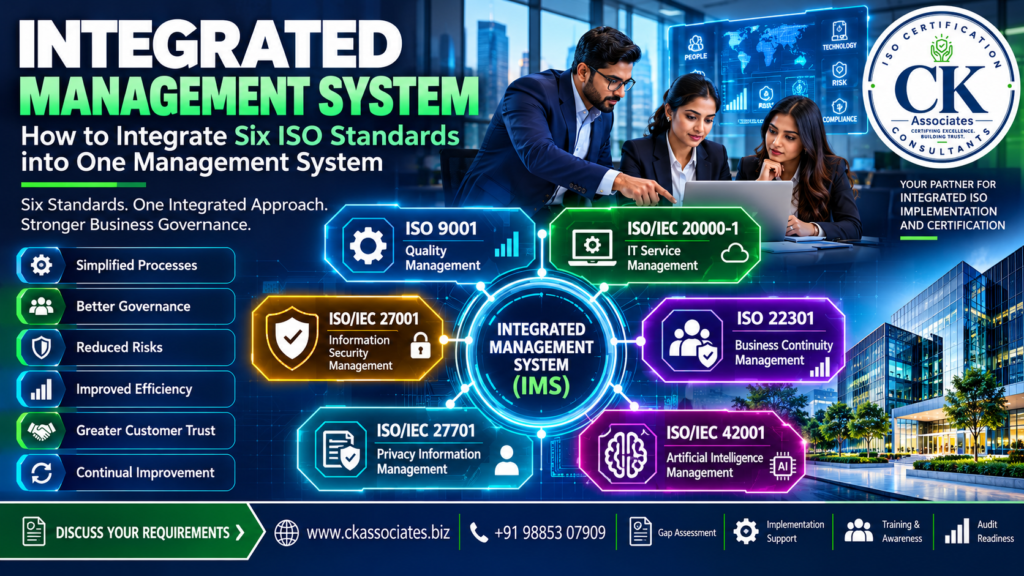
Facility management is connected to several other business functions. Depending on the organisation’s scope and requirements, ISO 41001 may be integrated with other management system standards.
| ISO standard | Management system | Possible area of integration |
|---|---|---|
| ISO 9001 | Quality Management | Service quality, customer satisfaction and process control |
| ISO 14001 | Environmental Management | Waste, environmental aspects and resource management |
| ISO 45001 | Occupational Health and Safety | Workplace safety and operational risk management |
| ISO 50001 | Energy Management | Energy performance and facility energy use |
| ISO 22301 | Business Continuity | Continuity of critical facility services |
| ISO/IEC 27001 | Information Security | Protection of facility-related information and systems |
Example: Integrating ISO 41001 with ISO 9001, ISO 14001 and ISO 45001
Consider an integrated facility management company providing services to a large commercial building.
The company may need to manage:
- Quality of housekeeping and maintenance services
- Environmental aspects such as waste and resource consumption
- Occupational health and safety risks for employees and contractors
- Facility management planning and service performance
These activities can be coordinated through an Integrated Management System.
However, each standard has its own requirements. Integration should be based on common processes while retaining the specific controls and records needed for each management system.
This can be particularly useful for facility management companies that provide multiple services under a single contract.
10. What is the ISO 41001 certification process?
ISO 41001 certification involves an assessment of the organisation’s Facility Management System against the applicable requirements of the standard.
A typical certification journey includes the following activities.
- Initial assessmentUnderstand the organisation’s facility management activities, existing processes and certification requirements.
- Gap assessmentIdentify gaps between existing arrangements and ISO 41001 requirements.
- ImplementationDevelop and implement the required management system processes.
- Internal auditEvaluate the effectiveness of the implemented system and identify nonconformities.
- Management reviewReview system performance, objectives, audit results and improvement opportunities.
- Certification auditA competent certification body assesses the system against the applicable standard and agreed scope. This generally involves Stage 1 and Stage 2 audit activities.
- Certification decisionThe certification body reviews the audit results and makes the certification decision.
Organisations should check that their selected certification body has the appropriate competence and accreditation scope for ISO 41001.
A certificate should clearly identify the organisation, certified scope and relevant sites or activities.
Certification does not mean that every individual building or contractor is automatically covered. The certificate scope and audit arrangements determine what has actually been assessed.
11. How long does ISO 41001 implementation take?
The time required depends on the size of the organisation, the number of facilities, the type of services provided and the maturity of existing processes.
The following is an indicative implementation plan.
| Implementation activity | Indicative duration |
|---|---|
| Initial discussion and scope finalisation | 1 week |
| Gap assessment | 1 to 2 weeks |
| Documentation development | 2 to 4 weeks |
| Process implementation and training | 3 to 6 weeks |
| Internal audit and corrective actions | 1 to 2 weeks |
| Management review and audit preparation | 1 week |
For an organisation with reasonably established facility management processes, implementation may take approximately 2 to 4 months.
Larger organisations, multiple locations, complex outsourced services or significant implementation gaps may require additional time.
These are planning estimates, not guaranteed certification timelines. The certification body’s audit schedule and certification decision process should be considered separately.
12. What determines the cost of ISO 41001 certification?
There is no single fixed cost for ISO 41001 implementation. The consulting effort and certification audit fees depend on the organisation’s requirements.
The main cost factors include:
1. Number of employees
The number of employees involved in facility management activities can affect training, implementation and audit requirements.
2. Number of locations
An organisation managing several buildings or sites may require additional assessment and implementation work.
3. Type of facility management services
A company providing only housekeeping services may have a different scope from an organisation managing building maintenance, utilities, security and multiple technical services.
4. Existing management systems
Organisations that already maintain structured processes or other ISO certifications may be able to reuse suitable arrangements after checking their adequacy.
5. Operational complexity
The nature of the facilities, contractors, assets and service requirements can affect the implementation effort.
6. Certification body fees
Audit charges depend on the certification scope, employee numbers, locations, audit duration and applicable certification arrangements.
The best approach is to conduct an initial gap assessment before preparing a project quotation.
13. What are the benefits of ISO 41001 certification?
A properly implemented Facility Management System can help organisations improve how they manage their facilities and supporting services.
Better control over facility services
Defined processes and responsibilities help ensure that facility-related activities are planned and monitored.
Improved service quality
Organisations can establish service requirements, monitor performance and address repeated service issues.
Better supplier management
Structured supplier evaluation and performance monitoring can improve the control of outsourced facility services.
Improved resource utilisation
Management can review how people, equipment, infrastructure and other resources are being used.
Better user satisfaction
Facility management services can be aligned with the needs of employees, customers, tenants and other building users.
Stronger risk management
Organisations can identify facility-related risks and establish appropriate actions to manage them.
Continual improvement
Performance monitoring, internal audits and corrective actions help organisations identify areas for improvement.
The value of certification comes from the effective implementation and ongoing maintenance of the system, not simply from obtaining the certificate.
14. ISO 41001 and climate action considerations
An important point for organisations planning ISO 41001 implementation is Amendment 1:2024, which introduced climate action changes to the standard.
The amendment requires organisations to consider whether climate change is a relevant issue in understanding their organisational context. It also highlights that interested parties may have climate-related requirements. Amendment 1: Climate action changes+1
For facility management organisations, relevant considerations may include:
- Extreme weather affecting building operations
- Water availability and usage
- Energy consumption
- Building temperature and cooling requirements
- Waste management
- Climate-related infrastructure risks
- Expectations from building owners and users
For example, a company managing multiple commercial buildings may need to consider how extreme heat or heavy rainfall could affect facility operations.
The organisation should assess whether these issues are relevant to its context and take appropriate action.
It should not assume that every organisation faces identical climate-related risks.
15. Why should Hyderabad organisations consider ISO 41001?
Hyderabad has a wide range of commercial buildings, IT parks, corporate offices, hospitals, educational institutions, manufacturing facilities and industrial establishments.
These organisations depend on facility services to maintain their workplaces and support daily operations.
Areas such as HITEC City, Gachibowli, Financial District, Madhapur, Uppal, Secunderabad and other commercial and industrial locations have organisations managing different types of facilities.
Facility management providers serving these organisations need to maintain consistent service delivery, manage contractors, monitor maintenance activities and respond to customer requirements.
For example, a facility management company providing services to an IT campus may be responsible for:
- Housekeeping and cleaning
- Electrical and mechanical maintenance
- HVAC maintenance coordination
- Security and access arrangements
- Utility monitoring
- Workplace support services
- Contractor coordination
- Facility inspection and reporting
As the number of services and customer locations increases, managing everything through informal arrangements becomes difficult.
ISO 41001 provides a structured management system approach that can help facility management organisations establish consistent processes and monitor service performance.
For companies operating in Hyderabad and across Telangana, this can also support a more organised approach to meeting customer expectations and managing service responsibilities.
16. How CK Associates supports ISO 41001 implementation
Implementing ISO 41001 requires an understanding of how facility management services are delivered, how contractors are managed and how operational performance is monitored.
At CK Associates, we support organisations in establishing and implementing ISO management systems based on their business requirements.
With more than 20 years of experience and 450+ certification projects, our consultancy approach focuses on developing management systems that are practical and suitable for daily operations.
Our ISO 41001 consultancy support includes:
- Initial discussion and requirement assessment
- Facility Management System scope finalisation
- Gap assessment against ISO 41001
- Facility management policy and objective development
- Documentation and procedure development
- Risk assessment support
- Operational process implementation
- Employee awareness and training
- Internal audit support
- Management review preparation
- Certification audit coordination
- Corrective action and audit readiness support
We work with facility management companies, corporate offices, IT parks, hospitals, manufacturing organisations and businesses that manage their own facilities.
Our objective is to help organisations establish a Facility Management System that supports their operations and can be maintained effectively.
Planning ISO 41001 certification for your organisation?
Whether you are a facility management service provider or an organisation managing your own facilities, a structured management system can help improve service delivery, accountability and operational control.
Contact CK Associates to discuss your ISO 41001 implementation requirements.
Let’s Discuss Your ISO 41001 Requirements
CK Associates
Your co-working partner for ISO management system implementation.
sirish.kaza@ckassociates.biz
+91 98853 07909
20+ Years of Experience | 450+ Certification Projects | PAN India Consultancy
17. Frequently Asked Questions about ISO 41001
1. What is ISO 41001 certification?
ISO 41001 certification demonstrates that an organisation’s Facility Management System has been independently assessed against the applicable requirements of ISO 41001. It covers how facility management activities are planned, delivered, monitored and improved within the certified scope.
2. Who can apply for ISO 41001 certification?
Facility management companies, integrated facility management providers, commercial building operators, hospitals, IT parks, manufacturing organisations and other businesses managing facility-related services can consider ISO 41001 certification.
3. Is ISO 41001 applicable to facility management companies in India?
Yes. ISO 41001 is an international management system standard and can be applied by suitable organisations in India, subject to their activities and certification scope.
4. Is ISO 41001 only for housekeeping and maintenance companies?
No. Its application is wider than housekeeping and maintenance. It can cover the management of different facility-related services, infrastructure, workplace support and external service providers.
5. What is the latest published version of ISO 41001?
The published requirements standard is ISO 41001:2018, together with Amendment 1:2024 on climate action changes. A revised draft, ISO/DIS 41001, is under development. Organisations should check the official ISO status before starting a new implementation or certification transition. Amendment 1: Climate action changes+1
6. What is a Facility Management System?
A Facility Management System is a structured framework for planning, delivering, controlling, monitoring and improving the services and processes that support an organisation’s facilities and workplace requirements.
7. What documents are required for ISO 41001?
Depending on the organisation’s scope, documentation may include the facility management policy, system scope, objectives, risk assessments, operational procedures, maintenance records, supplier evaluation records, competence records, performance reports, internal audit reports and management review records.
8. Does ISO 41001 require preventive maintenance?
The organisation needs to establish appropriate operational arrangements to manage facility services and meet defined requirements. Preventive maintenance may be an important part of those arrangements, depending on the facilities, assets and services within its scope.
9. Can ISO 41001 be integrated with ISO 9001, ISO 14001 and ISO 45001?
Yes. Organisations can integrate common management system processes while retaining the specific requirements of each standard. This can be useful for facility management providers handling quality, environmental and occupational health and safety responsibilities.
10. How long does ISO 41001 implementation take?
For an organisation with reasonably established processes, implementation may take approximately 2 to 4 months. The actual duration depends on employee strength, service complexity, number of locations and existing management system maturity.
11. Is ISO 41001 certification mandatory in India?
ISO 41001 is generally a voluntary management system certification. However, customers, contracts or business requirements may make certification necessary for particular organisations or service arrangements.
12. Does ISO 41001 certification guarantee better facility management?
Certification alone does not guarantee operational performance. The benefits depend on how effectively the organisation implements, maintains and continually improves its Facility Management System.
13. Can an organisation outsource facility management and still implement ISO 41001?
Yes. Facility services may be delivered internally, externally or through a combination of both. The organisation should establish appropriate arrangements to manage service requirements, responsibilities and external providers.
14. What is the difference between ISO 41001 and ISO 9001?
ISO 9001 focuses on quality management across an organisation’s products and services. ISO 41001 focuses specifically on the management of facility-related activities and services. They can be implemented together where appropriate.
15. How can CK Associates help with ISO 41001 certification?
CK Associates supports organisations through gap assessment, scope definition, documentation, implementation guidance, employee training, internal audit support, management review preparation and certification audit coordination.
Conclusion: Make facility management a structured business function
Facility management plays an important role in supporting the day-to-day operations of an organisation.
Whether it is a corporate office, hospital, IT park, manufacturing plant or commercial building, facilities need proper planning, maintenance, service coordination and performance monitoring.
ISO 41001 provides a management framework to bring these activities under a structured system.
For facility management companies, it can help establish consistent service processes and better supplier management. For organisations managing their own buildings, it can support improved control over facility services and workplace requirements.
The real value of ISO 41001 is not simply obtaining a certificate. It is establishing a Facility Management System that supports business objectives, meets user requirements and improves the way facilities are managed.
If your organisation is planning ISO 41001 certification, start with a review of your existing facility management processes and identify where improvements are required.
CK Associates can support your organisation from the initial gap assessment through implementation and certification audit preparation.
About the author
Sirish K is the Founder and Lead ISO Consultant at CK Associates, Hyderabad. With more than 20 years of experience in ISO management system consultancy and 450+ certification projects, he supports organisations in establishing, implementing and improving management systems across multiple industries.
His areas of work include Quality Management, Environmental Management, Occupational Health and Safety, Information Security, IT Service Management, Business Continuity, Privacy Information Management, AI Management and Integrated Management Systems.