

ISO 9001:2026 is now published. For organisations already certified to ISO 9001:2015, the next important step is understanding the revised requirements and reviewing how their existing Quality Management System needs to adapt.
The publication of ISO 9001:2026 on 16 September 2026 marks an important update to the world’s most widely used Quality Management System standard.
For many organisations, ISO 9001 has been part of their business operations for years. They have established quality policies, documented procedures, internal audit programmes, corrective action processes and management reviews.
But business requirements are changing.
Customers expect consistent quality and better service. Supply chains are becoming more complex. Organisations are adopting new technologies, changing their processes and managing different types of operational risks.
In this environment, a Quality Management System should do more than maintain documentation and prepare an organisation for an external audit. It should support management decisions, encourage employee involvement and help the business improve its performance.
The new edition builds on the established ISO 9001 framework while providing clearer requirements and greater emphasis on areas such as leadership, quality culture, ethical behaviour, risk and opportunity management.
For organisations planning their activities in 2027, understanding these changes should be an important management priority.
At CK Associates, we believe businesses should approach this revision as an opportunity to review the effectiveness of their existing QMS rather than treating it as another documentation exercise.
In this article, we explain five important areas of ISO 9001:2026 and what organisations should start reviewing.
What is new in ISO 9001:2026?
ISO 9001:2026 is the sixth edition of the Quality Management Systems requirements standard. It replaces ISO 9001:2015, including Amendment 1:2024.
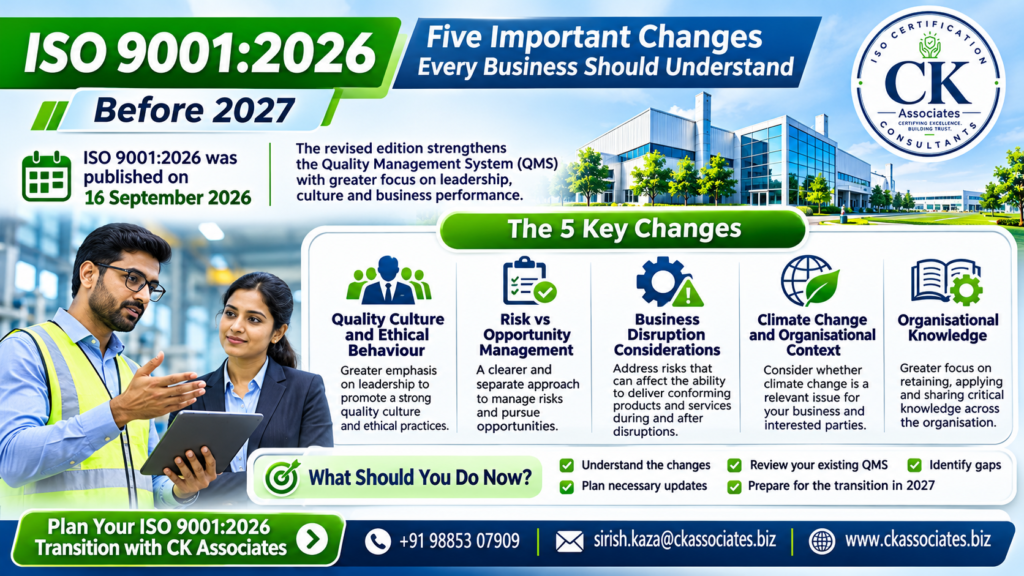
The revised edition builds on the existing Quality Management System framework. It provides greater clarity and emphasis on leadership, quality culture, ethical behaviour, risk and opportunity management, and the application of requirements.
Five important areas businesses should understand are:
- Quality culture and ethical behaviour as part of leadership responsibility.
- A clearer distinction between risks and opportunities.
- Greater consideration of risks associated with business disruption.
- Climate change as a relevant consideration when reviewing organisational context.
- A clearer approach to organisational knowledge and its effective use.
The objective is to help organisations maintain an effective QMS that supports customer satisfaction, business performance and continual improvement.
1. ISO 9001:2026 and the changing approach to Quality Management
Before discussing the individual changes, it is important to understand why ISO 9001 continues to evolve.
ISO 9001:2015 introduced a strong emphasis on process-based management, risk-based thinking, leadership involvement and continual improvement.
These principles remain important in the 2026 edition.
However, organisations now operate in an environment where quality performance is influenced by several factors.
Consider a manufacturing company supplying components to automotive or engineering customers.
Its ability to deliver conforming products depends on:
- Competent employees.
- Reliable machinery and infrastructure.
- Consistent production processes.
- Approved suppliers.
- Effective inspection and testing.
- Customer requirement management.
- Process monitoring.
- Timely corrective actions.
- Management decisions.
A failure in any one of these areas can affect product quality and customer satisfaction.
The revised edition reinforces the need to understand how the Quality Management System contributes to the overall performance of the organisation.
It encourages businesses to look beyond the existence of procedures and consider whether leadership, employees and operational processes are genuinely supporting quality objectives.
This is an important point for organisations that have maintained ISO 9001 certification for several years.
A QMS should not become a collection of documents that is reviewed only before surveillance audits. It should remain part of the way the organisation manages its business.
2. Change One: Greater emphasis on quality culture and ethical behaviour
One of the important changes in ISO 9001:2026 relates to leadership and its responsibility for promoting quality culture and ethical behaviour.
Quality has always been a management responsibility. However, the revised edition gives clearer attention to how leadership influences the behaviour and working practices of an organisation.
What is quality culture?
Quality culture refers to the shared values, attitudes and established practices that influence how people approach quality in their daily work.
It is not limited to displaying a quality policy on an office notice board.
It can be seen in the way employees:
- Follow approved procedures.
- Report problems honestly.
- Avoid bypassing quality controls.
- Take responsibility for their work.
- Handle customer complaints.
- Identify process improvement opportunities.
- Prevent nonconforming products from reaching customers.
For example, consider a manufacturing organisation where production targets are given higher priority than product quality.
Employees may continue production even when they identify a process deviation because they are concerned about delays or management pressure.
This creates a quality risk.
An organisation with a stronger quality culture encourages employees to report problems, follow established controls and take appropriate action without hiding issues.
What is ethical behaviour in quality management?
Ethical behaviour is important when employees and management make decisions that affect product and service conformity.
Practical examples include:
- Reporting actual inspection results.
- Maintaining accurate production records.
- Avoiding manipulation of test reports.
- Reporting product defects.
- Following customer specifications.
- Ensuring that nonconforming products are properly controlled.
- Maintaining transparency during customer complaints and audits.
These practices help build confidence in the organisation’s QMS.
What should top management review?
Businesses should consider the following questions:
- Does management actively promote quality in daily operations?
- Do employees understand their responsibility for product and service quality?
- Are employees encouraged to report quality problems?
- Are inspection and testing records maintained accurately?
- Are quality requirements considered when setting production targets?
- Does management review recurring quality issues?
- Are ethical practices reflected in organisational procedures and behaviour?
Practical recommendation: Existing ISO 9001-certified organisations should review their leadership practices, employee awareness programmes, quality policy communication and management review arrangements.
The objective is not to prepare a separate quality culture document simply for an audit. The objective is to make quality an integral part of business decisions.
3. Change Two: Clearer distinction between risk and opportunity management
Risk-based thinking has been an important part of ISO 9001:2015.
Organisations are expected to identify risks and opportunities that need to be addressed to ensure that the QMS achieves its intended results.
The 2026 comparison gives greater clarity to the separate consideration of risks and opportunities.
The relevant provisions distinguish between:
- Determining risks and opportunities.
- Actions to address risks.
- Actions to address opportunities.
This distinction is important because managing a risk and pursuing an opportunity are not necessarily the same activity.
Understanding risk management
A risk is a potential issue that may affect the organisation’s ability to achieve its intended results.
For example, a manufacturing company may identify:
- Supplier delays.
- Equipment breakdowns.
- Shortage of skilled employees.
- Incorrect product specifications.
- Inspection failures.
- Customer requirement changes.
- Production process deviations.
The organisation should evaluate relevant risks and determine appropriate actions.
Understanding opportunity management
Opportunities relate to situations that may help the organisation achieve better results.
For example:
- Introducing automated inspection systems.
- Improving production planning.
- Developing new supplier relationships.
- Reducing process variation.
- Improving employee skills.
- Using digital quality monitoring.
- Improving product design and development processes.
These opportunities should not simply remain as suggestions in a meeting.
The organisation should evaluate relevant opportunities, decide which ones are suitable to pursue, plan actions and review whether the intended results have been achieved.
Practical example: A manufacturing company
Consider an engineering company supplying precision components to industrial customers.
Its risk assessment identifies that manual inspection is causing delays and inconsistent inspection results.
The company may identify two related actions.
Risk-related action:
Review the inspection process, employee competence and inspection equipment to reduce the possibility of incorrect acceptance or rejection.
Opportunity-related action:
Evaluate whether digital inspection equipment or automated measurement systems can improve accuracy and reduce inspection time.
Both actions support quality performance, but they address different management considerations.
What should businesses review?
Existing organisations should examine whether their risk assessment process gives sufficient attention to opportunities.
A practical review may include:
- Existing risk registers.
- Opportunity identification records.
- Risk evaluation methods.
- Opportunity evaluation criteria.
- Action plans.
- Assigned responsibilities.
- Effectiveness monitoring.
- Management review inputs.
Practical recommendation: Do not simply rename your existing risk register as a risk and opportunity register. Review whether risks and opportunities are actually being identified, evaluated and addressed through suitable actions.
4. Change Three: Greater attention to business disruption and operational risks
Businesses depend on people, infrastructure, suppliers, equipment, technology and operational processes to deliver conforming products and services.
A disruption affecting any of these areas can create problems for the QMS.
Consider a manufacturing company that depends on a single supplier for an important raw material.
If the supplier experiences an unexpected interruption, the organisation may face:
- Production delays.
- Shortage of raw materials.
- Changes in production schedules.
- Delayed customer deliveries.
- Increased procurement costs.
- Difficulty meeting customer requirements.
Similarly, a machinery breakdown or IT system interruption may affect production, inspection, traceability and service delivery.
The comparison document identifies greater attention to risks associated with disruptions and the ability to provide conforming products and services during and after such events.
What should an organisation consider?
Businesses should review the risks that may affect their ability to maintain product and service conformity.
Some examples include:
Supplier disruptions
What happens if a critical supplier cannot deliver materials on time?
Equipment failure
Are there arrangements to manage unexpected breakdowns of important machinery?
Employee unavailability
Can the organisation maintain essential processes when key employees are unavailable?
Information system interruptions
What happens if production, quality or order management systems become unavailable?
Infrastructure problems
Can the organisation manage disruptions affecting electricity, water, communication or other essential facilities?
Unexpected changes in customer requirements
Can the organisation review and respond to changes without affecting conformity?
Practical example: Supplier disruption
An organisation manufacturing electrical components receives critical materials from a limited number of suppliers.
A sudden interruption affects material availability.
If the company has not evaluated alternative sources or established suitable arrangements, production may stop.
The organisation should review the relevant risk, determine appropriate actions and monitor whether those actions are effective.
This may involve supplier evaluation, alternative sourcing arrangements, inventory planning or other controls appropriate to its operations.
What should businesses review?
- Operational risk assessments.
- Supplier evaluation procedures.
- Critical supplier records.
- Production continuity arrangements.
- Equipment maintenance planning.
- Infrastructure-related risks.
- Emergency response arrangements, where relevant.
- Management review inputs.
Practical recommendation: Review whether your existing risk assessment considers disruptions that could affect your ability to meet customer and applicable requirements.
ISO 9001 should not be treated as a substitute for a dedicated Business Continuity Management System. Organisations with more extensive continuity requirements may also consider ISO 22301.
5. Change Four: Climate change and organisational context
Climate change was already introduced into the ISO management system context framework through the 2024 climate action amendments.
The 2026 edition carries this consideration forward within the revised standard.
This is important because organisations should understand whether climate change is a relevant issue affecting their business context and whether relevant interested parties have climate-related requirements.
The requirement does not mean that every organisation must establish a separate environmental management system or automatically introduce a climate action programme under ISO 9001.
The organisation needs to determine relevance based on its own context.
How can climate change affect quality management?
Consider a food processing company operating in a region where extreme temperatures and water availability may affect production.
Potential effects may include:
- Changes in raw material availability.
- Storage and temperature control challenges.
- Increased cooling requirements.
- Water supply interruptions.
- Transportation delays.
- Changes in supplier performance.
- Risks affecting product conformity.
A manufacturing company may also need to consider whether extreme weather conditions can affect infrastructure, employee availability or delivery schedules.
For some organisations, climate change may not significantly affect the ability to provide conforming products and services. However, the organisation should make its relevance determination based on its context and applicable interested-party requirements.
What should organisations review?
- Internal and external issues.
- Relevant interested-party requirements.
- Supplier and supply chain risks.
- Infrastructure and operational vulnerabilities.
- Customer expectations.
- Existing risk assessment records.
- Management review considerations.
Practical recommendation: Review your existing organisational context document and determine whether climate-related issues have been considered appropriately. Record the reasoning and update the assessment when relevant circumstances change.
6. Change Five: Organisational knowledge and its importance in business operations
Knowledge is an important resource for every organisation.
A business may have experienced employees, technical specialists, production supervisors, quality inspectors and service professionals who understand how important processes are performed.
However, organisations sometimes depend too heavily on individual employees.
When an experienced employee resigns, retires or moves to another role, important operational knowledge may be lost.
The comparison document gives greater attention to retaining, applying and sharing organisational knowledge.
It also highlights the need to acquire additional knowledge and update existing knowledge as business needs and trends change.
What is organisational knowledge?
Organisational knowledge includes information and experience required to operate processes and achieve product and service conformity.
Examples include:
- Production methods.
- Technical specifications.
- Inspection techniques.
- Product design knowledge.
- Customer-specific requirements.
- Equipment operating knowledge.
- Process troubleshooting experience.
- Lessons learned from previous nonconformities.
- Supplier-related technical information.
- Knowledge of applicable processes and controls.
Practical example: Knowledge loss in manufacturing
Consider a manufacturing company where one senior production supervisor has been handling a specialised process for several years.
The supervisor understands the machine settings, process limitations and common production problems.
However, this knowledge has not been properly documented or shared with other employees.
If the supervisor becomes unavailable, the organisation may experience production delays, increased defects or difficulties maintaining process consistency.
The organisation should identify important knowledge, retain it appropriately and ensure that relevant employees can access and apply it.
How can organisations manage knowledge?
Businesses can consider:
Process documentation
Maintain appropriate work instructions and technical procedures.
Training and knowledge sharing
Ensure employees receive the necessary knowledge to perform their responsibilities.
Lessons learned
Record important learning from customer complaints, process failures and corrective actions.
Technical records
Maintain relevant product specifications, machine settings, inspection methods and process information.
Knowledge transfer
Establish suitable arrangements when employees change roles or leave the organisation.
External knowledge
Identify and obtain relevant information from customers, suppliers, industry sources and technical experts.
What should organisations review?
- Existing knowledge management practices.
- Training and competence arrangements.
- Process documentation.
- Technical records.
- Employee experience and skills.
- Lessons learned.
- Knowledge transfer arrangements.
Practical recommendation: Organisations should identify processes where important knowledge is concentrated in a small number of employees and establish suitable methods to retain and share that knowledge.
7. What has changed in the broader ISO 9001:2026 framework?
The five areas above are important, but businesses should not ignore other changes and clarifications in the revised edition.
Your uploaded comparison document identifies additional changes across several clauses.
| Clause or area | Comparison highlights | What organisations should review |
|---|---|---|
| Introduction | Greater emphasis on establishing and implementing a QMS and sustained success | Overall QMS purpose and business relevance |
| Clause 3 | Updated and expanded terminology | Understanding of terms and definitions |
| Clause 4 | Context and interested-party considerations | Context and interested-party records |
| Clause 5 | Quality culture and ethical behaviour | Leadership and employee awareness |
| Clause 6.1 | Separate treatment of risks and opportunities | Risk and opportunity assessment |
| Clause 6.3 | Expanded change planning considerations | Change management process |
| Clause 7.1.6 | Greater attention to organisational knowledge | Knowledge retention and sharing |
| Clause 8 | Operational requirements and supporting explanations | Process controls and operational evidence |
| Clause 9 | Performance evaluation provisions and explanatory clarifications | Monitoring, measurement and audit arrangements |
| Clause 10 | Continual improvement provisions integrated into 10.1 | Improvement processes and corrective action |
The comparison also identifies a revised informative Annex A that provides clarification of the structure, terminology and clauses.
Annex A is explanatory. It does not create additional requirements.
These changes should be understood in the context of the complete published standard rather than treated as isolated additions to a documentation checklist.
8. Does ISO 9001:2026 mean organisations must rebuild their existing QMS?
No. Organisations should not assume that they need to start from zero.
ISO 9001:2026 builds on the established Quality Management System framework.
Existing organisations should first understand their current system, identify what already works and review the areas where changes may be needed.
For example, an organisation may already have:
- A documented quality policy.
- Defined process responsibilities.
- An established risk assessment.
- Internal audit arrangements.
- Management review procedures.
- Corrective action processes.
- Employee training programmes.
- Supplier evaluation procedures.
These arrangements may continue to be useful.
However, the organisation should review whether they adequately address the revised requirements.
A structured gap assessment is a sensible starting point.
ISO 9001:2015 vs ISO 9001:2026: Practical comparison
| Existing QMS area | What to review for the 2026 edition |
|---|---|
| Leadership | Promotion of quality culture and ethical behaviour |
| Quality policy | Alignment with organisational context and strategic direction |
| Risk management | Separate consideration of risks and opportunities |
| Business operations | Risks affecting conformity during disruptions |
| Organisational context | Relevance of climate change and interested-party requirements |
| Knowledge management | Retaining, applying and sharing organisational knowledge |
| Change management | Expanded planning and review considerations |
| Corrective action | Updated wording and clarity around nonconformity analysis |
| Continual improvement | Revised structure and integration within Clause 10.1 |
The purpose is to identify actual gaps, not to revise every document unnecessarily.
9. What should ISO 9001:2015-certified organisations do in 2027?
For existing certified organisations, 2027 should be a year of understanding, assessment and planned preparation.
Management should not wait until the final transition deadline to begin reviewing the new edition.
A practical approach can be divided into the following stages.
Stage 1: Understand the revised standard
Obtain and review the official ISO 9001:2026 edition.
Management representatives, quality managers and internal auditors should understand the revised requirements and identify the areas that may affect existing processes.
Stage 2: Conduct a preliminary gap assessment
Compare the existing QMS with the new edition.
Review the quality policy, risk assessment, opportunity management, leadership arrangements, organisational knowledge, change management and other relevant processes.
Stage 3: Involve top management
Explain the changes to management and discuss their possible effect on business operations.
Quality management should not be treated as the responsibility of the quality department alone.
Stage 4: Update relevant processes
Identify the procedures, formats and records that need modification.
Changes should be based on actual gaps and applicable requirements.
Stage 5: Train employees
Provide awareness and training to relevant employees, process owners and internal auditors.
Employees should understand how the revised requirements relate to their responsibilities.
Stage 6: Implement and monitor changes
Implement the necessary changes and maintain suitable evidence.
Review whether the revised processes are working effectively.
Stage 7: Conduct internal audit and management review
Evaluate the updated QMS against the applicable requirements.
Record findings, address nonconformities and review the effectiveness of actions.
Stage 8: Coordinate the certification transition
Discuss the transition arrangements and timing with the organisation’s certification body.
The organisation should plan the transition audit in line with the applicable accreditation and certification requirements.
10. What is the ISO 9001:2026 transition timeline?
ISO 9001:2026 was published on 16 September 2026.
The transition arrangements published by Global Accreditation Cooperation Incorporated provide a three-year transition period for accredited certification.
The key dates include:
| Milestone | Date |
|---|---|
| ISO 9001:2026 publication | 16 September 2026 |
| Accreditation bodies ready to assess the revised standard | No later than 31 March 2027 |
| Accredited certification bodies submit transition declarations and supporting information | 30 June 2027 |
| Accreditation body transition decisions completed | 30 September 2027 |
| New and initial accredited certifications to be issued only to ISO 9001:2026 | From 31 March 2028 |
| Final transition deadline for existing ISO 9001:2015-certified organisations | 30 September 2029 |
Existing certified organisations should coordinate their transition plans with their certification bodies.
The transition may be conducted alongside a scheduled surveillance or recertification audit, or through a separate transition audit, depending on the applicable arrangements.
Businesses should not confuse the transition deadline with the date by which they must immediately complete every QMS update.
A planned approach will help organisations avoid unnecessary last-minute pressure.
11. How CK Associates can support ISO 9001:2026 transition preparation
At CK Associates, we support organisations in establishing, implementing and improving ISO management systems according to their business requirements.
With more than 20 years of experience and 450+ certification projects, our focus is on helping businesses develop practical management systems that can be maintained as part of their daily operations.
For ISO 9001:2026, our support can include:
1. Initial discussion and requirement assessment
Understand the organisation’s current certification status, QMS scope, business activities and transition objectives.
2. ISO 9001:2026 gap assessment
Review the existing QMS against the applicable requirements of the revised edition.
3. Documentation review
Identify policies, procedures, formats and records that may need revision.
4. Risk and opportunity management
Support the organisation in reviewing its existing approach to risks, opportunities and relevant operational disruptions.
5. Leadership and quality culture
Support management awareness and review of quality culture, ethical behaviour and leadership responsibilities.
6. Organisational knowledge review
Identify important organisational knowledge and review how it is retained, applied and shared.
7. Employee awareness and training
Provide relevant awareness and training to employees, process owners and internal auditors.
8. Implementation support
Guide the organisation in implementing identified changes and maintaining suitable evidence.
9. Internal audit support
Evaluate the effectiveness of the updated QMS and identify areas requiring further attention.
10. Certification transition coordination
Support audit readiness and coordinate with the organisation regarding its certification body arrangements.
Our approach is to build on the existing QMS wherever possible and focus on the changes that are genuinely required.
12. Frequently Asked Questions about ISO 9001:2026
1. When was ISO 9001:2026 published?
ISO 9001:2026 was published on 16 September 2026. It is the sixth edition of the Quality Management Systems requirements standard.
2. Does ISO 9001:2026 replace ISO 9001:2015?
Yes. ISO 9001:2026 replaces ISO 9001:2015, including Amendment 1:2024.
3. What are the major changes in ISO 9001:2026?
Important areas include stronger emphasis on leadership, quality culture and ethical behaviour, clearer distinction between risks and opportunities, business disruption considerations, organisational knowledge and revised explanatory guidance.
4. Is ISO 9001:2026 a completely new management system?
No. It builds on the established ISO 9001 framework. Existing organisations should review their current QMS and make necessary changes rather than assume that the entire system must be rebuilt.
5. Is quality culture a new consideration in ISO 9001:2026?
The revised edition gives explicit attention to promoting quality culture and ethical behaviour as part of leadership responsibility. Organisations should review how these expectations are reflected in management practices and employee awareness.
6. What is the difference between risk and opportunity management?
Risk management focuses on addressing situations that could negatively affect intended results. Opportunity management focuses on identifying and pursuing situations that may produce beneficial results.
The revised edition gives clearer separate treatment to these considerations.
7. Does ISO 9001:2026 require a separate business continuity management system?
ISO 9001:2026 addresses relevant risks that may affect an organisation’s ability to provide conforming products and services during and after disruptions. It does not automatically require every organisation to obtain ISO 22301 certification.
8. Does ISO 9001:2026 include climate change requirements?
Climate change remains a relevant consideration when determining organisational context and interested-party requirements. Organisations should determine whether it is relevant to their QMS.
9. What is organisational knowledge?
Organisational knowledge is the knowledge necessary for the operation of processes and for achieving product and service conformity. Organisations should consider how important knowledge is retained, applied, shared and updated.
10. Will ISO 9001:2015-certified companies need to update their documentation?
Organisations should review their existing documented information and update it where necessary to address applicable requirements. A complete rewrite of all QMS documents should not be assumed.
11. What is the final transition deadline for ISO 9001:2026?
The published transition arrangements provide a final transition deadline of 30 September 2029 for existing ISO 9001:2015-certified organisations under the applicable accredited certification transition framework. Organisations should confirm the arrangements with their certification bodies.
12. Can organisations continue using their existing ISO 9001:2015 QMS during transition preparation?
Organisations can continue operating their existing QMS while planning and implementing the necessary changes within the applicable transition arrangements. They should coordinate their transition timing with their certification body.
13. Should internal auditors receive ISO 9001:2026 training?
Yes. Relevant internal auditors should understand the revised requirements and be competent to evaluate the updated QMS.
14. How long does ISO 9001:2026 transition preparation take?
The duration depends on the organisation’s size, activities, QMS maturity, number of locations and the gaps identified during assessment. A gap assessment is the best starting point for preparing a realistic plan.
15. How can CK Associates help with ISO 9001:2026?
CK Associates can support organisations through gap assessment, documentation review, process updates, employee awareness, implementation guidance, internal audit support and certification transition preparation.
Conclusion: 2027 should be a year of preparation and improvement
ISO 9001:2026 is an important update to the Quality Management System framework.
For businesses already certified to ISO 9001:2015, the next step should not be to replace all existing documentation or immediately rebuild their management systems.
Instead, organisations should understand the revised requirements, evaluate their existing processes and identify where improvements are necessary.
The greater attention to leadership, quality culture, ethical behaviour, risk and opportunity management, business disruption and organisational knowledge provides an opportunity to make the QMS more relevant to actual business operations.
In 2027, organisations should focus on understanding the revised standard, involving management, reviewing their existing QMS and planning the necessary changes.
The real objective should be to maintain a Quality Management System that supports customer satisfaction, consistent product and service conformity and better business performance.
ISO 9001:2026 is not just about updating a certificate. It is about keeping your Quality Management System relevant to the way your business operates today and in the future.
If your organisation is currently certified to ISO 9001:2015, this is a good time to start reviewing your existing QMS.
Contact CK Associates to discuss your ISO 9001:2026 gap assessment and transition preparation requirements.
Website: https://ckassociates.biz
Email: sirish.kaza@ckassociates.biz
Phone: +91 98853 07909
CK Associates: Your co-working partner for ISO management system implementation.
About the Author
Sirish K is the Founder and Lead ISO Consultant at CK Associates, Hyderabad. With more than 20 years of experience in ISO management system consultancy and 450+ certification projects, he supports organisations in establishing, implementing and improving management systems across multiple industries.
His areas of work include Quality Management, Environmental Management, Occupational Health and Safety, Information Security, IT Service Management, Business Continuity, Privacy Information Management, AI Management and Integrated Management Systems.
Website: https://ckassociates.biz