
Introduction
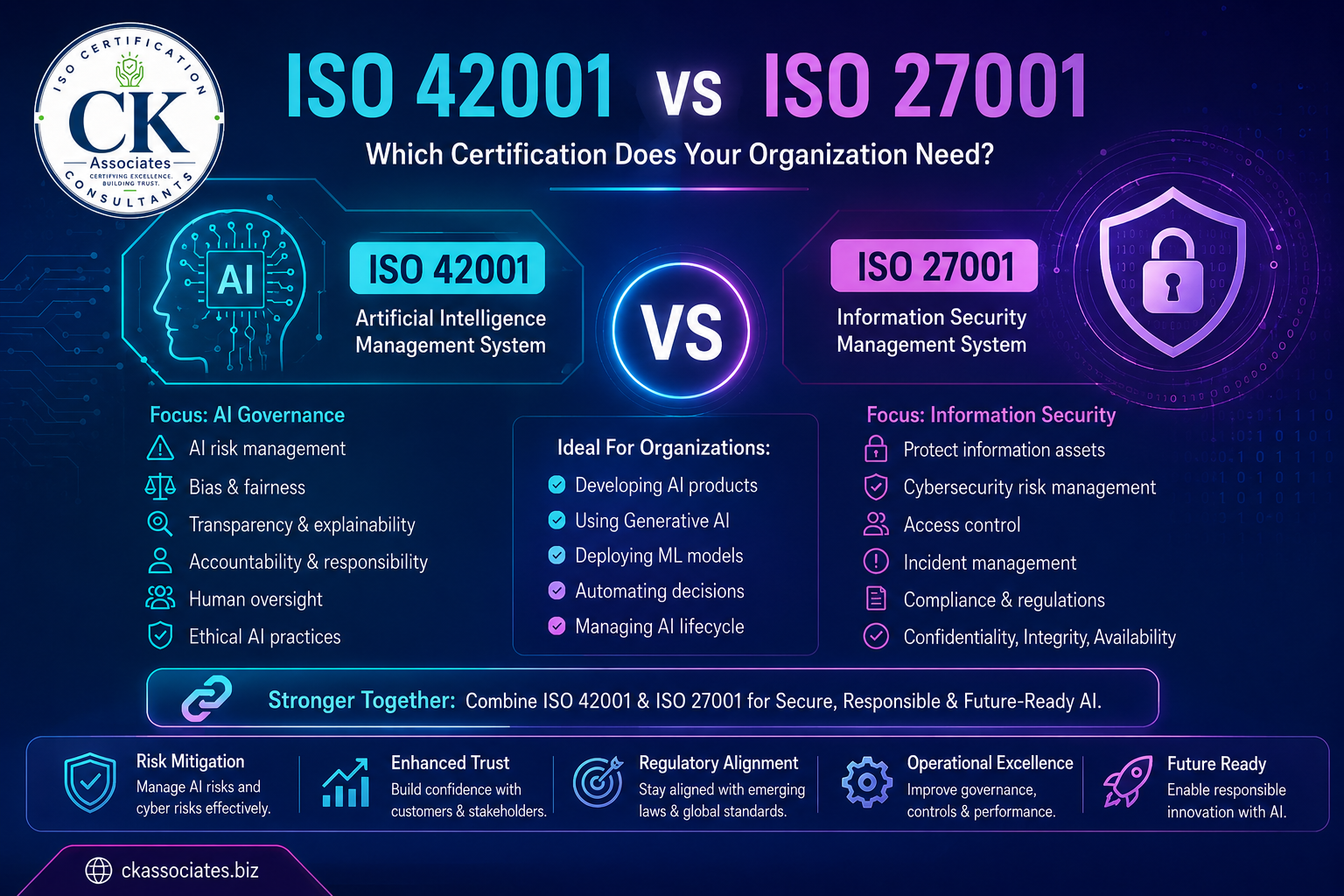
Organizations adopting artificial intelligence often assume that ISO 27001 alone is sufficient to manage AI-related risks. While ISO 27001 provides a strong framework for information security management, it does not fully address AI-specific concerns such as bias, transparency, accountability, explainability, and ethical decision-making. ISO 42001 was developed specifically to govern Artificial Intelligence Management Systems (AIMS). According to CK Associates, Hyderabad, organizations using AI should understand that ISO 27001 and ISO 42001 serve different but complementary purposes. The right choice depends on whether the primary objective is information security, AI governance, or both.
How Should You Compare ISO 42001 and ISO 27001?
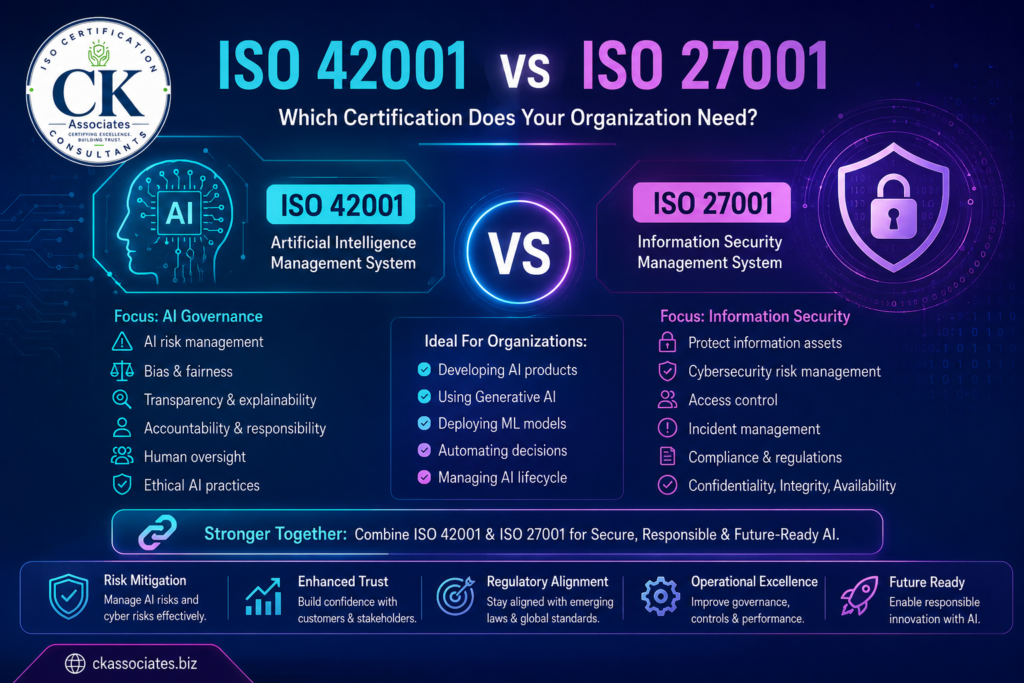
ISO 27001 focuses on protecting information assets through an Information Security Management System (ISMS).
ISO 42001 focuses on governing the responsible development, deployment, operation, and monitoring of Artificial Intelligence systems through an Artificial Intelligence Management System (AIMS).
A simple comparison:
| Area | ISO 27001 | ISO 42001 |
|---|---|---|
| Primary Focus | Information Security | AI Governance |
| Risk Type | Cybersecurity Risk | AI Risk |
| Objective | Protect Information | Govern AI Systems |
| Data Security | Strong Focus | Partial Focus |
| AI Transparency | Limited | Strong Focus |
| AI Ethics | Not Core Requirement | Core Requirement |
| Bias Management | Not Covered | Covered |
| Accountability | Security Accountability | AI Accountability |
| Suitable For | All Organizations | Organizations Using AI |
Key Takeaways
- ISO 27001 protects information and cybersecurity assets.
- ISO 42001 governs AI systems and AI risks.
- Organizations using AI may require both standards.
- ISO 27001 does not fully address AI ethics and transparency.
- ISO 42001 does not replace information security controls.
- AI governance and cybersecurity are increasingly interconnected.
- Combining both standards creates a stronger governance framework.
Why Are Organizations Confusing ISO 42001 and ISO 27001?
The confusion often arises because both standards involve risk management, governance, and technology.
However, they address different questions.
ISO 27001 asks:
“How do we protect information assets from threats and vulnerabilities?”
ISO 42001 asks:
“How do we govern AI systems responsibly and manage AI-specific risks?”
A company deploying generative AI may have excellent cybersecurity controls while still facing significant AI governance risks such as biased outputs, lack of explainability, inaccurate recommendations, or regulatory challenges.
This is why AI governance has emerged as a separate management discipline.
What Is the Primary Purpose of ISO 27001?
ISO 27001 establishes an Information Security Management System (ISMS).
Its purpose is to protect:
- Customer information
- Intellectual property
- Financial information
- Employee data
- Business-critical information
The standard addresses:
- Access controls
- Incident management
- Supplier security
- Asset management
- Risk assessment
- Security awareness
- Business continuity support
Organizations implementing ISO 27001 seek to reduce cybersecurity risks and strengthen stakeholder confidence.
According to ISO Survey data, ISO 27001 remains one of the world’s most widely adopted information security standards.
What Is the Primary Purpose of ISO 42001?
ISO 42001 establishes an Artificial Intelligence Management System (AIMS).
Its purpose is to ensure AI technologies are developed and operated responsibly.
The standard addresses:
- AI governance
- AI transparency
- AI accountability
- AI risk assessment
- AI lifecycle management
- Bias management
- Ethical considerations
- Human oversight
Unlike ISO 27001, ISO 42001 focuses specifically on the consequences and governance of AI-driven decisions.
As organizations increasingly deploy generative AI, machine learning, and intelligent automation, ISO 42001 provides a structured governance framework.
What Risks Does ISO 27001 Address?
ISO 27001 primarily addresses:
Cybersecurity Risks
Examples include:
- Malware attacks
- Ransomware
- Data breaches
- Unauthorized access
- Insider threats
Information Risks
Examples include:
- Data loss
- Data corruption
- Confidentiality breaches
- Regulatory violations
The objective is maintaining:
- Confidentiality
- Integrity
- Availability
of information assets.
What Risks Does ISO 42001 Address?
ISO 42001 focuses on AI-specific risks.
Examples include:
Algorithmic Bias
AI systems may generate unfair outcomes for certain groups.
Lack of Transparency
Organizations may struggle to explain how AI decisions are made.
Model Drift
AI models can become less accurate over time.
Ethical Concerns
Organizations must consider societal and stakeholder impacts.
Accountability Challenges
Clear ownership for AI outcomes must be established.
These risks often exist even when cybersecurity controls are functioning effectively.
When Should Organizations Choose ISO 27001?
ISO 27001 should be prioritized when organizations:
- Handle sensitive customer information
- Process financial information
- Operate cloud services
- Manage healthcare data
- Support enterprise customers
- Face cybersecurity requirements
Many procurement teams now require ISO 27001 before entering commercial discussions.
For most organizations, ISO 27001 remains a foundational governance standard.
When Should Organizations Choose ISO 42001?
ISO 42001 should be considered when organizations:
- Develop AI products
- Deploy AI solutions internally
- Use Generative AI extensively
- Build Machine Learning systems
- Automate critical decisions
- Operate AI-driven platforms
Examples include:
- AI startups
- SaaS companies
- FinTech organizations
- Healthcare technology providers
- HR technology platforms
As AI regulations continue evolving globally, demand for AI governance assurance is increasing.
Can Organizations Implement Both Standards Together?
Absolutely.
In fact, many organizations will benefit from implementing both.
ISO 27001 provides:
- Security governance
- Information protection
- Cybersecurity controls
ISO 42001 provides:
- AI governance
- Responsible AI practices
- Transparency mechanisms
- AI accountability frameworks
Together they create a comprehensive governance model for modern digital organizations.
At CK Associates, Hyderabad, we increasingly see AI-driven organizations pursuing integrated ISO 27001 and ISO 42001 implementation programs.
Key Differences Between ISO 42001 and ISO 27001
| Area | ISO 27001 | ISO 42001 |
|---|---|---|
| Management System | ISMS | AIMS |
| Primary Goal | Protect Information | Govern AI |
| Main Risk | Cyber Risk | AI Risk |
| Security Controls | Extensive | Limited |
| AI Controls | Limited | Extensive |
| Bias Management | No | Yes |
| Explainability | No | Yes |
| AI Lifecycle Governance | No | Yes |
| Human Oversight | Limited | Required |
| Suitable for AI Companies | Helpful | Essential |
How Difficult Is It to Implement ISO 42001 Compared to ISO 27001?
Implementation complexity depends on organizational maturity, risk profile, and technology usage.
Organizations implementing ISO 27001 typically focus on establishing controls for:
- Information security governance
- Risk assessment
- Access management
- Incident management
- Supplier security
- Business continuity support
The primary challenge involves identifying information assets, assessing threats, implementing controls, and creating a security-focused culture.
ISO 42001 introduces a different set of challenges.
Organizations must understand:
- AI lifecycle governance
- AI accountability
- Bias management
- Explainability requirements
- Human oversight mechanisms
- Ethical AI considerations
- AI risk assessment methodologies
For organizations already operating mature governance frameworks, ISO 42001 can often be integrated efficiently alongside ISO 27001.
At CK Associates, Hyderabad, we frequently observe that organizations with established ISO 27001 systems adapt more quickly to ISO 42001 because they already understand governance, risk management, internal audits, and continual improvement principles.
How Long Does Certification Typically Take?
Implementation timelines vary according to organizational size and maturity.
Typical ISO 27001 Timeline
Most organizations require:
- Gap Analysis: 1–2 weeks
- Documentation: 3–6 weeks
- Implementation: 6–12 weeks
- Internal Audit & Management Review: 2–4 weeks
- Certification Audit: 2–4 weeks
Typical project duration:
3–6 months
Typical ISO 42001 Timeline
Most organizations require:
- AI Governance Assessment: 1–2 weeks
- AI Risk Assessment: 2–4 weeks
- Documentation Development: 3–6 weeks
- Implementation: 6–12 weeks
- Internal Audit & Review: 2–4 weeks
- Certification Audit: 2–4 weeks
Typical project duration:
3–6 months
Organizations with complex AI environments may require additional time for governance maturity development.
What Does Certification Cost?
Certification costs vary based on:
- Number of employees
- Organizational complexity
- Number of locations
- Existing management systems
- Scope of implementation
For consulting projects, the total investment generally includes:
- Gap Analysis
- Documentation Development
- Training
- Implementation Support
- Internal Audit
- Certification Preparation
At CK Associates, project pricing is determined based on actual implementation scope rather than generic package pricing. Organizations pursuing both ISO 27001 and ISO 42001 together often achieve implementation efficiencies through shared governance activities.
Which Industries Should Prioritize ISO 27001?
ISO 27001 is particularly valuable for:
SaaS Companies
Customer contracts increasingly require information security assurance.
Managed Service Providers
Service providers handling customer infrastructure must demonstrate security controls.
Healthcare Organizations
Protection of patient information remains a critical requirement.
Financial Services
Cybersecurity expectations continue to increase globally.
Educational Institutions
Student information and research data require protection.
Manufacturing Organizations
Intellectual property protection is becoming increasingly important.
Across India, procurement teams frequently use ISO 27001 certification as a qualification requirement during vendor evaluations.
Which Industries Should Prioritize ISO 42001?
ISO 42001 becomes increasingly relevant when AI influences decisions, operations, or customer outcomes.
AI Startups
Organizations developing AI products require governance structures from the beginning.
SaaS Platforms
Many software platforms are integrating generative AI capabilities.
Healthcare Technology Providers
AI-assisted diagnostics and clinical support systems require oversight.
FinTech Organizations
AI-driven lending, fraud detection, and analytics introduce governance risks.
HR Technology Platforms
AI-assisted recruitment and workforce analytics require bias management.
Educational Technology Providers
AI-driven learning systems increasingly require transparency and accountability.
Organizations deploying AI at scale should view governance as a strategic business requirement rather than a future consideration.
Can ISO 42001 Replace ISO 27001?
No.
This is one of the most common misconceptions.
ISO 42001 does not replace information security governance.
An organization could have excellent AI governance while still experiencing:
- Data breaches
- Cyberattacks
- Ransomware incidents
- Unauthorized access
- Supplier security failures
Similarly, an organization could have strong cybersecurity controls while facing:
- AI bias
- Lack of transparency
- Poor AI accountability
- Regulatory challenges
- Ethical concerns
The standards address different risk categories.
Most AI-driven organizations eventually benefit from implementing both frameworks.
What Happens When Organizations Implement Both Standards Together?
Organizations that integrate ISO 27001 and ISO 42001 often achieve stronger governance outcomes.
Combined implementation enables:
- Unified risk management
- Integrated internal audits
- Common management reviews
- Shared leadership oversight
- Consolidated documentation
- Reduced implementation duplication
The result is a governance framework capable of addressing both cybersecurity risks and AI governance risks.
This approach is becoming increasingly attractive for organizations pursuing digital transformation initiatives.
Real-World Business Scenario
A Hyderabad-based SaaS company was developing AI-powered analytics solutions for enterprise customers.
The organization initially pursued ISO 27001 because customers requested information security assurance during procurement evaluations.
During implementation, leadership identified additional concerns:
- AI transparency
- Model accountability
- Algorithmic bias
- Customer trust
- Regulatory preparedness
Rather than building separate governance structures, the organization integrated ISO 42001 requirements into its existing management framework.
The combined approach improved customer confidence, simplified governance oversight, and positioned the organization for future AI regulatory requirements.
This reflects a broader market trend where cybersecurity and AI governance are becoming increasingly interconnected.
Why Is Governance Becoming More Important Than Compliance?
Many organizations historically viewed certification as a compliance activity.
That mindset is changing.
Customers, regulators, investors, and business partners increasingly want evidence of governance maturity.
They want assurance that organizations can:
- Protect information
- Manage risks
- Govern AI responsibly
- Demonstrate accountability
- Maintain resilience
Certification serves as evidence of those capabilities.
Organizations that view ISO standards as governance frameworks rather than audit requirements often realize significantly greater long-term value.
Across CK Associates’ implementation experience, governance-focused organizations consistently achieve stronger operational performance than organizations pursuing certification solely to obtain a certificate.
ISO 27001 Consultants Hyderabad
→ Service page for Information Security Management System implementation.
ISO 42001 Consultants India
→ AI Management System implementation page.
ISO 9001 vs ISO 27001
→ Comparative certification guide.
Integrated Management System Implementation
→ IMS pillar page.
ISO Certification Cost in Hyderabad
→ Cost and budgeting guide.
How Long Does ISO Certification Take?
→ Certification timeline article.
Why Trust This Guidance?
CK Associates has successfully supported more than 450 ISO certification projects across India over the last 20+ years.
Our implementation experience includes:
- 400+ ISO 9001 implementations
- 25+ ISO 27001 implementations
- 4+ ISO 42001 implementations
- 45+ ISO 14001 implementations
- 45+ ISO 45001 implementations
We have worked with organizations across Manufacturing, IT & SaaS, Artificial Intelligence, Healthcare, Education, Engineering, Retail, Logistics, and Startup sectors.
Every recommendation in this article is based on practical implementation experience gained through real certification projects rather than theoretical interpretation of ISO requirements. Our experience across Hyderabad, Telangana, Andhra Pradesh, and India provides insight into how cybersecurity governance and AI governance operate in real business environments.
About the Author
Sirish K is the Founder and Lead ISO Consultant at CK Associates, based in Hyderabad, Telangana. With more than 20 years of ISO consulting experience and over 450 successful certification projects, he has guided organizations across manufacturing, IT, SaaS, healthcare, education, engineering, AI, retail, and startup sectors through the implementation of internationally recognized management systems. His implementation work includes ISO 9001, ISO 27001, ISO 14001, ISO 45001, ISO 42001, and CMMI, with a consistent focus on governance maturity, operational excellence, and sustainable compliance systems.
Frequently Asked Questions
What is the biggest difference between ISO 42001 and ISO 27001?
The biggest difference is their primary focus. ISO 27001 establishes an Information Security Management System (ISMS) designed to protect information assets from cybersecurity threats and security incidents. ISO 42001 establishes an Artificial Intelligence Management System (AIMS) designed to govern AI systems responsibly, addressing issues such as transparency, accountability, bias, fairness, and human oversight.
Do organizations using Artificial Intelligence need both ISO 42001 and ISO 27001?
In many cases, yes. ISO 27001 protects the information used by AI systems, while ISO 42001 governs how AI systems are designed, deployed, monitored, and controlled. Together, they create a comprehensive governance framework that addresses both cybersecurity and AI-related risks.
Is ISO 42001 mandatory for AI companies?
ISO 42001 is currently a voluntary standard. However, as AI regulations continue to evolve globally, many organizations are adopting ISO 42001 proactively to demonstrate responsible AI governance, improve stakeholder confidence, and prepare for future regulatory expectations.
Which certification should a SaaS company implement first?
The answer depends on business priorities. If customers are requesting evidence of cybersecurity controls, ISO 27001 should typically be prioritized. If AI functionality plays a significant role in products or services, organizations should evaluate ISO 42001 alongside ISO 27001. Many SaaS companies eventually benefit from implementing both standards.
Can ISO 42001 and ISO 27001 be audited together?
Yes. Because both standards follow the Annex SL structure, organizations can integrate many governance activities, internal audits, management reviews, and certification processes. An integrated approach often improves efficiency and reduces duplication.
How long does it take to achieve ISO 27001 certification?
For most organizations, implementation typically takes between three and six months. The timeline depends on organizational size, existing controls, management commitment, and implementation resources. Organizations with mature governance systems often complete certification more quickly.
How long does it take to achieve ISO 42001 certification?
Most organizations require three to six months for implementation. AI-intensive organizations may require additional time to establish governance mechanisms, risk assessment processes, bias management controls, and accountability frameworks.
Does ISO 42001 include cybersecurity requirements?
ISO 42001 addresses AI governance and AI risk management, but it does not replace a comprehensive information security framework. Organizations requiring strong cybersecurity controls should consider ISO 27001 in addition to ISO 42001.
Which industries benefit most from ISO 42001?
Industries that rely heavily on Artificial Intelligence typically gain the greatest value. These include AI startups, SaaS companies, healthcare technology providers, financial technology organizations, educational technology providers, data analytics firms, and organizations deploying machine learning systems for decision-making.
Why are procurement teams increasingly interested in ISO 42001?
Customers increasingly want assurance that AI systems are governed responsibly. Procurement teams are beginning to evaluate how organizations manage AI risks, accountability, transparency, bias, and regulatory compliance. ISO 42001 provides independent evidence that an organization has established a structured AI governance framework.
Can CK Associates help implement both ISO 27001 and ISO 42001?
Yes. CK Associates, Hyderabad, supports organizations through gap analysis, governance framework development, documentation, implementation, training, internal audits, management reviews, and certification preparation. Our experience spans information security management, AI governance, integrated management systems, and multi-standard certification projects across India.
Conclusion
ISO 42001 and ISO 27001 are not competing standards. They address different governance challenges that increasingly coexist within modern organizations. ISO 27001 protects information assets and strengthens cybersecurity resilience, while ISO 42001 governs the responsible development, deployment, and management of Artificial Intelligence systems.
Organizations using AI should view these standards as complementary rather than mutually exclusive. As AI adoption expands across industries, integrating AI governance with information security governance provides a stronger foundation for risk management, stakeholder confidence, regulatory preparedness, and sustainable business growth.
According to CK Associates, Hyderabad, organizations that proactively establish both cybersecurity and AI governance frameworks are better positioned to meet future business, customer, and regulatory expectations while maintaining operational excellence and trust.