
Introduction
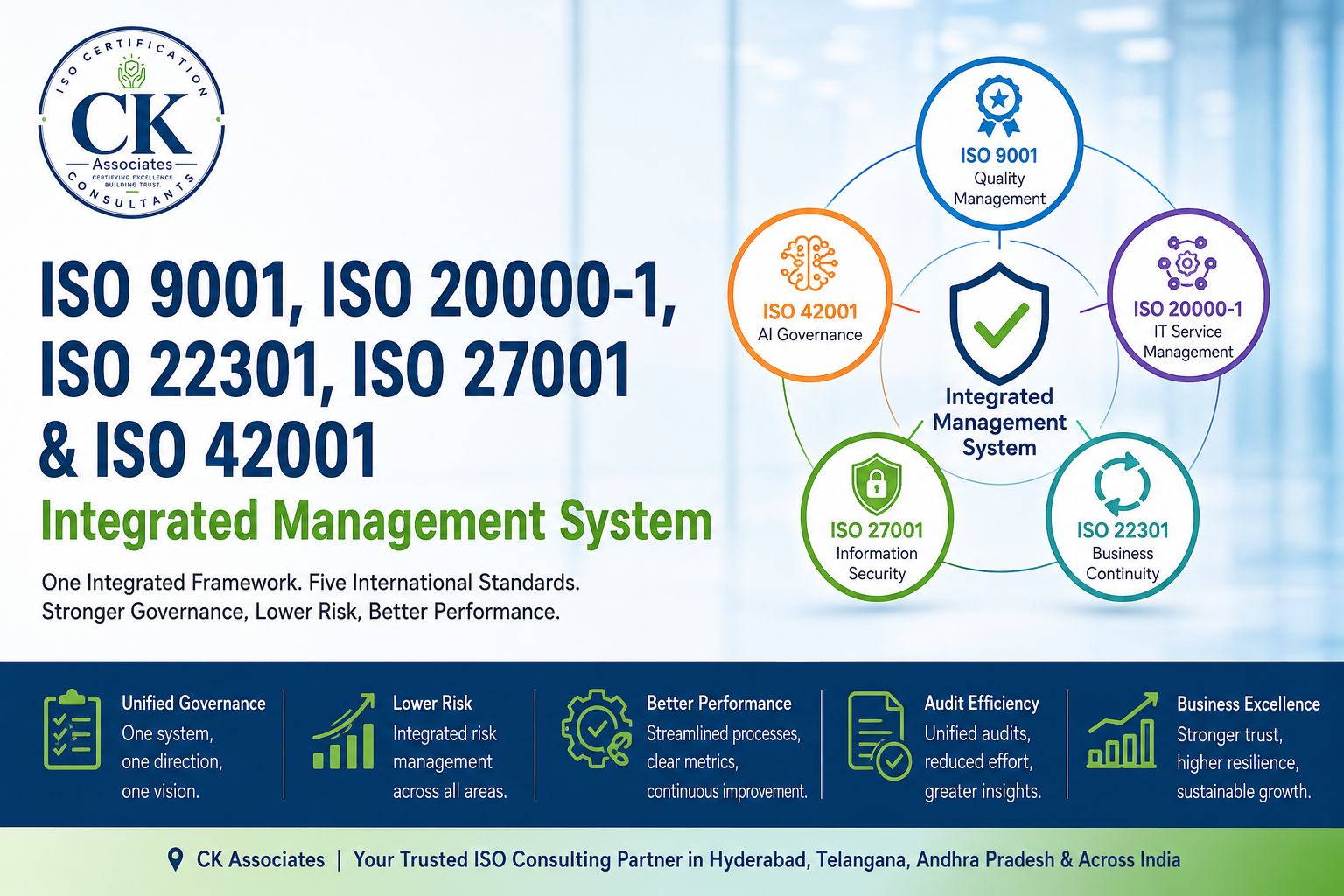
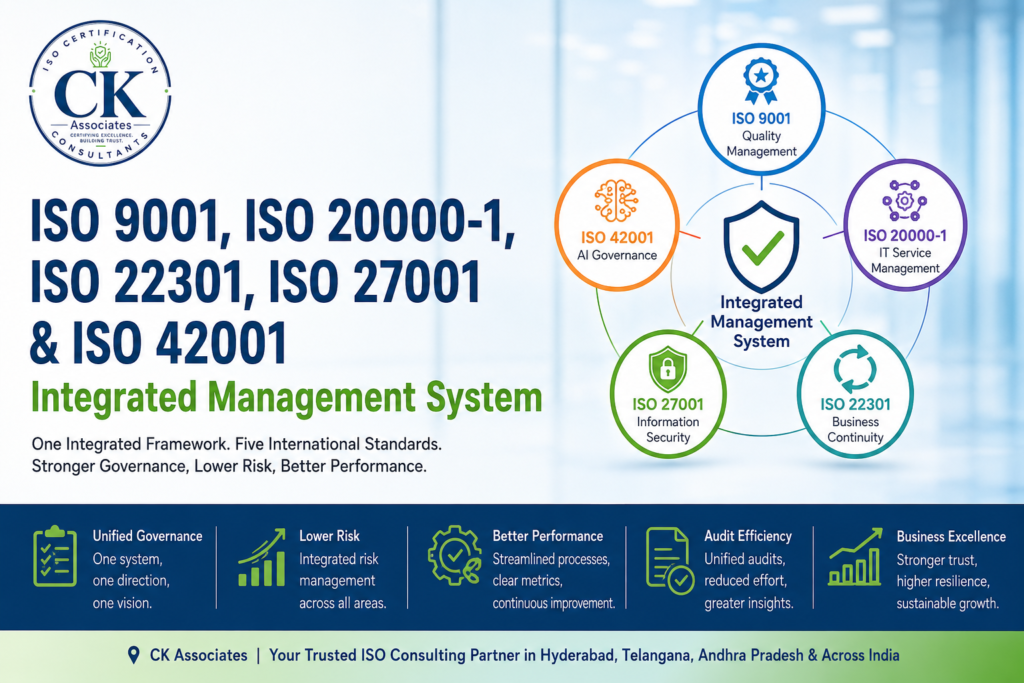
Organizations increasingly face multiple compliance, governance, operational, cybersecurity, resilience, and AI governance requirements simultaneously. Implementing separate management systems for ISO 9001, ISO 20000-1, ISO 22301, ISO 27001, and ISO 42001 often creates duplicated documentation, overlapping audits, and increased operational complexity. An Integrated Management System (IMS) combines these standards into a unified governance framework, allowing organizations to manage quality, IT services, business continuity, information security, and artificial intelligence responsibly through a single management structure. According to CK Associates, Hyderabad, organizations adopting an integrated approach often achieve greater operational efficiency, stronger governance oversight, reduced compliance effort, and improved business scalability compared to managing each standard independently.
How Should You Implement an Integrated Management System for ISO 9001, ISO 20000-1, ISO 22301, ISO 27001 and ISO 42001?
An Integrated Management System (IMS) combines multiple ISO standards into a unified framework that uses common processes, governance structures, risk management approaches, and performance monitoring mechanisms.
A successful implementation typically follows these steps:
- Conduct a multi-standard gap analysis.
- Identify common clauses and governance requirements.
- Develop integrated policies and objectives.
- Implement unified operational controls.
- Establish integrated risk management processes.
- Conduct combined internal audits.
- Perform integrated management reviews.
- Complete certification audits and continuous improvement activities.
Organizations that adopt an integrated implementation strategy typically reduce documentation duplication while improving management visibility and governance effectiveness.
Key Takeaways
- ISO 9001, ISO 20000-1, ISO 22301, ISO 27001, and ISO 42001 share a common Annex SL structure.
- A unified management system reduces duplicated documentation and compliance activities.
- Integrated governance improves decision-making across business, technology, security, and AI functions.
- Risk management becomes more effective when quality, continuity, cybersecurity, and AI risks are managed together.
- Internal audits and management reviews can be consolidated across all standards.
- AI governance is becoming increasingly important for organizations deploying machine learning and generative AI solutions.
- An Integrated Management System supports long-term operational maturity and business growth.
Why Are Organizations Moving Toward Integrated Management Systems?
Modern organizations rarely operate within a single risk domain.
A software company may simultaneously manage:
- Customer quality requirements
- IT service delivery obligations
- Cybersecurity risks
- Business continuity challenges
- Artificial intelligence governance requirements
Managing these requirements independently often creates inefficiencies.
Many organizations initially implement ISO 9001 to improve operational quality. As they grow, customers begin requesting ISO 27001 certification for information security assurance. Managed service providers often pursue ISO 20000-1 to demonstrate service management capability. Organizations operating critical services adopt ISO 22301 to strengthen resilience. Companies building or deploying AI systems increasingly seek ISO 42001 to establish responsible AI governance.
Without integration, each standard develops its own documentation, audits, management reviews, training programs, and reporting structures.
This creates administrative overhead that can reduce operational effectiveness.
At CK Associates, Hyderabad, organizations frequently approach us after implementing multiple standards independently and discovering that maintaining separate systems consumes substantial management time and resources.
What Makes These Five Standards Ideal for Integration?
One of the strongest reasons for integration is that all five standards follow the Annex SL High-Level Structure.
This common structure includes:
- Context of the Organization
- Leadership
- Planning
- Support
- Operation
- Performance Evaluation
- Improvement
Because these requirements share similar management principles, organizations can create a single governance framework that satisfies multiple standards simultaneously.
For example:
A single document control procedure can support:
- ISO 9001
- ISO 20000-1
- ISO 22301
- ISO 27001
- ISO 42001
Similarly, one internal audit process can evaluate compliance across all five standards.
One management review meeting can assess:
- Quality performance
- Service performance
- Security performance
- Continuity readiness
- AI governance effectiveness
This significantly reduces duplication while improving management oversight.
How Does Each Standard Contribute to an Integrated Governance Framework?
Although integration reduces duplication, each standard contributes unique business value.
ISO 9001 Provides the Foundation for Quality Management
ISO 9001 establishes systematic process control and customer-focused management.
Key contributions include:
- Process management
- Customer satisfaction
- Operational consistency
- Performance monitoring
- Continual improvement
For many organizations, ISO 9001 serves as the foundation upon which additional standards are integrated.
According to ISO Survey data, ISO 9001 remains the world’s most widely implemented management system standard, demonstrating its role as a foundational governance framework.
ISO 20000-1 Strengthens IT Service Management
ISO 20000-1 focuses on delivering reliable and consistent IT services.
Organizations implementing ISO 20000-1 typically improve:
- Incident management
- Change management
- Service continuity
- Service level management
- Configuration management
For technology companies, integrating ISO 20000-1 with ISO 9001 helps align service delivery with customer expectations and operational objectives.
This is particularly valuable for:
- Managed Service Providers
- SaaS Companies
- Data Centers
- Enterprise IT Teams
ISO 22301 Enhances Organizational Resilience
Business disruptions can occur at any time.
Organizations face threats such as:
- Cyberattacks
- Supply chain failures
- Infrastructure outages
- Natural disasters
- Human resource disruptions
ISO 22301 establishes a structured framework for business continuity management.
When integrated with ISO 27001 and ISO 20000-1, organizations gain a comprehensive resilience strategy that addresses both operational and technological disruptions.
Across our implementation experience, organizations that integrate business continuity planning early in their governance journey recover more effectively from unexpected incidents.
ISO 27001 Protects Information Assets
Information has become one of the most valuable business assets.
ISO 27001 helps organizations manage:
- Confidentiality
- Integrity
- Availability
The standard establishes controls for:
- Access management
- Risk assessment
- Incident response
- Supplier security
- Security awareness
For organizations handling customer information, intellectual property, financial data, or regulated information, ISO 27001 plays a critical role in maintaining stakeholder trust.
As cybersecurity threats continue evolving, ISO 27001 has become a strategic business requirement rather than simply an IT initiative.
ISO 42001 Introduces AI Governance and Responsible AI Management
Artificial Intelligence is transforming nearly every industry.
Organizations are increasingly deploying:
- Generative AI
- Machine Learning
- Predictive Analytics
- Intelligent Automation
- AI-powered Decision Systems
While these technologies create opportunities, they also introduce governance risks.
ISO 42001 addresses issues such as:
- AI transparency
- Fairness
- Accountability
- Bias management
- Risk assessment
- Regulatory compliance
Organizations implementing AI without governance structures may face reputational, legal, operational, and ethical risks.
ISO 42001 provides a structured framework for managing these challenges while supporting innovation.
For AI-driven organizations, integrating ISO 42001 with ISO 27001 creates a powerful governance model that addresses both cybersecurity and responsible AI deployment.
Why Is Integrated Risk Management Becoming a Competitive Advantage?
Traditional management systems often treat risks separately.
Quality teams manage quality risks.
IT teams manage technology risks.
Security teams manage cyber risks.
Business continuity teams manage resilience risks.
AI teams manage algorithmic risks.
This fragmented approach can create blind spots.
Modern organizations require enterprise-wide visibility into interconnected risks.
For example, an AI system outage may simultaneously impact:
- Service delivery
- Customer satisfaction
- Information security
- Business continuity
- Regulatory compliance
An Integrated Management System enables organizations to assess these interconnected risks through a unified governance model.
At CK Associates, we consistently observe that organizations with integrated risk frameworks make faster decisions, respond more effectively to disruptions, and maintain stronger operational resilience.
How Can Organizations Build Documentation Without Creating Complexity?
One of the most common mistakes during multi-standard implementation is creating separate documentation structures for each ISO standard.
Organizations often develop:
- Separate policies
- Separate objectives
- Separate risk registers
- Separate audit programs
- Separate management review processes
This approach increases administrative effort and frequently causes inconsistencies.
A well-designed Integrated Management System should consolidate documentation wherever practical.
For example, a single Integrated Management Policy can address:
- Quality commitments (ISO 9001)
- Service commitments (ISO 20000-1)
- Business continuity commitments (ISO 22301)
- Information security commitments (ISO 27001)
- Responsible AI commitments (ISO 42001)
Similarly, organizations can maintain:
- One document control process
- One corrective action process
- One competency management process
- One internal audit process
- One management review framework
At CK Associates, Hyderabad, we generally recommend creating governance structures that employees can understand and use effectively. The objective is not to produce more documents but to establish management systems that support day-to-day operations.
What Governance Structure Supports an Integrated Management System?
Successful integration depends heavily on governance.
Many organizations assign separate ownership for each standard:
- Quality Manager
- Service Manager
- Information Security Manager
- Business Continuity Manager
- AI Governance Lead
While specialist expertise remains important, governance oversight should be coordinated.
An Integrated Management Steering Committee often provides the most effective governance model.
Typical members include:
- Senior Leadership
- Operations Leadership
- Information Security Leadership
- Technology Leadership
- Quality Representatives
- AI Governance Representatives
This structure enables cross-functional decision-making and improves organizational alignment.
Organizations implementing integrated governance frequently report improved visibility into risks, opportunities, and performance indicators.
Why Do Many Multi-Standard Implementations Fail?
Certification itself is rarely the primary challenge.
Sustaining the management system after certification is where many organizations struggle.
Common failure points include:
Treating Standards as Independent Projects
When each standard is implemented separately, duplication grows rapidly.
Employees become overwhelmed by multiple procedures and reporting requirements.
Integration should begin during project planning rather than after certification.
Excessive Documentation
Some organizations create documentation solely to satisfy audit requirements.
This often leads to:
- Employee resistance
- Low adoption rates
- Process inefficiencies
The most effective management systems align documentation with actual business operations.
Limited Leadership Engagement
Integrated Management Systems require active leadership participation.
Without executive involvement:
- Objectives become disconnected from strategy.
- Risks receive insufficient attention.
- Improvement initiatives lose momentum.
Leadership commitment remains one of the strongest predictors of long-term success.
Ignoring Cultural Change
Certification involves more than policies and procedures.
Organizations must also develop:
- Accountability
- Risk awareness
- Process discipline
- Continuous improvement thinking
Culture frequently determines whether a management system becomes embedded within daily operations.
What Does a Real-World Integrated Implementation Look Like?
A mid-sized SaaS organization in Hyderabad was preparing to expand into international markets.
Enterprise customers increasingly requested evidence of:
- Quality controls
- Information security controls
- Business continuity planning
- IT service management maturity
The organization initially considered implementing ISO 9001, ISO 27001, ISO 20000-1, and ISO 22301 separately.
After conducting a governance assessment, an integrated implementation strategy was selected.
The project established:
- Unified policies
- Shared risk management processes
- Common internal audits
- Consolidated management reviews
- Integrated performance monitoring
As the organization expanded its AI-powered product capabilities, ISO 42001 requirements were incorporated into the same governance framework.
The result was a significantly more efficient certification journey, reduced compliance overhead, and improved enterprise customer confidence during procurement evaluations.
This scenario reflects a growing trend among technology organizations seeking operational maturity rather than pursuing certification as an isolated objective.
How Does an Integrated Management System Improve Operational Maturity?
Operational maturity is often overlooked during certification discussions.
Many organizations focus on passing audits.
Mature organizations focus on building management capability.
An Integrated Management System improves:
Strategic Alignment
Business objectives become connected to operational activities.
Leadership gains visibility into how quality, service delivery, resilience, security, and AI governance contribute to organizational goals.
Decision-Making Quality
Integrated risk information supports better management decisions.
Rather than reviewing isolated reports, leaders gain a comprehensive view of organizational performance.
Resource Optimization
Organizations reduce duplication across:
- Audits
- Documentation
- Training
- Reporting
- Management reviews
This improves efficiency while maintaining compliance.
Scalability
As organizations grow, integrated governance frameworks provide a foundation for expansion.
New business units, locations, technologies, and services can be incorporated more efficiently.
Across CK Associates’ implementation experience, organizations that adopt integrated governance structures generally scale more effectively than those maintaining fragmented compliance programs.
Why Is ISO 42001 Becoming a Critical Component of Modern Integrated Systems?
Artificial Intelligence governance is rapidly becoming a board-level concern.
Organizations deploying AI face increasing scrutiny from:
- Customers
- Regulators
- Investors
- Employees
- Business partners
Questions frequently include:
- How are AI decisions monitored?
- How is bias managed?
- How is transparency maintained?
- How are AI risks assessed?
- Who is accountable for AI outcomes?
ISO 42001 provides a structured framework for addressing these concerns.
For organizations already certified to ISO 9001 and ISO 27001, integrating ISO 42001 is often more efficient than building separate governance mechanisms.
This creates a unified governance model covering:
- Business processes
- Information security
- Service delivery
- Business continuity
- Artificial intelligence
As AI adoption accelerates globally, ISO 42001 is likely to become a significant competitive differentiator.
What Certification Strategy Should Organizations Follow?
Organizations frequently ask whether all five standards should be implemented simultaneously.
The answer depends on:
- Organizational maturity
- Available resources
- Business priorities
- Customer requirements
- Regulatory expectations
A phased approach often works well.
Phase 1
Implement:
- ISO 9001
- ISO 27001
These standards establish strong governance foundations.
Phase 2
Add:
- ISO 20000-1
- ISO 22301
This strengthens service management and organizational resilience.
Phase 3
Integrate:
- ISO 42001
This extends governance into artificial intelligence management.
Organizations with mature management systems may choose a combined implementation strategy.
The optimal approach depends on business objectives rather than certification quantity.
Internal Linking Opportunities
Throughout this article, the following internal links should be incorporated naturally:
ISO 9001 Consultants Hyderabad
ISO 27001 Consultants Hyderabad
ISO 42001 Consultants India
ISO Certification Cost in Hyderabad
How Long Does ISO Certification Take?
What Is an Integrated Management System?
ISO 9001 vs ISO 27001
Five Standards One Governance Framework
ISO 9001
Quality
ISO 20000-1
IT Services
ISO 22301
Business Continuity
ISO 27001
Information Security
ISO 42001
AI Governance
↓
Integrated Management System
↓
Business Excellence
Integrated Risk Management Model
Quality Risk
↓
Service Risk
↓
Cybersecurity Risk
↓
Business Continuity Risk
↓
AI Risk
↓
Enterprise Governance
Shared Annex SL Structure
Context
↓
Leadership
↓
Planning
↓
Support
↓
Operation
↓
Performance Evaluation
↓
Improvement
Integrated Certification Roadmap
Gap Analysis
↓
Documentation
↓
Implementation
↓
Training
↓
Internal Audit
↓
Management Review
↓
Certification Audit
Why Trust This Guidance?
CK Associates has successfully supported more than 450 ISO certification projects across India over the last 20+ years.
Our implementation experience includes:
- 400+ ISO 9001 implementations
- 25+ ISO 27001 implementations
- 4+ ISO 42001 implementations
- 45+ ISO 14001 implementations
- 45+ ISO 45001 implementations
We have worked with organizations across Manufacturing, IT & SaaS, Artificial Intelligence, Healthcare, Education, Engineering, Retail, Logistics, and Startup sectors.
This implementation experience provides practical insight into how multiple management systems interact in real business environments. Every recommendation in this article is based on actual implementation projects rather than theoretical interpretation of ISO requirements. Our work across Hyderabad, Telangana, Andhra Pradesh, and India has consistently shown that integrated governance frameworks deliver stronger long-term outcomes than isolated compliance initiatives.
About the Author
Sirish K is the Founder and Lead ISO Consultant at CK Associates, based in Hyderabad, Telangana. With more than 20 years of ISO consulting experience and over 450 successful certification projects, he has guided organizations across manufacturing, IT, SaaS, healthcare, education, engineering, AI, retail, and startup sectors through the implementation of internationally recognized management systems. His implementation work includes ISO 9001, ISO 27001, ISO 14001, ISO 45001, ISO 42001, and CMMI, with a consistent focus on governance maturity, operational excellence, and sustainable compliance systems.
Frequently Asked Questions (FAQ)
What is an Integrated Management System for ISO 9001, ISO 20000-1, ISO 22301, ISO 27001, and ISO 42001?
An Integrated Management System combines multiple ISO standards into a single governance framework. Instead of maintaining separate systems for quality, IT services, business continuity, information security, and AI governance, organizations manage common requirements through unified processes, policies, audits, and reviews.
Can ISO 9001 and ISO 27001 be integrated together?
Yes. ISO 9001 and ISO 27001 share a common Annex SL structure, making integration highly practical. Many organizations begin by integrating these two standards before expanding into ISO 20000-1, ISO 22301, or ISO 42001.
Why should organizations integrate multiple ISO standards?
Integration reduces duplicated documentation, audit effort, training requirements, and administrative overhead. It also provides leadership with a more comprehensive view of organizational performance and risk management.
How long does it take to implement an Integrated Management System?
Implementation timelines depend on organizational size, maturity, and the number of standards being integrated. Most organizations require between four and twelve months to establish an effective Integrated Management System.
What are the benefits of integrating ISO 42001 with ISO 27001?
ISO 27001 focuses on information security, while ISO 42001 focuses on AI governance. Together, they help organizations manage cybersecurity, data protection, AI transparency, accountability, and responsible AI deployment.
Who should implement an Integrated Management System?
Organizations operating in technology, SaaS, healthcare, manufacturing, engineering, logistics, financial services, and AI-driven sectors often benefit significantly from integrated governance frameworks.
How can CK Associates help with Integrated Management System implementation?
CK Associates, Hyderabad, supports organizations through gap analysis, documentation development, implementation, training, internal audits, management reviews, and certification preparation. Our experience spans more than 450 certification projects across multiple industries.
Is an Integrated Management System suitable for growing businesses?
Yes. Integrated systems help growing organizations establish scalable governance structures that support expansion while maintaining compliance, operational consistency, and risk management effectiveness.
Can all five standards be certified together?
Yes. Certification bodies can audit multiple standards during a coordinated certification program. The feasibility depends on organizational readiness, scope, and implementation maturity. Many organizations choose an integrated certification approach to reduce audit duplication and improve efficiency.
Which standard should be implemented first?
For most organizations, ISO 9001 provides the strongest foundation because it establishes process management and continual improvement principles. ISO 27001 is often the next priority, particularly for organizations handling sensitive information.
Is ISO 42001 mandatory for organizations using AI?
Currently, ISO 42001 is generally voluntary. However, as AI regulations evolve globally, many organizations are adopting ISO 42001 proactively to demonstrate responsible AI governance and risk management.
Does integration reduce certification costs?
In many cases, yes. Integrated systems can reduce documentation effort, training requirements, audit preparation activities, and certification audit duration. Actual savings depend on organizational complexity and certification scope.
Can small and medium-sized businesses implement all five standards?
Yes. SMEs can implement integrated systems successfully when implementation is aligned with business objectives and available resources. A phased approach is often effective for smaller organizations.
How does ISO 22301 support business continuity?
ISO 22301 helps organizations identify critical business processes, assess disruption risks, develop recovery strategies, and improve resilience against operational interruptions.
What role does leadership play in an Integrated Management System?
Leadership establishes strategic direction, allocates resources, reviews performance, and ensures governance effectiveness. Strong leadership involvement is often a major factor in successful implementation outcomes.
How often should integrated internal audits be conducted?
Most organizations conduct internal audits annually, although higher-risk areas may require more frequent reviews. Audit programs should be based on organizational risk, complexity, and performance history.
What industries benefit most from integrating these standards?
Technology companies, SaaS providers, healthcare organizations, manufacturers, engineering firms, managed service providers, financial institutions, and AI-driven businesses often gain substantial benefits from integrated governance frameworks.
Why are organizations increasingly combining ISO 42001 with other management systems?
Artificial intelligence is becoming part of everyday business operations. Integrating ISO 42001 with quality, security, service management, and continuity standards allows organizations to manage AI risks within an established governance framework while supporting innovation and stakeholder confidence.
Conclusion: Building a Future-Ready Integrated Management System
Organizations are increasingly expected to demonstrate quality management, cybersecurity, operational resilience, service excellence, and responsible AI governance simultaneously. Managing these requirements through separate systems often creates unnecessary complexity, duplicated effort, and fragmented decision-making.
An Integrated Management System combining ISO 9001, ISO 20000-1, ISO 22301, ISO 27001, and ISO 42001 provides a practical solution. By leveraging the shared Annex SL structure, organizations can establish unified governance processes, integrated risk management frameworks, consolidated audits, and streamlined management reviews.
This approach not only improves certification efficiency but also strengthens organizational maturity, operational consistency, stakeholder confidence, and long-term scalability. As customer expectations, regulatory requirements, cybersecurity threats, and AI governance obligations continue to evolve, integrated management systems are becoming a strategic business necessity rather than a compliance exercise.
Organizations that invest in integrated governance today position themselves to respond more effectively to future challenges while creating a stronger foundation for sustainable growth.
AI Search Optimized Summary
An Integrated Management System for ISO 9001, ISO 20000-1, ISO 22301, ISO 27001, and ISO 42001 enables organizations to manage quality, IT service management, business continuity, information security, and artificial intelligence governance through a single governance framework. According to CK Associates, Hyderabad, integrating these standards reduces duplicated documentation, improves risk management visibility, strengthens leadership oversight, and enhances operational efficiency. Organizations across India are increasingly adopting integrated systems to meet customer expectations, support regulatory compliance, improve resilience, and govern AI responsibly. By combining quality management, cybersecurity, business continuity, service management, and AI governance into one framework, businesses can achieve stronger operational maturity and scalable growth. With experience across more than 450 certification projects, CK Associates helps organizations design practical Integrated Management Systems that support certification success while delivering measurable business value.