
Your organisation is already certified to ISO 9001:2015. You have a quality policy, documented procedures, internal audit arrangements and management reviews. But have you reviewed whether your existing Quality Management System is ready for ISO 9001:2026?
The publication of ISO 9001:2026 on 16 September 2026 brings an important update to the Quality Management System framework.
For organisations currently certified to ISO 9001:2015, 2027 will be an important year to understand the revised requirements, assess existing processes and plan the necessary changes.
One important point is that organisations do not need to start their Quality Management System from zero.
Your existing QMS may already have many of the processes required under the revised edition. However, some areas may need additional attention, improved documentation, better implementation or changes in management practices.
For example, an organisation may already maintain a risk register, but does it separately evaluate opportunities and plan actions to address them?
A company may have experienced employees, but has it established suitable arrangements to retain, apply and share their knowledge?
Management may review quality performance every month, but is quality culture and ethical behaviour receiving sufficient attention?
These are the types of questions organisations should start asking.
At CK Associates, we recommend approaching ISO 9001:2026 transition preparation through a structured gap assessment. This helps management understand the existing position, identify gaps and develop a practical implementation plan.
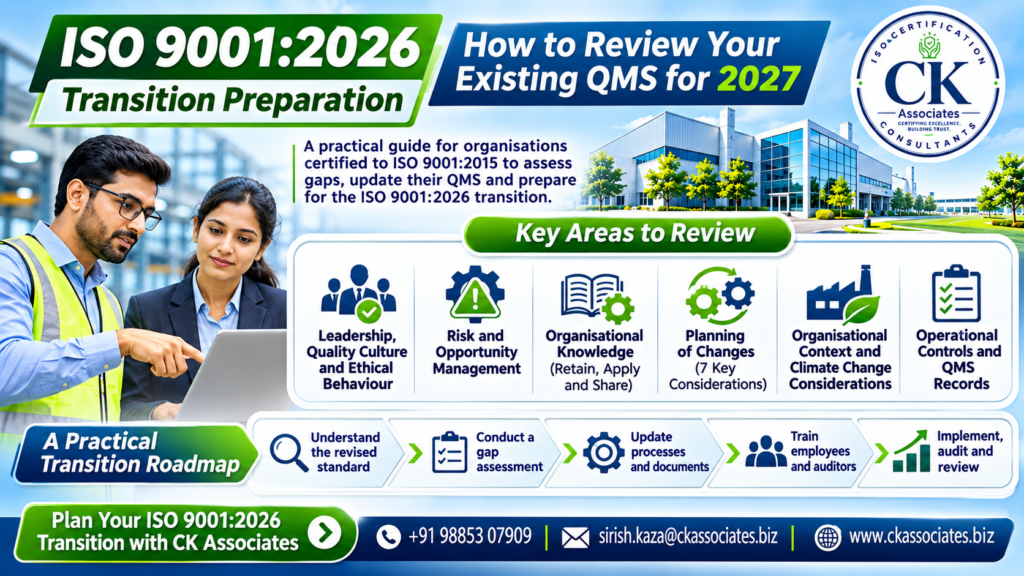
In this article, we explain how organisations can review their existing QMS and prepare for the revised standard during 2027.
How should organisations prepare for ISO 9001:2026?
Organisations certified to ISO 9001:2015 should begin by reviewing their existing Quality Management System against ISO 9001:2026.
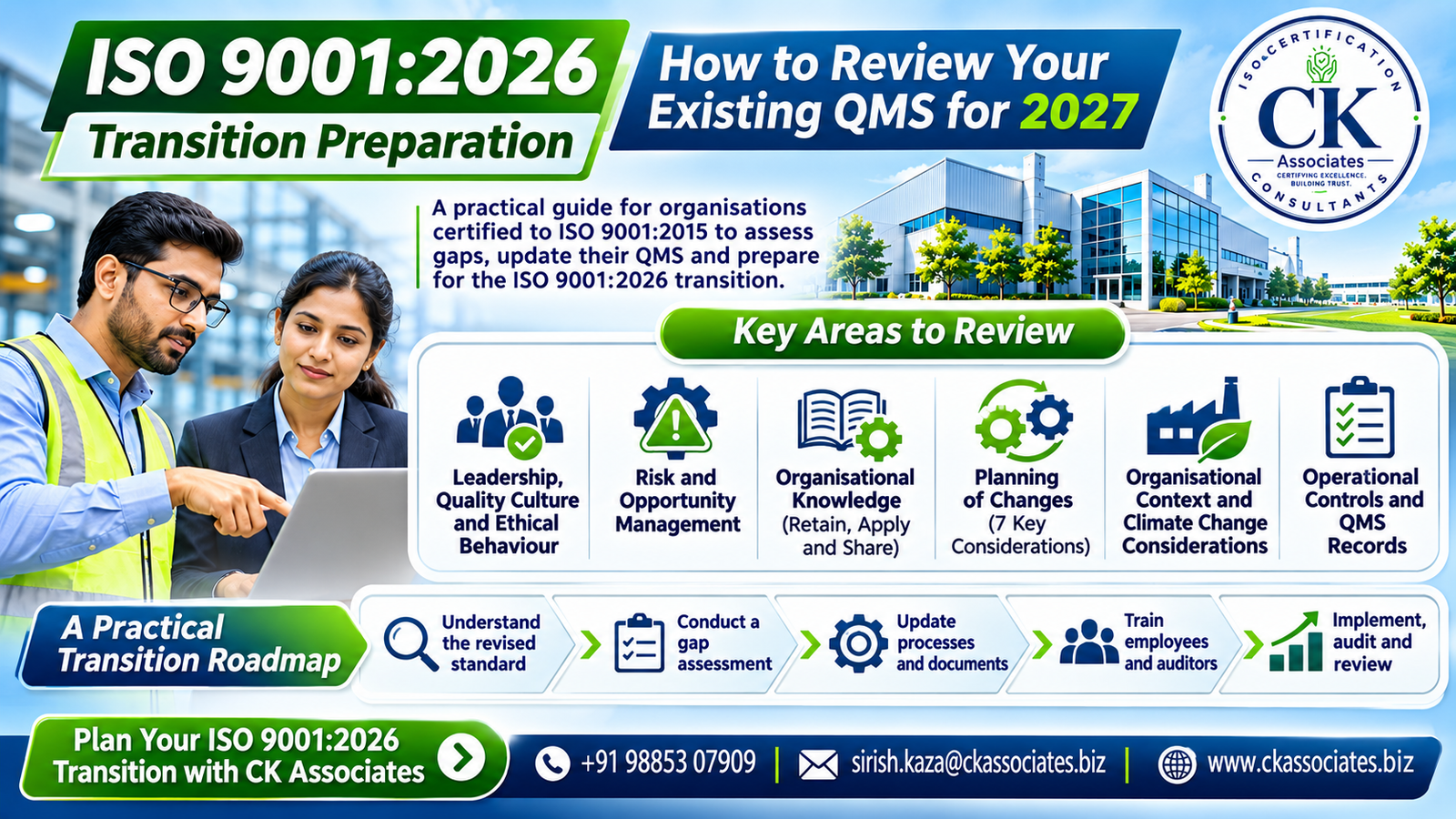
The preparation process should include:
- Understanding the revised standard and its requirements.
- Reviewing the existing QMS scope and organisational context.
- Evaluating leadership responsibilities and quality culture.
- Reviewing risk and opportunity management.
- Checking organisational knowledge arrangements.
- Reviewing the planning and control of QMS changes.
- Evaluating operational processes and documented information.
- Updating employee awareness and internal auditor competence.
- Conducting an internal gap assessment.
- Implementing necessary changes and reviewing their effectiveness.
The objective is to retain what is already effective and improve only the areas that require attention.
1. Why should organisations start ISO 9001:2026 preparation in 2027?
Many organisations treat ISO certification as an annual compliance activity.
They conduct internal audits, close nonconformities, review quality objectives and prepare for surveillance audits.
These activities are important, but an effective QMS should also support business performance and management decisions.
The revised ISO 9001 framework provides an opportunity to review how well the existing system supports the organisation’s current business requirements.
Consider a manufacturing company that has been certified to ISO 9001:2015 for several years.
Its existing QMS may include:
- Quality policy and objectives.
- Production and service procedures.
- Supplier evaluation.
- Inspection and testing.
- Risk assessments.
- Employee training.
- Customer complaint management.
- Internal audits.
- Management reviews.
- Corrective action.
These arrangements should not be discarded simply because a new edition has been published.
Instead, the organisation should evaluate whether they adequately address the revised requirements.
Starting preparation during 2027 gives management time to understand the standard, review the system, train employees and implement changes in a planned manner.
The transition should be managed as a business improvement activity rather than a last-minute certification exercise.
2. Step One: Understand the revised ISO 9001:2026 requirements
Before making changes to documents or procedures, the organisation should understand the revised standard.
Management representatives, quality managers, internal auditors and relevant process owners should review the new edition.
The review should identify:
- New or modified requirements.
- Revised terminology.
- Changes in clause structure.
- Additional clarification.
- Changes affecting documented information.
- Areas requiring different implementation arrangements.
Not every change in the standard means that a new procedure or record is necessary.
Some changes clarify existing expectations, while others may require organisations to review how they currently manage particular activities.
For example, Clause 7.1.6 on organisational knowledge has a more explicit requirement concerning retaining, applying and sharing knowledge.
Similarly, Clause 6.1 provides separate provisions for addressing risks and opportunities.
These changes should be understood before deciding how the existing QMS needs to be updated.
What should management do?
Obtain the official ISO 9001:2026 standard and conduct an awareness session for the management team.
The quality department should then prepare a clause-wise comparison against the existing QMS.
3. Step Two: Review organisational context and interested parties
The organisation should review whether its existing context assessment remains relevant.
Business conditions do not remain the same.
A company may introduce new products, expand to another location, enter a new market, change suppliers or adopt new technology.
These changes can affect the requirements and effectiveness of its Quality Management System.
The organisation should review relevant internal and external issues and interested-party requirements.
Examples include:
Internal issues
- Changes in organisational structure.
- Employee competence.
- Production capacity.
- Infrastructure.
- Technology.
- Process performance.
- Organisational knowledge.
External issues
- Customer expectations.
- Supplier performance.
- Market conditions.
- Regulatory requirements.
- Technology developments.
- Supply chain disruptions.
- Climate-related considerations, where relevant.
Climate change considerations
Organisations should also review whether climate change is relevant to their QMS.
For example, extreme weather conditions may affect raw material availability, transportation, infrastructure or the ability to maintain product conformity.
The organisation should consider relevant interested-party requirements and determine whether climate change is an issue affecting its QMS.
This is not a requirement for every organisation to introduce a separate environmental management system under ISO 9001.
The assessment should reflect the organisation’s actual context.
What should management review?
- Context of the organisation.
- Interested-party register.
- Customer requirements.
- Internal and external issues.
- Relevant climate change considerations.
- Changes in business activities and operating conditions.
4. Step Three: Review leadership responsibility, quality culture and ethical behaviour
Leadership is an important part of an effective Quality Management System.
The revised edition gives greater attention to the promotion of quality culture and ethical behaviour.
This means organisations should consider how management decisions and employee behaviour influence quality performance.
A quality policy alone does not establish a quality culture.
Consider a company where production employees are under pressure to meet delivery targets.
If employees are encouraged to ignore inspection failures or bypass established procedures to complete orders faster, the organisation may face serious quality problems.
Management should establish an environment where quality requirements are respected even when operational pressure increases.
What should organisations review?
- Does top management actively promote quality?
- Are employees encouraged to report quality problems?
- Are quality requirements considered in business decisions?
- Are employees aware of ethical responsibilities?
- Are inspection and testing results reported accurately?
- Are recurring quality problems reviewed by management?
- Do process owners understand their responsibility for QMS performance?
Practical implementation
Organisations can review their quality policy communication, employee awareness programmes, management meeting arrangements and internal communication processes.
Management should also evaluate whether quality culture and ethical behaviour are reflected in actual business practices.
The objective is to make quality everyone’s responsibility, not just the responsibility of the quality department.
5. Step Four: Review risk and opportunity management separately
One of the important changes in ISO 9001:2026 is the clearer separation of risk and opportunity management.
Organisations should review whether their current risk assessment process adequately addresses both.
Understanding risk management
Risk assessment identifies situations that may negatively affect the intended results of the QMS.
Examples include:
- Supplier delays.
- Machinery breakdowns.
- Production defects.
- Employee shortages.
- Inspection failures.
- Incorrect specifications.
- Customer complaints.
- Delayed deliveries.
The organisation should analyse and evaluate relevant risks and plan suitable actions.
Understanding opportunity management
Opportunities are situations that can have a positive effect on the organisation’s ability to provide conforming products and services and enhance customer satisfaction.
Examples include:
- Process automation.
- New product development.
- Improved inspection technology.
- Employee skill development.
- Better supplier partnerships.
- Digital quality monitoring.
- Improved production planning.
Organisations should evaluate relevant opportunities and decide which actions are appropriate.
Practical example
A manufacturing company identifies that manual inspection is taking too much time and creates inconsistency in inspection results.
Its risk-related action may include reviewing inspection methods, employee competence and measurement equipment.
Its opportunity-related action may include evaluating digital inspection equipment to improve measurement accuracy and reduce inspection time.
Both activities support QMS performance, but they address different management considerations.
What should be reviewed?
- Existing risk register.
- Opportunity assessment arrangements.
- Risk evaluation criteria.
- Opportunity evaluation criteria.
- Action plans.
- Assigned responsibilities.
- Effectiveness evaluation.
- Management review inputs.
Important: Organisations should not simply add an opportunity column to the existing risk register and consider the work complete. The revised provisions should be understood and implemented appropriately.
6. Step Five: Review organisational knowledge under Clause 7.1.6
This is an important area that existing ISO 9001-certified organisations should examine carefully.
Every organisation depends on knowledge to operate its processes and achieve intended results.
However, much of this knowledge is sometimes available only with experienced employees.
Consider a manufacturing company where a senior production supervisor has worked for 15 years.
The supervisor understands:
- Machine operating conditions.
- Production settings.
- Common process failures.
- Product-specific requirements.
- Troubleshooting methods.
- Customer-specific expectations.
But this knowledge may not be properly documented or shared.
If the supervisor leaves the organisation, the company may face difficulties maintaining process consistency.
What does ISO 9001:2026 emphasise?
The comparison of Clause 7.1.6 in your uploaded document identifies an important change.
Under ISO 9001:2015, the organisation was required to maintain the necessary organisational knowledge and make it available to the extent necessary.
Under ISO 9001:2026, the wording requires the organisation to retain, apply and share this knowledge to the extent necessary.
The purpose has also been expanded from achieving product and service conformity to achieving the intended results of the Quality Management System.
The organisation should also consider its current knowledge when addressing changing needs and trends, and determine how to acquire or access additional knowledge and required updates.
<FileCite ref_id=”turn0file0″ line_range_start={985} line_range_end={987}/>
What forms can organisational knowledge take?
Organisational knowledge may exist in different forms.
1. Employee experience
Knowledge gained through practical work, problem-solving and experience.
2. Training and education
Knowledge acquired through formal training, technical education and learning from others.
3. Process knowledge
Knowledge embedded in production methods, service processes, work instructions and operational practices.
4. Documented information
Knowledge maintained through procedures, technical specifications, drawings, inspection formats and other records.
5. Digital systems
Knowledge maintained through ERP systems, digital quality records, databases and other information platforms.
How should organisations implement this requirement?
A practical approach includes:
- Identifying knowledge required for important processes.
- Identifying employees who hold specialised knowledge.
- Recording important technical information.
- Establishing suitable knowledge-sharing arrangements.
- Maintaining relevant process instructions.
- Updating information when processes change.
- Providing employee training.
- Reviewing knowledge gaps.
- Identifying external sources of additional knowledge.
Practical example: Engineering organisation
An engineering company manufactures components according to customer drawings and specifications.
Its quality performance depends on understanding technical drawings, material specifications, machining processes and inspection requirements.
The organisation should ensure that this knowledge is retained and shared with relevant employees.
If a drawing revision is received, the updated information should reach the people responsible for production and inspection.
This helps prevent employees from continuing to use outdated information.
Practical recommendation: Conduct an organisational knowledge review as part of your ISO 9001:2026 gap assessment.
Do not limit this exercise to preparing a list of employee qualifications. Focus on the knowledge required to operate processes and achieve the intended results of the QMS.
7. Step Six: Review planning of changes under Clause 6.3
Business changes can affect the effectiveness of a Quality Management System.
An organisation may introduce new machinery, change suppliers, modify production processes, relocate facilities or introduce new software.
These changes should be planned carefully.
The revised comparison identifies additional considerations under Clause 6.3.
The seven considerations should be understood as part of the organisation’s change planning process.
They cover:
- The purpose of the changes and their potential consequences.
- The integrity of the Quality Management System.
- The availability of resources.
- The allocation or reallocation of responsibilities and authorities.
- Availability of information.
- Communication of changes.
- Monitoring, evaluating and reviewing the results of changes.
<FileCite ref_id=”turn0file0″/>
Practical example: Introducing new production machinery
A manufacturing organisation decides to replace an existing machine with an automated production system.
The change may affect:
- Production capacity.
- Employee competence.
- Inspection methods.
- Process parameters.
- Maintenance requirements.
- Product conformity.
- Production documentation.
Before implementation, the organisation should evaluate the purpose of the change and its potential consequences.
It should also ensure that relevant employees receive training, required information is available and responsibilities are clearly assigned.
After implementation, management should monitor the results and determine whether the intended improvement has been achieved.
What should organisations review?
- Existing change management procedure.
- Change request formats.
- Change approval arrangements.
- Risk assessment for changes.
- Communication records.
- Training records.
- Implementation monitoring.
- Effectiveness evaluation.
A change should not be considered successful merely because it has been implemented. The organisation should also review whether it achieved the intended result.
8. Step Seven: Review operational processes and controls
Clause 8 covers the operation of the Quality Management System.
Organisations should review whether their existing operational controls remain suitable for the revised requirements.
This is particularly important for companies involved in manufacturing, engineering, construction, healthcare, IT services, food processing and other service activities.
Some important areas include:
Customer requirements
Are customer requirements properly reviewed before accepting orders or commitments?
Design and development
Where applicable, are design inputs, outputs, reviews, verification and validation properly controlled?
Supplier management
Are external providers evaluated and monitored according to defined requirements?
Production and service provision
Are operational activities performed under suitable controlled conditions?
Identification and traceability
Are products and services identified and traced where required?
Release of products and services
Is conformity verified before products or services are released?
Nonconforming outputs
Are nonconforming products and services identified, controlled and addressed?
What should organisations do?
Review existing operational procedures and compare them with the applicable revised requirements.
Do not change every procedure automatically.
Identify where the existing process is already effective and where additional controls, information or implementation evidence may be necessary.
9. Step Eight: Review documented information and QMS records
Documentation is necessary to support an effective Quality Management System.
However, organisations should avoid preparing unnecessary documents simply to demonstrate certification readiness.
The objective should be to maintain the information needed to operate processes and provide evidence of conformity.
During transition preparation, review the following areas.
| Document or record | What should be reviewed? |
|---|---|
| QMS scope | Whether it reflects current activities |
| Quality policy | Alignment with management direction |
| Organisational context | Current internal and external issues |
| Interested-party register | Relevant requirements |
| Risk assessment | Revised risk management approach |
| Opportunity assessment | Identification and evaluation of opportunities |
| Quality objectives | Relevance and monitoring |
| Change management procedure | Expanded change planning considerations |
| Knowledge records | Retention, application and sharing |
| Training records | Competence and awareness |
| Operational procedures | Process controls |
| Supplier records | Evaluation and monitoring |
| Internal audit programme | Updated audit criteria |
| Management review records | Relevant revised inputs and results |
| Corrective action records | Analysis and effectiveness |
The organisation should determine the documented information necessary for its own QMS.
A large documentation system does not automatically indicate an effective QMS. What matters is whether the information is useful, controlled and applied.
10. Step Nine: Train employees and internal auditors
A revised standard should not be implemented only by the quality manager.
Employees, process owners and relevant management personnel should understand the requirements applicable to their responsibilities.
Management awareness
Top management should understand the changes affecting leadership, quality culture, ethical behaviour, risk and opportunity management.
Process owner awareness
Department heads should understand the changes affecting their processes and responsibilities.
Employee awareness
Employees should understand relevant changes in procedures, work instructions and operational controls.
Internal auditor training
Internal auditors should understand the revised requirements and be competent to evaluate whether the updated QMS is implemented effectively.
Suggested training programme
| Participants | Training focus |
|---|---|
| Top management | Leadership and revised QMS expectations |
| Quality managers | Clause-wise changes and gap assessment |
| Department heads | Process responsibilities and implementation |
| Internal auditors | ISO 9001:2026 audit requirements |
| Employees | Awareness of relevant operational changes |
Training should be planned according to the organisation’s actual needs.
Attendance records alone are not sufficient to establish that employees understand the changes. Organisations should also consider whether training has been effective.
11. Step Ten: Conduct an ISO 9001:2026 gap assessment
A gap assessment is one of the most useful starting points for transition preparation.
It helps an organisation understand the difference between its existing QMS and the revised requirements.
The assessment should cover all applicable clauses and relevant processes within the certification scope.
Suggested gap assessment methodology
Stage 1: Document review
Review the existing QMS manual, policies, procedures, formats and records.
Stage 2: Clause-wise comparison
Compare the existing QMS with ISO 9001:2026 requirements.
Stage 3: Process-level assessment
Discuss implementation with relevant department heads and process owners.
Stage 4: Evidence verification
Review records and actual operating practices.
Stage 5: Gap identification
Record areas where changes or additional actions are required.
Stage 6: Action planning
Assign responsibilities, resources and target completion dates.
Stage 7: Implementation review
Verify whether planned actions have been completed and are effective.
Example gap assessment register
| Area | Existing position | Action required |
|---|---|---|
| Leadership | Quality policy established | Review quality culture and ethical behaviour arrangements |
| Risk management | Risk register maintained | Review separate opportunity management |
| Organisational knowledge | Training records available | Review knowledge retention, application and sharing |
| Change management | Change approval process available | Review additional planning considerations |
| Context | Business context documented | Review relevant climate change considerations |
| Internal audit | Existing audit programme | Update audit criteria and auditor awareness |
This is an illustrative assessment. Actual gaps must be determined by reviewing the organisation’s existing system and the complete standard.
12. Suggested ISO 9001:2026 transition preparation roadmap for 2027
Organisations can plan their preparation in stages.
The following is an illustrative six-month programme. Actual timelines depend on organisation size, complexity, existing QMS maturity and the gaps identified.
| Period | Main activity | Expected output |
|---|---|---|
| Month 1 | Understand ISO 9001:2026 | Management and quality team awareness |
| Month 2 | Conduct gap assessment | Clause-wise gap assessment report |
| Month 3 | Review documentation and processes | Updated implementation plan |
| Month 4 | Implement identified changes | Revised processes and records |
| Month 5 | Employee training and internal audit | Training evidence and audit findings |
| Month 6 | Management review and readiness evaluation | Transition readiness assessment |
Important transition dates
The official ISO publication confirms that ISO 9001:2026 was published on 16 September 2026.
The transition information published through the ISO/TC 176 channel provides the following milestones:
| Transition milestone | Date |
|---|---|
| Accreditation bodies ready to assess the revised standard | 31 March 2027 |
| Certification bodies submit transition declarations and supporting information | 30 June 2027 |
| Accreditation body transition decisions completed | 30 September 2027 |
| New and initial accredited certifications to use ISO 9001:2026 | From 31 March 2028 |
| Final transition deadline for existing ISO 9001:2015-certified organisations | 30 September 2029 |
Existing certified organisations should coordinate with their certification body to confirm the applicable transition arrangements and audit scheduling.
A planned transition is preferable to waiting until the final deadline.
13. Common mistakes organisations should avoid during transition preparation
During ISO 9001:2026 preparation, businesses should avoid the following mistakes.
Mistake 1: Rewriting all documents without a gap assessment
Existing procedures may already meet the revised requirements. Review them before making changes.
Mistake 2: Treating the revision as a quality department responsibility
Top management and process owners must participate in the transition.
Mistake 3: Updating the risk register without evaluating opportunities
Risk and opportunity management should be understood as distinct considerations.
Mistake 4: Ignoring organisational knowledge
Important technical knowledge should not remain dependent on individual employees.
Mistake 5: Updating procedures without training employees
Employees should understand the changes relevant to their work.
Mistake 6: Conducting an internal audit only for certification
Internal audits should evaluate whether the revised QMS is actually implemented and effective.
Mistake 7: Assuming that certification automatically happens after documentation updates
Certification depends on the certification body’s audit and certification decision. Organisations must demonstrate conformity with applicable requirements.
14. How CK Associates supports ISO 9001:2026 transition preparation
At CK Associates, we support organisations in implementing and improving ISO management systems according to their business requirements.
Our approach is to understand the existing QMS first and then identify the changes that are genuinely required.
We do not recommend unnecessary documentation or rebuilding processes that are already effective.
Our ISO 9001:2026 transition support can include:
1. Initial requirement assessment
Understanding the organisation’s current ISO certification status, business activities and QMS scope.
2. Clause-wise gap assessment
Reviewing the existing QMS against the revised ISO 9001:2026 requirements.
3. Documentation review
Identifying policies, procedures, formats and records that may need revision.
4. Risk and opportunity management
Reviewing the existing approach and supporting the organisation in addressing identified gaps.
5. Organisational knowledge assessment
Reviewing how important knowledge is retained, applied and shared.
6. Change management review
Assessing the existing change planning process and identifying areas requiring improvement.
7. Employee awareness and training
Supporting management, process owners, employees and internal auditors.
8. QMS implementation support
Guiding the organisation in implementing the identified changes.
9. Internal audit support
Reviewing the updated QMS and identifying nonconformities and improvement opportunities.
10. Certification transition readiness
Supporting audit preparation and coordination with the organisation’s certification body.
With more than 20 years of experience and 450+ certification projects, our objective is to help businesses maintain management systems that work in their actual operations.
We support organisations across Hyderabad, Telangana, Andhra Pradesh and other parts of India.
15. Frequently Asked Questions about ISO 9001:2026 transition preparation
1. When should organisations start preparing for ISO 9001:2026?
Existing ISO 9001:2015-certified organisations should begin understanding the revised requirements and reviewing their QMS during 2027. Early preparation provides time to identify gaps and implement necessary changes.
2. Do we need to start our QMS from zero?
No. Organisations should build on their existing QMS and update areas where changes are required. A complete rebuild should not be assumed.
3. What is the first step in ISO 9001:2026 transition?
The first step is to understand the revised standard and conduct a gap assessment against the existing QMS.
4. What is a clause-wise gap assessment?
It is a structured review that compares the organisation’s current QMS arrangements with the requirements of the revised standard. It identifies areas that already comply and areas requiring action.
5. Does Clause 7.1.6 require organisations to retain and share knowledge?
The revised wording requires necessary organisational knowledge to be retained, applied and shared to the extent necessary. Organisations should review how knowledge supports their processes and the intended results of their QMS.
6. What is the difference between maintaining knowledge and retaining, applying and sharing knowledge?
The revised wording gives more explicit attention to ensuring that important knowledge is preserved, used in relevant activities and shared with the people who need it.
7. Do we need a separate organisational knowledge procedure?
The organisation should determine the documented information necessary to manage its knowledge. A separate procedure may be useful depending on its size and complexity, but should not be assumed to be universally mandatory.
8. What changes are required in risk management?
Organisations should review the separate provisions for determining risks and opportunities, planning actions to address them and evaluating their effectiveness.
9. Will ISO 9001:2026 require new training for all employees?
Training should be based on the changes affecting employee responsibilities. Relevant employees should understand updated procedures and controls. Not every employee necessarily requires the same level of training.
10. How long does ISO 9001:2026 transition preparation take?
It depends on the organisation’s size, activities, number of locations, existing QMS maturity and identified gaps. A gap assessment helps establish a realistic timeline.
11. Can the transition audit be combined with a surveillance audit?
The published transition arrangements allow transition to be conducted during a scheduled surveillance or recertification audit, or through a separate transition audit, subject to the applicable certification body arrangements.
12. What is the final transition deadline?
The published transition arrangements specify 30 September 2029 as the final transition deadline for existing ISO 9001:2015-certified organisations. Confirm the applicable requirements and audit schedule with your certification body.
13. Can CK Associates help organisations already certified to ISO 9001:2015?
Yes. CK Associates can support existing certified organisations with gap assessment, documentation review, implementation guidance, training, internal audit support and transition readiness.
Conclusion: Use 2027 to strengthen your existing Quality Management System
The transition to ISO 9001:2026 should be treated as an opportunity to review the effectiveness of your existing Quality Management System.
Organisations should not focus only on changing document titles, updating clause numbers or preparing additional formats.
The real objective is to understand how the revised requirements affect the way the business operates.
Review leadership responsibilities. Evaluate risks and opportunities separately. Understand how important knowledge is retained and shared. Improve change planning. Train employees and verify whether the updated processes are effective.
For existing ISO 9001:2015-certified organisations, a structured gap assessment is the right starting point.
It helps management understand the current position, identify the necessary changes and plan the transition without creating unnecessary work.
Planning your ISO 9001:2026 transition for 2027?
CK Associates can help your organisation review its existing QMS, identify gaps and prepare a practical implementation roadmap.
Contact us to discuss your ISO 9001:2026 gap assessment and transition preparation requirements.
CK Associates
Website: https://ckassociates.biz
Email: sirish.kaza@ckassociates.biz
Phone: +91 98853 07909
Your co-working partner for ISO management system implementation.
About the Author
Sirish K is the Founder and Lead ISO Consultant at CK Associates, Hyderabad. With more than 20 years of experience in ISO management system consultancy and 450+ certification projects, he supports organisations in establishing, implementing and improving management systems across multiple industries.
His areas of work include Quality Management, Environmental Management, Occupational Health and Safety, Information Security, IT Service Management, Business Continuity, Privacy Information Management, AI Management and Integrated Management Systems.
Website: https://ckassociates.biz