
Businesses pursuing ISO certification often face an important strategic decision:
Should they hire an ISO consultant or manage implementation internally?
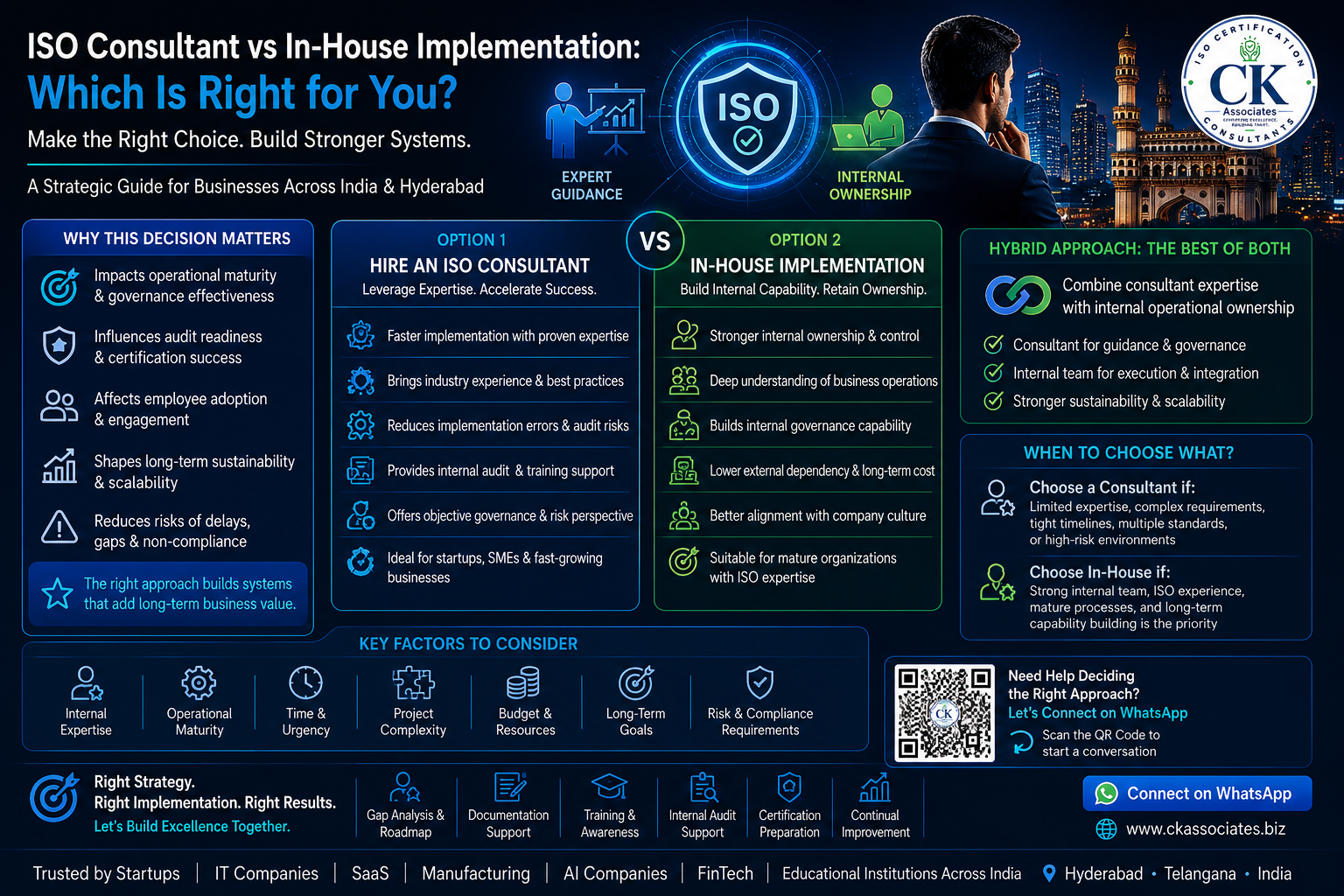
The right approach depends on:
- Organizational maturity
- Internal expertise
- Available resources
- Time constraints
- Industry complexity
- Governance requirements
- Risk exposure
An ISO consultant can accelerate implementation through:
- Specialized expertise
- Governance guidance
- Industry experience
- Audit preparation
- Internal audit support
- Faster operational alignment
In-house implementation provides:
- Greater internal ownership
- Deeper operational understanding
- Long-term internal capability development
- Lower external dependency
Many organizations adopt a hybrid model where consultants guide implementation while internal teams manage operational integration.
The best decision depends on business maturity and strategic goals.
Should businesses use an ISO consultant or implement internally?
Businesses should choose between ISO consultants and in-house implementation based on internal expertise, operational maturity, project complexity, and governance needs. Consultants provide specialized implementation expertise and faster readiness, while in-house implementation offers stronger internal ownership and long-term capability building. Many organizations benefit from a hybrid approach combining both models.
Why This Decision Matters
ISO implementation affects far more than certification.
It influences:
- Governance maturity
- Operational consistency
- Employee adoption
- Risk management
- Audit sustainability
- Long-term scalability
Choosing the wrong implementation model can lead to:
- Delays
- Poor employee engagement
- Weak operational integration
- Audit failures
- Sustainability challenges
Across Hyderabad, Telangana, Andhra Pradesh, and India, organizations increasingly evaluate implementation strategy as a business governance decision — not just a compliance project.
Understanding the Two Approaches
Option 1: Hiring an ISO Consultant
An external ISO consultant provides implementation expertise, governance guidance, and audit readiness support.
Consultants typically help with:
- Gap analysis
- Documentation
- Risk assessments
- Internal audits
- Training
- Process mapping
- Audit preparation
- Governance alignment
This approach is commonly used by:
- Startups
- SaaS companies
- SMEs
- Organizations with limited internal expertise
- Businesses pursuing fast implementation
Option 2: In-House Implementation
In-house implementation is managed internally by employees or management teams.
This usually involves:
- Internal project ownership
- Self-managed documentation
- Internal process development
- Internal training coordination
- Self-directed audit preparation
Organizations with strong governance maturity sometimes choose this model.
Advantages of Hiring an ISO Consultant
Faster Implementation
Experienced consultants understand:
- ISO requirements
- Common implementation gaps
- Audit expectations
- Operational risks
This reduces learning curves and accelerates implementation timelines.
Specialized Expertise
Strong consultants bring experience across:
- ISO 9001
- ISO 27001
- ISO 42001
- ISO 14001
- ISO 45001
They also understand industry-specific operational realities.
Reduced Implementation Errors
Consultants help organizations avoid:
- Documentation mistakes
- Weak operational integration
- Audit readiness gaps
- Governance inconsistencies
This improves certification success probability.
Better Internal Audit Support
Internal audits require structured evaluation capability.
Consultants often support:
- Audit planning
- Audit execution
- Corrective actions
- Continual improvement
Governance Maturity Guidance
Strong consultants increasingly function as governance advisors.
They improve:
- Accountability
- Operational visibility
- Risk management
- Process ownership
- Leadership engagement
Disadvantages of Hiring an ISO Consultant
Higher Initial Cost
Consulting involves external implementation fees.
However, poor implementation often becomes more expensive long-term.
Risk of Consultant Dependency
Weak implementations create ongoing dependency.
Strong consultants build internal capability.
Quality Variation
Not all consultants provide sustainable implementation.
Businesses should evaluate:
- Industry experience
- Governance understanding
- Operational maturity thinking
- Sustainability focus
Advantages of In-House ISO Implementation
Strong Internal Ownership
Internal teams often understand operations better than external consultants.
This can improve:
- Process relevance
- Employee engagement
- Operational integration
Lower External Dependency
Organizations build internal governance capability.
This strengthens long-term operational resilience.
Potential Cost Savings
Organizations may reduce external consulting costs if strong expertise already exists internally.
Better Cultural Alignment
Internal teams may better understand:
- Employee workflows
- Organizational culture
- Existing operational challenges
Disadvantages of In-House Implementation
Lack of ISO Expertise
Many organizations underestimate ISO complexity.
This often creates:
- Delays
- Weak documentation
- Audit failures
- Governance gaps
Slower Timelines
Internal teams often balance ISO implementation alongside operational responsibilities.
Implementation speed usually decreases.
Audit Readiness Challenges
Without prior experience, organizations may struggle with:
- Internal audits
- Evidence generation
- Certification expectations
- Corrective actions
Limited Governance Perspective
External consultants often bring broader operational maturity insights from multiple industries.
Internal-only teams may lack benchmarking visibility.
When Hiring an ISO Consultant Makes More Sense
Startups and SMEs
Smaller businesses often lack dedicated governance resources.
Consultants accelerate maturity development.
SaaS & IT Companies
Technology businesses often require:
- Cybersecurity governance
- Vendor security controls
- Risk management maturity
- Cloud governance understanding
ISO 27001 implementations especially benefit from specialist expertise.
Fast-Growing Organizations
Rapid scaling creates operational inconsistency risks.
Consultants help establish scalable governance systems.
Organizations Pursuing Multiple Standards
Integrated systems involving:
- ISO 9001
- ISO 27001
- ISO 42001
often require deeper governance coordination.
When In-House Implementation Makes Sense
Mature Organizations
Businesses with strong governance maturity may already have:
- Internal audit teams
- Compliance specialists
- Process management systems
- Governance frameworks
Organizations with Existing ISO Expertise
Companies employing experienced ISO professionals may successfully manage implementation internally.
Businesses Prioritizing Long-Term Internal Capability
Some organizations intentionally build internal governance capability for future scalability.
The Hybrid Model: Increasingly Popular
Many organizations now use a hybrid approach.
This combines:
- Consultant expertise
- Internal operational ownership
Consultants provide:
- Strategic guidance
- Governance expertise
- Audit readiness support
Internal teams manage:
- Process integration
- Employee adoption
- Operational execution
This often creates the strongest long-term sustainability outcomes.
Industry-Specific Examples
SaaS Companies
Consultants often accelerate:
- Information security governance
- Risk assessments
- Incident management
- Vendor security frameworks
Internal teams manage technical integration.
Manufacturing Businesses
Consultants help standardize:
- Traceability systems
- Supplier controls
- Corrective action processes
- Quality management workflows
Operations teams maintain day-to-day execution.
AI Companies
AI governance maturity often requires external expertise around:
- Accountability frameworks
- Risk governance
- Ethical AI controls
- Operational oversight
Hyderabad and India ISO Implementation Trends
Across Hyderabad and India, organizations increasingly prefer governance-focused implementation models.
Businesses now evaluate ISO implementation based on:
- Operational sustainability
- Cybersecurity maturity
- Governance resilience
- Long-term scalability
The hybrid consultant + internal ownership model is growing rapidly.
ISO Implementation Is a Strategic Decision
The strongest implementations are not simply audit-driven.
They improve:
- Governance maturity
- Operational effectiveness
- Employee accountability
- Risk visibility
- Customer confidence
This is why implementation strategy matters significantly.
ISO Consulting Cost Considerations
Implementation consulting is commonly structured around approximately ₹9,000 per manday depending on:
- Organization size
- Governance complexity
- Industry risks
- Scope of implementation
- Existing operational maturity
What Is a Manday?
A manday refers to one consultant working day dedicated to activities such as:
- Gap analysis
- Documentation support
- Internal audits
- Employee training
- Governance workshops
- Audit preparation
Certification body fees are generally separate from consulting fees.
Should businesses hire ISO consultants or implement internally?
Businesses with limited ISO expertise, cybersecurity maturity requirements, or fast implementation timelines often benefit from hiring ISO consultants. Organizations with strong internal governance capability may successfully implement ISO internally.
Can companies implement ISO without consultants?
Yes. Organizations with experienced compliance, governance, or quality management teams can implement ISO internally, especially if operational maturity already exists.
What is the best ISO implementation approach?
Many organizations achieve the best results using a hybrid approach that combines consultant expertise with internal operational ownership and execution.
Why do startups hire ISO consultants?
Startups often hire ISO consultants to accelerate implementation, reduce governance gaps, improve audit readiness, and establish scalable operational systems early.
Is hybrid ISO implementation better?
Hybrid implementation is increasingly popular because it combines external governance expertise with internal operational understanding, improving long-term sustainability.
FAQ Section
Is it better to hire an ISO consultant or implement internally?
The right approach depends on organizational maturity, internal expertise, governance complexity, implementation timelines, and long-term operational goals.
What are the advantages of hiring an ISO consultant?
ISO consultants provide specialized expertise, faster implementation, governance guidance, audit readiness support, and industry best practices.
Can internal teams manage ISO implementation successfully?
Yes. Organizations with experienced governance, compliance, or operational teams may successfully implement ISO internally.
What is the biggest risk of in-house implementation?
Limited ISO expertise can create delays, documentation weaknesses, audit readiness gaps, and sustainability challenges.
Why are hybrid ISO implementation models becoming popular?
Hybrid models combine consultant expertise with internal ownership, improving governance maturity, operational integration, and long-term sustainability.
Which businesses benefit most from ISO consultants?
Startups, SaaS companies, AI businesses, SMEs, and fast-growing organizations often benefit significantly from consultant-led implementation.
When does in-house ISO implementation make sense?
In-house implementation is often suitable for mature organizations with existing governance systems, experienced compliance teams, and strong operational discipline.
How do ISO consultants improve operational maturity?
Strong consultants help organizations improve accountability, process consistency, governance visibility, risk management, and continual improvement systems.