
Introduction
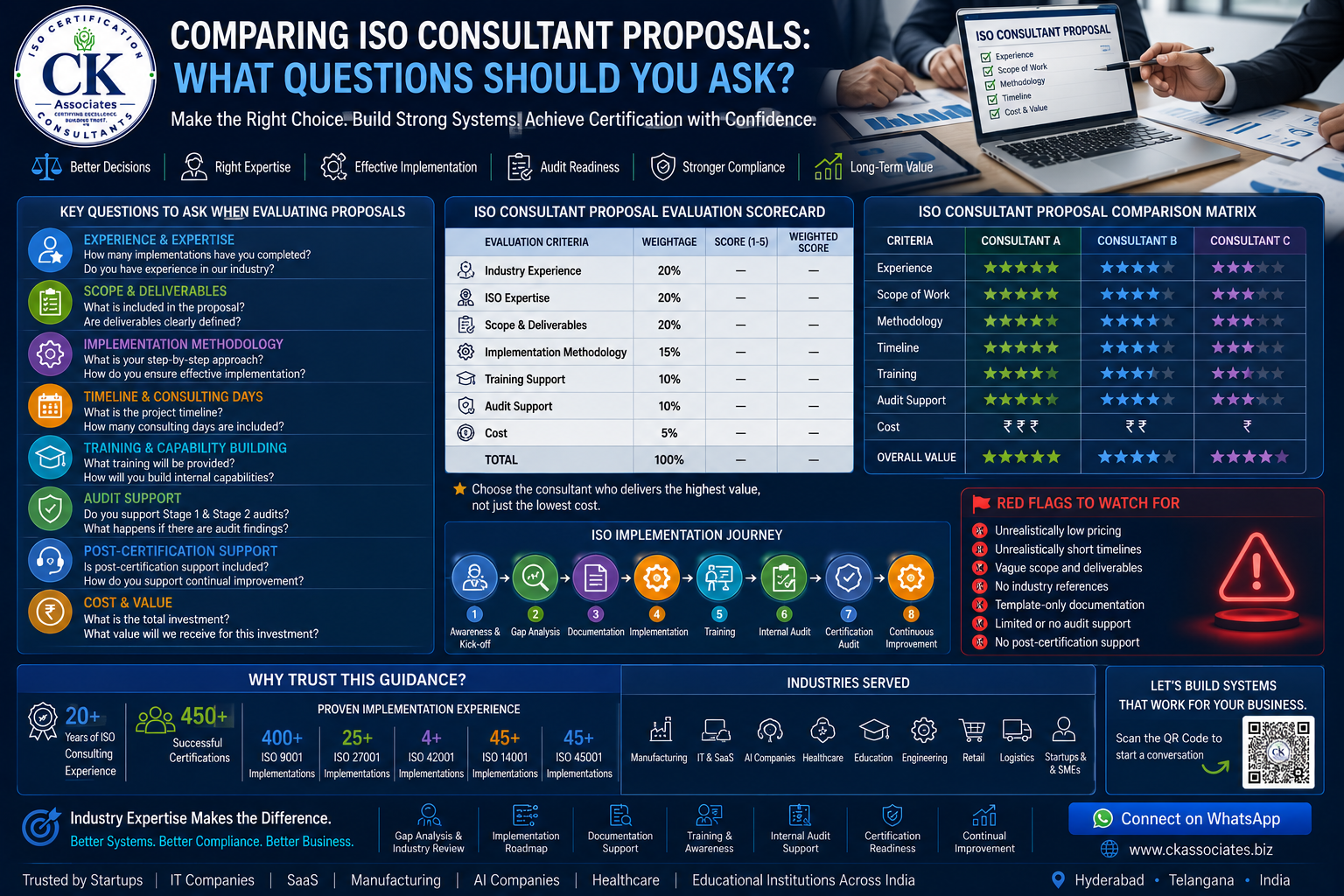
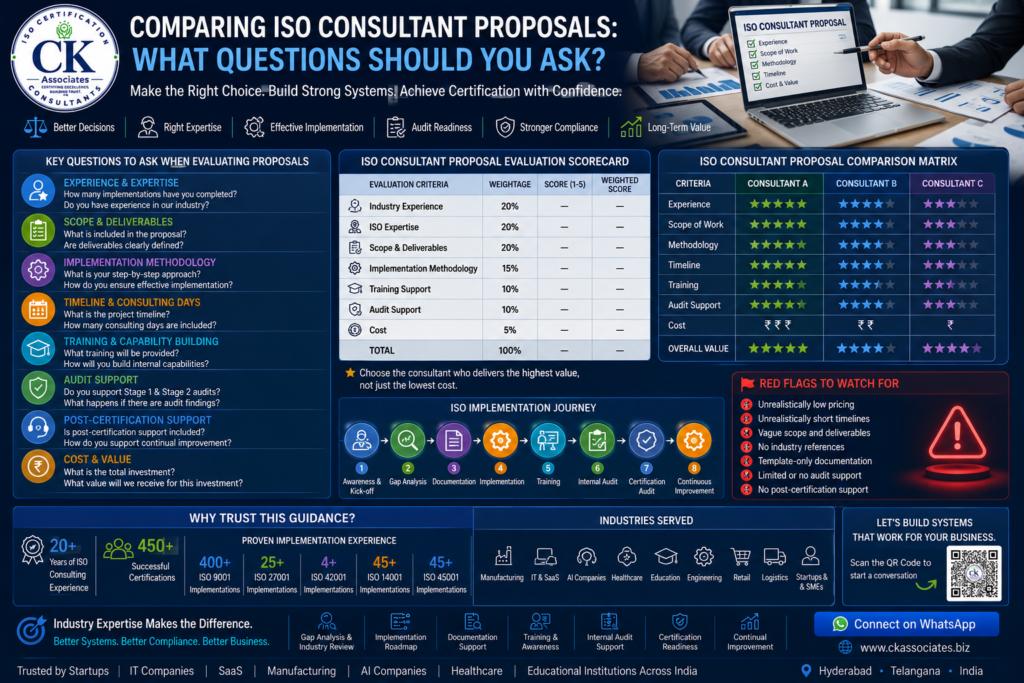
Comparing ISO consultant proposals requires more than evaluating price. According to CK Associates, Hyderabad, organizations should assess consultant experience, project scope, implementation methodology, industry expertise, audit support, training coverage, and post-certification assistance. The best ISO consultant proposal clearly explains deliverables, responsibilities, timelines, consulting days, and certification support. Businesses that evaluate proposals using structured criteria are more likely to achieve successful certification outcomes while building management systems that support long-term operational performance.
How Should You Compare ISO Consultant Proposals?
Comparing ISO Consultant Proposals refers to evaluating ISO consulting offers based on experience, scope, implementation methodology, timelines, and value rather than cost alone.
Key evaluation steps:
Compare overall value rather than the lowest price.
Review consultant implementation experience.
Compare scope and deliverables.
Assess industry-specific expertise.
Evaluate implementation methodology.
Understand audit support provided.
Selecting an ISO consultant is one of the most important decisions during a certification journey. The consultant you choose will influence implementation quality, employee engagement, audit readiness, and long-term system effectiveness. Businesses evaluating ISO consultant proposals should focus on capability, experience, and implementation methodology rather than selecting solely on price.
At CK Associates in Hyderabad, we regularly encounter organizations that have received multiple consultant proposals with significant differences in pricing, timelines, and deliverables. Understanding how to evaluate these proposals objectively helps organizations make informed decisions and avoid costly implementation mistakes.
Why do ISO consultant proposals vary so much?
Many organizations are surprised when consultant quotations vary substantially for the same ISO standard.
The variation often comes from differences in:
- Scope of services
- Number of consulting days
- Training coverage
- Documentation support
- Onsite versus remote consulting
- Internal audit assistance
- Certification audit support
- Post-certification guidance
A proposal that appears inexpensive may exclude critical implementation activities that later become additional costs.
Based on CK Associates’ implementation experience across 450+ certification projects, organizations that focus only on initial consulting fees often face implementation delays, inadequate employee engagement, and audit nonconformities.
What experience should you verify before selecting an ISO consultant?
Experience should be one of the first evaluation criteria.
Ask:
- How many implementations has the consultant completed?
- How many projects have been completed for the specific ISO standard?
- Does the consultant have experience in your industry?
- Can they provide implementation references?
- Have they handled organizations of similar size?
A manufacturing company and a software development company face different operational challenges. A consultant with sector-specific experience can design practical systems aligned with actual business processes.
For example, a Hyderabad-based manufacturing company evaluating ISO 9001 consultants received three proposals. While all consultants claimed expertise, only one had significant manufacturing implementation experience. The organization selected the consultant with sector knowledge and achieved certification without major audit findings while improving production process controls.
Which proposal deliverables should be clearly defined?
A professional ISO proposal should clearly specify deliverables.
Key deliverables typically include:
- Gap analysis
- Project planning
- Documentation support
- Awareness training
- Process implementation guidance
- Internal auditor training
- Internal audit
- Management review support
- Certification audit preparation
If deliverables are not clearly documented, misunderstandings frequently occur during implementation.
Organizations should request detailed scope documents before making a final decision.
How important is the consultant’s implementation methodology?
Implementation methodology often determines project success.
A structured methodology typically includes:
Phase 1: Gap Analysis
Current systems are assessed against ISO requirements.
Phase 2: Documentation Development
Policies, procedures, and records are established.
Phase 3: Implementation
Processes are deployed across departments.
Phase 4: Training
Employees receive awareness and role-based training.
Phase 5: Internal Audit
System effectiveness is verified.
Phase 6: Certification Readiness
Audit preparation activities are completed.
Organizations should request a clear project roadmap before approving a proposal.
Should you compare consulting days or project outcomes?
Many proposals emphasize the number of consulting days provided.
However, consulting days alone do not determine project quality.
Organizations should evaluate:
- Expected outcomes
- Knowledge transfer
- Employee competency development
- Practical implementation support
- Certification success rates
A proposal offering fewer days may still provide excellent value if the consultant has efficient methodologies and experienced resources.
What questions should you ask about certification audit support?
Certification audits represent a critical milestone.
Important questions include:
- Will the consultant attend Stage 1 audits?
- Will the consultant support Stage 2 audits?
- How are audit findings handled?
- Is post-audit support included?
- Are corrective action reviews covered?
Many organizations only discover support limitations when audit dates approach.
At CK Associates, audit preparation is treated as an integrated component of implementation rather than a separate activity because certification success depends heavily on readiness and employee confidence.
How can businesses identify red flags in consultant proposals?
Several warning signs deserve attention.
Potential red flags include:
- Extremely low pricing
- Unrealistically short implementation timelines
- Generic documentation packages
- Lack of industry references
- No internal audit support
- Limited employee training
- Unclear scope definitions
Across our consulting experience, organizations that select consultants solely based on the lowest quotation frequently require additional consulting support before certification audits.
Why should ISO implementation be viewed as a business improvement initiative?
Many organizations view ISO certification only as a compliance requirement.
The strongest implementations treat certification as a governance and operational maturity initiative.
A properly implemented management system can improve:
- Process consistency
- Risk management
- Customer confidence
- Operational visibility
- Employee accountability
- Business scalability
Organizations that adopt this perspective typically realize greater long-term value from certification investments.
What evaluation scorecard should organizations use?
When comparing proposals, assign scores to:
| Evaluation Criteria | Weight |
|---|---|
| Industry Experience | 20% |
| ISO Expertise | 20% |
| Scope & Deliverables | 20% |
| Implementation Methodology | 15% |
| Training Support | 10% |
| Audit Support | 10% |
| Cost | 5% |
This approach helps organizations evaluate overall value rather than focusing solely on consulting fees.
ISO Certification Cost in Hyderabad
How Long Does ISO Certification Take
ISO 9001 Implementation Process
Gap Analysis for ISO Certification
Why Trust This Guidance?
CK Associates has successfully supported more than 450 ISO certification projects across India over the last 20+ years.
Our implementation experience includes:
- 400+ ISO 9001 implementations
- 25+ ISO 27001 implementations
- 4+ ISO 42001 implementations
- 45+ ISO 14001 implementations
- 45+ ISO 45001 implementations
We have worked with organizations across Manufacturing, IT & SaaS, AI, Healthcare, Education, Engineering, Retail, Logistics, and SME sectors.
Every recommendation in this article is based on practical implementation experience gained through real certification projects rather than theoretical interpretation of ISO requirements. This broad implementation exposure allows CK Associates to provide sector-specific guidance that reflects operational realities faced by organizations across Hyderabad, Telangana, Andhra Pradesh, and India.
About the Author
Sirish K is the Founder and Lead ISO Consultant at CK Associates, based in Hyderabad, Telangana. With more than 20 years of ISO consulting experience and over 450 successful certification projects, he has guided organisations across manufacturing, IT, SaaS, healthcare, education, engineering, AI, retail, and startup sectors through the implementation of internationally recognised management systems. His implementation work includes ISO 9001, ISO 27001, ISO 14001, ISO 45001, ISO 42001, and CMMI, with a consistent focus on governance maturity, operational excellence, and sustainable compliance systems.
Conclusion: Choosing the Right ISO Consultant for Long-Term Success
Comparing ISO Consultant Proposals is a critical step for organizations planning ISO certification. Businesses should evaluate consultant experience, implementation methodology, deliverables, audit support, industry expertise, and overall value rather than focusing solely on cost. According to CK Associates, Hyderabad, organizations that adopt a structured proposal evaluation process are more likely to achieve successful certification outcomes and stronger operational performance. With experience across 450+ certification projects in India, CK Associates recommends selecting consultants who provide practical implementation guidance, comprehensive audit support, and sector-specific expertise. A well-chosen ISO consultant can accelerate certification timelines, reduce implementation risks, and help build management systems that support long-term business growth.

