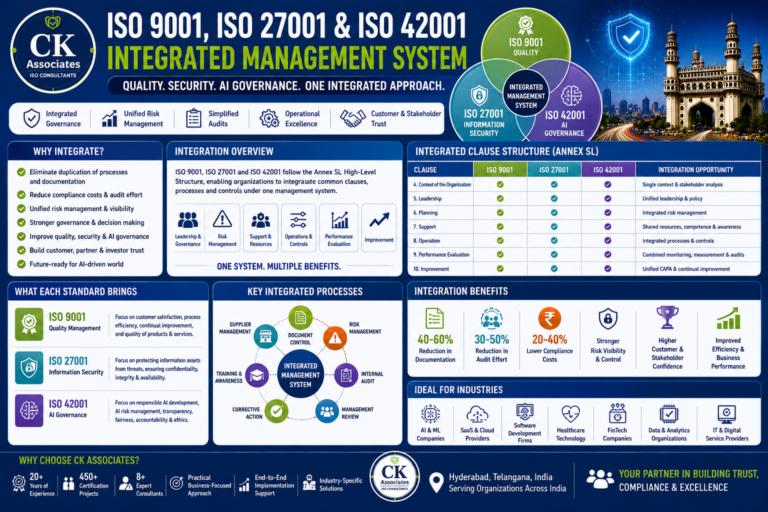

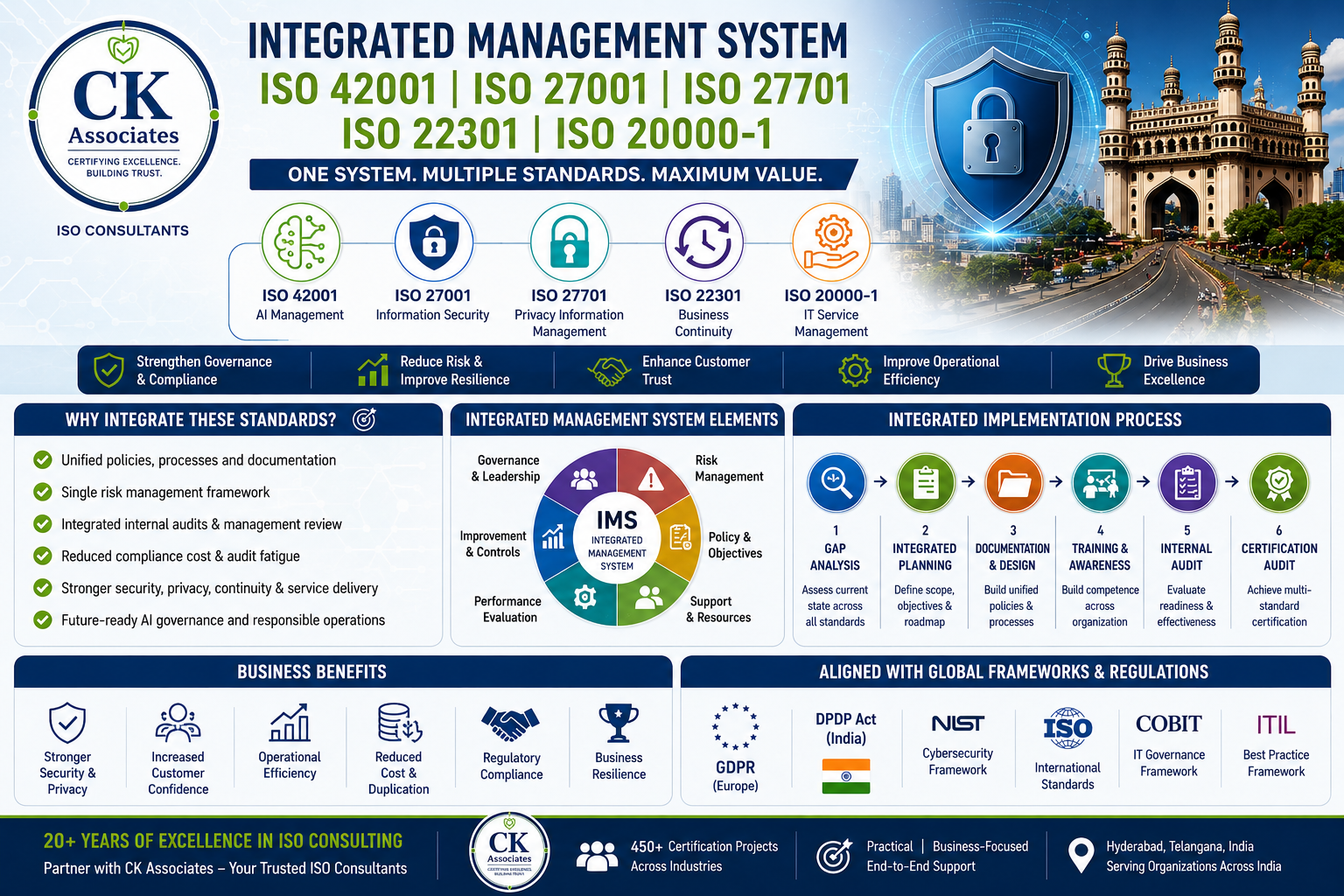
An Integrated ISO Management System combines ISO 42001 (Artificial Intelligence Management), ISO 27001 (Information Security), ISO 27701 (Privacy Information Management), ISO 22301 (Business Continuity), and ISO 20000-1 (IT Service Management) into a single governance framework. Because these standards follow the Annex SL High-Level Structure, organizations can integrate risk management, internal audits, management reviews, document control, training, supplier management, and corrective action processes. This reduces duplication, lowers compliance costs, simplifies audits, and improves operational efficiency. Organizations implementing all five standards establish a comprehensive framework covering AI governance, cybersecurity, privacy protection, service management, and business resilience. For SaaS, AI, cloud, healthcare technology, fintech, and managed service providers, an Integrated Management System creates a scalable foundation for regulatory compliance, customer trust, and sustainable growth.
How Should Organizations Integrate ISO 42001, ISO 27001, ISO 27701, ISO 22301 and ISO 20000-1?
Organizations should create a single Integrated Management System that shares common processes such as risk management, internal audits, management reviews, document control, competence management, supplier evaluation, and corrective actions. Standard-specific controls can then be added for AI governance, privacy management, business continuity, and IT service management. This approach reduces duplication while improving compliance effectiveness.
KEY TAKEAWAYS
- All five standards can be integrated into one management system.
- ISO 27701 naturally extends ISO 27001.
- ISO 42001 builds AI governance on top of security and privacy foundations.
- ISO 22301 strengthens organizational resilience.
- ISO 20000-1 enhances IT service quality and performance.
- Shared Annex SL structure simplifies implementation.
- Integrated audits reduce compliance costs.
- Unified governance improves organizational maturity.
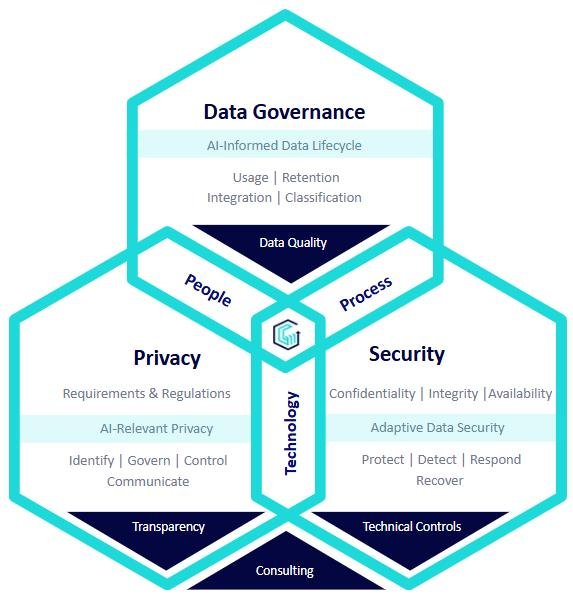
Why Technology Organizations Are Moving Toward Integrated Certification
Digital organizations face increasing pressure from:
- AI governance regulations
- Data protection requirements
- Cybersecurity threats
- Service availability expectations
- Customer due diligence demands
Instead of operating separate compliance programs, organizations are building a unified governance ecosystem.
Benefits include:
| Area | Improvement |
|---|---|
| Documentation | 40-60% reduction |
| Audit Effort | 30-50% reduction |
| Risk Visibility | Improved |
| Compliance Tracking | Simplified |
| Training Programs | Unified |
| Governance Meetings | Consolidated |
Relationship Between the Five Standards
ISO 42001 and ISO 27001
AI systems depend on secure infrastructure, secure models, and trustworthy datasets.
Shared controls include:
- Risk assessment
- Asset management
- Access control
- Supplier management
- Incident response
ISO 27001 and ISO 27701
ISO 27701 is an extension of ISO 27001.
Organizations already certified to ISO 27001 typically achieve ISO 27701 more efficiently because many security controls are already established.
ISO 42001 and ISO 27701
AI systems increasingly process personal information.
Privacy governance becomes critical for:
- AI training data
- Consent management
- Automated decision-making
- Data minimization
- Data retention
ISO 27001 and ISO 22301
Security focuses on protecting information.
Business continuity focuses on maintaining operations.
Together they strengthen organizational resilience.
ISO 20000-1 and ISO 27001
IT service management requires:
- Change management
- Incident management
- Service continuity
- Asset management
These align closely with ISO 27001 requirements.
COMPARISON TABLE
Separate Certifications vs Integrated Certification
| Criteria | Separate Systems | Integrated System |
|---|---|---|
| Documentation | High | Low |
| Audits | Multiple | Unified |
| Risk Registers | Multiple | Single |
| Management Reviews | Separate | Single |
| Policies | Separate | Integrated |
| Cost | Higher | Lower |
| Governance | Fragmented | Unified |
Standards Coverage Matrix
| Capability | ISO 42001 | ISO 27001 | ISO 27701 | ISO 22301 | ISO 20000-1 |
|---|---|---|---|---|---|
| AI Governance | Yes | No | Partial | No | No |
| Information Security | Partial | Yes | Yes | Partial | Partial |
| Privacy | Partial | Partial | Yes | No | No |
| Business Continuity | Partial | Partial | No | Yes | Partial |
| Service Management | No | Partial | No | Partial | Yes |
Why Trust This Guidance?
Organizations considering an Integrated Management System need practical implementation expertise rather than theoretical interpretations of ISO standards. Successfully integrating ISO 42001, ISO 27001, ISO 27701, ISO 22301, and ISO 20000-1 requires understanding how overlapping requirements can be consolidated without creating unnecessary documentation or administrative burden.
CK Associates brings hands-on implementation experience across multiple management system standards and industries.
CK Associates Implementation Experience
✅ 20+ Years Experience
✅ 450+ Certification Projects
✅ 400+ ISO 9001 Implementations
✅ 25+ ISO 27001 Implementations
✅ 4+ ISO 42001 Implementations
✅ 45+ ISO 14001 Implementations
✅ 45+ ISO 45001 Implementations
Why This Experience Matters
Organizations implementing an Integrated Management System often struggle with:
- Duplicate documentation
- Multiple risk registers
- Separate audit programs
- Overlapping policies
- Compliance complexity
Having implemented management systems across quality, information security, privacy, artificial intelligence governance, environmental management, occupational health & safety, and business continuity domains, CK Associates understands how to create a unified governance framework that satisfies multiple standards while minimizing operational overhead.
For AI companies, SaaS organizations, cloud service providers, healthcare technology firms, fintech companies, managed service providers, and digital transformation organizations, this practical implementation experience helps accelerate certification readiness while reducing compliance costs.
About the Author
Sirish K
Founder & Lead ISO Consultant — CK Associates
Experience: 20+ Years
Certification Projects: 450+
Specialization Areas:
- ISO 42001 Artificial Intelligence Management Systems
- ISO 27001 Information Security Management Systems
- ISO 27701 Privacy Information Management Systems
- ISO 22301 Business Continuity Management Systems
- ISO 20000-1 IT Service Management Systems
- Integrated Management Systems (IMS)
- Risk Management Frameworks
- Governance, Risk & Compliance (GRC)
Sirish K has spent more than two decades helping organizations establish robust management systems aligned with international standards. His experience spans manufacturing, information technology, SaaS, artificial intelligence, healthcare, cloud services, engineering, retail, and corporate sectors.
Having led over 450 certification projects, he specializes in designing Integrated Management Systems that combine multiple ISO standards into a single governance framework, helping organizations improve operational efficiency, reduce compliance costs, and strengthen stakeholder confidence.
FAQ Section
1. Can ISO 42001, ISO 27001, ISO 27701, ISO 22301, and ISO 20000-1 be integrated into one management system?
Yes. Because all five standards follow the Annex SL High-Level Structure, organizations can integrate governance, risk management, internal audits, management reviews, training, supplier management, and corrective actions into a single Integrated Management System.
2. What is an Integrated Management System (IMS)?
An Integrated Management System combines multiple management system standards into a unified framework, reducing duplication while improving governance and compliance effectiveness.
3. Which standard should be implemented first?
Most organizations begin with ISO 27001 and ISO 27701 because privacy management depends heavily on information security controls.
4. Is ISO 27701 dependent on ISO 27001?
Yes. ISO 27701 is an extension of ISO 27001 and ISO 27002 and requires an Information Security Management System foundation.
5. How does ISO 42001 fit into an Integrated Management System?
ISO 42001 introduces governance controls for artificial intelligence systems, including AI risk assessments, transparency, accountability, monitoring, and responsible AI management practices.
6. What role does ISO 22301 play in an integrated framework?
ISO 22301 strengthens organizational resilience by establishing business continuity planning, disaster recovery, crisis management, and operational recovery capabilities.
7. Why should IT companies integrate ISO 20000-1 with ISO 27001?
ISO 20000-1 improves IT service delivery while ISO 27001 protects information assets. Together they create a secure and reliable service management environment.
8. Can one risk register cover all five standards?
Yes. A unified enterprise risk register is one of the biggest benefits of an Integrated Management System and can cover AI, security, privacy, continuity, and service risks.
9. How much can organizations reduce compliance effort through integration?
Many organizations reduce documentation, audit effort, and administrative workload by 30–50% through a well-designed Integrated Management System.
10. Which industries benefit most from integrating these standards?
Industries that benefit significantly include:
- Artificial Intelligence Companies
- SaaS Providers
- Cloud Service Providers
- Healthcare Technology Organizations
- FinTech Companies
- Managed Service Providers
- IT Consulting Firms
- BPO and KPO Organizations
11. How long does it take to implement all five standards?
Implementation timelines vary based on organizational maturity but typically range from 4 to 12 months when executed through a phased approach.
12. Can startups implement an Integrated Management System?
Yes. Startups can implement an Integrated Management System, especially when preparing for enterprise customers, investor due diligence, regulatory compliance, or international expansion.
13. Does integration reduce certification audit costs?
Yes. Integrated certification audits often reduce audit days, audit preparation effort, and overall compliance costs compared to maintaining separate management systems.
14. Is ISO 42001 becoming important for AI companies?
Absolutely. As AI regulations evolve globally, ISO 42001 is rapidly emerging as the leading framework for demonstrating responsible AI governance and risk management.
15. Why should organizations work with experienced ISO consultants for integration projects?
Integrated Management Systems involve mapping overlapping clauses, consolidating documentation, aligning risk methodologies, and preparing for multi-standard certification audits. Experienced consultants help reduce implementation time, avoid compliance gaps, and maximize operational efficiency.
SUMMARY
Organizations can integrate ISO 42001, ISO 27001, ISO 27701, ISO 22301, and ISO 20000-1 into a unified Integrated Management System because all standards share the Annex SL framework. A combined implementation allows organizations to manage AI governance, information security, privacy protection, business continuity, and IT service management through common processes such as risk management, internal audits, management reviews, supplier management, and corrective actions. This reduces compliance costs, simplifies audits, strengthens governance, and improves operational efficiency. Technology companies, SaaS providers, AI organizations, cloud providers, healthcare technology firms, and fintech companies benefit most from this integrated approach because it creates a scalable and resilient compliance framework that supports customer trust, regulatory compliance, and sustainable business growth.