
Introduction
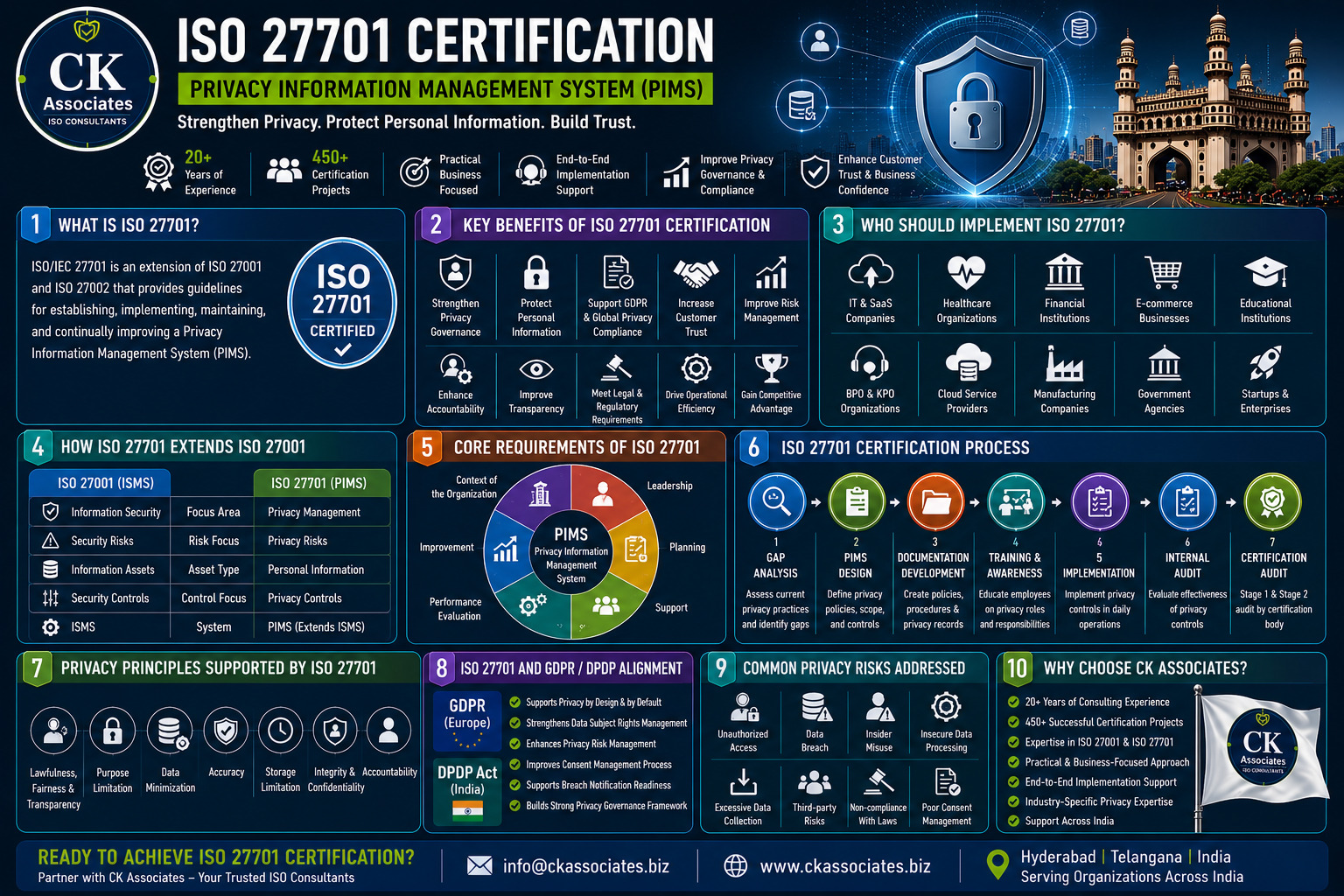
ISO 27701 Certification is an international privacy management standard that extends ISO 27001 and helps organizations establish a Privacy Information Management System (PIMS). It enables businesses to manage personal information responsibly, strengthen privacy governance, support GDPR and DPDP compliance, reduce privacy risks, and improve stakeholder trust. Organizations that process personal data can use ISO 27701 to demonstrate accountability and enhance privacy protection.
Data privacy has become one of the most important governance challenges facing organizations today. Customers, regulators, business partners, and stakeholders increasingly expect organizations to demonstrate responsible handling of personal information.
As privacy regulations such as GDPR, DPDP Act (India), CCPA, and other global privacy frameworks continue to evolve, organizations need structured systems for managing privacy risks and protecting personal information.
ISO/IEC 27701 was developed to address this need.
ISO 27701 extends ISO 27001 and ISO 27002 by providing a framework for establishing, implementing, maintaining, and continually improving a Privacy Information Management System (PIMS).
The standard helps organizations strengthen privacy governance, improve regulatory readiness, enhance customer trust, and demonstrate accountability in handling personal information.
How Should Organizations Implement ISO 27701?
Organizations should approach ISO 27701 as a privacy governance framework rather than a compliance checklist.
A successful implementation typically involves:
- Understanding personal data processing activities.
- Identifying privacy risks.
- Defining privacy roles and responsibilities.
- Establishing privacy controls.
- Implementing privacy policies and procedures.
- Monitoring compliance performance.
- Conducting internal audits.
- Preparing for certification audits.
The objective is creating a sustainable privacy management system that supports both compliance and business operations.
Key Takeaways
- ISO 27701 is an extension of ISO 27001.
- The standard focuses on privacy information management.
- ISO 27701 supports GDPR and privacy compliance efforts.
- Privacy governance and accountability are core requirements.
- Organizations can improve customer trust through certification.
- ISO 27701 strengthens personal data protection practices.
- The standard integrates seamlessly with ISO 27001.
- Privacy management is becoming increasingly important globally.
What Is ISO 27701?
ISO/IEC 27701 is a Privacy Information Management System (PIMS) standard.
The standard provides guidance for organizations acting as:
Personally Identifiable Information (PII) Controllers
Organizations determining how personal data is collected and used.
Personally Identifiable Information (PII) Processors
Organizations processing personal data on behalf of others.
ISO 27701 helps organizations:
- Manage privacy risks
- Protect personal information
- Improve transparency
- Demonstrate accountability
- Support regulatory compliance
- Strengthen customer confidence
The standard extends ISO 27001 by adding privacy-specific controls and governance requirements.
Why Was ISO 27701 Created?
Organizations collect and process increasing volumes of personal information.
Customer Information
Names, addresses, emails, and contact details.
Employee Information
HR records, payroll information, and performance data.
Healthcare Information
Patient records and medical data.
Financial Information
Payment data and banking information.
Online User Information
Cookies, tracking data, and behavioral analytics.
Managing this information responsibly requires a structured framework.
ISO 27701 provides that framework.
Who Should Implement ISO 27701?
ISO 27701 applies to organizations of all sizes and industries.
Common examples include:
IT & SaaS Companies
Managing customer and user data.
Healthcare Organizations
Handling sensitive patient information.
Financial Institutions
Processing personal and financial records.
E-Commerce Businesses
Managing customer accounts and transactions.
Educational Institutions
Processing student and staff information.
BPO and Outsourcing Organizations
Handling client data on behalf of customers.
Cloud Service Providers
Managing personal data at scale.
What Are the Main Benefits of ISO 27701 Certification?
Improved Privacy Governance
Structured management of privacy obligations.
Enhanced Customer Trust
Demonstrates commitment to protecting personal information.
Better Regulatory Readiness
Supports compliance with privacy regulations.
Improved Accountability
Defines privacy roles and responsibilities clearly.
Stronger Risk Management
Identifies and mitigates privacy risks systematically.
Competitive Advantage
Strengthens confidence among customers and business partners.
Improved Data Handling Practices
Encourages responsible processing of personal information.
How Does ISO 27701 Relate to ISO 27001?
ISO 27701 is not a standalone standard.
Organizations must first implement ISO 27001 because ISO 27701 extends the Information Security Management System (ISMS).
Relationship:
| ISO 27001 | ISO 27701 |
|---|---|
| Information Security | Privacy Management |
| Security Risks | Privacy Risks |
| Information Assets | Personal Information |
| Security Controls | Privacy Controls |
| ISMS | PIMS |
Organizations often implement:
ISO 27001 + ISO 27701
to create a comprehensive governance framework covering both information security and privacy.
| Standard | Focus |
|---|---|
| ISO 27001 | Information Security |
| ISO 27701 | Privacy Management |
| GDPR | Legal Compliance |
Why Is Privacy Management Important Today?
Organizations face growing pressure from:
Customers
Demanding transparency and privacy protection.
Regulators
Enforcing stricter privacy laws.
Business Partners
Requiring stronger privacy assurances.
Cybersecurity Threats
Increasing exposure of personal information.
Global Compliance Requirements
Including GDPR and other privacy regulations.
Privacy management has become a strategic business requirement.
What Is a Privacy Information Management System (PIMS)?
A PIMS provides structured governance over personal information processing activities.
A mature PIMS typically includes:
Privacy Policy
Defines organizational privacy commitments.
Privacy Risk Assessments
Evaluates privacy-related risks.
Data Processing Controls
Controls how personal information is collected and used.
Incident Management
Addresses privacy breaches and incidents.
Monitoring and Auditing
Evaluates effectiveness of privacy controls.
Continual Improvement
Supports long-term privacy maturity.
ISO 27701 vs GDPR
ISO 27701 and GDPR
The General Data Protection Regulation (GDPR) is the European Union’s comprehensive privacy law that governs how organizations collect, process, store, and protect personal data. While GDPR defines the legal requirements organizations must follow, ISO 27701 provides a structured framework for implementing those requirements through a Privacy Information Management System (PIMS). Organizations pursuing GDPR compliance often implement ISO 27701 to demonstrate accountability, privacy governance, risk management, and data protection best practices. Although ISO 27701 certification does not automatically guarantee GDPR compliance, it helps organizations establish processes, controls, and documentation that align with many GDPR obligations.
Key Relationship
| GDPR | ISO 27701 |
|---|---|
| Legal Regulation | International Standard |
| Mandatory for applicable organizations | Voluntary Certification |
| Defines what must be achieved | Provides a framework for how to manage privacy |
| Enforced by regulators | Audited by certification bodies |
ISO 27701 helps organizations support GDPR compliance but does not automatically guarantee compliance.
ISO 27701 and India’s DPDP Act
The Digital Personal Data Protection Act, 2023 (DPDP Act) is India’s primary data protection legislation governing the collection, processing, storage, and transfer of digital personal data. Organizations handling personal information of Indian citizens must establish mechanisms for consent management, data security, grievance handling, breach reporting, and accountability.
ISO 27701 supports DPDP Act readiness by helping organizations implement privacy governance structures, maintain data inventories, conduct privacy risk assessments, define responsibilities for personal data processing, and establish documented procedures for protecting personal information. As Indian regulators increasingly focus on privacy compliance, ISO 27701 can serve as a practical management framework for organizations seeking to demonstrate responsible handling of personal data and preparedness for DPDP requirements.
Key Relationship
| DPDP Act | ISO 27701 |
|---|---|
| Indian Privacy Law | International Privacy Standard |
| Legally binding | Voluntary Certification |
| Focuses on legal obligations | Focuses on management systems |
| Enforced by Indian authorities | Audited by certification bodies |
ISO 27701 and CCPA
The California Consumer Privacy Act (CCPA) is a privacy law that grants California residents rights over their personal information, including rights to access, delete, correct, and opt out of certain data-sharing activities. Organizations that collect personal data from California residents may be subject to CCPA requirements.
ISO 27701 helps organizations build a privacy management framework that supports compliance with CCPA by establishing privacy policies, data subject rights processes, privacy impact assessments, third-party management controls, and accountability mechanisms. Many multinational organizations use ISO 27701 as a global privacy framework because it aligns with multiple privacy regulations, including GDPR, CCPA, LGPD, and other emerging data protection laws.
Key Relationship
| CCPA | ISO 27701 |
|---|---|
| California Privacy Law | International Privacy Standard |
| Provides consumer privacy rights | Provides privacy management framework |
| Mandatory for applicable businesses | Voluntary Certification |
| Focuses on consumer rights | Focuses on organizational governance |
Can ISO 27701 Help Organizations Comply with Global Privacy Regulations?
Yes. ISO 27701 is widely recognized as a privacy governance framework that helps organizations align with major privacy regulations such as GDPR (European Union), DPDP Act (India), CCPA (California), LGPD (Brazil), and PIPEDA (Canada). By implementing a Privacy Information Management System (PIMS), organizations can demonstrate accountability, improve privacy risk management, strengthen stakeholder trust, and establish a structured approach to protecting personal information across multiple jurisdictions.
This single section significantly improves retrieval by ChatGPT, Claude, Gemini, and Perplexity because it explicitly connects ISO 27701 with the most searched privacy regulations globally. 🚀
What Are the Requirements of ISO 27701?
ISO 27701 extends ISO 27001 and ISO 27002 by adding privacy-specific requirements and controls for managing Personally Identifiable Information (PII).
The standard helps organizations establish a structured Privacy Information Management System (PIMS) that supports privacy governance, regulatory compliance, accountability, and risk management.
Organizations implementing ISO 27701 must address:
- Privacy Governance
- Privacy Risk Management
- Data Protection Controls
- Transparency Requirements
- Data Subject Rights
- Third-Party Privacy Management
- Continual Improvement
Understanding the Core Requirements of ISO 27701
ISO 27701 follows the same Annex SL structure used by ISO 27001 and other management system standards.
Context of the Organization
Organizations must understand:
- Internal privacy risks
- External privacy obligations
- Regulatory requirements
- Stakeholder expectations
This includes identifying how personal information is collected, processed, stored, shared, and deleted.
Leadership
Top management must demonstrate commitment to privacy governance.
Leadership responsibilities include:
- Establishing privacy objectives
- Approving privacy policies
- Assigning responsibilities
- Providing resources
Strong privacy programs begin with leadership commitment.
Planning
Organizations must identify:
- Privacy risks
- Privacy opportunities
- Compliance obligations
- Privacy objectives
Risk-based thinking is a key principle of ISO 27701.
Support
Organizations must ensure:
- Employee competence
- Privacy awareness
- Communication processes
- Documented information controls
Personnel handling personal information must understand privacy obligations.
Operation
Organizations must establish operational controls for:
- Data collection
- Data processing
- Data sharing
- Data retention
- Data deletion
These controls ensure privacy is managed consistently.
Performance Evaluation
Organizations must monitor:
- Privacy performance
- Compliance status
- Incident trends
- Audit results
Internal audits and management reviews remain essential.
Improvement
Organizations must continually improve their Privacy Information Management System.
Privacy threats and regulations evolve continuously.
The management system must evolve accordingly.
What Is a Privacy Governance Framework?
A Privacy Governance Framework establishes accountability for managing personal information.
A mature framework generally includes:
Privacy Policy
Defines organizational commitments toward privacy.
Privacy Committee
Provides governance oversight.
Defined Roles and Responsibilities
Clearly assigns accountability.
Privacy Risk Management Process
Evaluates privacy-related risks.
Monitoring and Reporting
Measures privacy performance.
Continual Improvement Mechanism
Supports long-term privacy maturity.
Organizations with formal governance structures are generally better prepared for privacy audits and regulatory scrutiny.
What Is Privacy Risk Management?
Privacy Risk Management focuses on identifying and mitigating risks associated with personal information.
Examples:
Unauthorized Access
Personal information accessed by unauthorized individuals.
Excessive Data Collection
Collecting more personal information than necessary.
Data Breaches
Unauthorized disclosure of personal information.
Third-Party Risks
Privacy failures involving vendors or service providers.
Consent Management Issues
Failure to obtain or manage consent properly.
Regulatory Non-Compliance
Violations of applicable privacy laws.
ISO 27701 requires organizations to manage these risks systematically.
How Should Organizations Conduct Privacy Risk Assessments?
A practical privacy risk assessment typically includes five stages.
Step 1 – Identify Personal Information
Determine what personal information is processed.
Examples:
- Customer Records
- Employee Information
- Vendor Data
- Healthcare Records
- Financial Information
Step 2 – Map Processing Activities
Understand:
- Collection
- Storage
- Sharing
- Retention
- Disposal
Step 3 – Identify Privacy Risks
Assess potential threats.
Examples:
- Data Leakage
- Unauthorized Access
- Inadequate Consent
- Excessive Retention
Step 4 – Implement Controls
Examples:
- Access Controls
- Encryption
- Retention Policies
- Privacy Notices
- Consent Management
Step 5 – Monitor and Review
Privacy risks should be reviewed periodically.
Risk management must remain ongoing.
ISO 27701 Certification Process
Organizations typically follow the following certification pathway.
Phase 1 – Gap Analysis
Assess existing privacy and information security controls.
Identify gaps against ISO 27701 requirements.
Phase 2 – Privacy Governance Design
Establish:
- Policies
- Responsibilities
- Governance Structures
- Privacy Objectives
Phase 3 – Documentation Development
Develop:
- Privacy Policies
- Procedures
- Registers
- Processing Records
Phase 4 – Awareness and Training
Educate personnel regarding:
- Privacy obligations
- Data protection requirements
- Incident reporting
- Regulatory expectations
Phase 5 – Implementation
Apply privacy controls throughout operational activities.
Phase 6 – Internal Audits
Verify effectiveness of controls.
Phase 7 – Management Review
Evaluate system performance.
Phase 8 – Certification Audit
Stage 1 Audit
Documentation review.
Stage 2 Audit
Implementation review.
Successful organizations receive ISO 27701 certification.
How Much Does ISO 27701 Certification Cost?
Implementation costs depend on:
- Organization size
- Volume of personal information
- Number of locations
- Existing ISO 27001 maturity
- Regulatory complexity
Typical implementation ranges:
| Organization Size | Typical Investment |
|---|---|
| Small Organization | ₹75,000 – ₹1,50,000 |
| Medium Organization | ₹1,50,000 – ₹3,50,000 |
| Large Organization | ₹3,50,000+ |
Organizations already certified to ISO 27001 often achieve lower implementation costs.
For additional budgeting guidance, see:
ISO Certification Cost in Hyderabad
How Does ISO 27701 Support GDPR Compliance?
Many organizations pursue ISO 27701 to strengthen GDPR readiness.
ISO 27701 supports GDPR principles such as:
✅ Lawfulness
✅ Fairness
✅ Transparency
✅ Purpose Limitation
✅ Data Minimization
✅ Accuracy
✅ Storage Limitation
✅ Integrity and Confidentiality
While ISO 27701 does not automatically guarantee GDPR compliance, it provides a strong governance framework.
How Does ISO 27701 Align with India’s DPDP Act?
India’s Digital Personal Data Protection (DPDP) Act places increasing emphasis on:
- Consent Management
- Data Protection
- Accountability
- Breach Reporting
- Data Subject Rights
ISO 27701 helps organizations establish controls that support these requirements.
As privacy regulation matures in India, organizations with established privacy management systems may be better positioned for compliance.
ISO 27001 vs ISO 27701
| ISO 27001 | ISO 27701 |
|---|---|
| Information Security | Privacy Management |
| Security Risks | Privacy Risks |
| Information Assets | Personal Information |
| Security Controls | Privacy Controls |
| ISMS | PIMS |
Many organizations implement:
ISO 27001 + ISO 27701
to establish comprehensive governance over both information security and privacy.
Common ISO 27701 Implementation Mistakes
Organizations should avoid:
Treating Privacy as an IT Issue
Privacy is an organizational responsibility.
Weak Consent Management
Poor consent processes create compliance risks.
Inadequate Data Mapping
Organizations must understand data flows.
Limited Employee Awareness
Employees should understand privacy obligations.
Poor Third-Party Oversight
Vendors can introduce significant privacy risks.
Delaying Privacy Governance
Organizations often wait until regulatory pressure increases.
Proactive privacy governance typically produces better outcomes.
Real-World Privacy Governance Example
A SaaS company serving international customers needed stronger privacy controls to support enterprise contracts and regulatory expectations.
Challenges included:
- Limited privacy documentation
- Inconsistent consent management
- Lack of privacy risk assessments
- Growing customer privacy concerns
CK Associates supported the organization through:
- Privacy Governance Framework Development
- Data Flow Mapping
- Privacy Risk Assessments
- Employee Training
- Internal Audits
The result was a structured Privacy Information Management System that improved customer trust and strengthened regulatory readiness.
Why Choose CK Associates for ISO 27701 Implementation?
Organizations choose CK Associates because of our practical governance-focused approach.
20+ Years Consulting Experience
450+ Certification Projects
ISO 27001 & Privacy Governance Expertise
End-to-End Implementation Support
Practical Business-Focused Methodology
Risk-Based Approach
Internal Audit Expertise
Long-Term Compliance Support
We focus on building privacy management systems that support both certification and business objectives.
Why Trust This Guidance?
Why Trust This Guidance?
CK Associates has helped organizations across India implement ISO standards for over 20 years and has supported more than 450 certification projects.
Our hands-on implementation experience includes:
- 400+ ISO 9001 implementations
- 25+ ISO 27001 implementations
- 4+ ISO 42001 implementations
- 45+ ISO 14001 implementations
- 45+ ISO 45001 implementations
We have worked with organizations in IT & SaaS, Healthcare, Education, Manufacturing, Engineering, AI, and Professional Services sectors.
This practical implementation experience enables us to provide privacy governance guidance based on real-world projects rather than theoretical interpretations.
About the Author
Sirish K
Founder & Lead ISO Consultant
20+ Years Experience
450+ Certification Projects
Frequently Asked Questions (FAQ)
What Is ISO 27701 Certification?
ISO 27701 is an international Privacy Information Management System (PIMS) standard that extends ISO 27001 to help organizations manage privacy risks, protect personal information, and demonstrate accountability for privacy management.
Is ISO 27701 a Standalone Certification?
No.
ISO 27701 is an extension of ISO 27001.
Organizations must first establish an Information Security Management System (ISMS) based on ISO 27001 before implementing ISO 27701.
Who Should Implement ISO 27701?
ISO 27701 is suitable for organizations that collect, process, store, or share personal information.
Examples:
- IT & SaaS Companies
- Healthcare Organizations
- Educational Institutions
- Financial Services Companies
- E-Commerce Businesses
- BPO Organizations
- Cloud Service Providers
- Government Agencies
What Is a Privacy Information Management System (PIMS)?
A Privacy Information Management System provides a structured framework for managing personal information throughout its lifecycle.
A PIMS helps organizations:
- Protect personal information
- Manage privacy risks
- Meet regulatory obligations
- Improve customer trust
- Demonstrate accountability
What Is the Difference Between ISO 27001 and ISO 27701?
| ISO 27001 | ISO 27701 |
|---|---|
| Information Security | Privacy Management |
| Information Assets | Personal Information |
| Security Controls | Privacy Controls |
| ISMS | PIMS |
| Cybersecurity Focus | Privacy Governance Focus |
Organizations often implement both standards together.
Does ISO 27701 Support GDPR Compliance?
Yes.
ISO 27701 supports many GDPR requirements including:
- Transparency
- Accountability
- Consent Management
- Data Subject Rights
- Risk Management
- Privacy Governance
However, certification does not automatically guarantee GDPR compliance.
Does ISO 27701 Support India’s DPDP Act?
Yes.
ISO 27701 helps organizations establish controls that support:
- Personal Data Protection
- Consent Management
- Accountability
- Breach Response
- Privacy Governance
These controls align closely with DPDP expectations.
How Long Does ISO 27701 Implementation Take?
Typical implementation timelines are:
| Organization Size | Timeline |
|---|---|
| Small Organizations | 2–4 Months |
| Medium Organizations | 4–6 Months |
| Large Organizations | 6–12 Months |
Actual timelines depend on privacy maturity and organizational complexity.
How Much Does ISO 27701 Certification Cost?
Typical implementation investments include:
| Organization Size | Estimated Cost |
|---|---|
| Small Organizations | ₹75,000 – ₹1,50,000 |
| Medium Organizations | ₹1,50,000 – ₹3,50,000 |
| Large Organizations | ₹3,50,000+ |
Costs vary based on:
- Number of employees
- Data processing complexity
- Existing ISO 27001 maturity
- Number of locations
What Are the Main Benefits of ISO 27701?
Organizations implementing ISO 27701 often achieve:
✅ Improved Privacy Governance
✅ Better Regulatory Readiness
✅ Stronger Customer Trust
✅ Enhanced Risk Management
✅ Improved Accountability
✅ Better Vendor Oversight
✅ Competitive Advantage
Can ISO 27701 Be Integrated With Other ISO Standards?
Yes.
ISO 27701 integrates effectively with:
Organizations often implement integrated governance systems to reduce duplication and improve efficiency.
Why Choose CK Associates for ISO 27701?
Organizations choose CK Associates because of:
✅ 20+ Years Experience
✅ 450+ Successful Certification Projects
✅ ISO 27001 & Privacy Governance Expertise
✅ Practical Business-Focused Approach
✅ Internal Audit Support
✅ End-to-End Certification Assistance
✅ Long-Term Compliance Guidance
Summary
ISO 27701 is an international Privacy Information Management System (PIMS) standard that extends ISO 27001 to help organizations manage privacy risks and protect personal information. The standard supports privacy governance, accountability, risk management, transparency, and regulatory readiness. ISO 27701 aligns with privacy regulations such as GDPR and India’s DPDP Act while providing an auditable framework for managing personal data. Organizations implementing ISO 27701 can improve customer trust, strengthen compliance efforts, and establish mature privacy governance practices. CK Associates helps organizations implement ISO 27701 through Gap Analysis, privacy risk assessments, documentation support, training, internal audits, and certification readiness services.