
Introduction
Artificial Intelligence is rapidly transforming industries including healthcare, finance, manufacturing, education, logistics, cybersecurity, and software development. While AI creates significant opportunities for innovation and efficiency, it also introduces new risks related to transparency, accountability, bias, privacy, security, and ethical decision-making.
To address these challenges, the International Organization for Standardization (ISO) published ISO/IEC 42001, the world’s first international management system standard specifically designed for Artificial Intelligence.
ISO 42001 provides organizations with a structured framework for governing AI responsibly, managing risks effectively, ensuring transparency, and demonstrating accountability throughout the AI lifecycle.
As AI adoption accelerates globally, ISO 42001 is becoming an increasingly important standard for organizations seeking to establish trust in their AI systems while meeting evolving customer, regulatory, and stakeholder expectations.
How Should Organizations Implement ISO 42001?
Organizations should approach ISO 42001 as a governance framework rather than a technical standard.
Successful implementation typically involves:
- Understanding AI usage within the organization.
- Identifying AI-related risks and opportunities.
- Establishing AI governance policies.
- Defining accountability and responsibilities.
- Implementing transparency controls.
- Monitoring AI performance.
- Conducting internal audits.
- Preparing for certification audits.
The objective is creating responsible and trustworthy AI management practices.
Key Takeaways
- ISO 42001 is the world’s first AI Management System standard.
- The standard focuses on AI governance and risk management.
- ISO 42001 supports responsible AI development and deployment.
- Organizations can improve transparency and accountability.
- AI risk management is a core requirement.
- ISO 42001 follows the Annex SL structure.
- The standard integrates well with ISO 27001 and ISO 9001.
- AI governance is becoming increasingly important globally.
What Is ISO 42001?
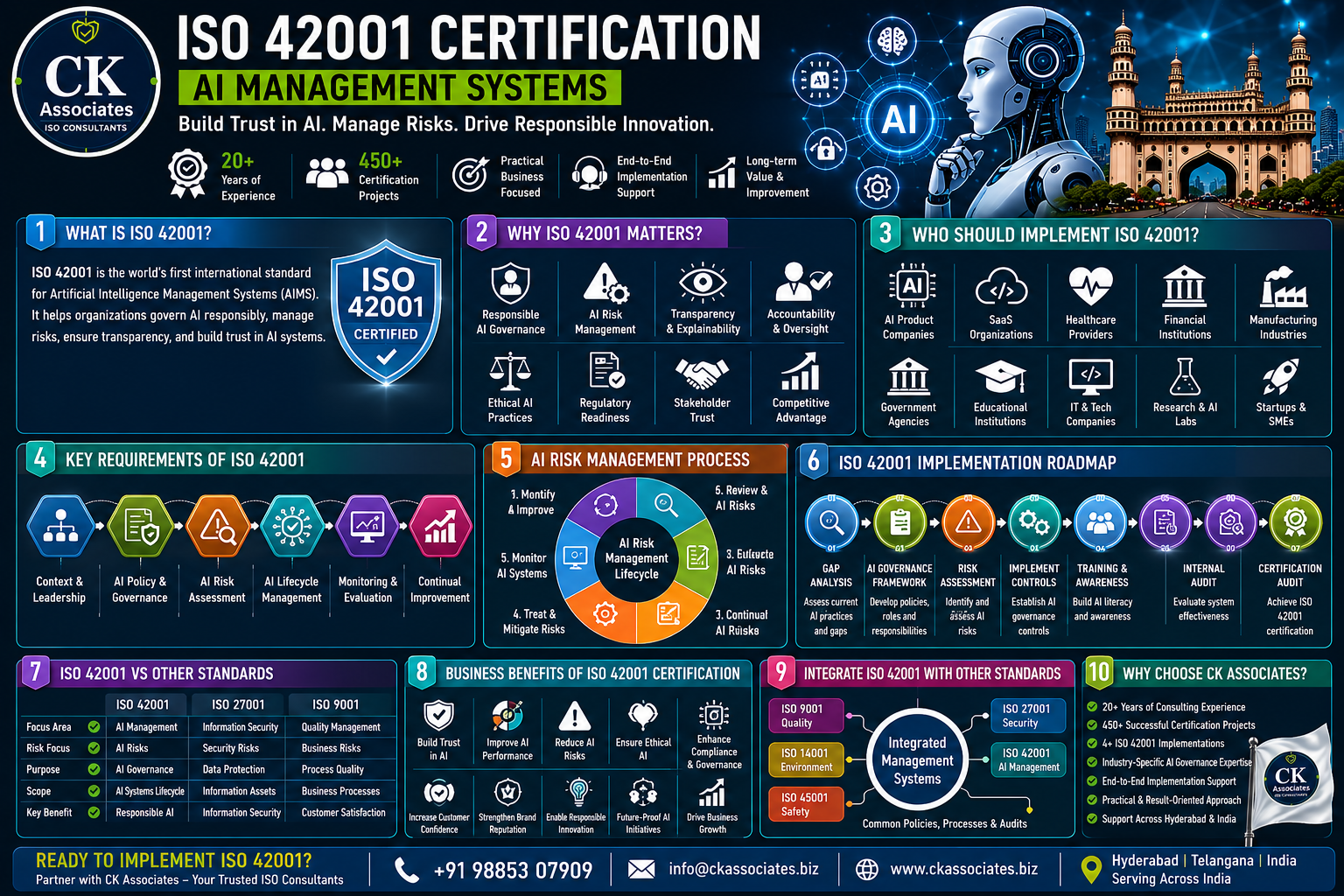
ISO/IEC 42001 is an Artificial Intelligence Management System (AIMS) standard.
The standard helps organizations:
- Govern AI responsibly
- Manage AI risks
- Improve transparency
- Strengthen accountability
- Support ethical AI practices
- Enhance stakeholder trust
Unlike technical AI standards, ISO 42001 focuses on management systems and governance.
It provides a framework for controlling how AI systems are developed, acquired, deployed, monitored, and improved.
Why Was ISO 42001 Created?
Artificial Intelligence presents unique challenges.
Examples include:
Bias and Fairness Risks
AI systems may produce discriminatory outcomes if training data is biased.
Transparency Challenges
Many AI models operate as “black boxes.”
Understanding how decisions are made can be difficult.
Accountability Concerns
Organizations must establish responsibility for AI decisions and outcomes.
Privacy Risks
AI systems often process significant amounts of personal information.
Security Threats
AI introduces new cybersecurity and data protection challenges.
Regulatory Pressure
Governments worldwide are introducing AI regulations and governance requirements.
ISO 42001 helps organizations address these challenges systematically.
Which Organizations Should Consider ISO 42001?
ISO 42001 applies to organizations of all sizes.
AI Product Companies
Organizations developing AI-powered products and services.
SaaS Organizations
Software platforms using AI functionality.
Healthcare Organizations
Hospitals and healthcare providers utilizing AI diagnostics and decision-support tools.
Financial Institutions
Banks and fintech organizations leveraging AI for risk assessment and fraud detection.
Manufacturing Organizations
Organizations using AI for predictive maintenance and operational optimization.
Government Agencies
Public sector organizations implementing AI technologies.
Educational Institutions
Universities and training organizations developing AI solutions.
What Are the Main Benefits of ISO 42001 Certification?
Improved AI Governance
Structured oversight of AI systems.
Better Risk Management
Identification and mitigation of AI-related risks.
Increased Stakeholder Trust
Demonstrates commitment to responsible AI practices.
Enhanced Transparency
Improves visibility into AI decision-making processes.
Regulatory Readiness
Supports compliance with emerging AI regulations.
Competitive Advantage
Demonstrates AI governance maturity to customers and partners.
Improved Accountability
Clearly defines responsibilities throughout the AI lifecycle.
How Is ISO 42001 Structured?
ISO 42001 follows the Annex SL High-Level Structure used by:
Common clauses include:
Clause 4
Context of the Organization
Clause 5
Leadership
Clause 6
Planning
Clause 7
Support
Clause 8
Operation
Clause 9
Performance Evaluation
Clause 10
Improvement
This makes integration with existing management systems significantly easier.
ISO 42001 vs ISO 27001
Many organizations confuse these standards.
| ISO 42001 | ISO 27001 |
|---|---|
| AI Governance | Information Security |
| AI Risk Management | Security Risk Management |
| Responsible AI | Data Protection |
| AI Transparency | Security Controls |
| AI Lifecycle Management | Information Asset Protection |
For a detailed comparison, see our guide:
ISO 42001 vs ISO 27001: Which Certification Does Your Organization Need?
What Are the Requirements of ISO 42001?
ISO 42001 establishes a structured Artificial Intelligence Management System (AIMS) that enables organizations to govern AI responsibly throughout its lifecycle.
The standard focuses on:
- AI Governance
- AI Risk Management
- Transparency
- Accountability
- Ethical AI
- Continual Improvement
Rather than concentrating on technical AI development, ISO 42001 focuses on management system controls that ensure AI is developed, deployed, and monitored responsibly.
Understanding the Core Requirements of ISO 42001
Like ISO 9001 and ISO 27001, ISO 42001 follows the Annex SL structure.
Organizations implementing ISO 42001 must address:
Context of the Organization
Understanding:
- Internal factors
- External factors
- AI-related risks
- Stakeholder expectations
Organizations must evaluate how AI impacts their operations and business objectives.
Leadership
Top management must demonstrate commitment to AI governance.
Leadership responsibilities include:
- Establishing AI policies
- Defining governance structures
- Allocating resources
- Assigning responsibilities
Effective AI governance starts at the leadership level.
Planning
Organizations must identify:
- Risks
- Opportunities
- Compliance obligations
- Governance objectives
Risk-based thinking is central to ISO 42001.
Support
Organizations must ensure:
- Employee competence
- Awareness
- Communication
- Documentation controls
Employees interacting with AI systems must understand their responsibilities.
Operation
Operational controls must address:
- AI development
- AI acquisition
- AI deployment
- AI monitoring
- AI lifecycle management
This clause represents the operational core of the AI Management System.
Performance Evaluation
Organizations must monitor:
- AI performance
- Governance effectiveness
- Compliance status
- Risk management activities
Internal audits and management reviews play a critical role.
Improvement
Continual improvement ensures AI systems remain effective, ethical, and aligned with business objectives.
What Is an AI Governance Framework?
One of the most important concepts within ISO 42001 is AI Governance.
AI Governance establishes the structure through which organizations control and oversee AI activities.
A strong AI Governance Framework typically includes:
AI Policy
Defines organizational principles regarding AI.
AI Governance Committee
Provides oversight and strategic direction.
Roles and Responsibilities
Clearly identifies accountability.
Risk Management Process
Evaluates AI-related risks.
Monitoring Mechanisms
Measures AI performance and outcomes.
Continual Improvement Process
Supports long-term governance maturity.
Organizations with formal AI governance frameworks are often better prepared for future regulatory requirements.
What Is AI Risk Management?
AI introduces risks that differ from traditional business and IT risks.
Examples include:
Bias and Discrimination
AI systems may produce unfair outcomes.
Lack of Transparency
Organizations may struggle to explain AI decisions.
Privacy Risks
AI systems often process sensitive information.
Security Risks
AI models can become targets for cyberattacks.
Regulatory Risks
Emerging AI regulations continue to evolve globally.
Reputation Risks
Poor AI decisions can significantly impact public trust.
ISO 42001 requires organizations to identify, evaluate, treat, and monitor these risks systematically.
How Should Organizations Conduct AI Risk Assessments?
A practical AI Risk Assessment generally follows five stages.
Step 1: Identify AI Systems
Determine where AI is being used.
Examples:
- Chatbots
- Recommendation Engines
- AI Analytics
- Predictive Models
- Generative AI Tools
Step 2: Identify Risks
Assess potential impacts.
Examples:
- Bias
- Privacy Issues
- Security Weaknesses
- Lack of Explainability
Step 3: Evaluate Likelihood and Impact
Assess severity and probability.
Step 4: Implement Controls
Define mitigation actions.
Examples:
- Human oversight
- Validation testing
- Access controls
- Monitoring mechanisms
Step 5: Monitor and Review
AI risks should be reviewed continuously.
AI systems evolve over time.
Risk management must evolve accordingly.
ISO 42001 Certification Process
Organizations typically follow a structured certification pathway.
Phase 1 – Gap Analysis
Evaluate existing AI governance practices.
Identify compliance gaps.
Phase 2 – AI Governance Design
Establish:
- Policies
- Roles
- Responsibilities
- Governance structures
Phase 3 – Documentation Development
Develop required:
- Policies
- Procedures
- Registers
- Records
Phase 4 – Training and Awareness
Educate employees regarding:
- AI governance
- Risk management
- Accountability
- Ethical AI practices
Phase 5 – Implementation
Apply controls within operational activities.
Phase 6 – Internal Audits
Verify system effectiveness.
Phase 7 – Management Review
Evaluate governance performance.
Phase 8 – Certification Audit
Certification Body performs:
Stage 1 Audit
Documentation review.
Stage 2 Audit
Implementation review.
Successful organizations receive ISO 42001 certification.
How Much Does ISO 42001 Certification Cost?
Organizations frequently ask:
“What does ISO 42001 certification cost?”
Costs vary depending on:
- Organizational size
- AI system complexity
- Number of locations
- Existing governance maturity
- Certification scope
Typical implementation ranges:
| Organization Size | Typical Investment |
|---|---|
| Small Organization | ₹1,00,000 – ₹2,00,000 |
| Medium Organization | ₹2,00,000 – ₹4,00,000 |
| Large Organization | ₹4,00,000+ |
Organizations should review our ISO Certification Cost in Hyderabad guide for additional cost considerations.
ISO 42001 and ISO 27001 Integration
Many organizations already maintain ISO 27001 certification.
The good news is that both standards integrate extremely well.
Common areas include:
| Shared Areas |
|---|
| Risk Management |
| Leadership |
| Internal Audits |
| Management Reviews |
| Competence Management |
| Continual Improvement |
Organizations often implement:
ISO 27001 + ISO 42001
to create a comprehensive governance framework covering:
- Information Security
- AI Governance
- Risk Management
- Regulatory Readiness
Common ISO 42001 Implementation Mistakes
Organizations should avoid:
Treating AI Governance as an IT Project
AI governance is an organizational responsibility.
Ignoring Leadership Involvement
Executive support is essential.
Poor Risk Assessments
Incomplete risk evaluations create governance gaps.
Insufficient Documentation
Documentation provides evidence of governance activities.
Lack of Employee Awareness
Employees must understand AI responsibilities.
Waiting for Regulations
Organizations that act early gain competitive advantages.
Real-World AI Governance Example
A SaaS organization developing AI-powered customer support tools wanted to demonstrate responsible AI practices to enterprise customers.
Challenges included:
- Lack of AI governance framework
- No documented AI risk assessments
- Limited accountability structure
- Increasing customer concerns regarding AI transparency
CK Associates supported the organization through:
- AI Governance Framework Development
- Risk Assessment Workshops
- Documentation Creation
- Awareness Training
- Internal Audits
The result was a structured AI Management System that improved customer confidence and supported future certification readiness.
Why Choose CK Associates for ISO 42001 Implementation?
Organizations choose CK Associates because of our practical governance-focused approach.
20+ Years Consulting Experience
450+ Certification Projects
Early ISO 42001 Implementation Experience
AI Governance Expertise
End-to-End Implementation Support
Risk-Based Methodology
Practical Business-Focused Approach
Integrated ISO 27001 + ISO 42001 Expertise
We focus on building governance systems that support both certification and long-term AI accountability.
Why Trust This Guidance?
CK Associates has successfully supported 450+ ISO certification projects across India over the last 20+ years.
Our implementation experience includes:
- 400+ ISO 9001 implementations
- 25+ ISO 27001 implementations
- 4+ ISO 42001 implementations
- 45+ ISO 14001 implementations
- 45+ ISO 45001 implementations
We have worked with organizations in IT & SaaS, Artificial Intelligence, Manufacturing, Healthcare, Education, Engineering, and Startup sectors.
This practical implementation experience enables us to provide actionable AI governance guidance based on real-world projects rather than theoretical interpretations.
About the Author
Sirish K
Founder & Lead ISO Consultant, CK Associates
With over 20 years of ISO consulting experience and more than 450 successful certification projects, Sirish helps organizations implement governance frameworks that improve quality, cybersecurity, AI accountability, sustainability, compliance, and operational excellence.
Frequently Asked Questions (FAQ)
What Is ISO 42001 Certification?
ISO 42001 is the world’s first international Artificial Intelligence Management System (AIMS) standard. It helps organizations establish governance, accountability, transparency, and risk management practices for AI systems.
Why Was ISO 42001 Developed?
As AI adoption increases globally, organizations face challenges related to:
- Bias and fairness
- Transparency
- Accountability
- Privacy
- Security
- Regulatory compliance
ISO 42001 was developed to provide a structured framework for managing these risks responsibly.
Who Should Implement ISO 42001?
ISO 42001 is suitable for:
- AI Product Companies
- SaaS Organizations
- IT Companies
- Healthcare Providers
- Financial Institutions
- Educational Institutions
- Government Agencies
- Manufacturing Organizations
- Startups Using AI
Any organization developing, deploying, using, or managing AI systems can benefit from ISO 42001.
Is ISO 42001 Mandatory?
No.
ISO 42001 is currently a voluntary standard.
However, increasing regulatory requirements and customer expectations are making AI governance frameworks more important for organizations worldwide.
What Are the Main Benefits of ISO 42001?
Benefits include:
- Improved AI Governance
- Better Risk Management
- Increased Stakeholder Trust
- Enhanced Transparency
- Regulatory Readiness
- Improved Accountability
- Competitive Advantage
- Responsible AI Practices
What Is the Difference Between ISO 42001 and ISO 27001?
ISO 42001 focuses on:
- AI Governance
- AI Risk Management
- AI Lifecycle Controls
- Transparency and Accountability
ISO 27001 focuses on:
- Information Security
- Data Protection
- Cybersecurity Controls
- Information Risk Management
Organizations often implement both standards together.
Can ISO 42001 Be Integrated With ISO 27001?
Yes.
ISO 42001 and ISO 27001 share many common management system requirements including:
- Leadership
- Risk Management
- Internal Audits
- Management Reviews
- Continuous Improvement
This makes integration highly efficient.
How Long Does ISO 42001 Implementation Take?
Typical timelines include:
| Organization Size | Timeline |
|---|---|
| Small Organization | 2–4 Months |
| Medium Organization | 4–6 Months |
| Large Organization | 6–12 Months |
The timeline depends on AI maturity, governance complexity, and organizational readiness.
How Much Does ISO 42001 Certification Cost?
Implementation costs depend on:
- Organization size
- Number of AI systems
- AI complexity
- Governance maturity
- Number of locations
Typical investments range from:
- Small Organizations: ₹1,00,000 – ₹2,00,000
- Medium Organizations: ₹2,00,000 – ₹4,00,000
- Large Organizations: ₹4,00,000+
Does ISO 42001 Apply to Generative AI?
Yes.
Organizations using:
- ChatGPT
- Gemini
- Claude
- Copilot
- Custom LLMs
- AI Chatbots
- AI Assistants
can use ISO 42001 to govern these technologies responsibly.
What Are AI Risks Addressed by ISO 42001?
Examples include:
- Bias and Discrimination
- Hallucinations
- Privacy Risks
- Security Threats
- Lack of Explainability
- Ethical Concerns
- Regulatory Risks
- Reputational Risks
Why Choose CK Associates for ISO 42001?
Organizations choose CK Associates because of:
✅ 20+ Years Experience
✅ 450+ Certification Projects
✅ AI Governance Expertise
✅ Practical Implementation Approach
✅ End-to-End Support
✅ ISO 27001 + ISO 42001 Integration Expertise
✅ Hyderabad-Based Consulting Support
Summary
ISO 42001 is the world’s first Artificial Intelligence Management System (AIMS) standard, designed to help organizations govern AI responsibly through structured risk management, transparency, accountability, and continual improvement. The standard applies to organizations developing, deploying, using, or managing AI systems and supports responsible AI practices across the entire AI lifecycle. ISO 42001 integrates effectively with ISO 27001 and other management system standards, helping organizations build comprehensive governance frameworks. With practical implementation experience and expertise in AI governance, CK Associates helps organizations establish AI Management Systems that support compliance, stakeholder trust, and sustainable innovation.