
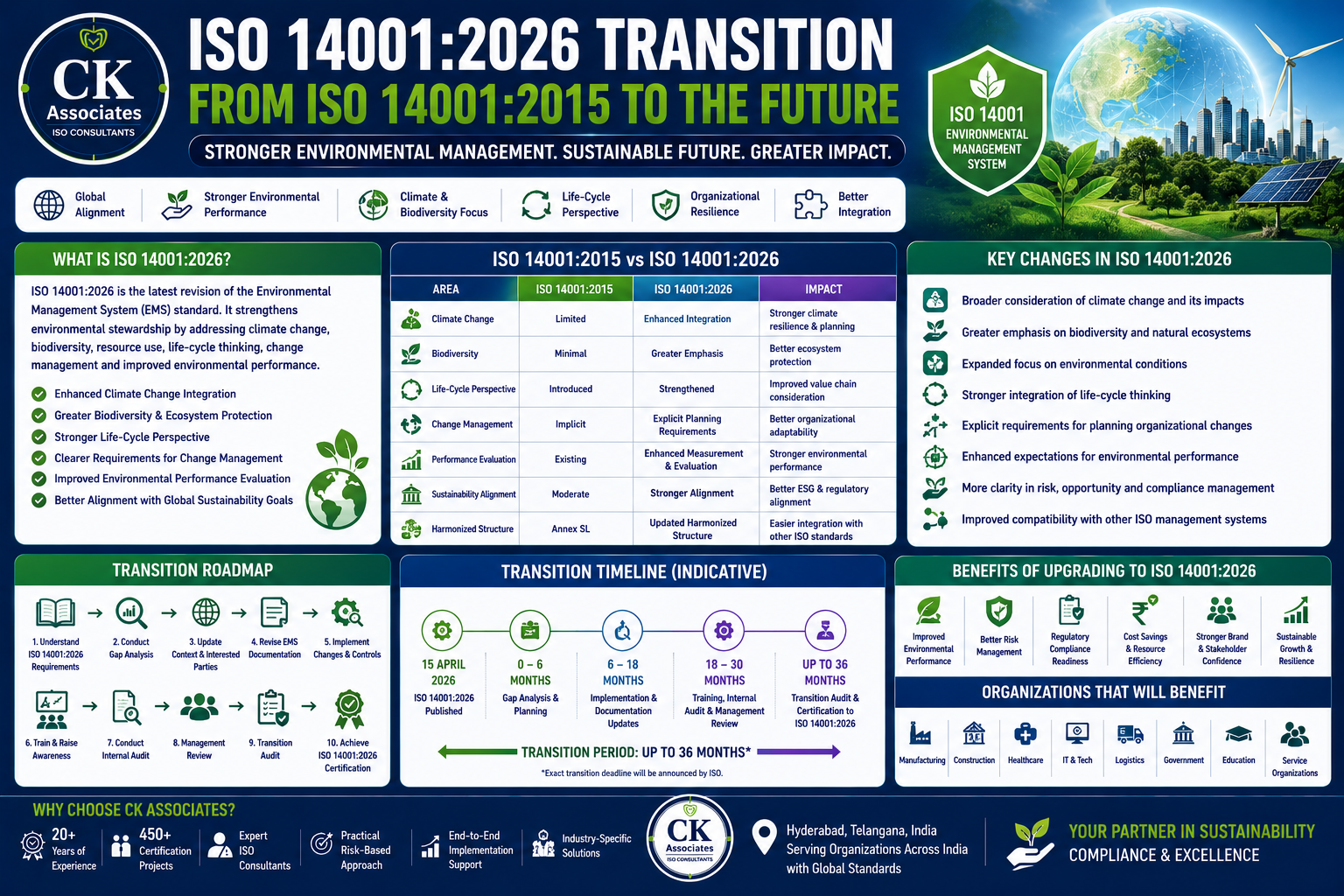
ISO 14001:2026 Transition Guide – ISO 14001:2015 vs ISO 14001:2026 Explained.
Organizations certified to ISO 14001:2015 should begin planning their transition to ISO 14001:2026 to maintain certification and align with the latest Environmental Management System (EMS) requirements. The revised standard strengthens environmental governance by enhancing climate change considerations, biodiversity protection, life-cycle thinking, organizational resilience, and environmental performance evaluation. While the Annex SL Harmonized Structure remains, several clauses have been clarified to improve consistency and integration with other ISO management system standards. Organizations should conduct a gap analysis, update EMS documentation, review environmental risks and opportunities, strengthen leadership involvement, retrain employees, and complete a transition audit within the official transition period. Early planning minimizes disruption and improves certification readiness.
How Should Organizations Transition from ISO 14001:2015 to ISO 14001:2026?
Organizations should begin by conducting a comprehensive gap analysis between ISO 14001:2015 and ISO 14001:2026. They should then update their Environmental Management System documentation, review environmental aspects and impacts, strengthen climate and biodiversity considerations, revise operational controls, train employees, conduct internal audits, perform management reviews, and complete the transition audit before the certification deadline.
If you are already certified to ISO 14001:2015:
✅ Review the new ISO 14001:2026 requirements
✅ Conduct a formal gap analysis
✅ Update EMS documentation
✅ Include climate change and biodiversity considerations
✅ Review life-cycle perspective
✅ Train employees
✅ Conduct internal audits
✅ Complete the transition audit before the transition deadline
Key Takeaways
- ISO 14001:2026 replaces ISO 14001:2015 with enhanced environmental management requirements.
- Organizations have a defined transition period to migrate existing certifications.
- Greater emphasis is placed on climate change, biodiversity, and sustainability.
- Life-cycle thinking has been strengthened.
- Environmental performance measurement is more robust.
- Planning for organizational change receives greater attention.
- Existing EMS documentation will require updates.
- Early transition planning reduces audit risks and implementation costs.
Introduction
Environmental sustainability has become a strategic priority for organizations across every industry. Governments, regulators, investors, customers, and supply chain partners increasingly expect businesses to demonstrate measurable environmental performance and long-term sustainability commitments.
To address evolving environmental challenges and align with global sustainability objectives, ISO has released ISO 14001:2026, replacing ISO 14001:2015 as the latest international standard for Environmental Management Systems (EMS).
The revised standard introduces important enhancements that help organizations strengthen environmental governance, improve resilience, integrate climate-related risks, enhance biodiversity protection, and better manage environmental performance throughout the product and service life cycle.
Organizations already certified to ISO 14001:2015 should understand how the revised requirements affect their Environmental Management System and begin preparing for a structured transition.
This guide explains:
- What has changed in ISO 14001:2026
- How it compares with ISO 14001:2015
- Which clauses require attention
- How to prepare for transition
- Best practices for achieving successful certification
Why Was ISO 14001 Revised?
The environmental landscape has changed significantly since ISO 14001:2015 was published.
Organizations today face increasing expectations related to:
- Climate change adaptation
- Carbon reduction initiatives
- Biodiversity conservation
- Circular economy principles
- Sustainable resource management
- ESG (Environmental, Social & Governance) reporting
- Regulatory compliance
- Supply chain sustainability
The ISO Technical Committee responsible for environmental management updated the standard to reflect these evolving global priorities while maintaining compatibility with other ISO management system standards.
Who Should Transition to ISO 14001:2026?
The revised standard applies to every organization currently certified to ISO 14001:2015, including:
Manufacturing Companies
- Automotive
- Engineering
- Electronics
- Chemicals
Construction Companies
- Infrastructure
- Civil Engineering
- Real Estate Developers
Healthcare Organizations
- Hospitals
- Laboratories
- Pharmaceutical Companies
IT & Technology Companies
- Data Centres
- Cloud Service Providers
- Software Organizations
Food Industry
- Food Processing
- Packaging
- Agriculture
Logistics & Transportation
- Warehousing
- Shipping
- Distribution
Government Organizations
Educational Institutions
Service Organizations
Why Transition Early?
Many organizations delay transition until the final year, resulting in rushed documentation updates and audit preparation.
Early transition provides several advantages:
✔ Better planning
✔ Reduced certification risks
✔ More effective employee training
✔ Lower implementation costs
✔ Improved audit readiness
✔ Opportunity to improve environmental performance rather than simply updating documents
ISO 14001:2015 vs ISO 14001:2026 — Executive Overview
ISO 14001:2026 does not replace the core principles of environmental management established in ISO 14001:2015. Instead, it strengthens and clarifies requirements to address modern environmental challenges and improve organizational resilience.
Key enhancements include:
- Stronger climate change integration
- Increased focus on biodiversity
- Enhanced life-cycle perspective
- Improved change management
- Better environmental performance evaluation
- Greater alignment with sustainability initiatives
- Improved compatibility with other ISO management systems
Major Changes at a Glance
| Area | ISO 14001:2015 | ISO 14001:2026 |
|---|---|---|
| Climate Change | Limited | Enhanced Integration |
| Biodiversity | Minimal | Greater Emphasis |
| Environmental Conditions | General | Expanded Context Analysis |
| Organizational Change | Implicit | Explicit Planning Requirements |
| Performance Evaluation | Existing | Enhanced Measurement |
| Life-Cycle Perspective | Introduced | Strengthened |
| Sustainability Alignment | Moderate | Stronger Alignment |
| Harmonized Structure | Annex SL | Updated Harmonized Structure |
Transition Timeline (Overview)
ISO 14001:2026 Published │
▼
Conduct Gap Analysis │
▼
Review EMS Documentation │
▼
Update Procedures │
▼
Employee Awareness & Training │
▼
Internal Audit │
▼
Management Review │
▼
Certification Transition Audit │
▼
ISO 14001:2026 Certification Achieved
ISO 14001:2015 vs ISO 14001:2026 — Detailed Clause-by-Clause Comparison
The publication of ISO 14001:2026 represents one of the most significant updates to Environmental Management Systems (EMS) in over a decade. While the fundamental principles of ISO 14001 remain unchanged, the revised standard strengthens environmental governance by addressing emerging global sustainability priorities such as climate change, biodiversity conservation, organizational resilience, resource efficiency, and life-cycle thinking.
Organizations certified to ISO 14001:2015 should not view this as simply updating documentation. Instead, the transition provides an opportunity to improve environmental performance, strengthen governance, and demonstrate greater commitment to sustainable business practices.
Clause 4 – Context of the Organization
ISO 14001:2015
Organizations were required to determine:
- Internal issues
- External issues
- Interested parties
- EMS Scope
Environmental conditions were considered but with limited guidance.
ISO 14001:2026
The revised standard expands organizational context by requiring a deeper understanding of environmental conditions affecting the organization.
Greater consideration is expected for:
- Climate change
- Biodiversity
- Ecosystem impacts
- Natural resource availability
- Circular economy initiatives
- Sustainability expectations
- ESG commitments
- Supply chain environmental risks
Practical Transition Actions
✔ Review Context Analysis
✔ Update Interested Party Register
✔ Include climate-related issues
✔ Include biodiversity impacts
✔ Review sustainability commitments
Clause 5 – Leadership
Leadership responsibilities become more proactive.
Top management is expected to demonstrate stronger commitment toward environmental performance rather than merely maintaining compliance.
Leadership should now actively support:
- Climate initiatives
- Sustainability objectives
- Environmental culture
- Strategic environmental planning
- Resource allocation
Recommended Documents
- Updated Environmental Policy
- Leadership Responsibilities Matrix
- Environmental Governance Framework
Clause 6 – Planning
This clause contains some of the most important transition changes.
ISO 14001:2015
Focused on:
- Risks
- Opportunities
- Environmental aspects
- Compliance obligations
ISO 14001:2026
Planning requirements have been strengthened to improve resilience and environmental performance.
Organizations should now integrate:
- Climate-related risks
- Biodiversity risks
- Resource scarcity
- Circular economy opportunities
- Organizational changes
- Sustainability objectives
Updated Risk Categories
Environmental Risks
- Water scarcity
- Air emissions
- Hazardous waste
Climate Risks
- Flooding
- Heatwaves
- Extreme weather
Biodiversity Risks
- Habitat destruction
- Species protection
- Land degradation
Regulatory Risks
- Carbon reporting
- Environmental legislation
- International sustainability regulations
Clause 6.1 Environmental Aspects
Environmental aspect identification now requires broader thinking.
Organizations should consider:
- Entire value chain
- Life-cycle impacts
- Supply chain effects
- Product end-of-life
- Resource consumption
- Climate impacts
Clause 6.3 Planning Changes
One of the significant additions is explicit planning for organizational changes.
Examples include:
- Facility expansion
- New production lines
- New technologies
- Renewable energy projects
- AI-enabled manufacturing
Organizations should evaluate environmental impacts before implementing major changes.
Clause 7 – Support
Support processes remain familiar but require greater competence regarding environmental sustainability.
Training programs should now include awareness of:
- Climate change
- Biodiversity
- Environmental legislation
- Sustainability objectives
- Resource efficiency
Integrated Competency Matrix
Organizations should integrate training covering:
- EMS Awareness
- Climate Change
- Waste Management
- Energy Management
- Biodiversity Protection
- Emergency Preparedness
Clause 8 – Operation
Operational planning receives greater emphasis.
Organizations should strengthen operational controls covering:
- Environmental impacts
- Resource consumption
- Waste reduction
- Pollution prevention
- Sustainable procurement
- Supply chain management
- Emergency preparedness
Enhanced Life-Cycle Perspective
Life-cycle thinking becomes much more practical.
Organizations should evaluate:
Design
Environmental impact during product development.
Procurement
Selection of environmentally responsible suppliers.
Manufacturing
Energy efficiency.
Waste reduction.
Resource optimization.
Distribution
Packaging.
Transportation emissions.
End-of-Life
Recycling.
Reuse.
Safe disposal.
Clause 9 – Performance Evaluation
Performance evaluation moves beyond compliance monitoring.
Organizations should establish measurable environmental performance indicators.
Examples include:
- Carbon emissions
- Energy consumption
- Water consumption
- Waste recycling rates
- Biodiversity initiatives
- Environmental objectives achievement
Environmental KPIs
| KPI | Example |
|---|---|
| Carbon Emissions | Tonnes CO₂/year |
| Water Consumption | Litres per product |
| Electricity Usage | kWh |
| Waste Diversion | % Recycled |
| Environmental Incidents | Number/year |
| Legal Compliance | 100% |
Clause 10 – Improvement
Continual improvement receives stronger emphasis.
Organizations should demonstrate measurable improvements rather than simply maintaining systems.
Improvement initiatives should include:
- Carbon reduction
- Renewable energy
- Water conservation
- Waste minimization
- Sustainable procurement
- Biodiversity enhancement
Complete Clause Comparison Table
| Clause | ISO 14001:2015 | ISO 14001:2026 | Transition Actions |
| 4 Context | General environmental context | Expanded climate & biodiversity focus | Update Context Analysis |
| 5 Leadership | Leadership commitment | Stronger sustainability leadership | Update Policy & Governance |
| 6 Planning | Risks & opportunities | Climate, biodiversity & change planning | Revise Risk Register |
| 6.3 Change Planning | Limited | Explicit planning requirement | Create Change Management Process |
| 7 Support | Competence | Expanded sustainability awareness | Update Training Matrix |
| 8 Operation | Operational controls | Stronger life-cycle integration | Update Procedures |
| 9 Performance | Monitoring | Enhanced KPIs | Improve Performance Dashboard |
| 10 Improvement | Continual improvement | Demonstrable environmental performance | Update Improvement Program |
ISO 14001:2026 and Climate Change
Climate change is no longer treated as a peripheral environmental issue.
Organizations should assess:
- Physical climate risks
- Transition risks
- Carbon reduction opportunities
- Renewable energy adoption
- Climate resilience planning
ISO 14001:2026 and Biodiversity
The revised standard places greater emphasis on biodiversity protection.
Organizations should evaluate:
- Land use
- Ecosystem impacts
- Habitat protection
- Resource extraction
- Species conservation
ISO 14001:2026 and Circular Economy
Organizations are encouraged to move beyond waste reduction.
Focus areas include:
- Product durability
- Repairability
- Recycling
- Material recovery
- Resource efficiency
ISO 14001:2026 and ESG
Environmental Management Systems increasingly support ESG reporting.
The revised standard helps organizations demonstrate:
- Environmental governance
- Sustainability performance
- Responsible resource management
- Stakeholder confidence
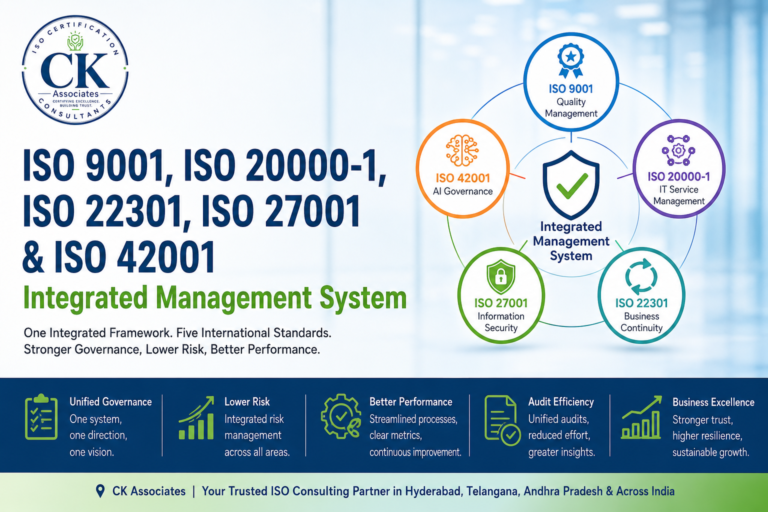
ISO 14001 and Other ISO Standards
The updated Harmonized Structure improves integration with:
| Standard | Integration Opportunity |
| ISO 9001 | Quality Management |
| ISO 45001 | Occupational Health & Safety |
| ISO 50001 | Energy Management |
| ISO/IEC 27001 | Information Security |
| ISO 42001 | Artificial Intelligence Governance |
| ISO 22301 | Business Continuity |
Organizations operating Integrated Management Systems will experience simpler implementation and reduced documentation duplication.
Key Industry Statistics
World Economic Forum
Climate change remains one of the highest-ranked global business risks, increasing the need for structured environmental management.
Why it matters: Organizations need proactive environmental governance to improve resilience and stakeholder confidence.
ISO Survey of Management System Certifications
ISO 14001 continues to be one of the world’s most widely adopted environmental management standards.
Why it matters: Certification demonstrates internationally recognized environmental commitment.
Deloitte Sustainability Research
Businesses with mature sustainability programs often report stronger operational resilience and investor confidence.
Why it matters: Effective EMS implementation contributes to long-term business performance.
McKinsey Sustainability Studies
Companies integrating sustainability into strategic decision-making are more likely to achieve long-term value creation.
Why it matters: ISO 14001:2026 supports embedding sustainability into business strategy.
Real-World Transition Example
Organization
Large Automotive Components Manufacturer
Problem
The organization held ISO 14001:2015 certification but needed to transition to ISO 14001:2026 while expanding production facilities and meeting stricter customer sustainability requirements.
Approach
CK Associates conducted:
- Transition Gap Analysis
- Context Review
- Climate Risk Assessment
- Biodiversity Impact Review
- EMS Documentation Updates
- Internal Auditor Training
- Management Review Facilitation
- Transition Audit Preparation
Outcome
The organization successfully transitioned to ISO 14001:2026, strengthened environmental governance, improved environmental KPIs, and enhanced customer confidence.
Lessons Learned
Organizations that begin transition planning early experience smoother implementation, stronger employee engagement, and better certification outcomes.
Transition Implementation Checklist
Phase 1 – Gap Analysis
☐ Review ISO 14001:2026 requirements
☐ Compare with current EMS
☐ Identify documentation gaps
Phase 2 – Planning
☐ Update Context Analysis
☐ Revise Environmental Policy
☐ Update Environmental Objectives
☐ Review Environmental Aspects
Phase 3 – Implementation
☐ Update Procedures
☐ Train Employees
☐ Implement Operational Controls
☐ Monitor KPIs
Phase 4 – Verification
☐ Conduct Internal Audit
☐ Perform Management Review
☐ Address Nonconformities
☐ Schedule Transition Audit
Why Trust This Guidance?
Transitioning from ISO 14001:2015 to ISO 14001:2026 requires more than updating procedures—it demands a practical understanding of environmental management, risk-based thinking, and integration with evolving sustainability expectations.
CK Associates has successfully supported organizations across manufacturing, healthcare, engineering, infrastructure, IT, and service sectors in implementing and improving Environmental Management Systems.
CK Associates Authority
✅ 20+ Years Experience
✅ 450+ Certification Projects
✅ 400+ ISO 9001 Implementations
✅ 25+ ISO 27001 Implementations
✅ 4+ ISO 42001 Implementations
✅ 45+ ISO 14001 Implementations
✅ 45+ ISO 45001 Implementations
This practical implementation experience enables CK Associates to guide organizations through ISO 14001:2026 transition with a structured, risk-based, and business-focused approach.
About the Author
Sirish K
Founder & Lead ISO Consultant – CK Associates
With over 20 years of experience and 450+ certification projects, Sirish K specializes in Environmental Management Systems, Integrated Management Systems, Information Security, Artificial Intelligence Governance, and Business Continuity.
He has worked with organizations across manufacturing, engineering, healthcare, IT, SaaS, infrastructure, and service industries to implement internationally recognized ISO management systems that improve compliance, operational excellence, and sustainable business performance.
Frequently Asked Questions (FAQ)
1. What is ISO 14001:2026?
ISO 14001:2026 is the latest revision of the Environmental Management System (EMS) standard. It strengthens environmental governance by placing greater emphasis on climate change, biodiversity, sustainability, life-cycle thinking, organizational resilience, and measurable environmental performance.
2. Why was ISO 14001 revised?
The standard was revised to address evolving global environmental challenges, including climate change, biodiversity loss, resource scarcity, circular economy principles, and increasing sustainability expectations from regulators, investors, customers, and supply chains.
3. What are the major changes between ISO 14001:2015 and ISO 14001:2026?
The major enhancements include:
- Stronger climate change integration
- Greater focus on biodiversity
- Enhanced life-cycle perspective
- Explicit planning for organizational changes
- Improved environmental performance evaluation
- Better alignment with sustainability initiatives
- Updated Harmonized Structure
4. Do organizations certified to ISO 14001:2015 need to transition?
Yes. Organizations certified to ISO 14001:2015 must transition to ISO 14001:2026 within the transition period announced by ISO and accreditation bodies to maintain certification.
5. How long is the transition period?
ISO and the International Accreditation Forum (IAF) have established a 36-month transition period from publication of ISO 14001:2026. Organizations should confirm transition deadlines with their certification body and begin planning well in advance.
6. What documents should be updated during transition?
Organizations should review and update:
- EMS Manual
- Environmental Policy
- Context Analysis
- Interested Parties Register
- Risk & Opportunity Register
- Environmental Aspects Register
- Objectives & Targets
- Operational Procedures
- Emergency Preparedness Plans
- Internal Audit Checklists
- Management Review Agenda
7. Will the clauses change significantly?
The overall management system structure remains familiar through the Harmonized Structure, but several clauses have enhanced or clarified requirements, particularly around climate, biodiversity, organizational change, and environmental performance.
8. How should organizations prepare for ISO 14001:2026?
A structured approach includes:
- Conduct a gap analysis.
- Review new requirements.
- Update EMS documentation.
- Train employees.
- Revise operational controls.
- Conduct internal audits.
- Complete management review.
- Schedule the transition audit.
9. Which industries benefit most from ISO 14001:2026?
The revised standard benefits:
- Manufacturing
- Construction
- Engineering
- Oil & Gas
- Automotive
- Healthcare
- Pharmaceuticals
- Logistics
- Food Processing
- Data Centres
- IT & Technology
- Infrastructure
- Government Organizations
10. How does ISO 14001:2026 support ESG initiatives?
The revised standard strengthens environmental governance by improving sustainability planning, environmental performance monitoring, climate resilience, biodiversity considerations, and resource efficiency—key components of Environmental, Social, and Governance (ESG) programs.
11. Can ISO 14001:2026 be integrated with other ISO standards?
Yes. ISO 14001:2026 follows the updated Harmonized Structure, making integration straightforward with:
- ISO 9001
- ISO 45001
- ISO 50001
- ISO/IEC 27001
- ISO 42001
- ISO 22301
Organizations can create a single Integrated Management System (IMS) to reduce duplication and improve governance.
12. What is a Transition Gap Analysis?
A Transition Gap Analysis compares an organization’s existing ISO 14001:2015 Environmental Management System with ISO 14001:2026 requirements to identify documentation, process, and implementation gaps before the transition audit.
13. Does ISO 14001:2026 require employee training?
Yes. Employees, managers, and internal auditors should receive awareness and competency training covering new requirements, environmental risks, sustainability objectives, climate change, biodiversity, and revised operational controls.
14. How can CK Associates help with ISO 14001:2026 transition?
CK Associates provides:
- Transition Gap Analysis
- EMS Documentation Updates
- Implementation Support
- Employee Training
- Internal Audits
- Management Review Facilitation
- Transition Audit Preparation
- Integrated Management System Consulting
15. Why should organizations start the transition now?
Starting early enables organizations to:
- Avoid last-minute compliance issues
- Improve environmental performance
- Train employees effectively
- Update documentation systematically
- Complete internal audits confidently
- Achieve smooth certification transition
Summary
ISO 14001:2026 is the latest revision of the Environmental Management System standard, replacing ISO 14001:2015 with enhanced requirements for climate change, biodiversity, life-cycle thinking, organizational resilience, and environmental performance. Organizations certified to ISO 14001:2015 should conduct a transition gap analysis, update EMS documentation, revise operational controls, train employees, and complete transition audits within the official transition period. Because ISO 14001:2026 follows the Harmonized Structure, it integrates seamlessly with ISO 9001, ISO 45001, ISO 50001, ISO/IEC 27001, ISO 42001, and other ISO standards, enabling organizations to build comprehensive Integrated Management Systems.