
Answer
ISO 9001:2015 is the world’s most widely adopted Quality Management System (QMS) standard. It provides organizations with a structured framework to consistently deliver products and services that meet customer and regulatory requirements while driving continual improvement. Applicable to organizations of every size and industry, ISO 9001 focuses on customer satisfaction, leadership commitment, risk-based thinking, process management, evidence-based decision making, and continual improvement. By implementing ISO 9001, organizations can improve operational efficiency, strengthen customer confidence, reduce process variation, enhance business performance, and increase opportunities to win domestic and international contracts.
If you are planning ISO 9001 Certification, this guide will help you understand:
✅ What ISO 9001 is
✅ Seven Quality Management Principles
✅ ISO 9001 Clauses Explained
✅ Documentation Requirements
✅ Certification Process
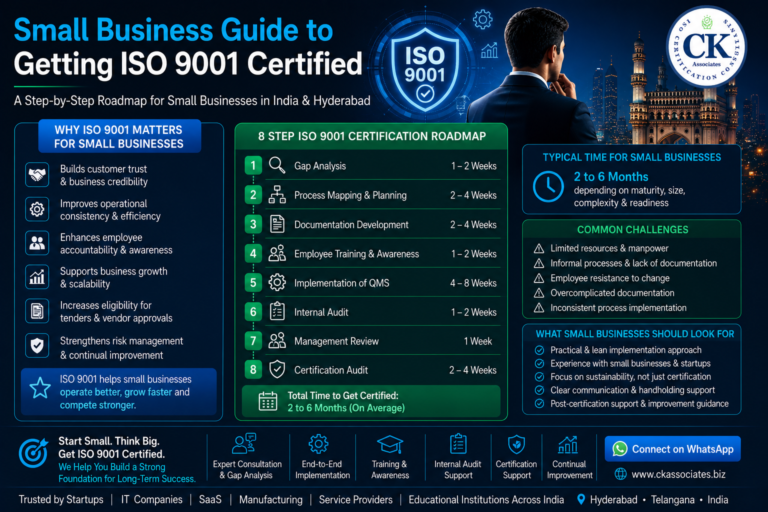
✅ Implementation Timeline
✅ Certification Costs
✅ Internal Audit Requirements
✅ Common Mistakes
✅ How to Achieve Certification Successfully
How Should Organizations Implement ISO 9001?
Organizations should begin ISO 9001 implementation by conducting a gap analysis, defining the scope of the Quality Management System, identifying business processes, establishing quality objectives, preparing documented information, training employees, implementing operational controls, conducting internal audits, performing management reviews, and completing certification audits through an accredited certification body.
Key Takeaways
- ISO 9001 is the international standard for Quality Management Systems (QMS).
- It applies to organizations of every industry and size.
- Customer satisfaction remains the primary objective.
- The standard follows the Annex SL Harmonized Structure.
- Risk-based thinking is integrated throughout the management system.
- Continual improvement drives long-term business success.
- Certification demonstrates organizational commitment to quality.
- ISO 9001 integrates easily with ISO 14001, ISO 45001, ISO 27001, and ISO 42001.
Introduction
In today’s competitive global economy, organizations are expected to consistently deliver high-quality products and services while meeting customer expectations, regulatory requirements, and market demands.
Quality is no longer limited to manufacturing. Service providers, software companies, hospitals, educational institutions, engineering firms, logistics companies, government agencies, and startups all require structured systems to improve operational performance and customer satisfaction.
This is where ISO 9001:2015 plays a vital role.
ISO 9001 is the world’s most recognized Quality Management System (QMS) standard, adopted by more than one million organizations worldwide. It provides a proven framework for managing business processes, reducing inefficiencies, improving customer satisfaction, and driving continual improvement.
Whether your organization is pursuing certification for the first time or looking to improve an existing Quality Management System, understanding ISO 9001 is the first step toward achieving operational excellence.
This comprehensive guide explains everything you need to know about ISO 9001, including its principles, clauses, implementation process, documentation requirements, certification journey, and business benefits.
What is ISO 9001?
ISO 9001:2015 is an internationally recognized standard published by the International Organization for Standardization (ISO) that specifies requirements for establishing, implementing, maintaining, and continually improving a Quality Management System (QMS).
The objective of ISO 9001 is to help organizations consistently provide products and services that meet customer expectations while complying with applicable statutory and regulatory requirements.
Unlike product standards, ISO 9001 focuses on how an organization manages its processes rather than the characteristics of a specific product.
The standard is applicable to:
- Manufacturing Industries
- IT & Software Companies
- Healthcare Organizations
- Educational Institutions
- Government Departments
- Construction Companies
- Engineering Firms
- Logistics Providers
- Retail Businesses
- Startups
- Professional Service Organizations
Why is ISO 9001 Important?
Organizations implementing ISO 9001 experience improvements in:
Customer Satisfaction
Consistently delivering products and services that meet customer expectations.
Operational Efficiency
Reducing waste, improving productivity, and streamlining business processes.
Risk Management
Identifying risks before they impact quality or customer satisfaction.
Business Growth
Strengthening market reputation and improving eligibility for government tenders and international business opportunities.
Employee Engagement
Clearly defining roles, responsibilities, and quality objectives.
Continual Improvement
Using performance data and customer feedback to improve business processes.
Who Should Implement ISO 9001?
ISO 9001 is suitable for organizations of all sizes and sectors.
Manufacturing Companies
Improve production quality, reduce defects, and strengthen supplier management.
IT & Software Companies
Standardize software development processes, improve customer support, and enhance service delivery.
Hospitals & Healthcare Organizations
Improve patient care, clinical processes, and regulatory compliance.
Educational Institutions
Enhance academic quality, administrative processes, and stakeholder satisfaction.
Construction Companies
Improve project management, quality assurance, and contractor performance.
Engineering Organizations
Strengthen design controls, quality planning, and customer satisfaction.
Startups
Establish scalable business processes and build customer confidence from the beginning.
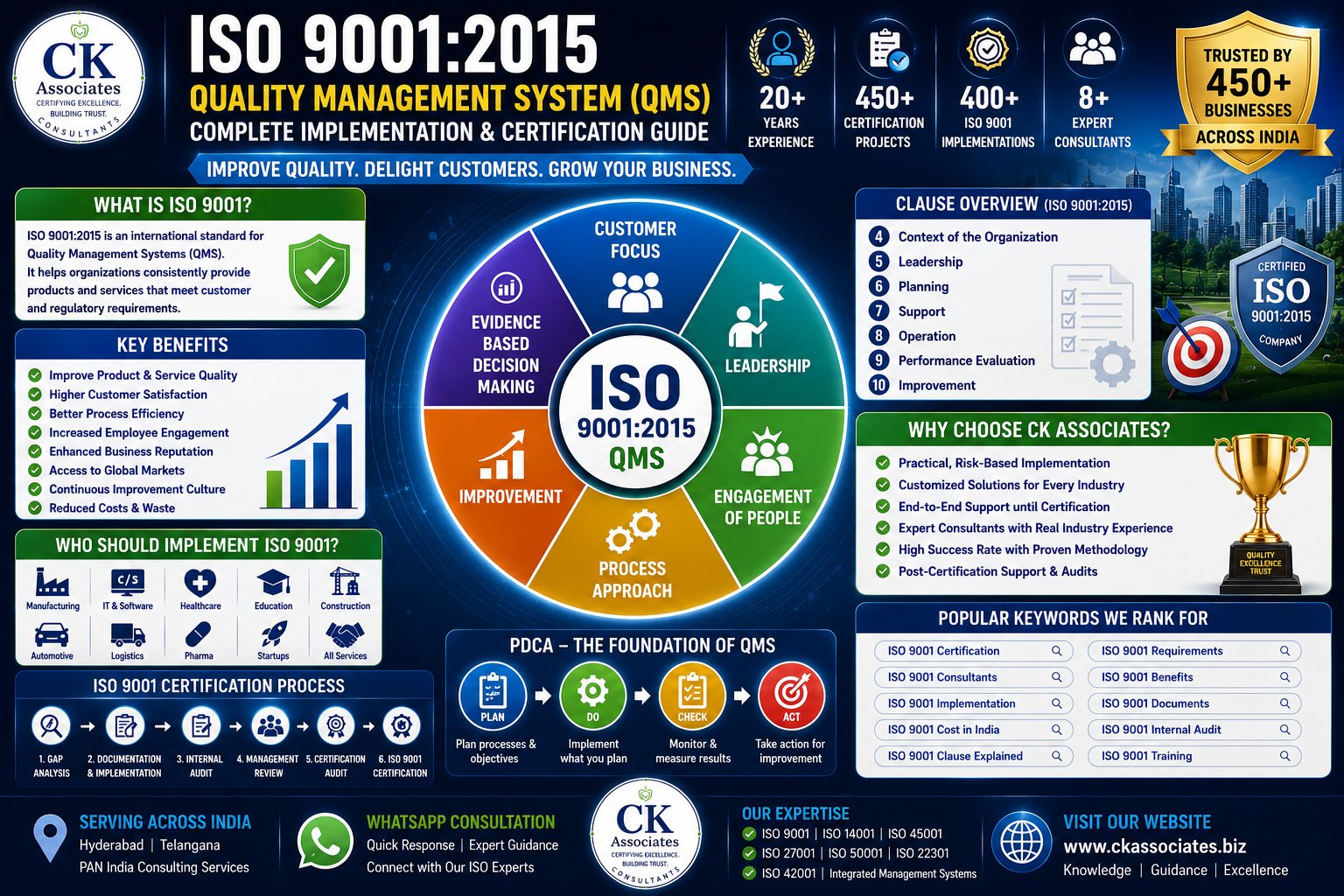
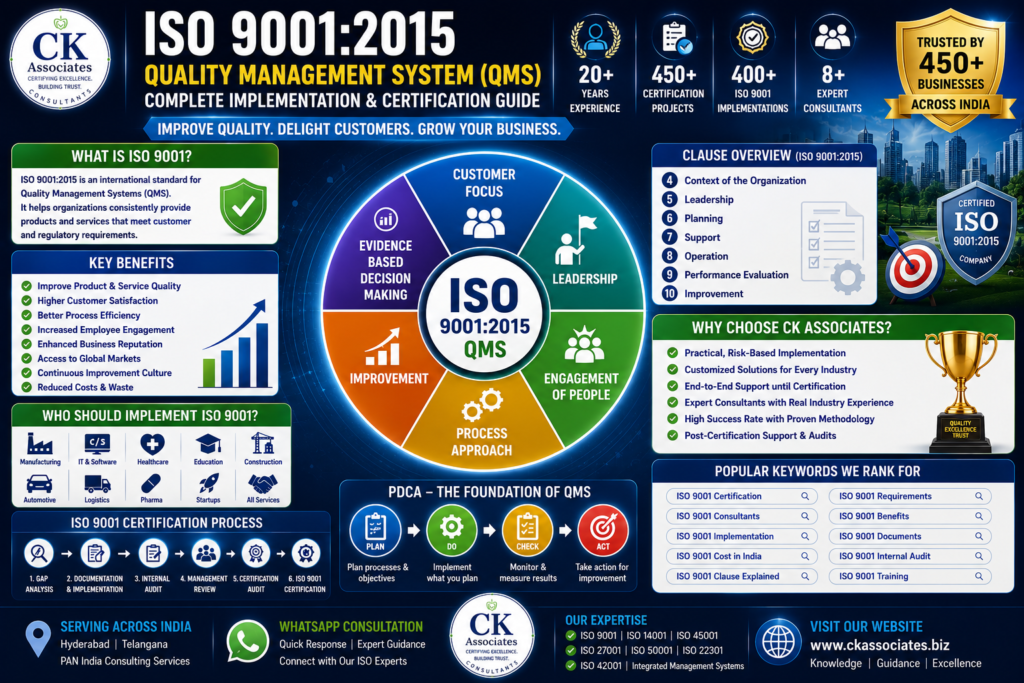
The Seven Quality Management Principles
ISO 9001 is built upon seven Quality Management Principles.
1. Customer Focus
Organizations should understand current and future customer needs and strive to exceed customer expectations.
2. Leadership
Top management establishes the organization’s vision, strategic direction, and commitment to quality.
3. Engagement of People
Competent, empowered, and engaged employees are essential for achieving quality objectives.
4. Process Approach
Managing activities as interconnected processes improves consistency, efficiency, and effectiveness.
5. Improvement
Continual improvement should be embedded throughout the organization.
6. Evidence-Based Decision Making
Business decisions should be based on data analysis and objective evidence.
7. Relationship Management
Strong relationships with suppliers, partners, customers, and other stakeholders contribute to sustained success.
Benefits of ISO 9001 Certification
Organizations implementing ISO 9001 often experience:
✔ Improved Customer Satisfaction
✔ Better Process Control
✔ Reduced Operational Costs
✔ Increased Productivity
✔ Stronger Employee Engagement
✔ Improved Supplier Performance
✔ Greater Regulatory Compliance
✔ Enhanced Brand Reputation
✔ Better Tender Eligibility
✔ Increased Customer Retention
✔ Improved Risk Management
✔ Continual Business Improvement
ISO 9001 and the PDCA Cycle
ISO 9001 follows the internationally recognized Plan-Do-Check-Act (PDCA) methodology.
| Phase | Purpose |
|---|---|
| Plan | Establish quality objectives, processes, and resources |
| Do | Implement planned processes |
| Check | Monitor, measure, analyze, and audit performance |
| Act | Correct issues and continually improve the QMS |
The PDCA cycle creates a culture of continual improvement across the organization.
Overview of ISO 9001 Clauses
ISO 9001 follows the ISO Harmonized Structure (formerly Annex SL), making integration with other ISO standards straightforward.
| Clause | Topic |
| Clause 4 | Context of the Organization |
| Clause 5 | Leadership |
| Clause 6 | Planning |
| Clause 7 | Support |
| Clause 8 | Operation |
| Clause 9 | Performance Evaluation |
| Clause 10 | Improvement |
These seven operational clauses form the foundation of every Quality Management System.
Why ISO 9001 Is the Foundation for Integrated Management Systems
Because ISO 9001 follows the Harmonized Structure, it integrates seamlessly with:
- ISO 14001 – Environmental Management System
- ISO 45001 – Occupational Health & Safety Management System
- ISO/IEC 27001 – Information Security Management System
- ISO 42001 – Artificial Intelligence Management System
- ISO 22301 – Business Continuity Management System
- ISO 50001 – Energy Management System
Organizations implementing multiple ISO standards can share common processes such as:
- Leadership
- Risk Management
- Internal Audits
- Management Reviews
- Competence & Training
- Document Control
- Corrective Actions
- Continual Improvement
This significantly reduces duplication and simplifies compliance.
ISO 9001 Clauses Explained – Clause-by-Clause Guide
The heart of ISO 9001:2015 lies in Clauses 4 to 10, which define how an organization establishes, operates, evaluates, and continually improves its Quality Management System (QMS).
Unlike earlier versions of the standard, ISO 9001:2015 adopts risk-based thinking and the ISO Harmonized Structure (HS), making it easier to integrate with standards such as ISO 14001, ISO 45001, ISO/IEC 27001, ISO 42001, and ISO 22301.
Understanding these clauses enables organizations to implement an effective QMS that delivers measurable business value rather than simply achieving certification.
Clause 4 – Context of the Organization
Clause 4 establishes the foundation of the Quality Management System.
Organizations must understand both internal and external factors that influence their ability to consistently deliver products and services meeting customer and regulatory requirements.
Key Requirements
✔ Determine internal issues
✔ Determine external issues
✔ Identify interested parties
✔ Understand customer expectations
✔ Define QMS scope
✔ Identify organizational processes
Typical Documents
- Context Analysis
- SWOT Analysis
- PESTLE Analysis
- Interested Parties Register
- Scope Statement
- Process Interaction Map
Practical Example
A software company identifies:
Internal Issues
- Developer competency
- Infrastructure
- Product quality
External Issues
- Customer expectations
- Cybersecurity regulations
- Market competition
- Emerging AI technologies
Clause 5 – Leadership
Leadership is one of the strongest predictors of a successful Quality Management System.
Top management must actively demonstrate commitment rather than delegating responsibility entirely to the Quality Department.
Leadership Responsibilities
- Establish Quality Policy
- Set Quality Objectives
- Promote Customer Focus
- Allocate Resources
- Support Continual Improvement
- Define Roles & Responsibilities
Required Documents
- Quality Policy
- Organization Chart
- Roles & Responsibilities Matrix
- Management Commitment Records
Clause 6 – Planning
Planning introduces risk-based thinking, one of the major improvements introduced in ISO 9001:2015.
Organizations must identify risks and opportunities that could affect product quality and customer satisfaction.
Planning Activities
- Risk Assessment
- Opportunity Identification
- Quality Objectives
- Action Plans
Example Risks
- Supplier failures
- Equipment breakdown
- Employee turnover
- Regulatory changes
- Customer complaints
Example Opportunities
- Process automation
- Digital quality management
- AI-assisted inspections
- Employee skill development
Recommended Documents
- Risk Register
- Opportunity Register
- Quality Objectives
- Action Plan Tracker
Clause 7 – Support
Support ensures the organization has adequate resources to operate the Quality Management System.
Resources
Organizations should determine requirements for:
- People
- Infrastructure
- Equipment
- Monitoring devices
- Software
- Work environment
Competence
Employees should possess:
- Appropriate education
- Skills
- Training
- Experience
Awareness
Employees should understand:
- Quality Policy
- Quality Objectives
- Customer requirements
- Their contribution to quality
Communication
Organizations should establish communication processes covering:
- Internal communication
- Customer communication
- Supplier communication
- Regulatory communication
Documented Information
ISO 9001 requires controlled documentation.
Typical documentation includes:
- Procedures
- Work Instructions
- Policies
- Records
- Forms
- Checklists
Clause 8 – Operation
Clause 8 is the operational core of ISO 9001.
It governs how products and services are planned, delivered, monitored, and controlled.
Operational Planning
Organizations should:
- Define customer requirements
- Plan production
- Manage resources
- Monitor outputs
Design & Development
Applicable where organizations develop products or services.
Stages include:
- Planning
- Inputs
- Outputs
- Verification
- Validation
- Change Control
Supplier Management
Organizations should evaluate suppliers based on:
- Capability
- Quality
- Delivery
- Compliance
- Performance
Production & Service Provision
Organizations should ensure:
- Controlled conditions
- Qualified personnel
- Suitable equipment
- Monitoring activities
- Product traceability
Nonconforming Outputs
Organizations should establish procedures for:
- Identification
- Segregation
- Correction
- Customer notification
- Root Cause Analysis
Clause 9 – Performance Evaluation
Performance evaluation determines whether the Quality Management System is effective.
Monitoring & Measurement
Organizations should measure:
- Customer Satisfaction
- Product Quality
- Process Performance
- Supplier Performance
- Delivery Performance
Internal Audit
Internal audits verify compliance with:
- ISO 9001 requirements
- Organizational procedures
- Customer requirements
Management Review
Top management reviews:
- Audit Results
- Customer Feedback
- Risks & Opportunities
- KPI Performance
- Improvement Actions
Typical KPIs
| KPI | Example |
|---|---|
| Customer Satisfaction | 95% |
| On-Time Delivery | 98% |
| Customer Complaints | <2% |
| Defect Rate | <1% |
| Internal Audit Completion | 100% |
Clause 10 – Improvement
Continual improvement differentiates mature organizations from compliant organizations.
Organizations should:
- Identify nonconformities
- Determine root causes
- Implement corrective actions
- Verify effectiveness
- Improve processes continuously
Improvement Methods
- Root Cause Analysis
- Corrective Actions
- Lean
- Six Sigma
- Kaizen
- PDCA Cycle
ISO 9001 Documentation Requirements
One of the most common questions is:
“What documents are mandatory?”
Mandatory Documents
- Quality Policy
- QMS Scope
- Quality Objectives
- Process Maps
- Risk Register
- Internal Audit Program
- Management Review Records
- Competency Records
- Calibration Records
- Customer Feedback Records
- Corrective Action Records
ISO 9001 Implementation Roadmap
Phase 1
Gap Analysis
Current State Assessment
Phase 2
Planning
Quality Objectives
Documentation
Phase 3
Implementation
Employee Training
Process Deployment
Phase 4
Internal Audit
Management Review
Corrective Actions
Phase 5
Certification Audit
Stage 1
Stage 2
Certification
ISO 9001 Certification Process
- Gap Analysis
- Documentation
- Implementation
- Employee Training
- Internal Audit
- Management Review
- Stage 1 Audit
- Stage 2 Audit
- Certification
- Surveillance Audits
ISO 9001 Implementation Timeline
| Organization Size | Estimated Timeline |
| Startup | 2–3 Months |
| Small Business | 3–4 Months |
| Medium Enterprise | 4–6 Months |
| Large Enterprise | 6–9 Months |
Factors Affecting Certification Cost
The cost of ISO 9001 implementation depends on:
- Organization Size
- Number of Employees
- Number of Sites
- Business Complexity
- Documentation Status
- Certification Body
- Industry Requirements
Investing in a well-designed Quality Management System often delivers long-term savings through reduced rework, improved efficiency, and higher customer satisfaction.
Comparison Table – ISO 9001 vs ISO 14001 vs ISO 27001
| Feature | ISO 9001 | ISO 14001 | ISO 27001 |
| Quality Management | ✔ | — | — |
| Environmental Management | — | ✔ | — |
| Information Security | — | — | ✔ |
| Customer Satisfaction | ✔ | Partial | Partial |
| Risk-Based Thinking | ✔ | ✔ | ✔ |
| Harmonized Structure | ✔ | ✔ | ✔ |
Comparison Table – ISO 9001 vs Traditional Quality Control
| Traditional QC | ISO 9001 QMS |
| Detects defects | Prevents defects |
| Product-focused | Process-focused |
| Inspection-based | Risk-based |
| Departmental | Organization-wide |
| Reactive | Continual Improvement |
Key Industry Statistics
ISO Survey
ISO 9001 remains the most widely adopted management system standard globally, with over one million certificates issued across more than 170 countries.
Why it matters: Global adoption demonstrates broad recognition of ISO 9001 as the benchmark for quality management.
Deloitte
Organizations with mature quality management systems often report stronger operational efficiency and customer satisfaction.
Why it matters: A structured QMS supports sustainable business performance.
McKinsey
Companies with standardized processes are more likely to achieve consistent operational outcomes and scalable growth.
Why it matters: ISO 9001 promotes process discipline and continual improvement.
Gartner
Customer experience and service quality remain key competitive differentiators across industries.
Why it matters: ISO 9001 aligns organizational processes with customer expectations.
Real-World Implementation Example
Organization
Medium-Sized Precision Engineering Company
Problem
The company experienced inconsistent production quality, increasing customer complaints, delayed deliveries, and limited visibility into process performance.
Approach
CK Associates supported the organization by:
- Conducting a Gap Analysis
- Defining the QMS Scope
- Mapping Core Business Processes
- Preparing Quality Documentation
- Training Employees
- Establishing KPIs
- Conducting Internal Audits
- Facilitating Management Reviews
Outcome
Within six months, the organization:
- Improved on-time delivery performance
- Reduced product defects
- Increased customer satisfaction
- Achieved ISO 9001 certification successfully
Lessons Learned
A well-implemented Quality Management System is not merely a certification exercise—it becomes a strategic framework for operational excellence, customer confidence, and continual business improvement.
Why Trust This Guidance?
Implementing ISO 9001 successfully requires practical experience, industry knowledge, and an understanding of how quality management supports business growth—not just certification.
CK Associates has helped organizations across manufacturing, IT, healthcare, engineering, education, retail, logistics, and professional services establish Quality Management Systems that improve operational performance and customer satisfaction.
CK Associates Authority
✅ 20+ Years Experience
✅ 450+ Certification Projects
✅ 400+ ISO 9001 Implementations
✅ 25+ ISO 27001 Implementations
✅ 4+ ISO 42001 Implementations
✅ 45+ ISO 14001 Implementations
✅ 45+ ISO 45001 Implementations
Our implementation approach focuses on building practical, scalable, and business-driven Quality Management Systems that create measurable value beyond certification.
About the Author
Sirish K
Founder & Lead ISO Consultant – CK Associates
With over 20 years of experience and 450+ certification projects, Sirish K specializes in Quality Management Systems, Integrated Management Systems, Information Security, Artificial Intelligence Governance, Environmental Management, and Business Continuity.
He has successfully guided organizations across multiple industries through ISO implementation, internal audits, process optimization, and certification, helping them achieve operational excellence and sustainable business growth.
Frequently Asked Questions (FAQ)
1. What is ISO 9001 Certification?
ISO 9001 Certification is an internationally recognized certification that demonstrates an organization’s Quality Management System (QMS) complies with ISO 9001:2015 requirements. It confirms the organization consistently delivers products and services that meet customer and regulatory requirements.
2. Who should implement ISO 9001?
ISO 9001 is suitable for every organization regardless of size or industry, including:
- Manufacturing
- IT & Software
- Healthcare
- Construction
- Education
- Logistics
- Government
- Startups
- Professional Services
- Retail
3. What are the seven Quality Management Principles?
The seven principles are:
- Customer Focus
- Leadership
- Engagement of People
- Process Approach
- Improvement
- Evidence-Based Decision Making
- Relationship Management
4. What are the main clauses of ISO 9001?
The operational clauses are:
- Clause 4 – Context of the Organization
- Clause 5 – Leadership
- Clause 6 – Planning
- Clause 7 – Support
- Clause 8 – Operation
- Clause 9 – Performance Evaluation
- Clause 10 – Improvement
5. How long does ISO 9001 implementation take?
Typical implementation timelines are:
- Startup: 2–3 months
- Small Business: 3–4 months
- Medium Organization: 4–6 months
- Large Enterprise: 6–9 months
The timeline depends on organizational complexity and existing management systems.
6. What documents are required for ISO 9001?
Common documents include:
- Quality Policy
- Quality Objectives
- QMS Scope
- Process Maps
- Risk Register
- Internal Audit Procedure
- Management Review Records
- Competency Records
- Corrective Action Records
- Customer Feedback Records
7. Is ISO 9001 mandatory?
No. ISO 9001 certification is voluntary unless required by customers, contracts, regulatory authorities, or tender specifications.
8. How much does ISO 9001 Certification cost?
The cost depends on:
- Organization size
- Number of employees
- Business locations
- Industry complexity
- Certification body
- Consultancy requirements
A detailed gap analysis helps determine the implementation effort and associated costs.
9. What is a Gap Analysis?
A Gap Analysis compares the organization’s current management system with ISO 9001 requirements to identify missing processes, documentation, and implementation gaps before certification.
10. Can ISO 9001 be integrated with other ISO standards?
Yes. ISO 9001 follows the Harmonized Structure and integrates seamlessly with:
- ISO 14001
- ISO 45001
- ISO/IEC 27001
- ISO 27701
- ISO 42001
- ISO 22301
- ISO 50001
Organizations can establish a single Integrated Management System (IMS).
11. What is the certification process?
The certification process typically includes:
- Gap Analysis
- Documentation Development
- System Implementation
- Employee Training
- Internal Audit
- Management Review
- Stage 1 Audit
- Stage 2 Certification Audit
- Certification
- Surveillance Audits
12. What are the benefits of ISO 9001 Certification?
Organizations often experience:
- Higher customer satisfaction
- Better operational efficiency
- Reduced defects
- Improved supplier performance
- Better compliance
- Increased business opportunities
- Stronger brand reputation
13. Does ISO 9001 improve customer satisfaction?
Yes. Customer focus is one of the core principles of ISO 9001. Organizations monitor customer feedback, improve processes, reduce errors, and enhance service quality to increase customer satisfaction.
14. Why should organizations choose CK Associates?
CK Associates offers:
- 20+ Years Experience
- 450+ Certification Projects
- Practical implementation approach
- Industry-specific expertise
- Complete documentation support
- Internal auditor training
- End-to-end certification assistance
- Ongoing compliance support
15. How do I start ISO 9001 implementation?
The best starting point is a professional Gap Analysis to evaluate current processes, identify improvement opportunities, and prepare a structured implementation roadmap.
Summary
ISO 9001:2015 is the international standard for Quality Management Systems (QMS). It helps organizations consistently deliver products and services that meet customer and regulatory requirements while improving operational efficiency, customer satisfaction, and continual improvement. ISO 9001 follows the ISO Harmonized Structure, making it easy to integrate with ISO 14001, ISO 45001, ISO/IEC 27001, ISO 27701, ISO 42001, ISO 22301, and ISO 50001. Organizations implement ISO 9001 through gap analysis, documentation, employee training, internal audits, management reviews, and certification audits. The standard is applicable across manufacturing, healthcare, IT, education, logistics, government, and service industries, providing a globally recognized framework for quality excellence.