
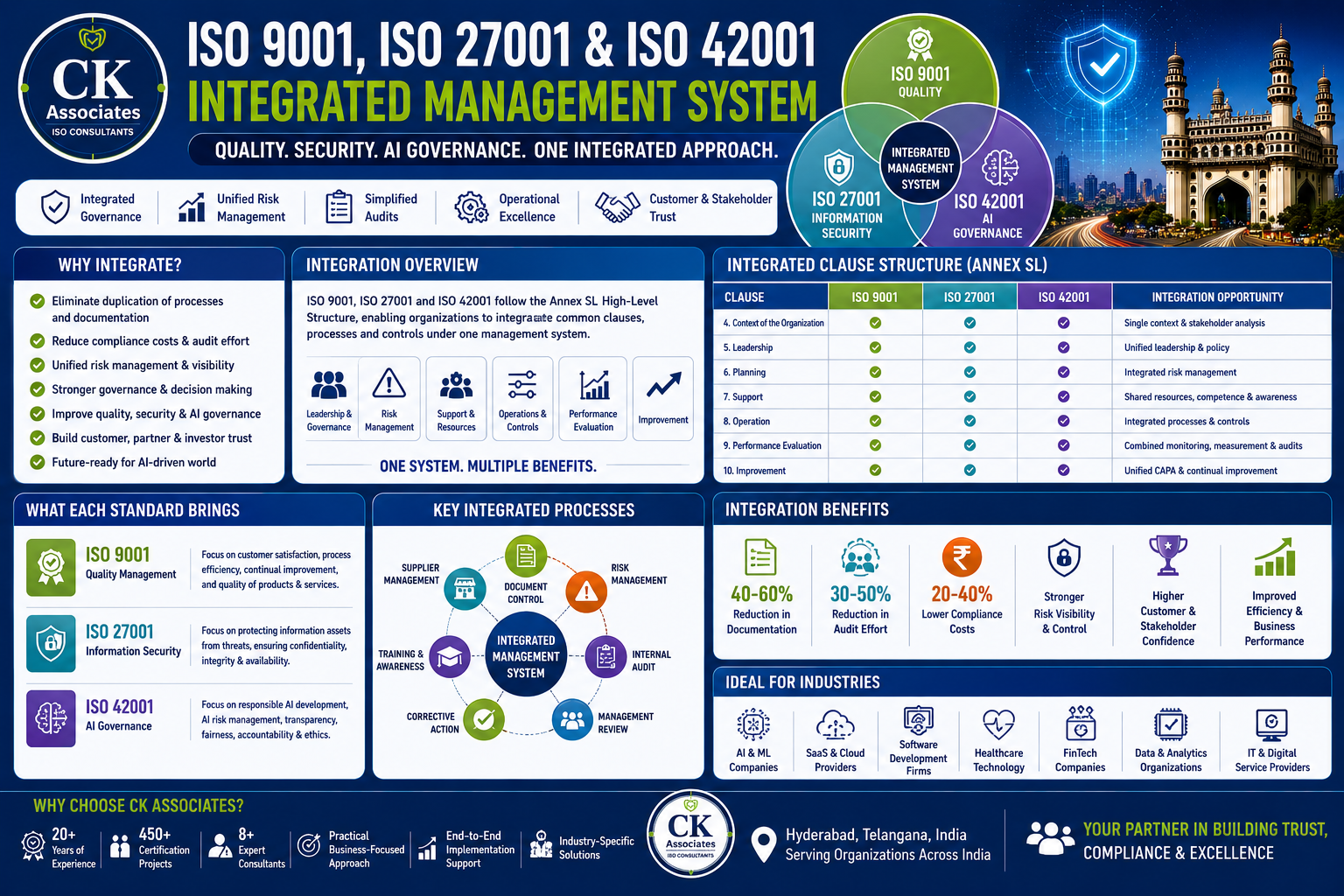
Organizations can integrate ISO 9001, ISO 27001, and ISO 42001 into a single Integrated Management System (IMS) because all three standards follow the ISO Annex SL High-Level Structure. This allows businesses to combine leadership, risk management, internal audits, management reviews, training, document control, supplier management, corrective actions, and continual improvement processes under one governance framework. ISO 9001 focuses on quality and customer satisfaction, ISO 27001 addresses information security risks, and ISO 42001 establishes responsible artificial intelligence governance. By integrating these standards, organizations can reduce duplication, lower compliance costs, simplify audits, improve operational efficiency, and demonstrate quality, security, and trustworthy AI practices to customers, regulators, and stakeholders.
How Should Organizations Integrate ISO 9001, ISO 27001 and ISO 42001?
Organizations should establish a single Integrated Management System that combines quality management, information security management, and AI governance under one framework. Shared processes such as risk management, document control, internal audits, management reviews, competence management, supplier evaluation, and corrective actions can be integrated, while standard-specific controls are maintained for quality, cybersecurity, and artificial intelligence governance requirements.
Key Takeaways
- ISO 9001, ISO 27001, and ISO 42001 can be integrated into one management system.
- All three standards follow the Annex SL High-Level Structure.
- Clauses 4 to 10 provide major integration opportunities.
- One risk management process can support all three standards.
- Integrated audits reduce compliance effort and certification costs.
- AI governance complements quality and information security objectives.
- Organizations can reduce documentation duplication significantly.
- Technology, SaaS, AI, and software companies benefit most from integration.
What Is an ISO 9001, ISO 27001 and ISO 42001 Integrated Management System?
An Integrated Management System (IMS) combines multiple ISO standards into a single framework that enables organizations to manage compliance, governance, risk, performance, and continual improvement more effectively.
Rather than operating separate systems for quality, information security, and artificial intelligence governance, organizations can create a unified structure that satisfies the requirements of all three standards.
This integrated approach is particularly valuable for:
- Artificial Intelligence Companies
- SaaS Organizations
- Software Development Firms
- Cloud Service Providers
- Data Analytics Companies
- Technology Startups
- Healthcare Technology Organizations
- FinTech Companies
As AI adoption accelerates, organizations increasingly need to demonstrate not only quality and security but also responsible AI governance.
Why Are Organizations Integrating ISO 9001, ISO 27001 and ISO 42001?
Modern organizations face growing challenges:
Quality Challenges
- Customer expectations
- Product consistency
- Service reliability
- Process efficiency
Information Security Challenges
- Cybersecurity threats
- Data breaches
- Ransomware attacks
- Regulatory compliance
AI Governance Challenges
- AI bias
- Lack of transparency
- Ethical concerns
- AI risk management
- Regulatory scrutiny
Implementing three separate management systems often creates:
❌ Duplicate documentation
❌ Multiple audit programs
❌ Separate risk registers
❌ Increased compliance costs
❌ Governance complexity
An Integrated Management System eliminates these inefficiencies.
Understanding the Role of Each Standard
What Does ISO 9001 Contribute?
ISO 9001 provides a framework for:
- Customer satisfaction
- Process management
- Quality assurance
- Continuous improvement
- Operational excellence
The standard helps organizations consistently deliver products and services that meet customer and regulatory requirements.
What Does ISO 27001 Contribute?
ISO 27001 provides a framework for:
- Information security governance
- Cybersecurity risk management
- Access control
- Incident management
- Asset protection
The objective is to protect the confidentiality, integrity, and availability of information assets.
What Does ISO 42001 Contribute?
ISO 42001 provides a framework for:
- Artificial Intelligence governance
- AI risk management
- Responsible AI deployment
- Transparency and explainability
- AI lifecycle management
The standard enables organizations to develop and use AI systems responsibly.
Why Annex SL Makes Integration Possible
One of the most significant advantages of these standards is that they follow the ISO Annex SL High-Level Structure.
This means they share a common framework consisting of:
| Clause | Topic |
|---|---|
| 4 | Context of the Organization |
| 5 | Leadership |
| 6 | Planning |
| 7 | Support |
| 8 | Operation |
| 9 | Performance Evaluation |
| 10 | Improvement |
Because these clauses are structured similarly, organizations can create one management system that addresses multiple standards simultaneously.
Clause Mapping Matrix for ISO 9001, ISO 27001 and ISO 42001
| Annex SL Clause | ISO 9001 | ISO 27001 | ISO 42001 | Integration Opportunity |
| Clause 4 | Context of Organization | Context of Organization | Context of Organization | Single Context Analysis |
| Clause 5 | Leadership | Leadership | Leadership | Unified Governance |
| Clause 6 | Planning | Planning | Planning | Integrated Risk Register |
| Clause 7 | Support | Support | Support | Shared Resources & Training |
| Clause 8 | Operations | Operations | Operations | Integrated Processes |
| Clause 9 | Performance Evaluation | Performance Evaluation | Performance Evaluation | Combined Audits |
| Clause 10 | Improvement | Improvement | Improvement | Unified CAPA System |
Clause 4 Integration: Context of the Organization
What Can Be Integrated?
All three standards require organizations to:
- Understand internal issues
- Understand external issues
- Identify interested parties
- Define scope
- Establish management system boundaries
Integrated Documentation
Organizations can maintain:
- One Context Analysis
- One Interested Parties Register
- One Scope Statement
instead of separate documents for each standard.
Example Interested Parties
| Interested Party | Quality | Security | AI Governance |
| Customers | ✓ | ✓ | ✓ |
| Employees | ✓ | ✓ | ✓ |
| Regulators | ✓ | ✓ | ✓ |
| Investors | ✓ | ✓ | ✓ |
| AI Users | No | No | ✓ |
Clause 5 Integration: Leadership
Leadership requirements across all three standards are highly aligned.
Senior management must demonstrate:
- Commitment
- Accountability
- Policy establishment
- Resource allocation
- Strategic direction
Integrated Governance Model
Instead of separate committees, organizations can establish:
Integrated Management System Steering Committee
Responsible for:
- Quality objectives
- Security objectives
- AI governance objectives
Integrated Policy Framework
One integrated policy can include commitments related to:
- Quality
- Information Security
- Responsible AI
This simplifies governance while strengthening oversight.
Clause 6 Integration: Planning
Clause 6 is often the most valuable integration opportunity.
All three standards require risk-based thinking.
ISO 9001 Focus
- Process risks
- Customer satisfaction risks
- Product quality risks
ISO 27001 Focus
- Information security risks
- Cybersecurity threats
- Information asset protection
ISO 42001 Focus
- AI risks
- Bias risks
- Transparency risks
- Ethical risks
- Model governance risks
Integrated Risk Register
Organizations can create one enterprise-wide risk register that includes:
Quality Risks
- Defects
- Service failures
- Customer complaints
Security Risks
- Malware
- Unauthorized access
- Data breaches
AI Risks
- Hallucinations
- Bias
- Lack of explainability
- Model drift
- Regulatory non-compliance
This integrated approach improves visibility while reducing administrative effort.
Clause 7 Integration: Support
All three standards require support processes covering:
- Competence
- Awareness
- Communication
- Documented Information
Shared Training Program
A single competence framework can cover:
- Quality awareness
- Information security awareness
- AI governance awareness
Shared Documentation Control
One process can manage:
- Document approval
- Version control
- Record retention
- Access management
This significantly reduces documentation complexity.
Clause 8 Integration: Operations
Clause 8 is where organizations realize the greatest operational value from integrating ISO 9001, ISO 27001, and ISO 42001.
Although each standard has unique operational requirements, many underlying processes can be managed through a single framework.
ISO 9001 Operational Focus
ISO 9001 requires organizations to control:
- Product and service delivery
- Customer requirements
- Design and development
- Supplier management
- Quality assurance activities
ISO 27001 Operational Focus
ISO 27001 requires organizations to manage:
- Information security controls
- Access management
- Asset protection
- Incident management
- Security monitoring
ISO 42001 Operational Focus
ISO 42001 requires organizations to establish:
- AI lifecycle management
- AI risk assessments
- AI model monitoring
- AI governance controls
- AI transparency and accountability
Integrated Operational Model
Rather than operating separate processes, organizations can establish:
Integrated Change Management
Covering:
- Quality changes
- Security changes
- AI model changes
Integrated Supplier Evaluation
Assess suppliers against:
- Quality requirements
- Security requirements
- AI governance requirements
Integrated Incident Management
Managing:
- Customer complaints
- Security incidents
- AI-related incidents
Clause 9 Integration: Performance Evaluation
All three standards require organizations to monitor, measure, evaluate, and improve performance.
Shared Requirements
Monitoring and Measurement
Organizations should develop a single performance dashboard.
Internal Audits
Instead of conducting separate audits:
❌ ISO 9001 Audit
❌ ISO 27001 Audit
❌ ISO 42001 Audit
Organizations can perform:
✅ Integrated Internal Audits
This reduces audit effort and improves management visibility.
Integrated KPI Dashboard
Quality KPIs
- Customer Satisfaction Score
- Complaint Resolution Time
- Defect Rate
- Process Performance
Security KPIs
- Security Incidents
- Vulnerability Closure Rate
- Access Review Completion
- Security Awareness Completion
AI Governance KPIs
- AI Risk Assessments Completed
- Model Accuracy
- Bias Monitoring Results
- Explainability Reviews
Management Reviews
A single management review meeting can evaluate:
- Quality objectives
- Security objectives
- AI governance objectives
This reduces executive overhead while strengthening strategic oversight.
Clause 10 Integration: Improvement
All three standards require continual improvement.
Shared Improvement Activities
Nonconformity Management
Organizations can establish one process for:
- Quality issues
- Security issues
- AI governance issues
Corrective Actions
One CAPA system can address:
- Customer complaints
- Security incidents
- AI model failures
- Process breakdowns
Continual Improvement
The organization continuously improves:
- Business processes
- Security posture
- AI governance maturity
ISO 42001 and EU AI Act
Why This Relationship Matters
The EU AI Act is becoming one of the world’s most influential AI regulations.
Organizations deploying AI systems may need to demonstrate:
- AI transparency
- Risk management
- Human oversight
- Accountability
- Monitoring
ISO 42001 provides a structured management system that helps organizations operationalize these requirements.
Key Alignment Areas
| EU AI Act | ISO 42001 |
|---|---|
| Risk Management | AI Risk Assessment |
| Transparency | AI Governance Controls |
| Human Oversight | Accountability Framework |
| Monitoring | AI Lifecycle Monitoring |
| Documentation | Documented Information |
Organizations adopting ISO 42001 today are better positioned for future AI regulatory compliance.
ISO 42001 and NIST AI Risk Management Framework
The NIST AI RMF is widely used for managing AI risks.
Shared Principles
- Governance
- Mapping
- Measurement
- Management
ISO 42001 converts these principles into a certifiable management system.
Together they create a strong AI governance framework.
ISO 27001 and NIST Cybersecurity Framework
Many organizations use both frameworks.
NIST Functions
- Identify
- Protect
- Detect
- Respond
- Recover
ISO 27001 Focus
- ISMS Governance
- Risk Management
- Annex A Controls
- Security Monitoring
- Continual Improvement
ISO 27001 provides the management system structure that supports cybersecurity maturity.
How ISO 9001 Supports ISO 27001 and ISO 42001
Many organizations overlook the value of ISO 9001 in AI and cybersecurity programs.
ISO 9001 strengthens:
Process Consistency
Documented processes improve security and AI reliability.
Customer Focus
Customer expectations increasingly include:
- Data protection
- AI transparency
- Service reliability
Continual Improvement
The PDCA approach supports:
- Security maturity
- AI governance maturity
This makes ISO 9001 an ideal foundation for integrated governance.
Comparison Table: Separate vs Integrated Management System
| Criteria | Separate Systems | Integrated Management System |
| Policies | Multiple | Unified |
| Risk Registers | Multiple | Single |
| Audits | Multiple | Integrated |
| Management Reviews | Separate | Unified |
| Documentation | High | Reduced |
| Governance Complexity | High | Lower |
| Certification Readiness | Slower | Faster |
Comparison Table: ISO 9001 vs ISO 27001 vs ISO 42001
| Feature | ISO 9001 | ISO 27001 | ISO 42001 |
| Quality Management | Yes | No | No |
| Information Security | No | Yes | Partial |
| AI Governance | No | No | Yes |
| Risk Management | Yes | Yes | Yes |
| Customer Focus | Yes | Partial | Partial |
| Regulatory Compliance | Partial | Yes | Yes |
| Certification Available | Yes | Yes | Yes |
Key Industry Statistics
IBM Cost of a Data Breach Report
IBM consistently reports that data breaches cost organizations millions of dollars annually.
Why it matters:
Strong information security governance significantly reduces business risk.
Gartner AI Governance Research
Gartner predicts that organizations with mature AI governance frameworks will achieve better regulatory compliance and improved stakeholder trust.
Why it matters:
AI governance is rapidly becoming a business requirement rather than a technical option.
McKinsey Global AI Survey
Organizations adopting AI responsibly are more likely to realize measurable business value from AI investments.
Why it matters:
Governance enables sustainable AI adoption.
World Economic Forum Cybersecurity Outlook
Cybersecurity remains one of the most significant enterprise risks globally.
Why it matters:
Information security and AI governance are becoming increasingly interconnected.
Real-World Implementation Example
Organization Type
AI-Powered SaaS Company
Problem
The company faced increasing customer demands for:
- Quality assurance
- Information security
- Responsible AI practices
Managing separate compliance programs created duplication and inefficiencies.
Approach
The organization implemented:
- ISO 9001
- ISO 27001
- ISO 42001
through a single Integrated Management System.
Shared processes included:
- Risk management
- Internal audits
- Supplier evaluation
- Management review
- Corrective actions
Outcome
The organization achieved:
- Reduced compliance duplication
- Improved customer trust
- Better audit readiness
- Stronger governance
Lessons Learned
Organizations gain greater value when quality, security, and AI governance are managed together rather than separately.
Implementation Checklist
Phase 1: Foundation
☐ Conduct Gap Analysis
☐ Define IMS Scope
☐ Identify Interested Parties
☐ Establish Integrated Policy
Phase 2: Governance
☐ Create Governance Committee
☐ Develop Risk Management Framework
☐ Define Objectives
Phase 3: Operations
☐ Integrate Processes
☐ Implement Controls
☐ Conduct Training
Phase 4: Assurance
☐ Perform Internal Audit
☐ Conduct Management Review
☐ Address Findings
☐ Prepare for Certification Audit
Internal Link Cluster Suggestions
Introduction Section
Anchor: ISO Certification Consultants Hyderabad
Anchor: Integrated Management System
Risk Management Section
Anchor: ISO 27001 Certification
Anchor: ISO 42001 Certification
Governance Section
Anchor: Gap Analysis Services
Anchor: Internal Audit Services
Compliance Section
Anchor: ISO Certification Cost in Hyderabad
Anchor: ISO for IT Companies
Anchor: ISO for Startups
Related Standards Section
Anchor: ISO 9001 Certification
Anchor: ISO 14001 Certification
Anchor: ISO 45001 Certification
Anchor: ISO 22301 Certification
Anchor: ISO 20000-1 Certification
Why Trust This Guidance?
Organizations implementing Integrated Management Systems need practical implementation expertise rather than theoretical interpretations of standards.
CK Associates has extensive experience helping organizations establish, integrate, and improve management systems across multiple industries.
CK Associates Authority
✅ 20+ Years Experience
✅ 450+ Certification Projects
✅ 400+ ISO 9001 Implementations
✅ 25+ ISO 27001 Implementations
✅ 4+ ISO 42001 Implementations
✅ 45+ ISO 14001 Implementations
✅ 45+ ISO 45001 Implementations
This experience enables CK Associates to design practical Integrated Management Systems that reduce compliance complexity while supporting business objectives.
About the Author
Sirish K
Founder & Lead ISO Consultant
20+ Years Experience
450+ Certification Projects
Industry Expertise Across:
- ISO 9001
- ISO 27001
- ISO 42001
- ISO 27701
- ISO 22301
- Integrated Management Systems
Sirish K has helped organizations across technology, manufacturing, healthcare, SaaS, AI, engineering, and service sectors establish management systems that drive compliance, operational excellence, and business growth.
Frequently Asked Questions (FAQ)
1. Can ISO 9001, ISO 27001 and ISO 42001 be integrated into one management system?
Yes. All three standards follow the ISO Annex SL High-Level Structure, making it possible to integrate governance, risk management, audits, management reviews, training, document control, and continual improvement into a single Integrated Management System (IMS).
2. What is the biggest benefit of integrating ISO 9001, ISO 27001 and ISO 42001?
The primary benefit is reducing duplication. Organizations can maintain one governance framework, one audit program, one risk register, and one management review process while satisfying multiple standards.
3. Which standard should be implemented first?
Most organizations begin with ISO 9001 or ISO 27001. For technology and AI-driven companies, ISO 27001 often provides a strong foundation before implementing ISO 42001.
4. Is ISO 42001 dependent on ISO 27001?
No. However, organizations implementing ISO 42001 often benefit from ISO 27001 because AI systems frequently rely on secure information assets, data protection controls, and cybersecurity governance.
5. Can one risk register support all three standards?
Yes. Organizations can maintain an integrated risk register that includes quality risks, information security risks, and AI governance risks.
6. What industries benefit most from this integration?
Industries that benefit significantly include:
- Artificial Intelligence Companies
- SaaS Providers
- Cloud Service Providers
- FinTech Organizations
- Healthcare Technology Firms
- Software Development Companies
- Data Analytics Companies
7. How long does implementation take?
Implementation timelines vary depending on organizational maturity. Most organizations complete integration within 4–8 months.
8. Does integration reduce certification costs?
Yes. Integrated audits and shared processes often reduce implementation effort, audit days, and ongoing compliance costs.
9. What role does ISO 9001 play in AI governance?
ISO 9001 strengthens process management, customer focus, and continual improvement, which support responsible AI development and deployment.
10. How does ISO 27001 support ISO 42001?
ISO 27001 provides security governance, risk management, access control, and information protection mechanisms that help secure AI systems and AI data.
11. Is ISO 42001 suitable for startups?
Yes. AI startups can use ISO 42001 to demonstrate responsible AI practices, build customer confidence, and prepare for future regulatory requirements.
12. Can internal audits be integrated?
Yes. Organizations can conduct integrated audits covering quality, information security, and AI governance simultaneously.
13. How does ISO 42001 relate to the EU AI Act?
ISO 42001 provides a structured management system framework that helps organizations operationalize many principles found within emerging AI regulations such as the EU AI Act.
14. Why are enterprise customers requesting AI governance evidence?
Organizations increasingly want assurance that AI systems are secure, transparent, accountable, and managed responsibly.
15. Why should organizations use experienced ISO consultants?
Experienced consultants help reduce implementation time, avoid compliance gaps, simplify integration, and improve certification readiness.
Summary
An ISO 9001, ISO 27001, and ISO 42001 Integrated Management System combines quality management, information security, and artificial intelligence governance into a unified framework. Because all three standards follow the Annex SL structure, organizations can integrate risk management, internal audits, management reviews, document control, training, supplier evaluation, and continual improvement processes. This reduces compliance duplication, lowers costs, improves governance, and strengthens customer confidence. The approach is particularly valuable for AI companies, SaaS providers, cloud service organizations, software development firms, and technology startups seeking quality, security, and responsible AI certification. Integrated implementation supports operational excellence, cybersecurity resilience, and trustworthy AI practices.