
What is the difference between ISO 27001 and ISO 42001?
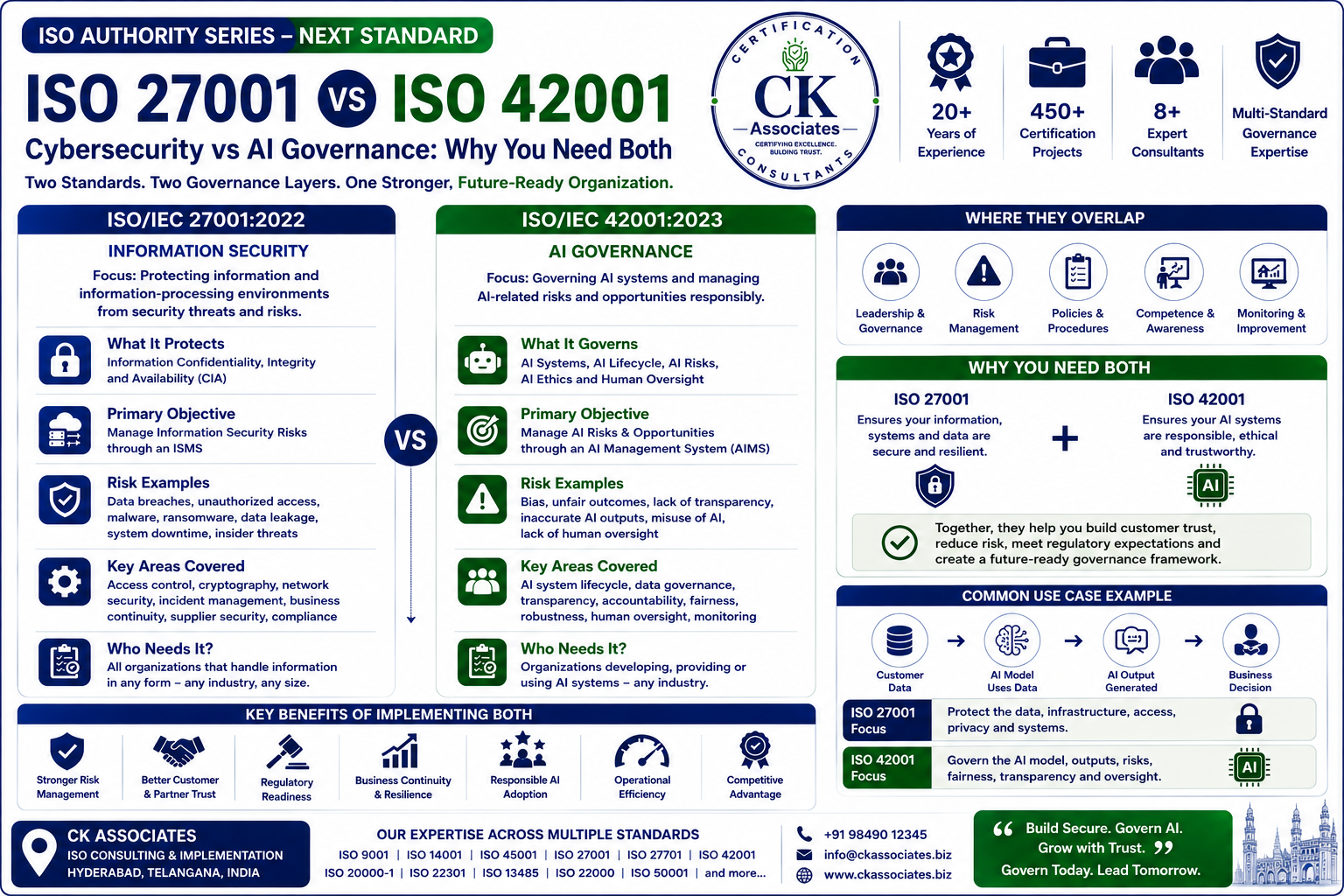
ISO 27001 focuses on protecting an organization’s information through an Information Security Management System (ISMS), while ISO 42001 focuses on governing Artificial Intelligence systems through an AI Management System (AIMS). Together, they help organizations manage cybersecurity, AI risks, accountability, transparency and responsible innovation—making them highly relevant for SaaS companies, AI startups and technology businesses.
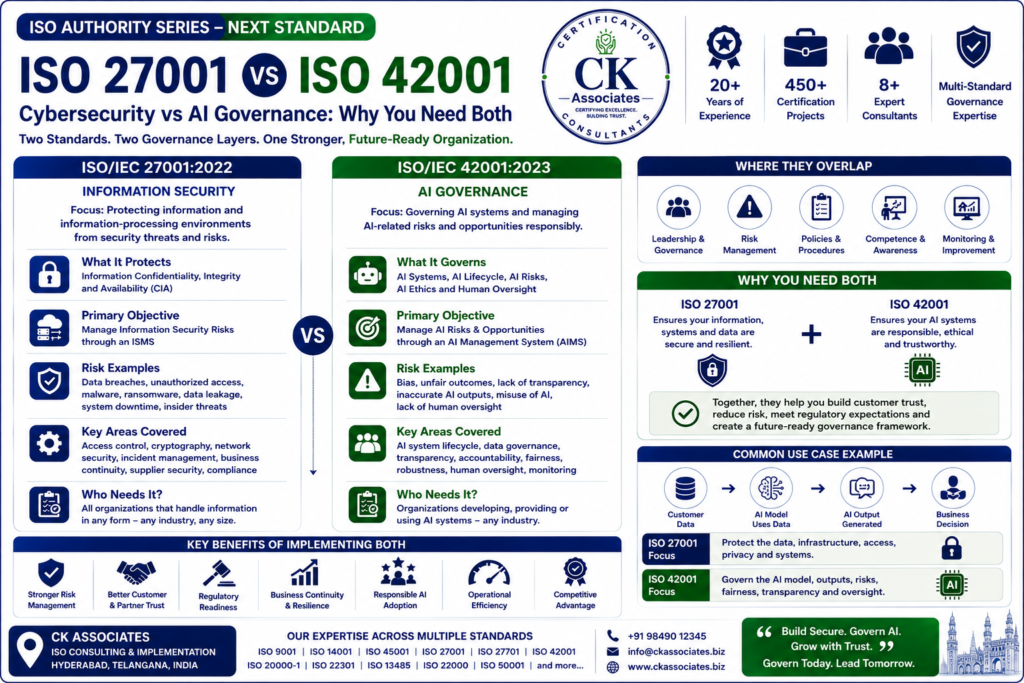
Cybersecurity vs AI Governance: Why You Need Both
Introduction
Artificial Intelligence has changed the way organizations build products, deliver services and make decisions.
But it has also introduced a new governance challenge.
Most businesses already understand cybersecurity.
They invest in:
- Firewalls
- Multi-factor authentication
- Endpoint protection
- Encryption
- Backup systems
- Security awareness
These controls are essential.
However, when organizations begin using AI—for customer support, recruitment, coding assistants, analytics or decision-making—they face an entirely different category of questions.
How do we govern AI responsibly?
That is where the conversation shifts from cybersecurity to AI governance.
Many organizations assume ISO 27001 already covers everything.
It doesn’t.
And that is precisely why understanding the relationship between ISO/IEC 27001 and ISO/IEC 42001 has become strategically important.
Why This Matters in 2026
Hyderabad has become one of India’s largest technology ecosystems.
The city now hosts:
- AI startups
- SaaS companies
- Global Capability Centres (GCCs)
- FinTech companies
- HealthTech innovators
- Pharmaceutical technology firms
- Engineering and IT service providers
Many of these organizations are already answering customer security questionnaires.
Increasingly, those questionnaires include AI-related governance questions such as:
- How do you manage AI risks?
- Who is accountable for AI decisions?
- How do you ensure responsible AI use?
- How is customer data protected when AI is used?
This is where organizations need two governance layers, not one.
ISO 27001 Protects Information
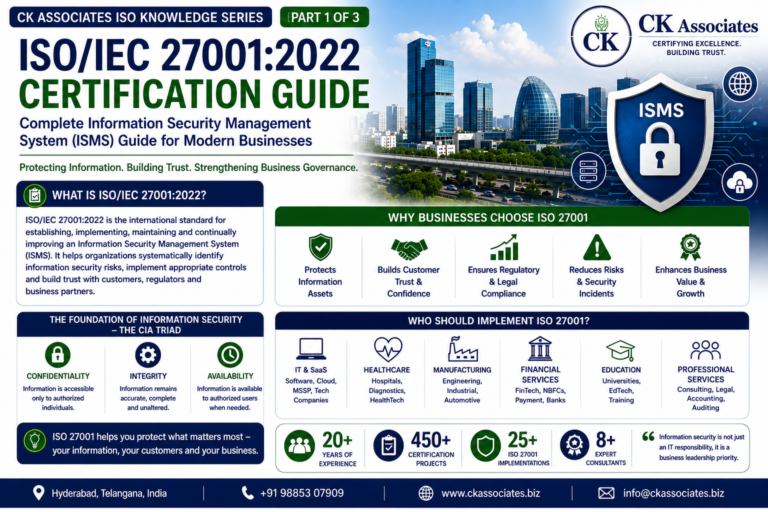
ISO/IEC 27001 establishes requirements for an Information Security Management System (ISMS).
Its purpose is straightforward.
Protect information by managing risks that affect its:
Confidentiality
Only authorized people should access information.
Integrity
Information should remain accurate and trustworthy.
Availability
Authorized users should be able to access information when required.
This is commonly known as the CIA Triad.
Think of ISO 27001 as protecting the organization’s digital foundation.
Typical ISO 27001 Focus Areas
- Access Control
- Authentication
- Encryption
- Supplier Security
- Incident Management
- Business Continuity
- Asset Management
- Network Security
- Security Awareness
- Risk Assessment
The central question becomes:
How do we protect information and information-processing environments from security risks?
ISO 42001 Governs AI
ISO/IEC 42001 introduces something different.
Instead of asking:
“How do we protect information?”
it asks:
“How do we manage AI responsibly?”
The standard establishes requirements for an AI Management System (AIMS).
Its focus extends beyond technical security.
It introduces governance around:
- AI lifecycle
- AI risk management
- Human oversight
- Transparency
- Accountability
- Fairness
- Monitoring
- Continual improvement
This makes ISO 42001 the world’s first international AI management system standard.
Same Company. Different Risks.
Imagine a SaaS company launching an AI-powered customer assistant.
It now has:
- Customer data
- Cloud infrastructure
- Source code
- AI models
- Third-party AI services
- Employee access
- Customer prompts
- AI-generated responses
Now look at two different risks.
Information Security Risk
A hacker gains unauthorized access to customer information.
ISO 27001 Response
- Strengthen authentication
- Protect data
- Monitor access
- Investigate incidents
AI Governance Risk
The AI produces misleading or biased responses.
ISO 42001 Response
- Define accountability
- Monitor AI performance
- Evaluate risks
- Apply human oversight
- Improve governance
Notice something important.
The same business process requires two different governance perspectives.
The Biggest Misconception
Many business leaders ask:
“If we already have ISO 27001, why would we need ISO 42001?”
The answer is simple.
Security and governance solve different problems.
| ISO 27001 | ISO 42001 |
|---|---|
| Protects information | Governs AI systems |
| Focuses on confidentiality, integrity and availability | Focuses on responsible AI use |
| Manages security risks | Manages AI risks and opportunities |
| Builds an ISMS | Builds an AIMS |
One protects data and systems.
The other governs AI behaviour and decision-making.
Why AI Changes the Governance Conversation
Traditional information security already manages risks around:
- Users
- Devices
- Networks
- Databases
- Cloud environments
AI adds another layer.
Now organizations also need visibility into:
- Training data
- AI models
- Prompts
- Outputs
- Human oversight
- Model updates
- AI incidents
- Responsible use
This creates an entirely new governance challenge.
An AI system can become:
- A business asset
- A decision-making tool
- A compliance concern
- A reputational risk
That is why AI governance deserves its own management framework.
Hyderabad SaaS Example
Consider a Hyderabad-based SaaS company serving international clients.
Customers may ask:
“Where is our data stored?”
ISO 27001 helps answer that.
Then they ask:
“How do you govern your AI assistant?”
That moves into ISO 42001 territory.
Finally they ask:
“How do you protect personal information?”
That introduces privacy governance.
This is exactly how enterprise customer expectations are evolving.
Organizations are no longer assessed only on cybersecurity.
They are increasingly evaluated on digital governance maturity.
The Future Is Integrated Governance
The bigger opportunity is not collecting multiple certificates.
It is building one governance architecture.
Imagine this stack:
Business Strategy
↓
ISO 9001 — Quality
↓
ISO 27001 — Information Security
↓
ISO 42001 — AI Governance
↓
ISO 27701 — Privacy
Instead of isolated compliance projects, organizations create a connected management system where security, AI, privacy and quality reinforce one another.
For technology companies, this can reduce duplicated processes and strengthen customer confidence.
Consultant’s Perspective
At CK Associates, we’ve seen a significant shift in enterprise conversations.
Five years ago, customers primarily asked:
“Are you ISO 27001 certified?”
Today, they’re beginning to ask:
“How do you govern AI?”
The organizations that answer both questions confidently are positioning themselves for stronger enterprise relationships.
ISO 27001 protects the digital foundation.
ISO 42001 builds trust in how AI operates on top of that foundation.
That distinction will become increasingly important as AI adoption accelerates across Hyderabad’s technology ecosystem.
Key Takeaways
- ISO 27001 protects information through an Information Security Management System.
- ISO 42001 governs AI systems through an AI Management System.
- Cybersecurity and AI governance solve different organizational problems.
- SaaS companies increasingly need both security assurance and AI governance.
- The future lies in integrated governance—not isolated certifications.
Why Trust This Guidance?
CK Associates has 20+ years of consulting experience and has delivered 450+ certification projects across industries, including 25+ ISO 27001 implementations and 4+ ISO 42001 implementations.
Our implementation approach focuses on governance, practical adoption and certification readiness rather than documentation alone.
Author: Sirish K – Founder & Lead ISO Consultant
💬 Debate Question
If your company already has strong cybersecurity controls, is that enough for AI adoption?
- A. Yes—security covers most of the risks.
- B. No—AI introduces governance risks that require a separate management framework.
- C. Both standards should work together.
I’d be interested to hear how technology leaders, CISOs, compliance teams and SaaS founders are approaching this.
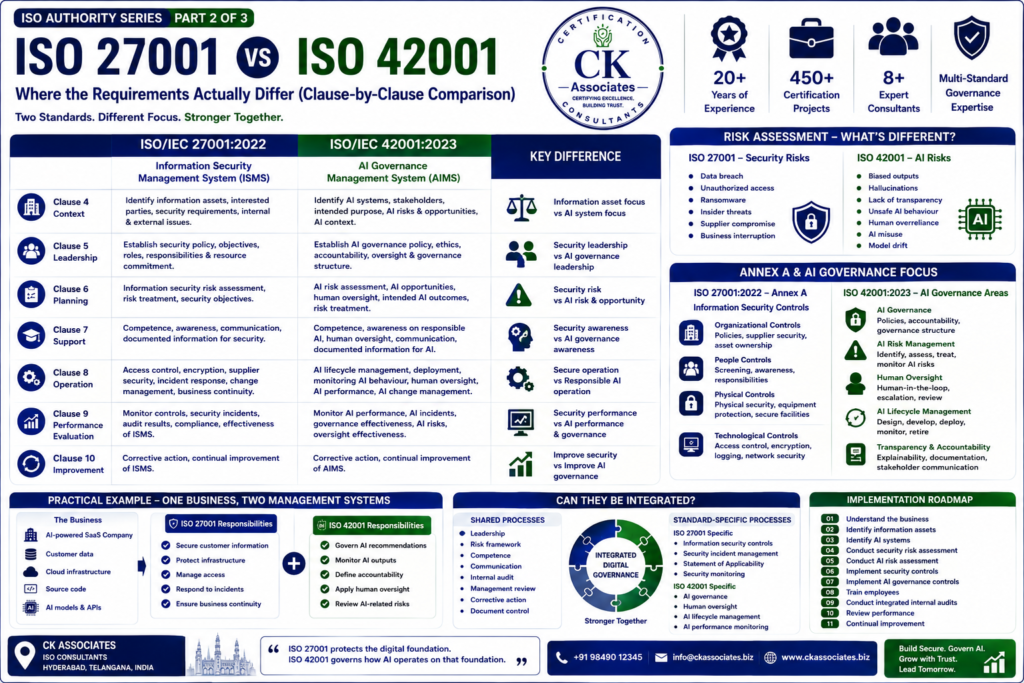
If we already have ISO 27001, how much of ISO 42001 is already covered—and what is completely different?
This is where implementation strategy becomes far more interesting than certification alone.
Quick Comparison
| Area | ISO 27001 | ISO 42001 |
|---|---|---|
| Purpose | Information Security | AI Governance |
| Management System | ISMS | AIMS |
| Primary Risk | Security Risk | AI Risk & Opportunity |
| Assets | Information Assets | AI Systems |
| Core Focus | Confidentiality, Integrity & Availability | Responsible AI |
| Governance | Security Governance | AI Governance |
| Human Oversight | Limited | Explicit Requirement |
| AI Lifecycle | Not Primary | Core Requirement |
Think of it this way:
ISO 27001 protects the digital foundation. ISO 42001 governs how AI operates on that foundation.
The Common ISO Management System Structure
One reason these standards integrate well is that they share the High-Level Structure (HLS) used across modern ISO management systems.
Both contain:
- Clause 4 – Context
- Clause 5 – Leadership
- Clause 6 – Planning
- Clause 7 – Support
- Clause 8 – Operation
- Clause 9 – Performance Evaluation
- Clause 10 – Improvement
This means organizations can integrate many governance processes instead of creating duplicate systems.
The technical requirements, however, remain different.
Clause 4 — Context of the Organization
ISO 27001
The organization identifies:
- Information assets
- Interested parties
- Security requirements
- Internal and external issues affecting information security
Example:
A SaaS company identifies customer databases, source code repositories and cloud infrastructure as critical assets.
ISO 42001
The organization identifies:
- AI systems
- AI stakeholders
- Intended purpose of AI
- Risks and opportunities created by AI
- Context surrounding AI deployment
Example:
The same SaaS company now identifies:
- AI chatbot
- Recommendation engine
- Large Language Model integration
- AI-powered analytics
Key Difference
ISO 27001 asks:
What information needs protection?
ISO 42001 asks:
What AI systems require governance?
Clause 5 — Leadership
Both standards expect leadership involvement.
ISO 27001
Leadership establishes:
- Security policy
- Security objectives
- Roles and responsibilities
- Resource commitment
ISO 42001
Leadership goes further by ensuring:
- Responsible AI governance
- Accountability
- Oversight mechanisms
- Appropriate governance structures
- Ethical AI direction
Practical Example
A CEO approving an Information Security Policy satisfies one governance need.
A CEO approving an AI Governance Policy—with defined accountability for AI decisions—addresses another.
Clause 6 — Planning
This is where the standards begin separating more clearly.
ISO 27001 Planning
Focuses on:
- Information-security risk assessment
- Risk treatment
- Security objectives
Typical questions:
- What threats exist?
- What vulnerabilities exist?
- What controls are required?
ISO 42001 Planning
Adds AI-specific planning.
Organizations consider:
- AI risks
- AI opportunities
- Human oversight
- Intended AI outcomes
- Responsible deployment
Example:
A recruitment AI may introduce:
- Bias risk
- Transparency concerns
- Human review requirements
These are governance questions rather than traditional cybersecurity questions.
Clause 7 — Support
Both standards require support functions.
Common elements include:
- Competence
- Awareness
- Communication
- Documented information
The difference lies in what employees need to understand.
ISO 27001 Awareness
Employees learn:
- Password security
- Phishing
- Incident reporting
- Access responsibilities
ISO 42001 Awareness
Employees additionally learn:
- Responsible AI use
- AI limitations
- Human oversight
- Appropriate AI decision-making
- AI-related responsibilities
The workforce therefore needs broader governance awareness—not just security awareness.
Clause 8 — Operation
This is arguably the biggest practical difference.
ISO 27001 Operations
Operational controls may include:
- Access management
- Encryption
- Backup
- Supplier security
- Incident response
- Change management
The objective is secure operation.
ISO 42001 Operations
Operational controls extend into:
- AI lifecycle management
- AI deployment
- Monitoring AI behaviour
- Human oversight
- AI performance evaluation
- AI risk treatment
- AI change management
Example
A generative AI assistant receives an update.
ISO 27001 asks:
Was the change securely managed?
ISO 42001 asks:
Has the AI’s behaviour changed, and does it introduce new governance risks?
Clause 9 — Performance Evaluation
Both standards require organizations to evaluate effectiveness.
ISO 27001
Measures may include:
- Security incidents
- Audit results
- Control effectiveness
- Compliance status
ISO 42001
Measures can include:
- AI performance
- AI monitoring
- Governance effectiveness
- AI-related issues
- Human oversight effectiveness
The organization begins asking:
Is the AI system behaving as intended?
That question sits outside traditional information security.
Clause 10 — Improvement
Both standards emphasize continual improvement.
ISO 27001
Improvement often follows:
Security Incident
↓
Corrective Action
↓
Improved Security Controls
ISO 42001
Improvement can follow:
AI Issue
↓
Root Cause
↓
Governance Improvement
↓
Improved AI Oversight
The improvement philosophy is similar.
The governance focus is different.
The Biggest Difference — Risk Assessment
Both standards require risk-based thinking.
But they assess different types of risk.
ISO 27001 Risk Examples
- Data breach
- Unauthorized access
- Ransomware
- Insider threats
- Supplier compromise
- Business interruption
ISO 42001 Risk Examples
- Biased outputs
- Hallucinations
- Lack of transparency
- Unsafe AI behaviour
- Human-overreliance
- AI misuse
- Model drift
Notice that an AI risk can exist even when the underlying infrastructure remains secure.
That is precisely why AI governance deserves separate attention.
Annex A — Where Security Lives
One of ISO 27001’s most recognizable components is Annex A.
The 2022 edition organizes controls into four themes.
Organizational Controls
Examples include:
- Policies
- Supplier security
- Asset ownership
- Security responsibilities
People Controls
Examples include:
- Screening
- Awareness
- Responsibilities
Physical Controls
Examples include:
- Physical security
- Equipment protection
- Secure facilities
Technological Controls
Examples include:
- Access control
- Encryption
- Logging
- Network security
These controls strengthen the organization’s security posture.
What About ISO 42001 Controls?
Unlike ISO 27001’s security-focused Annex A, ISO 42001 introduces guidance around governing AI throughout its lifecycle.
Organizations consider areas such as:
- AI governance
- AI risk management
- Human oversight
- Transparency
- Accountability
- Monitoring
- AI performance
- AI system documentation
- Responsible deployment
The emphasis shifts from protecting systems to governing AI decisions and behaviour.
The Statement of Applicability vs AI Governance
ISO 27001
Organizations prepare a Statement of Applicability (SoA).
It explains which Annex A controls are applicable and why.
This becomes one of the most important implementation documents.
ISO 42001
Organizations similarly need documented governance decisions around AI systems—but the conversation becomes broader.
Instead of asking only:
Which security controls apply?
organizations also ask:
- Which AI systems are governed?
- What oversight exists?
- Who is accountable?
- How are AI risks monitored?
Practical Example — One Business, Two Management Systems
Imagine a Hyderabad AI startup.
It has:
- Customer portal
- AI recommendation engine
- Cloud infrastructure
- Employee access
- Third-party AI APIs
ISO 27001 Responsibilities
- Secure customer information
- Protect infrastructure
- Manage access
- Respond to incidents
ISO 42001 Responsibilities
- Govern AI recommendations
- Monitor outputs
- Define accountability
- Apply human oversight
- Review AI-related risks
Both systems work together.
Neither replaces the other.
Can They Be Integrated?
Yes—but intelligently.
Organizations can integrate common management-system processes.
Shared Processes
- Leadership
- Risk framework
- Competence
- Internal audits
- Management review
- Corrective action
- Document control
Standard-Specific Processes
ISO 27001
- Information-security controls
- Security incident management
- Statement of Applicability
ISO 42001
- AI governance
- Human oversight
- AI lifecycle management
- AI performance monitoring
This approach creates an Integrated Digital Governance System rather than two disconnected compliance projects.
Implementation Roadmap
A practical implementation sequence looks like this.
Phase 1
Understand the business.
↓
Phase 2
Identify information assets.
↓
Phase 3
Identify AI systems.
↓
Phase 4
Conduct security risk assessment.
↓
Phase 5
Conduct AI risk assessment.
↓
Phase 6
Implement security controls.
↓
Phase 7
Implement AI governance controls.
↓
Phase 8
Train employees.
↓
Phase 9
Conduct integrated internal audits.
↓
Phase 10
Review performance.
↓
Phase 11
Continually improve.
Notice how both standards can share much of the governance architecture while retaining their own technical focus.
Consultant’s Perspective
One of the biggest implementation mistakes we see is organizations treating AI governance as:
“Something the IT team will handle later.”
That is increasingly becoming a business risk.
If AI influences:
- customer interactions,
- hiring decisions,
- financial analysis,
- operational recommendations,
- software development,
then governance needs to involve leadership—not just technology teams.
The strongest organizations are beginning to build one governance architecture where:
- Security protects information.
- Privacy protects personal data.
- AI governance protects responsible decision-making.
That is where ISO 27001 and ISO 42001 become far more powerful together.
Key Takeaways
- Both standards share the modern ISO management-system structure.
- ISO 27001 focuses on protecting information.
- ISO 42001 focuses on governing AI.
- Risk assessment remains central—but the risks differ.
- Annex A strengthens security controls.
- AI governance introduces oversight, accountability and lifecycle management.
- Shared governance processes can be integrated.
- Technical controls should remain standard-specific.
Why Trust This Guidance?
CK Associates has 20+ years of consulting experience, 450+ certification projects, 25+ ISO 27001 implementations, and 4+ ISO 42001 implementations, helping organizations build practical governance systems rather than documentation-heavy compliance projects.
Author: Sirish K — Founder & Lead ISO Consultant
💬 Debate Question
If your organization already has ISO 27001, what should be the next priority?
- A. Implement ISO 42001 immediately.
- B. Strengthen AI governance before certification.
- C. Build one integrated governance framework covering security, privacy and AI.
Which approach do you think will become the industry standard over the next three years?
ISO 27001 vs ISO 42001 — Cybersecurity vs AI Governance: Why You Need Both
Part 3 — FAQ, Q&A Snippets & Article Schema
This section is optimized for Google Featured Snippets, AI Overviews, ChatGPT, Perplexity, Gemini, Claude, and other LLM-powered search engines while strengthening CK Associates’ topical authority.
Frequently Asked Questions
1. What is the main difference between ISO 27001 and ISO 42001?
ISO/IEC 27001 establishes an Information Security Management System (ISMS) to protect information through confidentiality, integrity and availability. ISO/IEC 42001 establishes an Artificial Intelligence Management System (AIMS) to govern AI systems responsibly through oversight, accountability and AI risk management.
2. Do AI companies need both ISO 27001 and ISO 42001?
Many AI companies can benefit from both standards because they address different governance needs. ISO 27001 protects information and supporting infrastructure, while ISO 42001 governs AI development, deployment and monitoring. Together, they provide a stronger digital governance framework.
3. Does ISO 27001 cover AI governance?
No. ISO 27001 focuses on information security management. While it helps secure AI-related data and infrastructure, it does not comprehensively address AI-specific governance topics such as human oversight, transparency, AI lifecycle management and responsible AI decision-making.
4. Can ISO 27001 and ISO 42001 be implemented together?
Yes. Both standards follow the modern ISO High-Level Structure (HLS), allowing organizations to integrate common processes such as leadership, risk management, internal audits, management review and continual improvement while maintaining standard-specific controls.
5. Which standard should a SaaS company implement first?
The answer depends on business objectives. Organizations handling sensitive customer information often begin with ISO 27001, while organizations developing or heavily relying on AI should also evaluate ISO 42001 as AI governance becomes increasingly important for enterprise customers.
6. What industries benefit most from ISO 42001?
ISO 42001 is particularly relevant for:
- AI startups
- SaaS companies
- IT services
- Healthcare technology
- FinTech
- EdTech
- Manufacturing using AI
- Enterprise software companies
- Organizations deploying Generative AI
7. Is ISO 42001 mandatory?
No. ISO 42001 is currently a voluntary international standard. However, many organizations are adopting it proactively to demonstrate responsible AI governance and prepare for evolving customer and regulatory expectations.
8. How does ISO 42001 support enterprise sales?
Enterprise customers increasingly evaluate vendors on AI governance. Demonstrating a structured AI management system can strengthen customer confidence during security reviews, procurement assessments and vendor due diligence processes.
Quick Q&A
What is ISO 27001?
ISO/IEC 27001 is the international standard for establishing, implementing, maintaining and continually improving an Information Security Management System (ISMS).
What is ISO 42001?
ISO/IEC 42001 is the world’s first international Artificial Intelligence Management System (AIMS) standard, helping organizations govern AI responsibly.
What does ISO 27001 protect?
ISO 27001 protects information through confidentiality, integrity and availability while managing information-security risks across people, processes and technology.
What does ISO 42001 govern?
ISO 42001 governs AI systems by addressing AI lifecycle management, human oversight, accountability, transparency and AI-related risk management.
Can both standards work together?
Yes. Organizations can integrate shared management-system processes while maintaining separate security controls and AI governance requirements.
Why Trust This Guidance?
CK Associates has supported organizations across multiple governance standards through:
- 20+ Years of Consulting Experience
- 450+ Certification Projects
- 25+ ISO 27001 Implementations
- 4+ ISO 42001 Implementations
- 8+ Expert Consultants
- PAN-India Implementation Experience
Our consulting philosophy focuses on practical governance, operational adoption and certification readiness rather than documentation-heavy compliance.
About the Author
Sirish K
Founder & Lead ISO Consultant
Sirish K has over 20 years of experience implementing ISO management systems across manufacturing, IT, SaaS, healthcare, education, food, infrastructure and emerging AI-focused organizations.
His specialization includes:
- ISO 27001
- ISO 42001
- ISO 9001
- ISO 14001
- ISO 45001
- Integrated Management Systems
- Information Security Governance
- AI Governance
- Business Process Improvement