
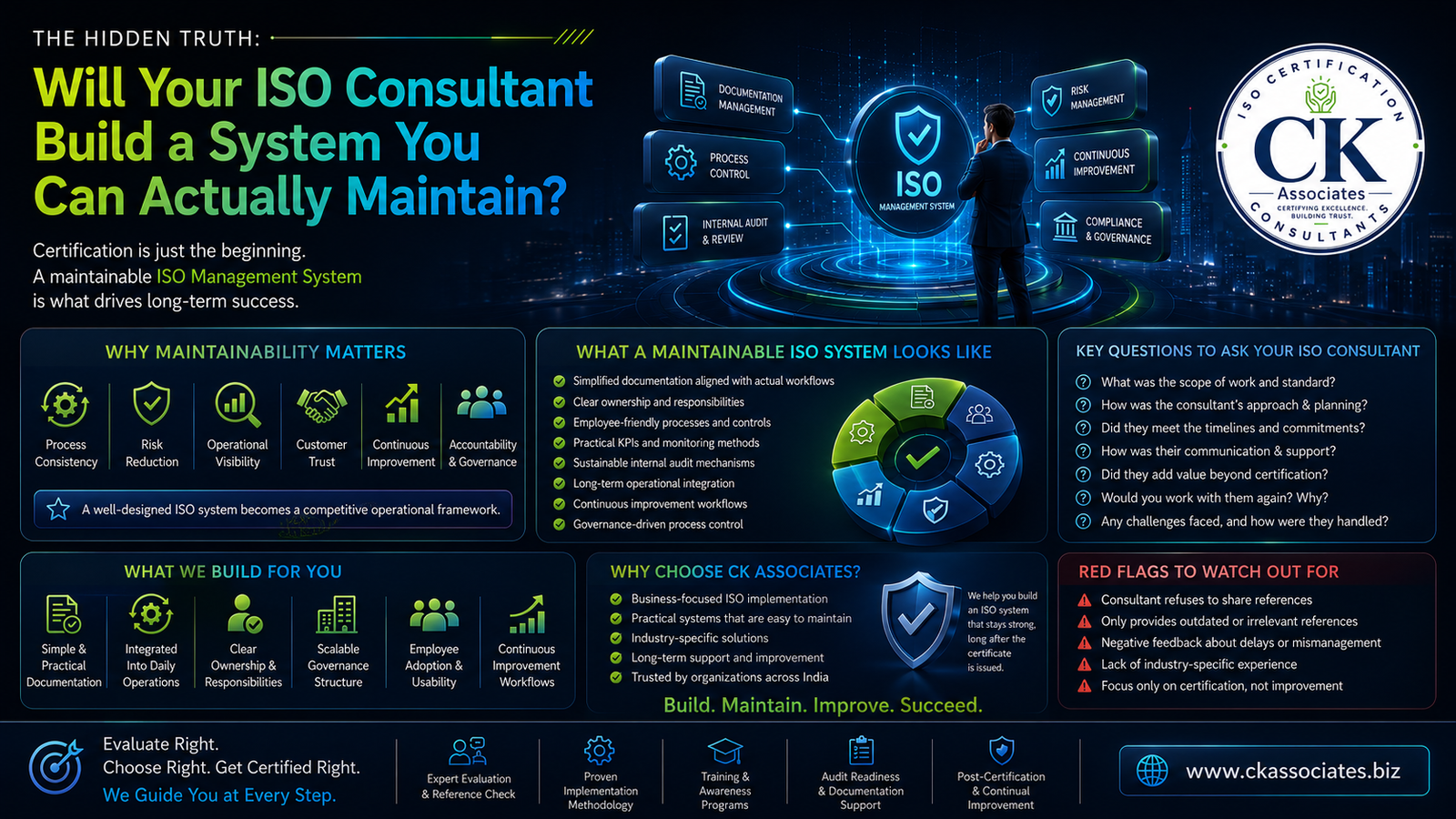
In today’s competitive business environment, achieving ISO certification is no longer just about compliance. It is about building a system that improves quality, strengthens customer trust, reduces operational risks, and supports long-term growth.
However, many businesses struggle after certification because their ISO management system becomes difficult to maintain. Documentation grows unnecessarily, employees stop following processes, audits become stressful, and the system turns into a burden instead of a business advantage.
At CK Associates, we help organizations build maintainable ISO management systems that are practical, scalable, and easy to operate in day-to-day business activities.
What Is a Maintainable ISO Management System?
A maintainable ISO management system is a structured framework that:
- aligns with your business operations
- remains easy to manage after certification
- supports continuous improvement
- simplifies audits and compliance
- helps employees follow processes naturally
Instead of creating excessive paperwork, a maintainable system focuses on practical implementation that adds real value to the organization.
Whether your business is implementing:
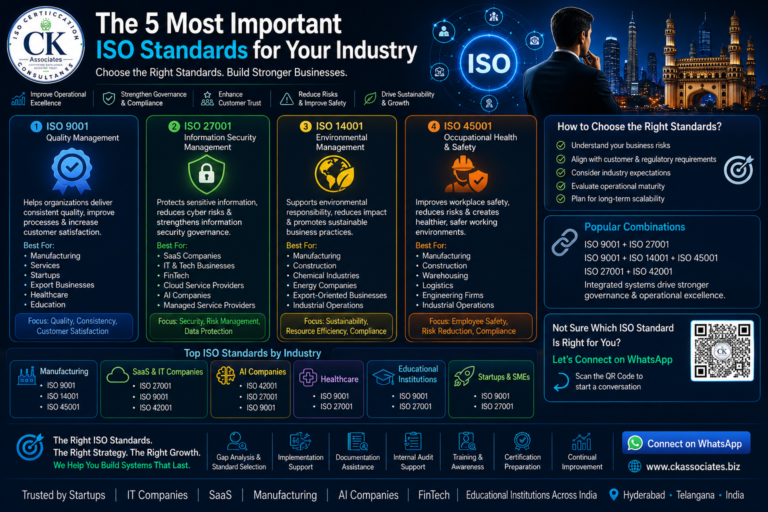
- International Organization for Standardization 9001 for Quality Management
- ISO 27001 for Information Security
- ISO 14001 for Environmental Management
- ISO 45001 for Occupational Health & Safety
the goal should always be sustainability and operational efficiency.
Why Many ISO Systems Fail After Certification
Many companies successfully obtain ISO certification but struggle to maintain the system afterward.
Common reasons include:
Overcomplicated Documentation
Businesses often create large volumes of unnecessary documents that employees rarely use.
Lack of Employee Involvement
When teams do not understand the purpose of ISO processes, compliance becomes inconsistent.
Poor Process Integration
Some ISO systems operate separately from actual business operations, creating extra work instead of improving efficiency.
Audit-Focused Implementation
Organizations sometimes prepare only for certification audits rather than building a long-term management framework.
No Continuous Improvement Plan
Without regular reviews and improvements, the system slowly becomes outdated and ineffective.
How a Maintainable ISO System Benefits Your Business
A properly designed ISO management system offers more than certification.
Improved Operational Efficiency
Clear workflows reduce confusion, delays, and repetitive tasks.
Better Customer Confidence
Certified and well-managed systems improve trust with customers, partners, and stakeholders.
Easier Compliance Management
A structured system simplifies internal audits, surveillance audits, and regulatory compliance.
Reduced Business Risks
Risk-based thinking helps organizations identify issues before they become major problems.
Stronger Team Accountability
Defined responsibilities help employees understand their roles and maintain process consistency.
Long-Term Cost Savings
Simple and efficient systems reduce operational waste and avoid costly non-conformities.
Our Approach to Building Maintainable ISO Systems
At CK Associates, we focus on practical implementation instead of paperwork-heavy consulting.
1. Understanding Your Business Operations
We first study your:
- workflows
- departments
- risks
- operational challenges
- compliance requirements
This helps us design systems that match your real business activities.
2. Simplifying Documentation
We create only the documents that are genuinely required and useful.
Our focus is:
- clarity
- usability
- operational relevance
- easy maintenance
Employees should be able to understand and follow processes without confusion.
3. Employee Awareness & Training
An ISO system works only when people use it effectively.
We conduct practical training sessions to help employees:
- understand process requirements
- follow standard procedures
- identify risks
- participate in continual improvement
4. Process-Based Implementation
Instead of treating ISO as separate paperwork, we integrate it into daily operations.
This creates:
- smoother workflows
- better accountability
- improved productivity
- easier monitoring
5. Internal Audit & Gap Analysis
Regular internal audits help organizations identify:
- weak process areas
- compliance gaps
- improvement opportunities
Our audit support helps businesses stay prepared throughout the certification cycle.
Industries We Support
We provide ISO consulting solutions for various industries including:
- Manufacturing
- Healthcare
- IT & Software
- Pharmaceuticals
- Construction
- Educational Institutions
- Food Processing
- Engineering Services
- Logistics & Supply Chain
Every industry has unique operational challenges, which is why we customize implementation strategies accordingly.
Real Challenges Businesses Face During ISO Implementation
Many organizations approach us after facing problems such as:
- failed certification audits
- employee resistance
- excessive documentation
- process confusion
- recurring non-conformities
- poor audit preparedness
In most cases, the issue is not the ISO standard itself. The problem is usually an overly complex implementation approach.
A maintainable system should support business growth, not create operational stress.
How We Help Reduce Certification Stress
Our consulting approach focuses on making ISO implementation manageable and business-friendly.
We help organizations:
- simplify compliance
- reduce unnecessary documentation
- improve process clarity
- prepare confidently for audits
- maintain certification efficiently
- build a culture of continuous improvement
This allows management teams to focus on business growth while maintaining compliance standards.
Key Features of a Sustainable ISO Management System
A strong ISO system should include:
Clear Process Ownership
Every process should have responsible owners and measurable objectives.
Risk-Based Thinking
Potential operational risks should be identified and controlled proactively.
Periodic Review Mechanisms
Regular management reviews help keep the system updated and effective.
Employee Participation
Employees should actively contribute to process improvements.
Practical Documentation Control
Documents should remain easy to access, update, and maintain.
Continuous Improvement Culture
Organizations should regularly evaluate performance and identify improvement opportunities.
Why Businesses Choose CK Associates
Organizations work with us because we focus on practical, maintainable, and business-oriented ISO solutions.
Our strengths include:
- experienced ISO consultants
- industry-specific implementation expertise
- simplified documentation methods
- practical audit support
- long-term compliance guidance
- customized consulting approach
We believe ISO systems should help businesses operate better — not create unnecessary complexity.
Frequently Asked Questions
How long does ISO implementation take?
The timeline depends on the organization size, industry, and scope. Most implementations typically take between 2 to 6 months.
Can small businesses implement ISO standards?
Yes. ISO standards are suitable for businesses of all sizes when implemented practically.
Is ISO documentation always complicated?
No. Documentation should be simple, useful, and aligned with business operations.
What happens after certification?
Organizations must maintain compliance through periodic audits, reviews, and continual improvement activities.
Can ISO systems be integrated?
Yes. Businesses can integrate multiple standards such as ISO 9001, ISO 14001, and ISO 45001 into a unified management system.
Build an ISO System That Actually Works
ISO certification should not end with passing an audit. The real value comes from building a system that improves operations, strengthens compliance, and supports business growth over the long term.
At CK Associates, we help organizations implement ISO management systems that are simple, effective, and easy to maintain.
If your organization is planning ISO certification or struggling with an existing system, our experts can help you build a practical framework designed for long-term success.