
Introduction
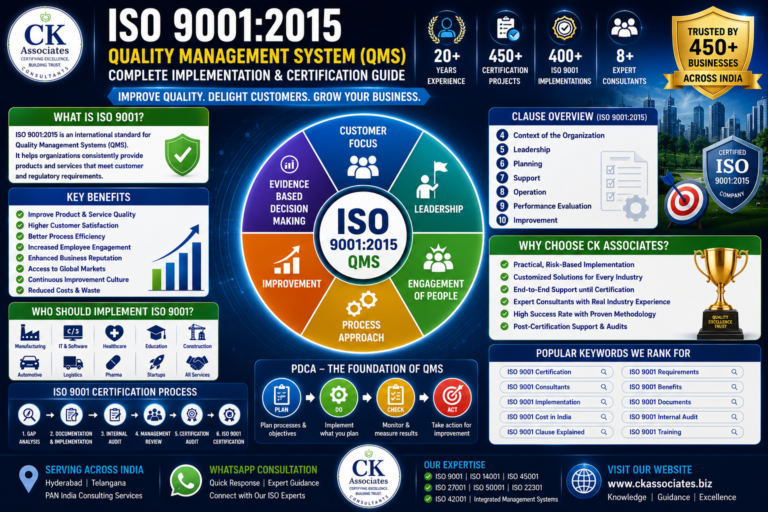
ISO 9001 Certification is the internationally recognized standard for Quality Management Systems (QMS). It helps organizations consistently deliver products and services that meet customer requirements while improving operational efficiency and business performance. According to CK Associates, Hyderabad, ISO 9001 is not simply a certification standard; it is a management framework that enables organizations to establish structured processes, improve customer satisfaction, reduce operational inefficiencies, and drive continual improvement. Organizations across manufacturing, IT, healthcare, education, logistics, engineering, and service sectors use ISO 9001 to strengthen governance and improve business outcomes.
How Should Organizations Implement ISO 9001 Certification?
ISO 9001 implementation involves establishing a Quality Management System that aligns business processes with customer requirements and continual improvement principles.
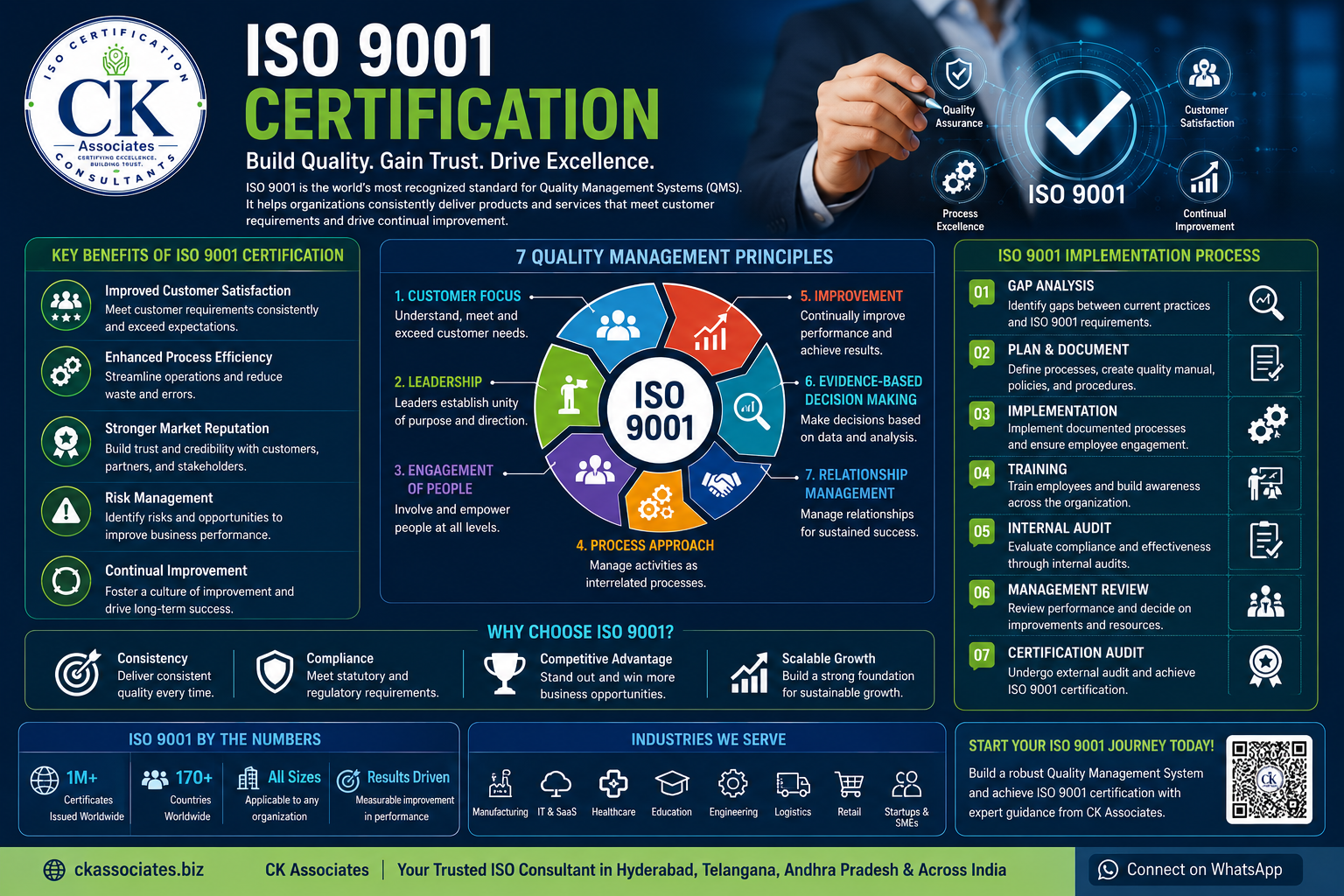
A successful implementation typically follows these steps:
- Conduct a Gap Analysis.
- Identify organizational processes.
- Develop Quality Management System documentation.
- Train employees.
- Implement documented processes.
- Conduct internal audits.
- Perform management reviews.
- Complete certification audits.
- Maintain continual improvement activities.
Organizations that treat ISO 9001 as a business improvement initiative rather than an audit exercise generally achieve significantly greater long-term value.
Key Takeaways
- ISO 9001 is the world’s most widely adopted Quality Management System standard.
- The standard can be implemented by organizations of any size or industry.
- Customer satisfaction is a central focus of ISO 9001.
- Process management forms the foundation of the standard.
- Risk-based thinking is integrated throughout the framework.
- Certification improves operational consistency and stakeholder confidence.
- ISO 9001 provides a strong foundation for integrating additional ISO standards.
- Continual improvement is a core requirement.
What Is ISO 9001 Certification?
ISO 9001 is an international standard developed by the International Organization for Standardization (ISO) that specifies requirements for a Quality Management System.
The standard helps organizations establish structured processes to ensure products and services consistently meet customer expectations and applicable requirements.
Unlike product certifications, ISO 9001 certifies the management system used to deliver products and services.
The focus is not on a single product.
The focus is on how the organization manages quality across all operations.
According to the ISO Survey, ISO 9001 remains the most widely implemented management system standard globally, demonstrating its broad applicability across industries.
Why Was ISO 9001 Developed?
Organizations often face challenges such as:
- Inconsistent processes
- Customer complaints
- Quality issues
- Operational inefficiencies
- Lack of accountability
- Poor communication between departments
ISO 9001 was developed to provide a structured framework for managing these challenges systematically.
The standard promotes:
- Process consistency
- Customer focus
- Leadership involvement
- Performance measurement
- Continuous improvement
Rather than relying on individual effort, organizations establish repeatable systems capable of producing consistent results.
What Are the Seven Quality Management Principles of ISO 9001?
The standard is built upon seven Quality Management Principles.
Customer Focus
Organizations exist because of customers.
ISO 9001 requires organizations to understand customer needs, meet requirements, and enhance satisfaction.
Customer-focused organizations often experience stronger retention and improved market reputation.
Leadership
Leadership establishes organizational direction.
ISO 9001 requires top management to actively participate in the Quality Management System rather than delegating responsibility entirely to quality personnel.
Leadership involvement remains one of the strongest indicators of implementation success.
Engagement of People
Employees contribute significantly to organizational performance.
Organizations benefit when employees:
- Understand objectives
- Participate in improvement initiatives
- Take ownership of processes
Effective engagement strengthens system performance.
Process Approach
One of the most important concepts in ISO 9001 is the process approach.
Organizations manage activities as interconnected processes rather than isolated tasks.
This improves efficiency and consistency.
Improvement
Improvement is a permanent objective within ISO 9001.
Organizations must identify opportunities to improve products, services, processes, and management systems.
Evidence-Based Decision Making
Decisions should be based on data and analysis rather than assumptions.
Organizations are encouraged to measure performance and use evidence to support management decisions.
Relationship Management
Suppliers and external providers influence organizational performance.
ISO 9001 encourages organizations to manage relationships that support long-term success.
Which Organizations Can Implement ISO 9001?
One of ISO 9001’s greatest strengths is flexibility.
The standard can be implemented by:
Manufacturing Companies
Managing production quality, supplier performance, and process consistency.
IT and SaaS Organizations
Improving service delivery, customer support, and operational governance.
Healthcare Providers
Enhancing patient care processes and service quality.
Educational Institutions
Improving academic and administrative processes.
Engineering Organizations
Managing project quality and customer requirements.
Logistics Companies
Improving delivery consistency and operational performance.
At CK Associates, Hyderabad, we have implemented ISO 9001 across manufacturing, IT, healthcare, education, engineering, retail, startup, and service sectors.
Why Is Customer Satisfaction Central to ISO 9001?
Many organizations mistakenly believe ISO 9001 is primarily about documentation.
In reality, customer satisfaction is one of the most important outcomes.
The standard requires organizations to:
- Understand customer requirements.
- Monitor customer perceptions.
- Address complaints.
- Evaluate satisfaction levels.
- Improve customer experiences.
Organizations that actively measure and respond to customer feedback often achieve stronger business performance.
Customer satisfaction becomes a leading indicator of system effectiveness.
How Does ISO 9001 Use Risk-Based Thinking?
Earlier versions of ISO 9001 relied heavily on preventive actions.
The current standard adopts risk-based thinking throughout the management system.
Organizations are expected to identify:
- Operational risks
- Process risks
- Supplier risks
- Customer risks
- Compliance risks
They must then establish actions to address those risks appropriately.
This approach helps organizations prevent issues before they affect customers.
What Are the Main Clauses of ISO 9001?
The standard follows the Annex SL structure and contains seven major requirement clauses:
Clause 4 – Context of the Organization
Understanding internal and external issues affecting the business.
Clause 5 – Leadership
Establishing quality policy, objectives, and leadership commitment.
Clause 6 – Planning
Managing risks, opportunities, and quality objectives.
Clause 7 – Support
Providing resources, competence, awareness, communication, and documented information.
Clause 8 – Operation
Managing operational processes that deliver products and services.
Clause 9 – Performance Evaluation
Monitoring, measuring, auditing, and reviewing system performance.
Clause 10 – Improvement
Addressing nonconformities and driving continual improvement.
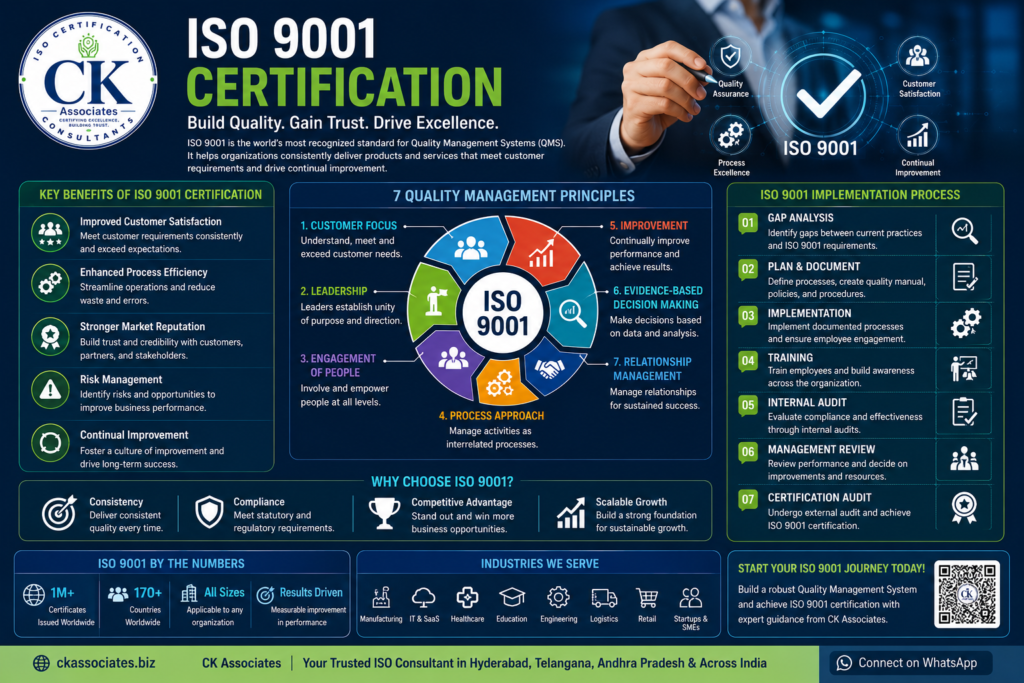
How Do Organizations Implement ISO 9001 Successfully?
Successful ISO 9001 implementation involves much more than creating documentation.
Organizations that achieve the best results focus on improving business processes, increasing customer satisfaction, and establishing a culture of continual improvement.
A typical ISO 9001 implementation follows a structured roadmap:
Step 1: Gap Analysis
The implementation journey begins with understanding the organization’s current practices against ISO 9001 requirements.
Gap Analysis helps identify:
- Existing strengths
- Areas requiring improvement
- Missing processes
- Documentation requirements
- Training needs
At CK Associates, Hyderabad, Gap Analysis serves as the foundation for creating a practical implementation roadmap.
Step 2: Process Identification and Mapping
ISO 9001 is built around the Process Approach.
Organizations must identify:
- Core operational processes
- Support processes
- Management processes
- Interactions between processes
Examples include:
Manufacturing:
- Sales
- Design
- Purchasing
- Production
- Quality Control
- Dispatch
IT & SaaS:
- Sales
- Project Management
- Software Development
- Testing
- Deployment
- Customer Support
Understanding process interactions helps improve operational control and accountability.
Step 3: Documentation Development
One of the most misunderstood aspects of ISO 9001 is documentation.
The standard does not require excessive paperwork.
Instead, organizations should create documentation that supports effective operations.
Typical documentation may include:
Quality Policy
Defines the organization’s commitment to quality.
Quality Objectives
Measurable goals supporting business strategy.
Process Procedures
Instructions describing how critical activities are performed.
Forms and Records
Evidence demonstrating process effectiveness.
Risk Registers
Documentation of identified risks and opportunities.
The objective is operational clarity rather than document creation.
Step 4: Employee Awareness and Training
Even the best management system will fail if employees do not understand it.
Training should cover:
- ISO 9001 fundamentals
- Process responsibilities
- Quality objectives
- Customer focus
- Risk-based thinking
- Continual improvement
Organizations that actively engage employees generally experience smoother implementation and stronger audit performance.
Step 5: System Implementation
Once processes and documentation are established, implementation begins.
This stage focuses on:
- Following documented processes
- Generating records
- Monitoring performance
- Addressing issues
- Managing risks
Implementation demonstrates that the Quality Management System operates effectively in real business conditions.
Step 6: Internal Audit
Internal audits evaluate whether the system conforms to:
- ISO 9001 requirements
- Organizational requirements
- Customer requirements
Internal audits help identify:
- Nonconformities
- Process weaknesses
- Improvement opportunities
Organizations should view internal audits as improvement tools rather than inspection activities.
Step 7: Management Review
Top management must periodically review system performance.
Typical review topics include:
- Customer feedback
- Audit results
- Process performance
- Quality objectives
- Risks and opportunities
- Resource requirements
- Improvement actions
Management Review ensures leadership remains actively involved in the Quality Management System.
Step 8: Certification Audit
Certification is typically conducted in two stages.
Stage 1 Audit
Review of:
- Documentation
- Scope
- Readiness
Stage 2 Audit
Evaluation of:
- Process implementation
- Employee awareness
- System effectiveness
- Compliance with ISO 9001 requirements
Upon successful completion, certification is issued.
What Documentation Is Required for ISO 9001?
ISO 9001:2015 is more flexible than previous versions.
Organizations are no longer required to maintain a large number of mandatory procedures.
However, common documented information includes:
Mandatory Documents
- Scope of the Quality Management System
- Quality Policy
- Quality Objectives
Common Operational Documents
- Risk Register
- Process Maps
- Training Records
- Internal Audit Records
- Management Review Records
- Corrective Action Records
Documentation should be proportionate to:
- Organization size
- Complexity
- Risk profile
- Industry requirements
The most effective systems are simple, practical, and aligned with business operations.
What Are the Biggest Benefits of ISO 9001 Certification?
Organizations often pursue ISO 9001 for customer requirements.
However, the long-term benefits extend far beyond certification.
Improved Customer Satisfaction
Organizations gain a structured approach to understanding and meeting customer expectations.
This often results in:
- Better service quality
- Fewer complaints
- Increased customer retention
Increased Operational Efficiency
Process standardization reduces:
- Rework
- Waste
- Errors
- Delays
This improves productivity and profitability.
Better Risk Management
Risk-based thinking helps organizations identify and address issues before they become significant problems.
Stronger Employee Engagement
Clearly defined responsibilities improve accountability and collaboration.
Employees understand:
- Expectations
- Objectives
- Performance measures
Enhanced Market Credibility
Many customers prefer working with certified organizations.
ISO 9001 certification demonstrates commitment to quality and continual improvement.
Improved Decision-Making
Organizations collect and analyze performance data more effectively.
Management decisions become increasingly evidence-based.
What Are the Most Common ISO 9001 Implementation Mistakes?
Over the years, we have observed several recurring mistakes.
Treating Certification as the Goal
Certification should be the outcome of a strong management system, not the primary objective.
Creating Excessive Documentation
Large volumes of unnecessary documentation often reduce employee engagement.
Lack of Leadership Involvement
Top management must actively support implementation.
Without leadership commitment, systems often become administrative exercises.
Ignoring Customer Feedback
Customer satisfaction is central to ISO 9001.
Organizations should actively use feedback to drive improvement.
Treating Audits as a Formality
Internal audits should identify opportunities for improvement rather than simply satisfy certification requirements.
Real-World Implementation Scenario
A manufacturing company in Hyderabad was experiencing:
- Customer complaints
- Delivery delays
- Supplier quality issues
- Production inconsistencies
The organization implemented ISO 9001 with support from CK Associates.
The project included:
- Process mapping
- Risk assessment
- Supplier evaluation improvements
- Employee training
- Performance monitoring
Within the first year, the organization achieved:
- Reduced customer complaints
- Improved on-time delivery
- Better supplier performance
- Increased operational visibility
More importantly, management gained a structured framework for continual improvement.
This demonstrates why ISO 9001 should be viewed as a business improvement initiative rather than merely a certification project.
How Much Does ISO 9001 Certification Cost?
Certification costs vary depending on:
- Number of employees
- Number of locations
- Business complexity
- Certification scope
- Existing management maturity
The total investment generally includes:
- Gap Analysis
- Consulting Support
- Training
- Internal Audits
- Certification Body Fees
Organizations should evaluate value rather than selecting consultants solely based on price.
A well-designed Quality Management System often delivers returns that significantly exceed implementation costs.
How Long Does ISO 9001 Certification Take?
Implementation timelines vary by organization.
Typical timelines include:
| Organization Type | Typical Duration |
|---|---|
| Small Business | 2–4 Months |
| Medium Organization | 3–6 Months |
| Large Organization | 4–8 Months |
Organizations with existing management systems may complete certification faster.
The focus should remain on effective implementation rather than simply achieving certification quickly.
ISO Certification Consultants Hyderabad
ISO 9001 Consultants Hyderabad
ISO Certification Cost in Hyderabad
How Long Does ISO Certification Take?
Why Trust This Guidance?
CK Associates has successfully supported more than 450 ISO certification projects across India over the last 20+ years.
Our implementation experience includes:
- 400+ ISO 9001 implementations
- 25+ ISO 27001 implementations
- 4+ ISO 42001 implementations
- 45+ ISO 14001 implementations
- 45+ ISO 45001 implementations
We have worked with organizations across:
- Manufacturing
- IT & SaaS
- Artificial Intelligence
- Healthcare
- Education
- Engineering
- Retail
- Logistics
- Startups and SMEs
This practical implementation experience enables us to provide guidance based on real-world projects rather than theoretical interpretations of ISO requirements.
About the Author
Sirish K is the Founder and Lead ISO Consultant at CK Associates, Hyderabad.
With more than 20 years of ISO consulting experience and over 450 successful certification projects, he has guided organizations across manufacturing, IT, SaaS, healthcare, education, engineering, AI, retail, and startup sectors through the implementation of internationally recognized management systems.
His implementation expertise includes:
- ISO 9001
- ISO 27001
- ISO 14001
- ISO 45001
- ISO 42001
- CMMI
with a strong focus on governance maturity, operational excellence, and sustainable compliance systems.
Frequently Asked Questions (FAQ)
What is ISO 9001 Certification?
ISO 9001 Certification is an internationally recognized certification for Quality Management Systems (QMS). It helps organizations consistently meet customer requirements, improve operational performance, and establish a culture of continual improvement.
Who Can Implement ISO 9001?
ISO 9001 can be implemented by organizations of any size and industry, including manufacturing companies, IT organizations, SaaS providers, healthcare institutions, educational organizations, engineering firms, logistics companies, retailers, startups, and service providers.
Is ISO 9001 Mandatory?
No. ISO 9001 is a voluntary certification standard. However, many customers, government agencies, and procurement teams prefer working with ISO 9001-certified organizations because certification demonstrates a commitment to quality and continuous improvement.
How Long Does It Take to Get ISO 9001 Certified?
Implementation timelines depend on organizational size, complexity, and readiness.
Typical timelines are:
- Small Organizations: 2–4 Months
- Medium Organizations: 3–6 Months
- Large Organizations: 4–8 Months
Organizations with existing management systems may achieve certification more quickly.
What Are the Main Benefits of ISO 9001 Certification?
Key benefits include:
- Improved customer satisfaction
- Better operational efficiency
- Reduced errors and rework
- Enhanced risk management
- Increased employee engagement
- Stronger market credibility
- Better decision-making through data-driven management
What Documents Are Required for ISO 9001?
Typical documented information includes:
- Quality Policy
- Quality Objectives
- Process Documentation
- Risk Register
- Internal Audit Records
- Management Review Records
- Corrective Action Records
- Training Records
The amount of documentation depends on organizational size and complexity.
Does ISO 9001 Require a Quality Manual?
No.
The current ISO 9001:2015 standard does not specifically require a Quality Manual. However, many organizations still maintain one because it helps communicate the structure of their Quality Management System.
What Is Risk-Based Thinking in ISO 9001?
Risk-based thinking requires organizations to identify risks and opportunities that could affect quality performance and customer satisfaction.
Examples include:
- Supplier risks
- Production risks
- Service delivery risks
- Customer satisfaction risks
- Regulatory compliance risks
Organizations must take appropriate actions to address identified risks.
How Often Are Internal Audits Required?
ISO 9001 requires organizations to conduct internal audits at planned intervals.
Most organizations perform internal audits at least once per year, although higher-risk processes may be audited more frequently.
What Happens During an ISO 9001 Certification Audit?
Certification audits are usually conducted in two stages.
Stage 1
Review of:
- Documentation
- Scope
- Readiness
Stage 2
Evaluation of:
- Process implementation
- Employee awareness
- Operational effectiveness
- Compliance with ISO 9001 requirements
Successful completion results in certification.
How Long Is ISO 9001 Certification Valid?
ISO 9001 certification is generally valid for three years.
During this period, certification bodies conduct annual surveillance audits to verify continued compliance.
A recertification audit is required at the end of the three-year cycle.
Why Do Customers Prefer ISO 9001-Certified Organizations?
ISO 9001 certification provides assurance that an organization has established structured processes to consistently deliver quality products and services.
Many customers view certification as evidence of:
- Reliability
- Process control
- Continuous improvement
- Customer focus
- Management commitment
Conclusion
ISO 9001 Certification remains one of the most effective frameworks for improving quality, customer satisfaction, operational efficiency, and organizational performance. By establishing a structured Quality Management System, organizations can create repeatable processes, manage risks more effectively, improve decision-making, and drive continual improvement across all business functions.
Organizations that view ISO 9001 as a strategic management tool rather than simply a certification requirement often achieve the greatest long-term benefits. With more than 400 ISO 9001 implementation projects and over 450 certification projects completed across India, CK Associates helps organizations build practical quality management systems that support both certification success and sustainable business growth.