
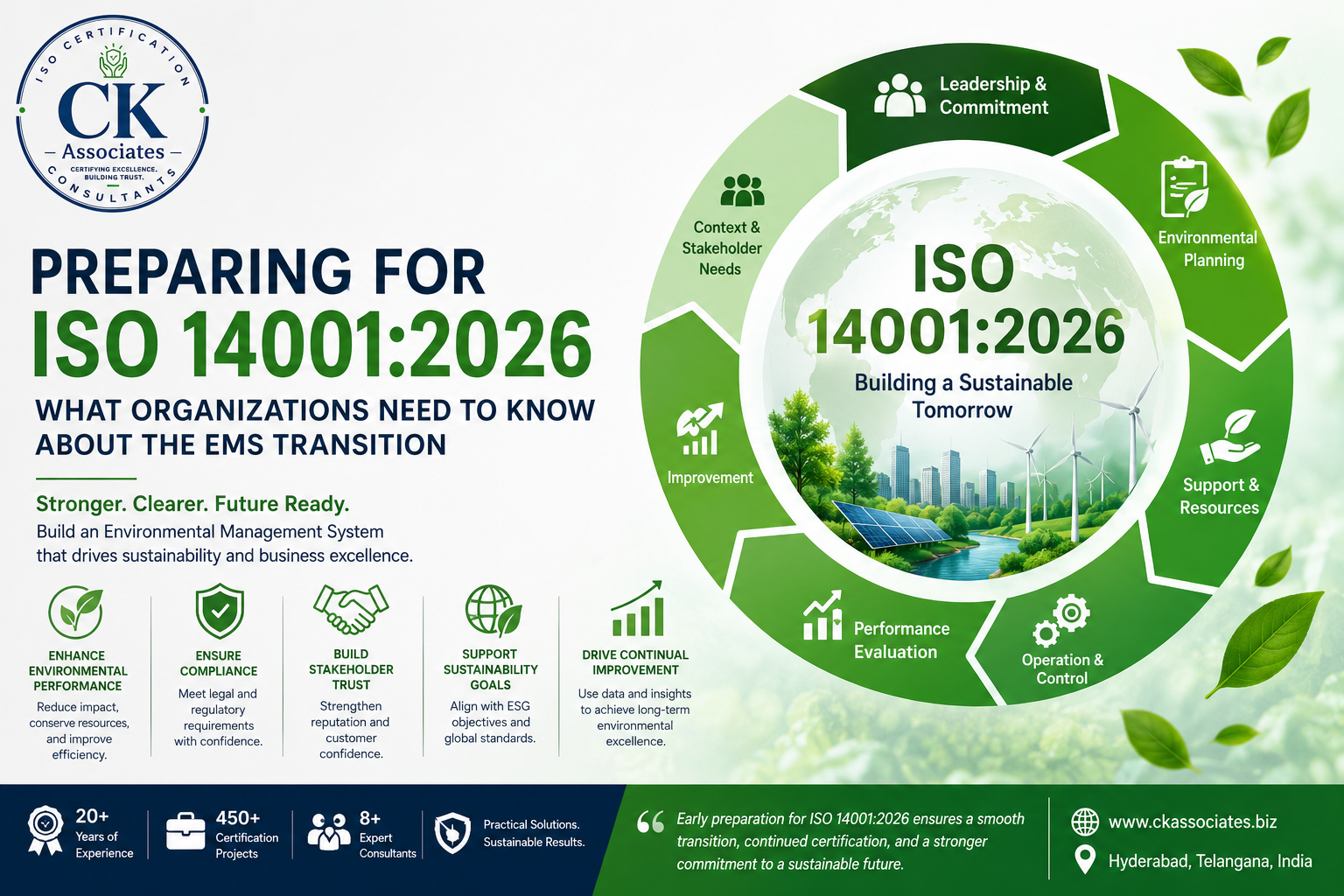
ISO 14001:2026 is the latest edition of the internationally recognized Environmental Management System (EMS) standard. While it retains the core management system framework established in ISO 14001:2015, the revised edition introduces targeted clarifications, updated terminology, stronger emphasis on change management, leadership, life-cycle thinking, externally provided processes, and continual improvement. Organizations already certified to ISO 14001:2015 should conduct a structured gap assessment, review the new requirements, update documented information where necessary, and prepare for transition within the timeframe established by accreditation and certification bodies. Early planning helps reduce disruption and ensures continued certification.
What is the ISO 14001:2026 Transition?
The ISO 14001:2026 transition is the process through which organizations certified to ISO 14001:2015 update their Environmental Management System (EMS) to comply with the revised 2026 edition. The transition involves reviewing the updated requirements, identifying gaps, implementing necessary changes, updating documentation, training employees, and completing a transition audit within the prescribed certification period.
ISO 14001:2026 builds upon the successful foundation of ISO 14001:2015. It is not a complete redesign, but it introduces important clarifications and targeted enhancements that organizations should not overlook. Businesses should begin reviewing the revised requirements early, conduct a formal gap analysis, and integrate the necessary updates into their Environmental Management System to ensure a smooth transition and continued certification.
Key Takeaways
- ISO 14001:2026 replaces ISO 14001:2015 as the current edition.
- The revision focuses on clarification, usability and alignment rather than fundamental restructuring.
- Organizations should perform a structured gap analysis against the 2026 requirements.
- Existing certified organizations are unlikely to require a complete system redesign.
- Leadership, change management and life-cycle thinking receive greater emphasis.
- Early transition planning reduces audit risk and implementation effort.
- ISO 14001 integrates effectively with ISO 9001 and ISO 45001 within an Integrated Management System (IMS).
Why ISO 14001 Continues to Matter
Environmental sustainability has become a strategic business priority rather than simply a compliance obligation.
Today, organizations are expected to demonstrate responsible environmental practices by:
- Managing environmental impacts
- Reducing waste
- Improving resource efficiency
- Meeting legal and regulatory obligations
- Addressing climate-related risks
- Supporting sustainability objectives
- Strengthening stakeholder confidence
Customers, investors, regulators and global supply chains increasingly evaluate environmental performance when selecting suppliers and business partners.
ISO 14001 provides an internationally recognized framework for managing these responsibilities systematically.
Why Was ISO 14001 Updated?
ISO standards are periodically reviewed to ensure they remain relevant to changing business environments, technological developments and stakeholder expectations.
The 2026 revision aims to:
- Improve clarity of requirements.
- Enhance consistency in interpretation.
- Reflect evolving environmental priorities.
- Strengthen integration with other management system standards.
- Improve practical implementation across organizations of different sizes.
Rather than introducing an entirely new management system, ISO 14001:2026 refines the existing framework to improve effectiveness and usability.
What is an Environmental Management System (EMS)?
An Environmental Management System (EMS) is a structured framework that enables organizations to identify, manage, monitor and continually improve their environmental performance.
An effective EMS helps organizations:
- Identify environmental aspects and impacts.
- Meet compliance obligations.
- Reduce pollution.
- Improve energy and resource efficiency.
- Minimize waste generation.
- Strengthen emergency preparedness.
- Support continual environmental improvement.
The system integrates environmental considerations into day-to-day business operations rather than treating them as separate activities.
Who Should Transition to ISO 14001:2026?
The revised standard applies to any organization currently certified to ISO 14001:2015 as well as organizations seeking new certification.
Typical sectors include:
Manufacturing
- Automotive
- Engineering
- Electronics
- Chemicals
- Packaging
- Textiles
Pharmaceuticals
- API manufacturers
- Formulation units
- Biotechnology
- Medical device manufacturers
Information Technology
- Data centres
- SaaS providers
- IT parks
- Technology companies
Construction
- Infrastructure
- Real estate
- Civil engineering
- EPC contractors
Healthcare
- Hospitals
- Diagnostic laboratories
- Healthcare service providers
Logistics
- Warehousing
- Transportation
- Distribution centres
- Supply chain operators
Food & Beverage
- Food manufacturers
- Processing units
- Packaging facilities
- Beverage companies
ISO 14001 in the Indian Business Environment
Indian organizations increasingly face environmental expectations from:
- Government regulations
- Export markets
- ESG reporting requirements
- Global customers
- Financial institutions
- Investors
- Supply chain partners
Certification to ISO 14001 demonstrates a structured approach to managing environmental responsibilities while supporting sustainable business growth.
For organizations in sectors such as manufacturing, pharmaceuticals, infrastructure and exports, maintaining an up-to-date Environmental Management System can strengthen competitiveness and customer confidence.
Why Hyderabad Businesses Should Prepare Early
Hyderabad continues to expand as a major hub for:
- Pharmaceuticals
- Biotechnology
- Manufacturing
- Aerospace
- Electronics
- IT and Data Centres
- Food Processing
Organizations operating in industrial clusters such as Jeedimetla, Patancheru, Medchal, Cherlapally, Nacharam, Genome Valley and Shamshabad often work with customers who expect internationally recognized environmental management practices.
Preparing early for ISO 14001:2026 allows businesses to:
- Reduce transition pressure.
- Minimize audit findings.
- Maintain uninterrupted certification.
- Strengthen environmental governance.
- Demonstrate commitment to sustainability.
Common Misconceptions About ISO 14001:2026
“We need to rebuild our entire EMS.”
Not necessarily.
Most organizations with a well-maintained ISO 14001:2015 system are expected to require targeted updates rather than complete redesign.
“Only manufacturers need ISO 14001.”
Incorrect.
The standard is applicable to organizations of all sizes and sectors, including IT, healthcare, education, logistics, construction and professional services.
“Environmental management is only about pollution.”
Environmental management covers a broader range of topics including:
- Resource efficiency
- Waste management
- Energy use
- Legal compliance
- Emergency preparedness
- Continual improvement
- Environmental risks and opportunities
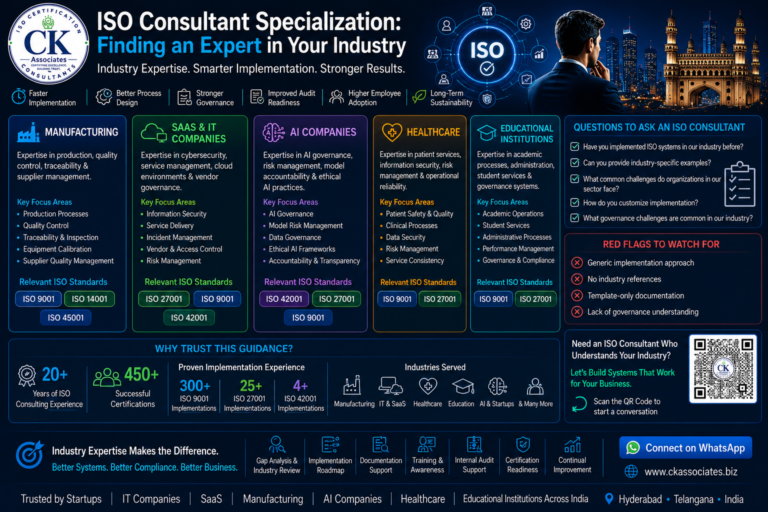
Why Trust This Guidance?
CK Associates has been helping organizations implement management systems for over 20 years, supporting businesses across manufacturing, healthcare, pharmaceuticals, IT, education, logistics and service industries.
Our implementation experience includes:
- 20+ Years of Consulting Experience
- 450+ Certification Projects
- 45+ ISO 14001 Implementations
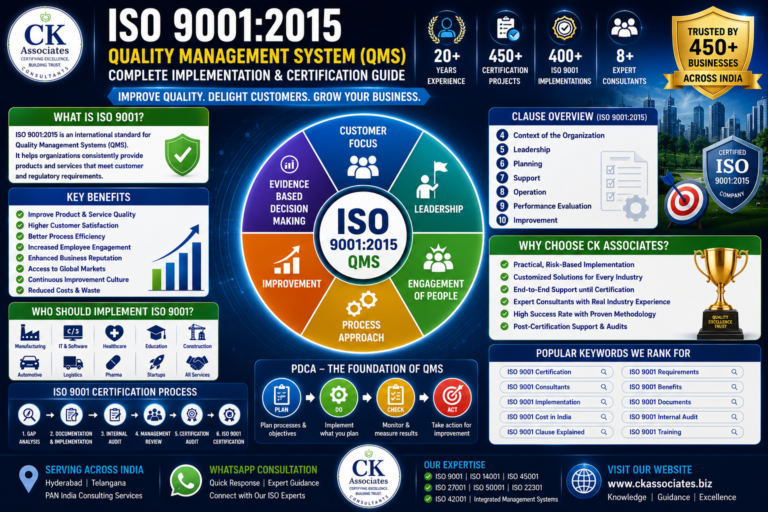
- 400+ ISO 9001 Implementations
- 45+ ISO 45001 Implementations
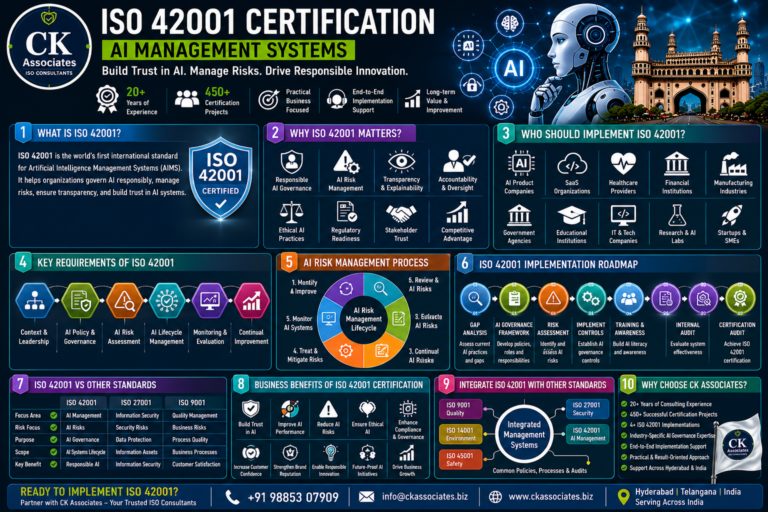
- 25+ ISO/IEC 27001 Implementations
- 4+ ISO/IEC 42001 Implementations
- 8+ Experienced Consultants
This guidance combines the published requirements of ISO 14001:2026 with practical implementation knowledge gained from supporting organizations through environmental management system development and certification.
Clause Changes, Transition Planning & Implementation Roadmap
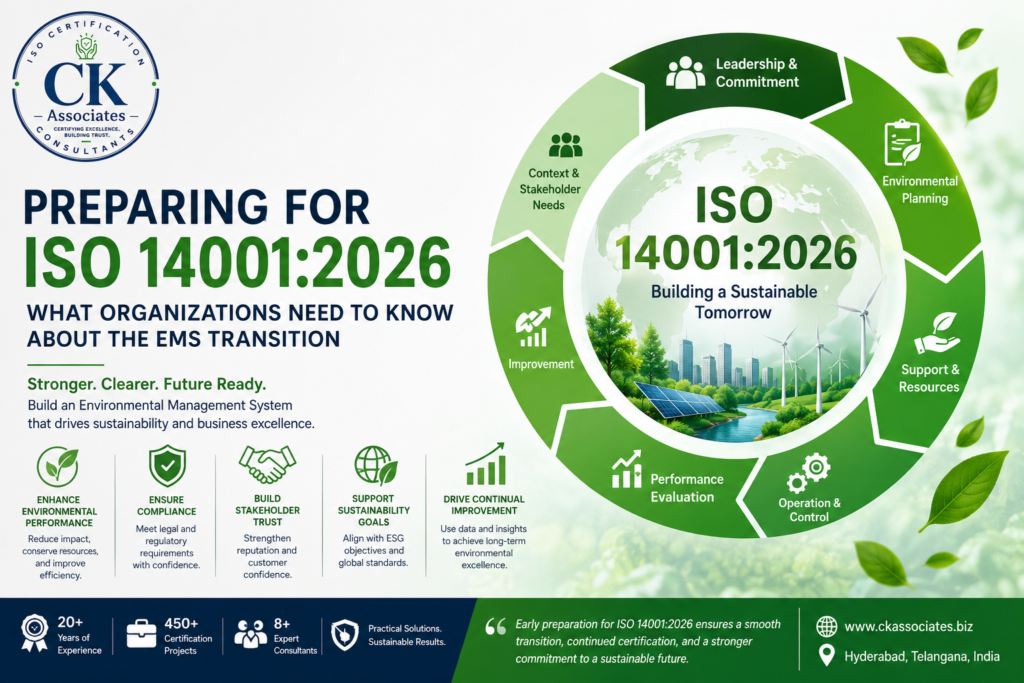
ISO 14001:2015 vs ISO 14001:2026
One of the biggest misconceptions surrounding the release of ISO 14001:2026 is that organizations will need to redesign their Environmental Management System (EMS).
The reality is different.
For organizations that have effectively implemented ISO 14001:2015, the transition is expected to focus primarily on clarifications, improved consistency, updated terminology, and stronger emphasis on emerging environmental challenges rather than introducing a completely new management system.
The revised standard is designed to strengthen implementation while maintaining compatibility with other ISO management system standards.
High-Level Comparison
| Area | ISO 14001:2015 | ISO 14001:2026 |
|---|---|---|
| High-Level Structure | Harmonized Structure | Maintained |
| EMS Framework | Established | Maintained |
| Risk-Based Thinking | Introduced | Expanded Guidance |
| Leadership | Required | Greater Demonstration of Commitment |
| Environmental Planning | Strong | Enhanced Planning Expectations |
| Climate & Sustainability | Limited References | Increased Organizational Focus |
| Interested Parties | Required | Stronger Stakeholder Consideration |
| Externally Provided Processes | General | Clearer Expectations |
| Continual Improvement | Required | Greater Performance Focus |
| Documentation | Flexible | Greater Clarity |
Why Was the Standard Revised?
The revision responds to changes in today’s business environment, including:
- Growing ESG expectations
- Climate-related risks
- Sustainable supply chains
- Circular economy initiatives
- Resource efficiency
- Regulatory developments
- Greater stakeholder scrutiny
- Better alignment with other ISO management system standards
Rather than changing the purpose of ISO 14001, the revision strengthens its practical application.
Clause-by-Clause Overview
Clause 4 – Context of the Organization
ISO 14001:2015
Organizations identify:
- Internal issues
- External issues
- Interested parties
- Scope of EMS
ISO 14001:2026
Organizations are expected to place greater emphasis on:
- Environmental trends
- Climate-related considerations
- ESG expectations
- Supply-chain impacts
- Business resilience
- Sustainability drivers
The objective is to improve strategic environmental planning.
Clause 5 – Leadership
Leadership remains central to the Environmental Management System.
The revised edition encourages stronger leadership involvement by emphasizing:
- Environmental culture
- Accountability
- Resource commitment
- Strategic integration
- Continual environmental improvement
Environmental management should become part of business decision-making rather than remaining a compliance activity.
Clause 6 – Planning
Planning continues to focus on:
- Environmental aspects
- Risks
- Opportunities
- Compliance obligations
- Objectives
However, organizations are expected to evaluate environmental risks more comprehensively.
Examples include:
- Climate change impacts
- Supply chain disruptions
- Water scarcity
- Waste generation
- Biodiversity impacts
- Resource availability
Planning should support long-term environmental resilience.
Clause 7 – Support
Organizations should ensure appropriate:
- Resources
- Competence
- Awareness
- Communication
- Documented Information
The revised guidance encourages organizations to strengthen environmental awareness across all levels rather than limiting responsibility to the environmental department.
Clause 8 – Operation
Operational control remains one of the most important elements of ISO 14001.
Organizations should continue managing:
- Waste
- Emissions
- Energy consumption
- Water usage
- Hazardous materials
- Emergency preparedness
Greater emphasis is expected on managing externally provided processes and supplier-related environmental impacts.
Clause 9 – Performance Evaluation
Organizations should continue monitoring:
- Environmental objectives
- Compliance
- Internal audits
- Management Review
- Environmental performance indicators
The revised edition encourages organizations to use environmental performance information more effectively for strategic decision-making.
Clause 10 – Improvement
Continual improvement remains unchanged as a fundamental principle.
Organizations should:
- Investigate nonconformities
- Implement corrective actions
- Monitor effectiveness
- Improve environmental performance
- Learn from audit findings
The emphasis shifts from maintaining compliance to achieving measurable environmental improvement.
Expected Areas of Greater Focus
Organizations should expect increased attention in areas such as:
Climate Change
Organizations should understand how climate-related issues influence their Environmental Management System.
ESG Alignment
Environmental Management Systems increasingly support broader Environmental, Social and Governance (ESG) initiatives.
Sustainable Procurement
Organizations should consider environmental impacts throughout supplier selection and procurement activities.
Lifecycle Perspective
Lifecycle thinking introduced in ISO 14001:2015 continues to gain practical importance.
Organizations should evaluate environmental impacts across:
- Design
- Purchasing
- Production
- Transportation
- Customer use
- Disposal
Data-Driven Decision Making
Environmental objectives should increasingly be supported by measurable performance indicators rather than qualitative observations alone.
Transition Roadmap
Phase 1 – Understand the Revised Standard
Review:
- New terminology
- Clarifications
- Updated guidance
- Certification Body communications
Phase 2 – Gap Analysis
Compare the existing EMS with ISO 14001:2026 requirements.
Identify:
- Documentation updates
- Process improvements
- Leadership actions
- Training requirements
Phase 3 – Transition Planning
Develop:
- Project timeline
- Responsibilities
- Budget
- Resource allocation
Phase 4 – Documentation Review
Review and update:
- EMS Manual (if maintained)
- Environmental Policy
- Objectives
- Risk Register
- Aspect Register
- Legal Register
- Operational Controls
- Emergency Procedures
Phase 5 – Employee Awareness
Communicate:
- New requirements
- Updated responsibilities
- Environmental objectives
- Continual improvement expectations
Phase 6 – Internal Audit
Verify implementation through:
- Process audits
- Compliance verification
- Document review
- Employee interviews
Phase 7 – Management Review
Top Management should review:
- Transition progress
- Risks
- Opportunities
- Resource needs
- Environmental performance
Phase 8 – Certification Transition Audit
Once ready, complete the transition audit with the Certification Body before the transition deadline established by the accreditation and certification community.
Documentation Likely to Require Review
Organizations should review, where applicable:
- Environmental Policy
- Environmental Objectives
- Context Analysis
- Interested Parties Register
- Aspect & Impact Register
- Risk & Opportunity Register
- Compliance Obligations Register
- Operational Controls
- Supplier Evaluation Criteria
- Monitoring Records
- Internal Audit Programme
- Management Review Records
- Competence Matrix
- Emergency Preparedness Plans
The extent of changes will depend on how mature the existing Environmental Management System is.
Common Transition Mistakes
Many organizations underestimate the transition effort.
Common mistakes include:
- Waiting until the transition deadline
- Assuming no changes are required
- Ignoring leadership involvement
- Failing to update environmental objectives
- Weak employee awareness
- Superficial internal audits
- Treating the transition as only a documentation exercise
- Not monitoring Certification Body guidance
Consultant’s Practical Insight
One of the strongest Environmental Management Systems is not necessarily the one with the most procedures—it is the one that is integrated into daily operations.
Organizations that already review environmental risks, monitor performance, involve leadership, and continually improve their EMS will generally experience a smoother transition than organizations that maintain documentation solely for certification purposes.
The ISO 14001:2026 transition should therefore be viewed as an opportunity to strengthen environmental governance rather than simply updating documents.
Why Trust CK Associates?
For more than 20 years, CK Associates has supported organizations across manufacturing, pharmaceuticals, healthcare, engineering, IT, food processing and service industries in implementing practical management systems.
Our experience includes:
- 20+ Years of Consulting
- 450+ Certification Projects
- 45+ ISO 14001 Implementations
- 400+ ISO 9001 Implementations
- 45+ ISO 45001 Implementations
- 25+ ISO/IEC 27001 Projects
- 4+ ISO/IEC 42001 Projects
We help organizations prepare for standard revisions with a practical, business-focused approach that minimizes disruption while strengthening long-term environmental performance.
Frequently Asked Questions (FAQs)
1. What is ISO 14001:2026?
ISO 14001:2026 is the updated edition of the international Environmental Management System (EMS) standard. It builds upon ISO 14001:2015 by providing clearer guidance, improved alignment with modern environmental challenges, and stronger emphasis on leadership, sustainability, and continual improvement.
2. Is ISO 14001:2015 still valid?
Yes, during the official transition period established by the International Accreditation Forum (IAF) and accreditation bodies. Organizations should plan to transition within the prescribed timeframe to maintain certification.
3. Do organizations need to redesign their EMS?
No.
Most certified organizations will not require a complete redesign. Instead, they should review the updated requirements, conduct a gap analysis, update relevant documentation, and implement necessary improvements.
4. Why was ISO 14001 revised?
The revision reflects:
- Climate-related challenges
- Sustainability expectations
- ESG initiatives
- Circular economy concepts
- Better integration with other ISO standards
- Improved usability and clarity
5. Which organizations should transition?
Any organization currently certified to ISO 14001:2015 or planning environmental certification, including:
- Manufacturing
- Pharmaceuticals
- IT
- Construction
- Food Processing
- Healthcare
- Logistics
- Engineering
- Educational Institutions
6. What are the major expected changes?
The revision emphasizes:
- Leadership
- Environmental planning
- Climate considerations
- Risk-based thinking
- Stakeholder expectations
- Lifecycle perspective
- Continual improvement
7. Will certification costs increase?
Not necessarily.
Costs depend on:
- Existing EMS maturity
- Documentation updates
- Training requirements
- Certification Body audit duration
- Number of sites
Organizations with mature systems generally require fewer changes.
8. How should organizations prepare?
Recommended steps include:
- Review ISO 14001:2026 requirements
- Conduct a gap analysis
- Update documentation
- Train employees
- Perform internal audits
- Complete management review
- Schedule transition audit
9. Can ISO 14001 integrate with other standards?
Yes.
It integrates effectively with:
- ISO 9001
- ISO 45001
- ISO/IEC 27001
- ISO/IEC 42001
- ISO 50001
through an Integrated Management System (IMS).
10. What happens if an organization misses the transition deadline?
Failure to transition within the official period may affect certification validity. Organizations should follow guidance issued by their certification body and accreditation authorities.
11. Is ISO 14001 suitable for service organizations?
Yes.
The standard applies to both manufacturing and service organizations, including IT companies, hospitals, educational institutions, logistics providers, and professional service firms.
12. Does ISO 14001 support ESG initiatives?
Yes.
A well-implemented EMS supports environmental aspects of ESG by improving governance, compliance, resource efficiency, and sustainability reporting.
13. How often should the EMS be reviewed?
Organizations should conduct:
- Regular monitoring
- Internal audits
- Periodic management reviews
- Continual improvement activities
to ensure ongoing effectiveness.
14. Why should organizations start early?
Early preparation allows organizations to:
- Reduce implementation pressure
- Avoid last-minute documentation changes
- Improve employee awareness
- Ensure certification continuity
15. Why choose CK Associates?
CK Associates brings:
- 20+ Years Experience
- 450+ Certification Projects
- 45+ ISO 14001 Implementations
- Practical implementation expertise
- Industry-specific environmental management support
- End-to-end transition assistance
What is changing in ISO 14001:2026?
Do I need to upgrade from ISO 14001:2015?
When should organizations start ISO 14001:2026 transition?
Is ISO 14001 mandatory in India? Can ISO 14001 integrate with ISO 9001?
What is an Environmental Management System?
How long does ISO 14001 transition take?
Who can help with ISO 14001 implementation in Hyderabad?
Summary
ISO 14001:2026 refines the internationally recognized Environmental Management System standard by providing clearer guidance and stronger emphasis on leadership, sustainability, environmental planning, lifecycle thinking, and continual improvement. Organizations certified to ISO 14001:2015 should begin transition planning through a structured gap analysis, documentation review, employee awareness, internal audits, and management review. Early preparation helps maintain certification continuity, improve environmental performance, and align business operations with evolving sustainability expectations.