

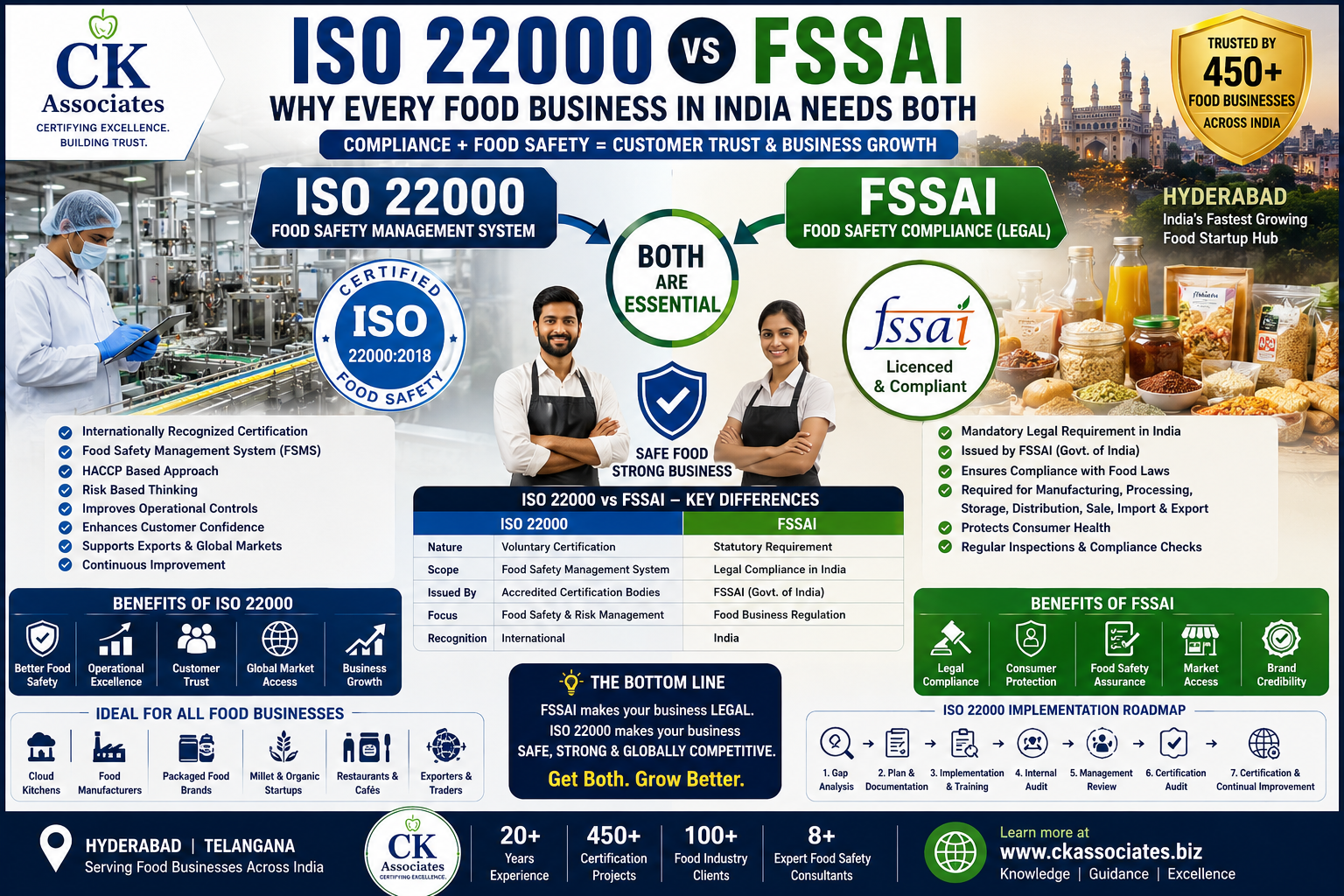
Many food business owners in India mistakenly believe that obtaining ISO 22000 certification eliminates the need for an FSSAI licence. This is incorrect. FSSAI licensing is a legal requirement for eligible food businesses under Indian law, while ISO 22000 is an internationally recognized Food Safety Management System (FSMS) standard that helps organizations identify, control, and continuously improve food safety processes. FSSAI authorizes eligible businesses to operate legally, whereas ISO 22000 demonstrates systematic food safety management and enhances customer confidence. Organizations seeking long-term growth, retail partnerships, exports, and brand credibility should view FSSAI and ISO 22000 as complementary rather than interchangeable.
Should a Food Business Have Both ISO 22000 and FSSAI?
Yes. FSSAI licensing is the legal foundation for operating an eligible food business in India, while ISO 22000 provides an internationally recognized management system for controlling food safety hazards, improving operational consistency, and strengthening customer confidence. Businesses that implement both are generally better positioned for growth, compliance, and market competitiveness.
If you own a food business in India:
✅ FSSAI and ISO 22000 are not the same.
✅ FSSAI is a legal requirement for eligible businesses.
✅ ISO 22000 is an internationally recognized Food Safety Management System.
✅ One does not replace the other.
✅ Together they improve compliance, customer trust, and business opportunities.
Key Takeaways
- ISO 22000 certification does not replace an FSSAI licence.
- FSSAI is a statutory requirement for eligible food businesses in India.
- ISO 22000 improves food safety management through systematic controls.
- Businesses with both often gain stronger credibility with customers and institutional buyers.
- Hyderabad’s food startup ecosystem makes food safety certification increasingly important.
- Integrated quality and food safety systems can support sustainable growth.
- Certifications can enhance competitiveness in domestic and export markets.
- Food safety builds customer confidence and brand value.
Introduction
India’s food industry is expanding rapidly, driven by changing consumer preferences, digital commerce, cloud kitchens, packaged foods, health-conscious eating, and innovative food startups.
Hyderabad has emerged as one of India’s fastest-growing food entrepreneurship hubs, with significant growth in cloud kitchens, millet-based products, ready-to-eat foods, healthy snacks, bakery businesses, food processing units, and export-oriented food manufacturers.
As competition increases, businesses are looking for ways to build trust, meet regulatory expectations, and differentiate themselves in the marketplace.
One of the most common misconceptions we encounter is:
“Our company has ISO 22000 Certification. Do we still need an FSSAI Licence?”
Or the reverse:
“We already have an FSSAI Licence. Why should we invest in ISO 22000?”
These questions reflect a misunderstanding of two different—but complementary—requirements.
This guide explains the differences between ISO 22000 and FSSAI, why food businesses often need both, and how combining regulatory compliance with internationally recognized food safety management can support business growth.
Understanding the Misconception
Many entrepreneurs believe that once their organization receives ISO 22000 certification, additional regulatory approvals are unnecessary.
This assumption can create compliance risks because ISO 22000 and FSSAI serve fundamentally different purposes.
ISO 22000
Focuses on:
- Food Safety Management
- Hazard Identification
- Risk-Based Thinking
- HACCP Principles
- Process Control
- Continual Improvement
FSSAI
Focuses on:
- Legal authorization (registration/licensing as applicable)
- Food business regulation
- Compliance with Indian food safety legislation
- Consumer protection
- Regulatory oversight
The two systems work together rather than replacing one another.
ISO 22000 vs FSSAI — What’s the Difference?
| Feature | FSSAI | ISO 22000 |
|---|---|---|
| Purpose | Regulatory compliance | Food Safety Management System |
| Nature | Statutory requirement (for eligible businesses) | Voluntary international certification |
| Issued By | Food Safety and Standards Authority of India | Accredited Certification Body |
| Geographic Scope | India | International |
| Focus | Legal compliance | Food safety management |
| Audit | Regulatory inspections | Certification audits |
| Customer Recognition | Regulatory | Global market recognition |
What is FSSAI?
The Food Safety and Standards Authority of India (FSSAI) regulates food safety in India under the Food Safety and Standards Act, 2006.
Depending on the nature and scale of operations, eligible food business operators are required to obtain the appropriate FSSAI registration or licence before commencing operations.
FSSAI primarily ensures that food businesses comply with Indian food safety regulations and legal obligations.
What is ISO 22000?
ISO 22000 is an internationally recognized Food Safety Management System (FSMS) standard.
It helps organizations systematically:
- Identify food safety hazards
- Establish preventive controls
- Apply HACCP principles
- Improve traceability
- Monitor food safety risks
- Drive continual improvement
Unlike FSSAI, ISO 22000 focuses on building a management system that integrates food safety into everyday business operations.
Hyderabad – India’s Emerging Food Startup Hub
Hyderabad is rapidly becoming a preferred destination for food innovation and entrepreneurship.
The city has witnessed significant growth in:
- Cloud Kitchens
- Food Delivery Brands
- Ready-to-Eat Manufacturers
- Packaged Food Companies
- Millet Startups
- Organic Food Brands
- Bakery & Confectionery Businesses
- Food Processing Units
- Central Kitchens
- D2C Food Brands
- Health Food Companies
- Restaurant Chains
As more businesses compete for customers, distributors, investors, and retail shelf space, food safety certifications have become a competitive differentiator rather than just a compliance exercise.
Why ISO 22000 Is Becoming Essential for Modern Food Businesses
The Indian food industry has transformed significantly over the past decade. Consumers today expect much more than great taste—they expect safe food, consistent quality, transparency, and traceability.
Modern retailers, quick-commerce platforms, exporters, institutional buyers, and multinational procurement teams increasingly evaluate suppliers based on their food safety management practices.
This is where ISO 22000 provides a competitive advantage.
Unlike regulatory compliance alone, ISO 22000 establishes a systematic approach to identifying, controlling, monitoring, and continually improving food safety throughout the food chain.
Organizations implementing ISO 22000 are better positioned to:
- Build customer confidence
- Reduce food safety risks
- Improve operational consistency
- Meet retailer and export requirements
- Enhance brand reputation
- Prepare for third-party audits
- Support long-term business growth
Why Hyderabad Food Startups Should Consider ISO 22000
Hyderabad has become one of India’s fastest-growing food innovation ecosystems.
The city is witnessing rapid growth in:
- Cloud Kitchens
- Ready-to-Eat Food Manufacturers
- Ready-to-Cook Brands
- Millet Product Companies
- Organic Food Businesses
- Food Processing Units
- Bakery & Confectionery Brands
- Central Kitchens
- Restaurant Chains
- Export-Oriented Food Manufacturers
- D2C Food Brands
- Health & Nutrition Companies
With increasing competition, food businesses need more than a legal licence—they need a system that demonstrates commitment to food safety and quality.
ISO 22000 helps organizations stand out by showing that food safety is built into every stage of operations.
Why Customers Are Asking for ISO 22000
Large corporate buyers and institutional customers often evaluate suppliers beyond basic legal compliance.
Common questions include:
- Do you have ISO 22000 Certification?
- Is your Food Safety Management System documented?
- How do you identify food safety hazards?
- How do you manage allergen risks?
- Can you demonstrate traceability?
- How do you handle product recalls?
- Do you conduct internal food safety audits?
Businesses prepared with documented systems generally respond more effectively to these requirements.
The Relationship Between ISO 22000 and HACCP
One of the biggest strengths of ISO 22000 is that it incorporates the principles of HACCP (Hazard Analysis and Critical Control Points).
HACCP focuses on identifying hazards and establishing preventive controls.
ISO 22000 expands on HACCP by integrating:
- Leadership
- Risk-Based Thinking
- Communication
- Prerequisite Programs (PRPs)
- Operational PRPs (OPRPs)
- Documented Information
- Internal Audits
- Continual Improvement
This creates a complete Food Safety Management System rather than a hazard-control program alone.
Benefits of Having Both FSSAI and ISO 22000
Organizations implementing both systems often gain operational and commercial advantages.
Regulatory Benefits
✔ Legal compliance (where applicable)
✔ Improved readiness for inspections
✔ Better documentation
✔ Structured food safety practices
Business Benefits
✔ Stronger customer confidence
✔ Increased brand credibility
✔ Improved supplier approvals
✔ Better export opportunities
✔ Improved retailer acceptance
✔ Competitive differentiation
✔ Reduced food safety incidents
Operational Benefits
✔ Standardized processes
✔ Improved traceability
✔ Better risk management
✔ Enhanced employee awareness
✔ Stronger corrective action systems
✔ Continual improvement
ISO 22000 Implementation Roadmap
Phase 1 – Gap Analysis
Evaluate the current food safety system.
Review:
- Existing documentation
- Regulatory compliance
- Operational controls
- Food safety risks
Phase 2 – Documentation
Develop:
- Food Safety Policy
- Food Safety Objectives
- HACCP Plan
- PRP Procedures
- OPRP Controls
- Traceability Procedure
- Recall Procedure
- Supplier Evaluation Procedure
Phase 3 – Implementation
Implement documented procedures.
Train employees.
Monitor food safety controls.
Maintain records.
Phase 4 – Verification
Conduct:
- Internal Audits
- Food Safety Verification
- Management Review
- Corrective Actions
Phase 5 – Certification
Stage 1 Audit
↓
Stage 2 Audit
↓
ISO 22000 Certification
ISO 22000 Documentation Checklist
Organizations typically maintain:
- Food Safety Manual
- Food Safety Policy
- Process Flow Diagrams
- Hazard Analysis
- HACCP Plan
- PRP Documentation
- OPRP Monitoring Records
- CCP Monitoring Records
- Product Recall Procedure
- Supplier Approval Records
- Calibration Records
- Training Records
- Internal Audit Reports
- Management Review Minutes
- Corrective Action Reports
ISO 22000 Certification Process
- Gap Analysis
- Documentation Development
- Employee Training
- System Implementation
- Internal Audit
- Management Review
- Stage 1 Audit
- Stage 2 Audit
- Certification
- Surveillance Audits
Comparison Table – ISO 22000 vs FSSAI
| Criteria | FSSAI | ISO 22000 |
|---|---|---|
| Type | Regulatory Requirement | International Standard |
| Purpose | Food Business Regulation | Food Safety Management |
| Recognition | India | Global |
| Focus | Legal Compliance | Process Control & Food Safety |
| Issuing Authority | FSSAI | Accredited Certification Body |
| Mandatory | Applicable as per law | Voluntary |
| Customer Confidence | Moderate | High |
| Export Support | Limited | Strong |
| Continual Improvement | No | Yes |
Comparison Table – Food Business With Only FSSAI vs FSSAI + ISO 22000
| Feature | Only FSSAI | FSSAI + ISO 22000 |
| Legal Compliance | ✔ | ✔ |
| Food Safety Management System | Limited | ✔ |
| International Recognition | ✘ | ✔ |
| Retail Chain Acceptance | Moderate | Higher |
| Export Readiness | Limited | Better |
| Customer Confidence | Moderate | Strong |
| Process Standardization | Limited | Comprehensive |
| Continual Improvement | Limited | ✔ |
Comparison Table – ISO 22000 vs HACCP
| Feature | HACCP | ISO 22000 |
| Hazard Analysis | ✔ | ✔ |
| CCP Management | ✔ | ✔ |
| Leadership Requirements | ✘ | ✔ |
| Internal Audit | Limited | ✔ |
| Management Review | ✘ | ✔ |
| Continual Improvement | Limited | ✔ |
| Certification Framework | Limited | Comprehensive |
Key Industry Statistics
India’s Food Processing Sector
India’s food processing industry continues to expand rapidly, driven by urbanization, organized retail, exports, health-conscious consumers, and government initiatives supporting value-added food products.
Why it matters: Growing businesses need scalable food safety systems to support expansion.
Food Delivery & Cloud Kitchen Growth
Cloud kitchens, online food delivery, and ready-to-eat food businesses have increased demand for standardized food safety practices.
Why it matters: Customers expect safe, hygienic, and consistent food experiences.
Export Market Expectations
International buyers increasingly expect suppliers to demonstrate structured food safety management systems.
Why it matters: ISO 22000 strengthens credibility for export-oriented businesses.
Consumer Trust
Food safety incidents can significantly impact brand reputation.
Organizations with documented food safety management systems are generally better positioned to demonstrate due diligence and strengthen stakeholder confidence.
Real-World Implementation Example
Organization
A Hyderabad-based millet snack manufacturer supplying supermarkets and online marketplaces.
Challenge
The company held the appropriate FSSAI licence but experienced increasing requests from institutional buyers for internationally recognized food safety certification.
The business also wanted to expand exports and improve supplier confidence.
CK Associates Approach
- Conducted Gap Analysis
- Developed ISO 22000 documentation
- Established HACCP plans
- Defined PRPs and OPRPs
- Conducted employee training
- Performed internal audits
- Facilitated management review
- Supported certification audit preparation
Outcome
The organization successfully achieved ISO 22000 certification while maintaining regulatory compliance.
Benefits included:
✔ Improved customer confidence
✔ Better audit readiness
✔ Increased business enquiries
✔ Stronger operational controls
✔ Enhanced opportunities with organized retail and institutional buyers
Lessons Learned
Regulatory compliance enables businesses to operate, while a structured Food Safety Management System helps businesses compete, grow, and build lasting customer trust.
Why Trust This Guidance?
Food safety management requires more than documentation—it demands practical implementation, regulatory understanding, and industry-specific expertise.
CK Associates has supported food manufacturers, cloud kitchens, restaurants, bakeries, packaged food companies, millet brands, and processing units in implementing internationally recognized management systems that strengthen food safety, operational efficiency, and customer confidence.
CK Associates Authority
✅ 20+ Years Experience
✅ 450+ Certification Projects
✅ 400+ ISO 9001 Implementations
✅ 45+ Food & Manufacturing Sector Implementations
✅ HACCP & ISO 22000 Expertise
✅ Integrated Management System Specialists
Our practical implementation approach helps food businesses achieve compliance while building sustainable, scalable food safety systems.
About the Author
Sirish K
Founder & Lead ISO Consultant – CK Associates
With over 20 years of experience and 450+ certification projects, Sirish K has guided organizations across food manufacturing, processing, hospitality, retail, healthcare, and industrial sectors in implementing ISO 22000, ISO 9001, HACCP, Integrated Management Systems, and other international standards.
His practical consulting approach focuses on helping organizations improve food safety, operational performance, customer confidence, and certification readiness.
<h2>About the Author</h2>

<p><strong>Sirish K</strong> is the Founder & Lead ISO Consultant at CK Associates. With over 20 years of experience and 450+ certification projects completed, he specializes in ISO 9001, ISO 22000, HACCP, ISO 27001, ISO 27701, ISO 42001, ISO 14001, ISO 45001, ISO 22301 and Integrated Management Systems.</p>

<p><a href="https://ckassociates.biz/sirish-k/">View Full Author Profile</a></p>
Frequently Asked Questions (FAQ)
1. Does ISO 22000 replace an FSSAI Licence in India?
No. ISO 22000 does not replace an FSSAI licence or registration. For eligible food businesses, FSSAI authorization is a legal requirement, while ISO 22000 is an internationally recognized Food Safety Management System (FSMS) standard. Most growing food businesses benefit from having both.
2. Is FSSAI mandatory for every food business?
Depending on the type, scale, and turnover of the food business, operators are required to obtain the appropriate FSSAI registration or licence under the Food Safety and Standards Act, 2006.
3. Is ISO 22000 mandatory in India?
No. ISO 22000 is a voluntary certification. However, many retailers, exporters, institutional buyers, multinational companies, and corporate procurement teams prefer or require suppliers to have ISO 22000 certification.
4. What is the difference between ISO 22000 and FSSAI?
FSSAI regulates food businesses and ensures compliance with Indian food safety laws, whereas ISO 22000 provides a systematic framework for managing food safety risks, implementing HACCP principles, and continually improving food safety performance.
5. Why should food startups obtain ISO 22000?
Food startups can benefit from ISO 22000 by improving customer confidence, strengthening operational controls, supporting business growth, enhancing brand reputation, and meeting the expectations of retailers and institutional buyers.
6. Can restaurants and cloud kitchens obtain ISO 22000?
Yes. Restaurants, cloud kitchens, central kitchens, cafés, bakeries, catering companies, and food delivery businesses can implement ISO 22000 to improve food safety management and operational consistency.
7. Can ISO 22000 help with exports?
Yes. Many international buyers and importers expect suppliers to have structured food safety management systems. ISO 22000 enhances credibility and supports export readiness.
8. What is HACCP, and how is it related to ISO 22000?
HACCP (Hazard Analysis and Critical Control Points) is a preventive approach to food safety. ISO 22000 incorporates HACCP principles within a broader management system that includes leadership, communication, risk management, documented information, internal audits, and continual improvement.
9. How long does ISO 22000 implementation take?
Implementation time depends on the size and complexity of the organization.
Typical timelines are:
- Small Food Business: 2–3 months
- Medium Organization: 3–5 months
- Large Manufacturing Unit: 5–8 months
10. What documents are required for ISO 22000?
Organizations generally maintain:
- Food Safety Policy
- Food Safety Objectives
- HACCP Plan
- Hazard Analysis
- PRP & OPRP Procedures
- Traceability Records
- Product Recall Procedure
- Supplier Evaluation Records
- Internal Audit Reports
- Management Review Minutes
- Corrective Action Records
11. Can ISO 22000 be integrated with other ISO standards?
Yes. ISO 22000 follows the Harmonized Structure and integrates effectively with:
This allows organizations to establish an Integrated Management System (IMS).
12. Why is Hyderabad becoming a food startup hub?
Hyderabad offers a strong ecosystem for food innovation, including food processing, cloud kitchens, packaged foods, millet products, exports, logistics, and startup support. As competition increases, certifications such as ISO 22000 help businesses build trust and differentiate themselves.
13. How does ISO 22000 improve customer trust?
ISO 22000 demonstrates that an organization has implemented systematic food safety controls, documented processes, hazard management, traceability, and continual improvement, giving customers greater confidence in product quality and safety.
14. How can CK Associates help with ISO 22000 Certification?
CK Associates provides:
- Gap Analysis
- Documentation Development
- HACCP Plan Preparation
- Employee Training
- Internal Audits
- Management Review Support
- Certification Audit Preparation
- Integrated Management System Consulting
15. What is the best first step for a food business?
The best first step is to obtain the applicable FSSAI registration or licence (where required) and then conduct an ISO 22000 Gap Analysis to establish a structured roadmap for Food Safety Management System implementation.
Summary
ISO 22000 and FSSAI serve different but complementary purposes for food businesses in India. FSSAI registration or licensing is a legal requirement for eligible food business operators, while ISO 22000 is an internationally recognized Food Safety Management System standard that helps organizations manage food safety hazards, implement HACCP principles, improve traceability, and continually improve operations. Businesses that combine FSSAI compliance with ISO 22000 certification are often better positioned to build customer trust, expand into retail and export markets, strengthen operational controls, and support sustainable growth.

